
A line of credit interest rate is the percentage charged on the amount you borrow, not on the full approved limit. For example, a $100,000 balance at 9.50% represents approximately $9,500 in simple annual interest, or about $792 per month before principal repayment, if the balance and rate stay unchanged.
That distinction matters when cash flow gets tight. A business owner might secure a $250,000 revolving facility, draw $50,000 to cover a busy season, and expect a manageable interest bill. Then the benchmark moves, a fee appears on the statement, or the balance stays outstanding longer than planned. The payment rises even though the owner never drew more money.
The advertised percentage is only the starting point. Your actual cost depends on the outstanding balance, the rate formula, how often the lender resets the rate, and charges attached to the unused portion of the facility. This guide focuses on those practical details, because the cheapest-looking line isn't always the least expensive source of working capital.
Table of Contents
- What a Line of Credit Actually Costs Beyond the Advertised Rate
- How Line of Credit Interest Rates Are Calculated
- Variable Versus Fixed Rate Options
- Analyzing Current Business LOC Rate Ranges
- Hidden Fees and Effective Borrowing Costs
- Worked Examples and Stress-Testing Scenarios
- Strategies to Secure Better Rates
- Frequently Asked Questions for Borrowers
What a Line of Credit Actually Costs Beyond the Advertised Rate
A retailer preparing for a seasonal rush draws $50,000 from an approved line to buy inventory and cover payroll. The first statement looks manageable. Months later, the payment rises because the rate follows a public benchmark that has changed, even though the owner has not increased the balance.
A line of credit interest rate applies to the amount drawn, not automatically to the full approved limit. Because a revolving line can be drawn, repaid, and used again, utilization drives the interest expense. The unused portion may still carry fees, but it generally is not treated as borrowed principal for ordinary interest calculations.
The two parts behind the percentage
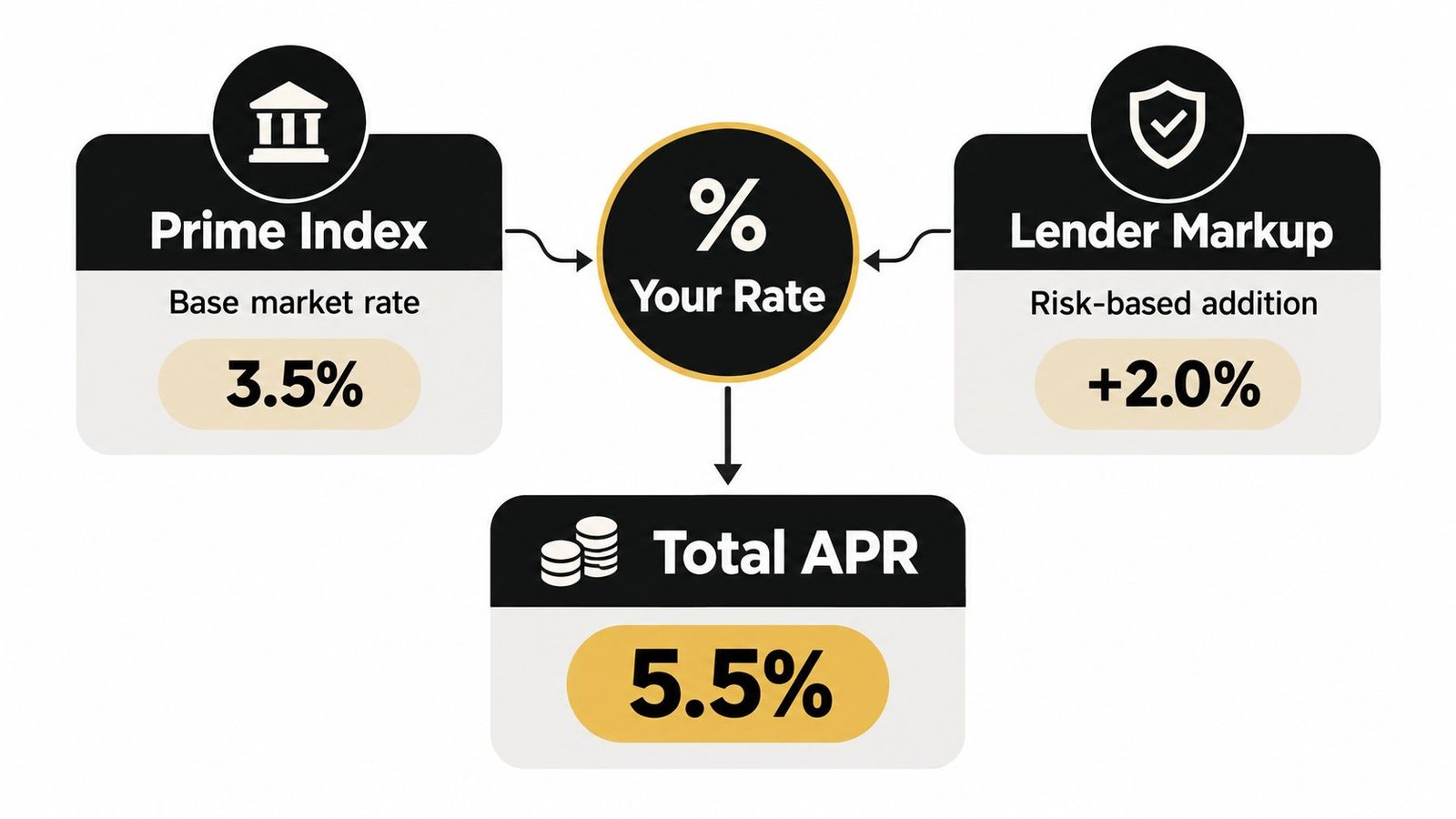
Most lines use a variable formula built from a public benchmark index plus a lender-specific margin. The benchmark might be the U.S. prime rate or a Treasury-based rate. The margin reflects the lender's assessment of risk, including the borrower's credit profile, business strength, collateral, facility size, and repayment history. The Consumer Financial Protection Bureau's explanation of credit-line pricing shows how a benchmark change can raise payments without a larger balance.
The advertised rate also leaves out timing and utilization. Carrying a balance for longer, drawing closer to the limit, or paying fees on unused capacity can make borrowing costlier than the headline percentage suggests. The Debt Help U guide to credit lines provides a plain-language explanation of revolving credit and repayment mechanics.
Practical rule: Treat the approved limit as available flexibility, not cost-free money. Budget around the balance you expect to carry, then test the payment if the benchmark rises.
Ask, “What will this line cost under my expected balance, fees, and repayment timing?” That answer is more useful than the qualifying rate alone.
How Line of Credit Interest Rates Are Calculated
The formula becomes easier to manage once you break it into steps. A variable business line commonly uses an index plus a margin. For example, a contract might state Prime + 2.00%. If the applicable prime rate is 7.50%, the annual borrowing rate is 9.50%. The exact offer depends on the lender and the borrower.
Decode the rate in four steps
Identify the index. Find the benchmark named in the agreement. “Prime” alone isn't enough. You need to know which prime rate the lender uses and where it publishes the applicable figure.
Find the margin. The margin is the lender's addition to that index. A strong financial profile, useful collateral, consistent repayment history, and a well-documented business may support more favorable pricing, although lenders weigh those factors differently.
Check the reset terms. Read how often the rate changes, whether the contract includes a floor or cap, and whether the lender can alter the margin at renewal. A variable line can become more expensive without any new draw when the index rises.
Apply the balance and time period. Interest generally reflects the outstanding principal, annual rate, days outstanding, and the agreement's day-count basis. A simplified calculation is:
Periodic interest = outstanding principal × annual rate × days outstanding ÷ day-count basis
The Federal Reserve Bank of St. Louis prime-rate data provides the benchmark context behind this type of pricing. On a 30-day basis, a $100,000 balance at 9.00% costs approximately $750 in interest before fees and repayment effects. A $40,000 balance at that same rate costs about $300 for the same period.
Why the statement may differ from your estimate
Your lender may calculate interest using daily balances rather than the balance shown at the end of the month. A mid-month repayment can reduce the charge, while a draw made early in the cycle can increase it. Fees, minimum-interest provisions, and payment timing can also make the statement differ from a simple annual-rate calculation.
Read the agreement for index, margin, reset frequency, floor, cap, day-count basis, and fee treatment. Those terms tell you more than a prominent rate printed in a marketing email.
Variable Versus Fixed Rate Options
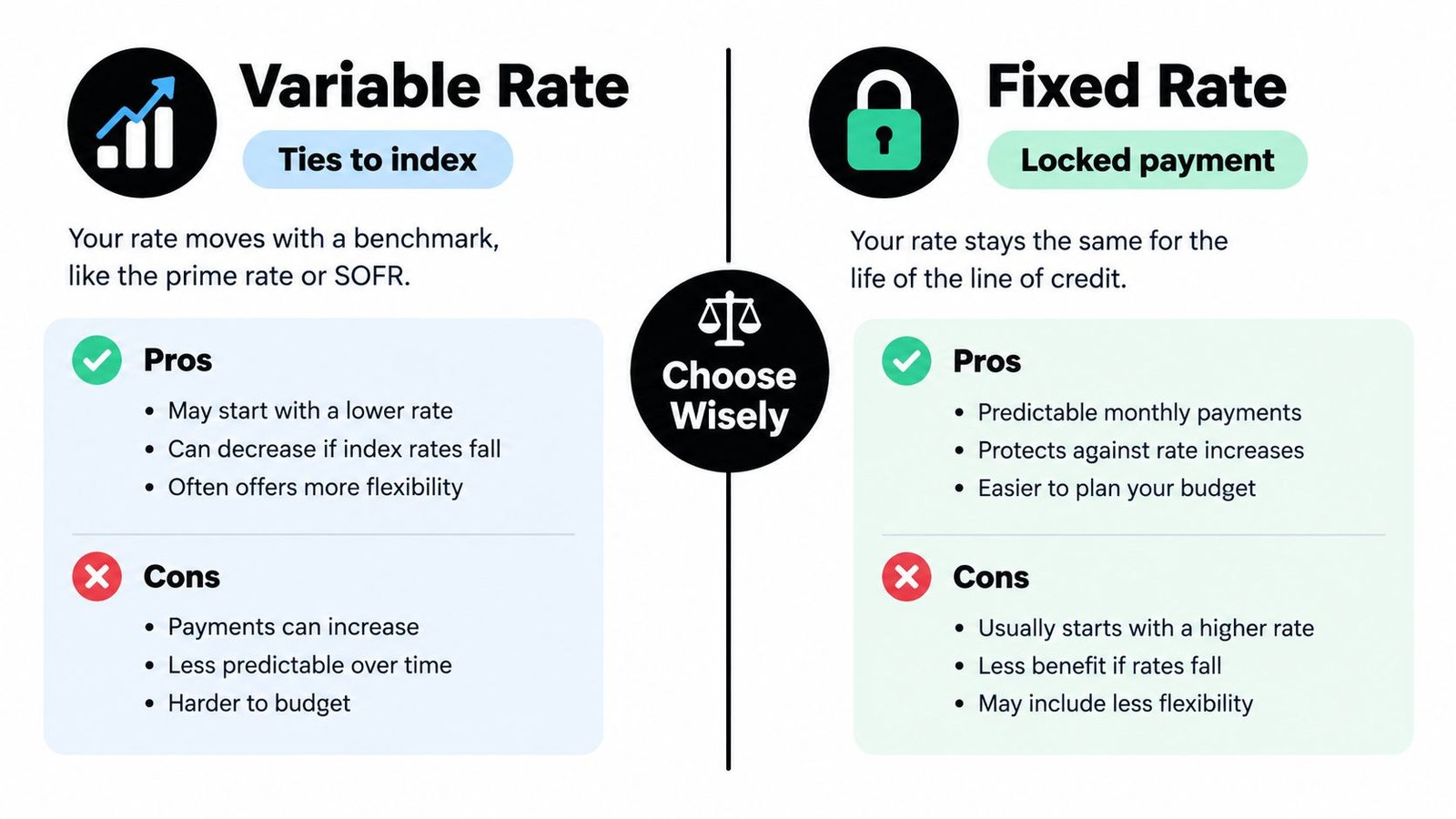
A variable line gives you a rate that moves with its index. That structure can work well when you expect short holding periods, have room in the budget for rate changes, or believe the flexibility of a revolving facility is worth the uncertainty. If the benchmark falls, your borrowing cost may fall too, assuming the margin and other terms remain unchanged.
A fixed-rate facility provides more payment predictability, but it may be less flexible or may cost more to establish. Some lenders offer fixed-rate draws, while others let borrowers convert part of a line into a fixed installment balance. The contract controls the details, so don't assume that “fixed” applies to every future draw.
Match the structure to the cash cycle
A variable line often fits a business that draws for inventory, receivables gaps, or short operating cycles and repays as cash arrives. The benefit is that interest generally follows utilization. The trade-off is that a large outstanding balance becomes exposed to benchmark increases.
A fixed option fits a borrower who values a stable payment and can forecast the borrowing need. It can be less attractive when the business needs repeated draws and repayments, because a traditional term structure may not provide the same revolving flexibility.
| Structure | Main advantage | Main risk |
|---|---|---|
| Variable rate | Can track falling benchmark rates and supports revolving use | Payments can rise when the index rises |
| Fixed rate | Makes budgeting more predictable | May offer less flexibility or carry different fees |
| Secured line | Collateral may support more favorable pricing | The pledged assets are exposed if the business defaults |
| Unsecured line | Doesn't require specified business collateral | Lenders may price the risk more conservatively |
Variable pricing is common because it lets lenders adjust the cost of funds as market conditions change. The Federal Reserve's business borrowing discussion also highlights why borrowers should consider rate exposure and credit availability together, rather than looking at the rate in isolation.
Use this video explanation of line-of-credit rate comparisons as a visual supplement, then compare the underlying contracts. A lower starting rate isn't automatically better if it comes with a smaller borrowing base, more collateral, or restrictive renewal terms.
Analyzing Current Business LOC Rate Ranges
Business line pricing varies widely because the products themselves vary widely. A traditional bank may offer a secured facility to an established company with detailed financial records. An online lender may serve a borrower who needs speed, accepts a shorter repayment structure, or has a different collateral profile.
Reported traditional-bank business-line rates were approximately 7.20% for fixed-rate lines and 7.80% to 8.10% for variable-rate lines, while online or alternative offerings ranged from 3.00% to 56.60% or higher, according to LendingTree's business lending rate data. These figures are ranges, not promises. Borrower risk, time in business, collateral, repayment terms, and lender costs can move an actual offer substantially.
| Lender Type | Typical Rate Range | Best For |
|---|---|---|
| Traditional bank | Approximately 7.20% fixed, 7.80% to 8.10% variable | Established businesses with strong documentation and credit |
| Online or alternative lender | Approximately 3.00% to 56.60% or higher | Businesses prioritizing access, speed, or flexible underwriting |
Why the range matters more than the midpoint
A broad market average can distract you from the terms that determine your own cost. A bank offer with a lower nominal rate may require collateral, personal guarantees, a minimum relationship balance, or a lengthy approval process. An alternative line with a higher rate may be usable for only a short period and could cost less in total if the business draws briefly and avoids substantial fixed fees.
The reverse can also happen. A fast approval doesn't make an expensive line sensible for permanent working capital. If you keep the balance outstanding, the rate has more time to work against your cash flow.
The Business Loan Warrior guide to understanding interest rates can provide additional context for comparing offers. Use any rate guide as a starting point, not as a substitute for reading your own term sheet.
Compare like with like
Record the benchmark, margin, repayment method, draw period, renewal conditions, collateral rules, and every fee. Then calculate the cost under the balance your company expects to carry. A line intended for occasional seasonal use should be evaluated differently from one that will fund payroll every month.
Hidden Fees and Effective Borrowing Costs
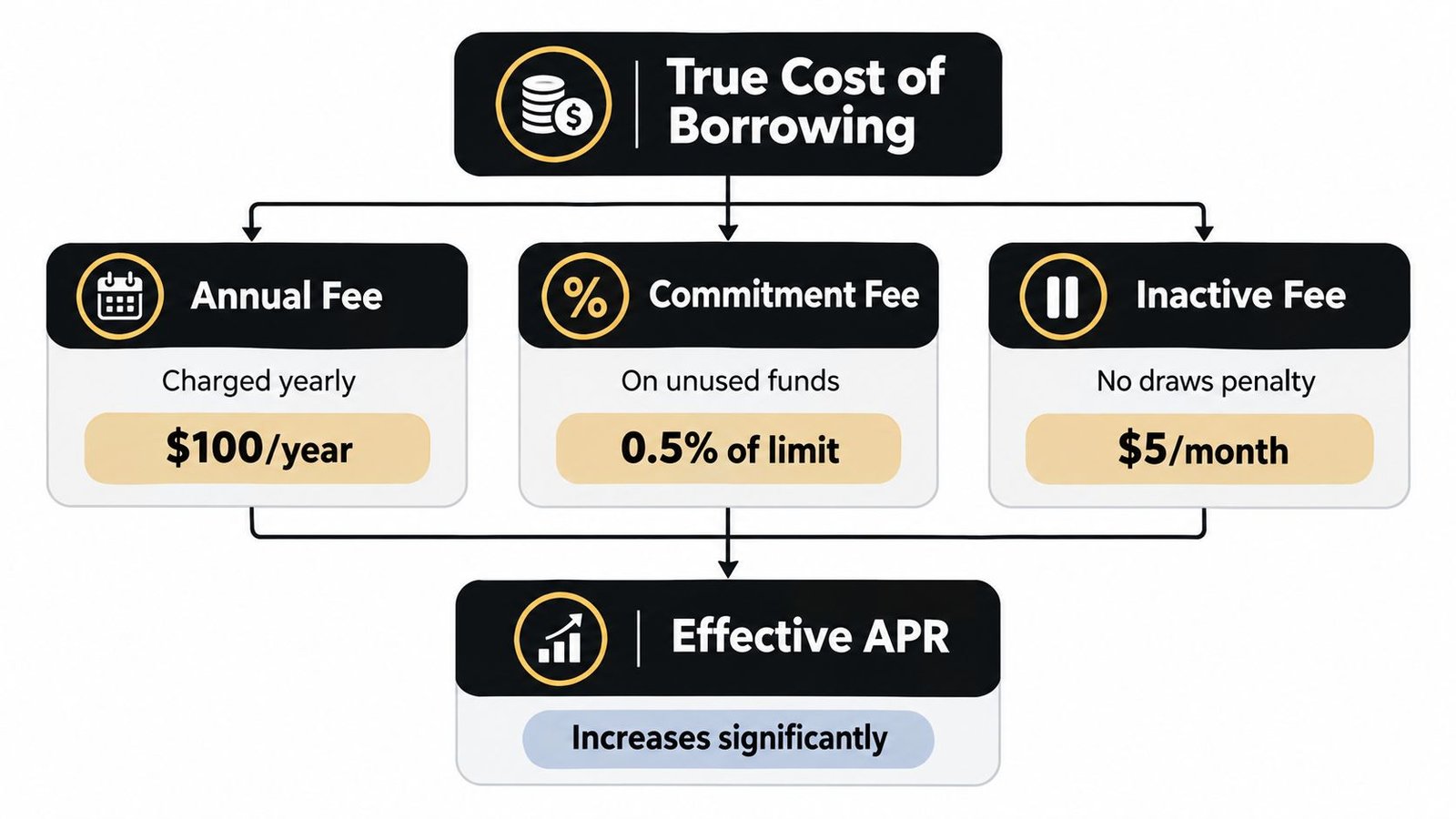
The interest rate is only one line on the pricing sheet. A lender may also charge an annual fee, commitment fee on unused capacity, draw fee, renewal fee, maintenance fee, inactivity charge, or minimum-interest amount. These charges can matter most when utilization is low, because the business pays for access while using relatively little of the facility.
Separate the stated rate from the all-in cost
The contract rate describes the interest charged on borrowed principal. APR is broader, because it can incorporate interest and applicable credit charges. The Business Loan Warrior explanation of APR versus interest rate is useful when you need to distinguish the quoted borrowing rate from the broader cost measure.
A line with no annual fee may be more economical for intermittent use, even if its stated rate is somewhat higher. A lower-rate line with a commitment fee can become costly when the business keeps most of the limit unused. Neither conclusion is universal. Utilization determines the answer.
Build a fee inventory
Before accepting an offer, ask the lender to identify:
- Annual or maintenance fees: Charges that apply only because the account remains open.
- Commitment fees: Costs tied to unused availability, which can reduce the value of a large limit you rarely draw.
- Draw and transfer fees: Charges applied when you access funds or move them to an operating account.
- Renewal and review fees: Costs that may appear when the lender reassesses the facility.
- Inactivity or minimum-interest charges: Terms that can penalize a line kept available for emergencies.
Then calculate the effective annual cost using your expected average balance. Include both interest and fees. Run the calculation again for a low-utilization month, a normal operating period, and a heavy seasonal draw.
The unused limit isn't free if the contract charges you for access.
Also check whether fees are refundable, whether the lender can change them at renewal, and whether paying down principal restores availability immediately. Those operational details can affect the line's practical value just as much as the headline rate.
Worked Examples and Stress-Testing Scenarios
A business draws $75,000 midway through its billing cycle on a line priced at prime plus 2.00%. If prime is 7.50%, the annual rate is 9.50%. A simple full-year estimate would be $7,125 in interest, but a mid-cycle draw earns less than a full year's charge. The actual amount depends on the daily balance, repayment timing, fees, and any rate reset.
Test the benchmark before relying on that estimate. A line priced at prime plus 2 percentage points would have carried an approximate rate of 9.50% when prime was 7.50% on December 20, 2024. When prime fell to 7.00% on October 30, 2025, the same formula produced approximately 9.00%. When prime reached 6.75% on December 11, 2025, the formula produced approximately 8.75%. Those historical points come from the Federal Reserve Bank of St. Louis prime-rate series.
Put utilization into the model
Suppose a business has a $250,000 limit but averages 20% utilization. Its average debt is roughly $50,000. At 10% annual interest, yearly interest is about $5,000 before fees. If the company fully draws the facility, the same rate produces about $25,000 in annual interest. The approved limit does not determine the cost by itself. The balance and time outstanding do.
| Scenario | Approximate balance | Annual rate | Simple annual interest |
|---|---|---|---|
| Average utilization | $50,000 | 10% | About $5,000 |
| Full utilization | $250,000 | 10% | About $25,000 |
Match the model to the cash cycle. A seasonal operator should calculate costs during both the heavy-draw and repayment periods. A company using the line as permanent working capital should test a higher benchmark and confirm that operating cash can absorb the added interest.
Payment sensitivity matters even on a smaller balance. For a $10,000 interest-only balance, payments are about $83 per month at 10% and $125 at 15%. Apply that principle to your own balance, then add fees and principal repayment. A useful stress test changes both the rate and the balance, because a rising benchmark and additional draws can increase the actual cost at the same time.
Strategies to Secure Better Rates
Lenders price risk, not just the business name. A company with organized financial statements, reliable deposits, manageable obligations, and a clear repayment source gives the lender more evidence to evaluate. Collateral and personal guarantees may also affect pricing, although they shift risk back to the borrower if the business cannot repay.
Prepare before you request terms
Bring recent business financial statements, a current balance sheet, bank statements, accounts-receivable information, tax filings, a debt schedule, and a concise explanation of how the line will be used. Explain when draws will occur, what will repay them, and how the business will handle a higher benchmark.
Ask specific questions:
- What index controls the rate?
- What is the margin, and can it change at renewal?
- How often does the rate reset?
- Is there a floor, cap, or fixed-rate conversion option?
- Are there annual, commitment, draw, renewal, or inactivity fees?
- What collateral and personal guarantees are required?
- How does the lender calculate the borrowing base?
- What happens if receivables or inventory fall?
A strong application doesn't guarantee approval or a lower spread, but it reduces avoidable uncertainty. It also gives you a better basis for negotiating. You can compare the offer with other business line-of-credit lenders using the same utilization and fee assumptions.
Improve the terms, not only the rate
A slightly higher rate may be acceptable if the line has no unused-limit fee, permits rapid repayment, and provides a larger usable borrowing base. Conversely, a low rate can be a poor fit if the lender restricts draws or demands collateral your company can't comfortably pledge.
Business Loan Warrior offers a single application process for funding options, including business lines of credit, with a dashboard for tracking approvals, repayments, and credit insights. Treat that type of platform as one comparison route, and still review the final offer's index, margin, fees, collateral, and repayment conditions.
Frequently Asked Questions for Borrowers
Is interest charged on the full credit limit?
Usually, the interest rate applies to the drawn amount, not the entire approved limit. The unused portion may still carry a commitment, annual, maintenance, or inactivity fee, so review the fee schedule separately.
Can a line's rate change without a new draw?
Yes. If the facility uses a variable benchmark, the rate can change when that index changes. Your balance may remain the same while the interest charge rises or falls.
Is a lower rate always the better offer?
No. A lower rate may come with tighter approval standards, stronger collateral requirements, a smaller borrowing base, or fees that raise the total cost. Compare the all-in expense at your expected utilization.
Should a seasonal business use a line permanently?
A line can support seasonal working capital, but permanent borrowing deserves closer scrutiny. Model the balance, fees, and rate under higher-cost conditions. If the business cannot repay the balance through its normal cash cycle, a term loan or another structured facility may be more appropriate.
What should I compare first?
Start with the benchmark and margin, then check reset frequency, rate protections, repayment requirements, fees, collateral, guarantees, and renewal terms. Finally, calculate total cost under low, normal, and high utilization.
Business Loan Warrior helps small businesses compare funding options, including lines of credit and other working-capital products, through a single application and secure dashboard. Review your expected balance, fees, and rate-reset exposure before applying, then visit Business Loan Warrior to explore financing options suited to your cash-flow needs.