
You've finished the work, sent the invoice, and delivered everything the customer requested. The problem is that payroll, suppliers, rent, and the next project won't wait for the customer's payment date. Your profit may look healthy on paper while your bank account feels dangerously thin.
That timing problem is where invoice financing for small businesses can help. It turns eligible unpaid business invoices into earlier working capital, but it doesn't create new revenue or remove customer risk. The right question isn't whether you can finance an invoice. It's whether the cost, risk, and administrative trade-off are healthier than changing your payment terms, improving collections, or using another funding product.
Table of Contents
- When Unpaid Invoices Stall Your Small Business
- How Invoice Financing Turns Receivables Into Cash
- Factoring and Discounting Compared for Owners
- What Invoice Financing Really Costs
- Eligibility Checks and Application Flow Made Simple
- Invoice Financing Versus Loans and Credit Lines
- Choosing Wisely and Avoiding Costly Traps
When Unpaid Invoices Stall Your Small Business
A small commercial contractor may complete a project, issue an invoice, and then wait while the customer's accounts-payable process runs its course. During that wait, the contractor still needs to pay electricians, purchase materials, cover payroll, and accept the next job. The company has earned the money, but it can't use that money yet.

This pressure is common. In January 2025, 56% of surveyed U.S. small businesses reported outstanding invoices, and those businesses were owed $17,500 on average. 47% said at least some invoices were more than 30 days overdue, according to QuickBooks' small-business late-payments report.
The central distinction: An unpaid invoice is an asset, but it isn't cash until the customer pays.
Invoice financing creates a bridge between those two dates. A provider may advance part of an eligible invoice, allowing the business to fund immediate obligations while the receivable remains outstanding. The provider then collects the invoice, or the business collects it under a discounting arrangement, and the remaining balance is settled after fees and any agreed deductions.
That bridge can be useful, but it can also become a habit. If customers routinely pay slowly, repeated advances may cover this month's payroll while creating another fee and reserve gap next month. Before applying, review your payment terms, overdue balances, collection process, and customer concentration. Resources on how to optimize cash flow in 2026 can help you examine the operational side before choosing external funding.
This guide focuses on the practical decision. You'll see how advances work, how factoring differs from discounting, what recourse and reserves mean, and how to compare the true cost with a loan or credit line. The aim isn't to make invoice financing sound universally attractive. It's to help you decide whether your business has a temporary timing gap or a deeper cash-flow design problem.
How Invoice Financing Turns Receivables Into Cash
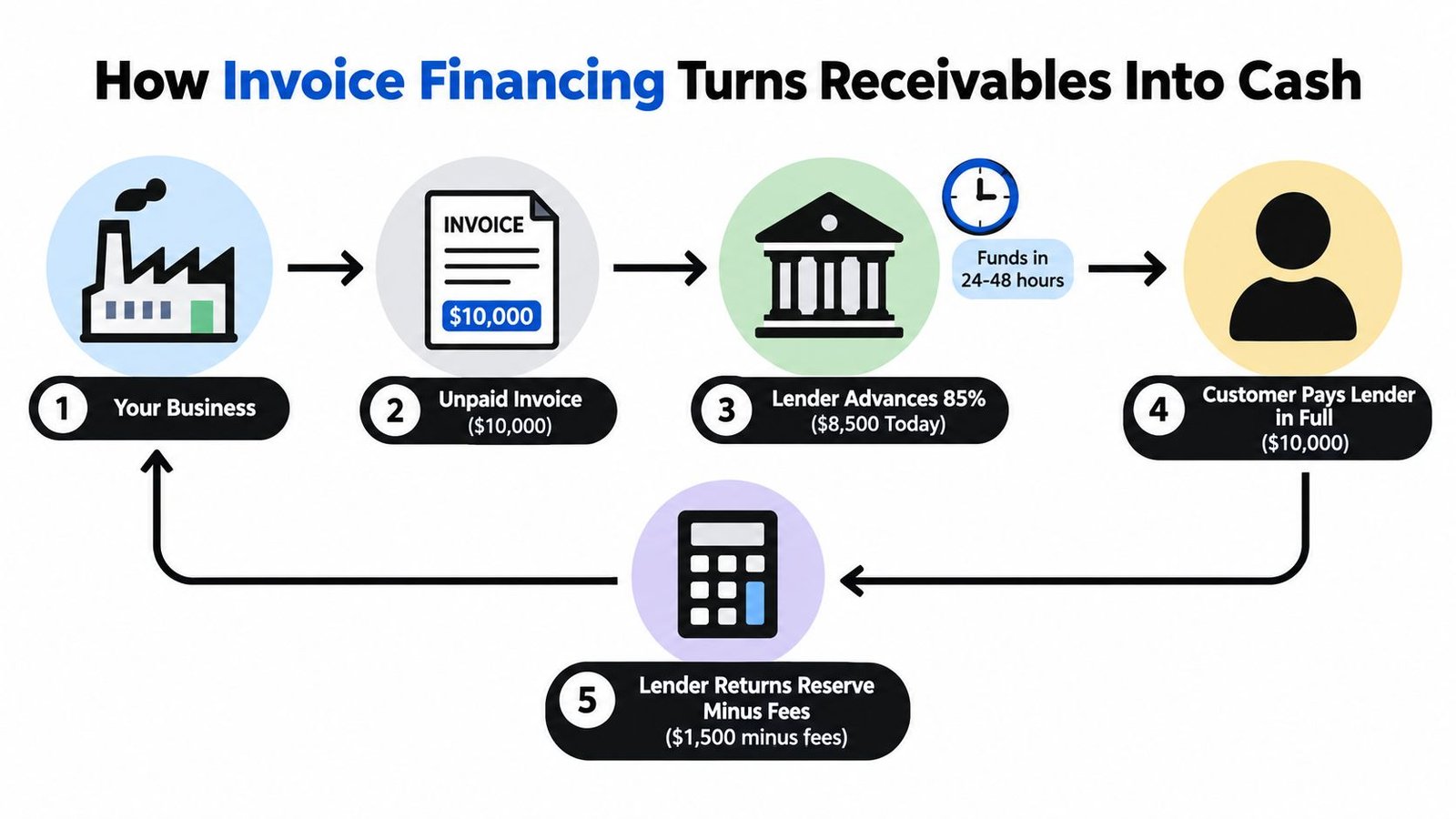
Think of an approved invoice as a promise of future cash. Invoice financing lets you exchange part of that future cash for liquidity today, usually at a cost. The transaction normally follows a clear sequence.
The basic funding cycle
First, you deliver the goods or services and issue a valid business-to-business invoice. The finance provider reviews the invoice, the customer who owes it, the payment terms, and evidence that the work was completed or accepted.
Next, the provider advances a portion of the approved value. Invoice factoring commonly advances approximately 80% to 90% of the invoice, then collects from the customer and remits the remaining amount after deducting its fee, as described in Federal Reserve guidance on factoring and small-business finance.
For a simple example, suppose you have an eligible $100,000 invoice and the provider offers an 85% advance. You receive $85,000 immediately. The remaining $15,000 becomes the reserve. Once the customer pays, the provider releases the reserve after subtracting the agreed fee and any valid adjustments.
The reserve protects the provider against uncertainty. A customer may claim that part of the work was incomplete, apply a credit, return goods, or pay less than the invoice total. Those issues are often called dilution, because they reduce the amount ultimately collectible from the original invoice.
Why the customer matters
The provider isn't assessing only your company. It's also assessing the party expected to pay. A financially strong commercial customer with a consistent payment history may support approval even when your business has a short credit history or a less established balance sheet.
That doesn't mean your own finances are irrelevant. The provider may still review tax records, bank activity, existing liens, sales ledgers, disputes, and legal ownership of the receivables. However, the quality and enforceability of the underlying invoice remain central.
Factoring usually transfers collection administration to the provider. The customer may be notified and instructed to pay the factor directly. Under some arrangements, the provider can also offer credit assessment or payment-risk protection, although the exact allocation depends on the contract.
For a broader explanation of how receivables-based funding fits into business finance, see this guide to accounts receivable financing.
The key is to follow the money all the way to settlement. Ask how much arrives upfront, who contacts the customer, what happens if payment is late, when the reserve is released, and which fees reduce the final amount. A fast advance is useful only when you understand what it will ultimately cost.
Factoring and Discounting Compared for Owners
Factoring and invoice discounting both use receivables to release working capital, but they place control in different hands. The practical choice often comes down to whether you want a provider to manage collections or prefer to keep that responsibility inside your company.
With factoring, the provider typically purchases or funds the invoices and manages collection activity. Customers may know that a factor is involved and may be instructed to pay the provider. This can save an owner time, particularly when the business has many accounts and limited administrative capacity.
With invoice discounting, the business generally borrows against its sales ledger while retaining responsibility for collecting payment. Customers may continue paying the business directly, and the arrangement can be less visible externally. The business must still maintain accurate records and meet the provider's reporting requirements.
Factoring versus invoice discounting
| Feature | Factoring | Invoice Discounting |
|---|---|---|
| Collection responsibility | Usually handled by the finance provider | Retained by the business |
| Customer contact | Customers may pay the provider directly | Customers generally continue paying the business |
| Administrative workload | Lower internal collection workload | Greater internal collection responsibility |
| Customer visibility | Often disclosed, depending on the agreement | May be confidential, depending on the arrangement |
| Main operational benefit | Outsourced collection and earlier cash | Continued control over customer relationships |
| Main operational risk | Less control over collection tone and process | The business must manage collections and reporting well |
The distinction matters for more than convenience. A staffing company may value factoring because it wants someone else to monitor dozens of payment dates. A specialist consultancy with a small number of long-standing customers may prefer discounting so client communication stays with the account team.
Neither structure automatically solves disputed invoices. A provider can advance against an invoice, but it may still hold the reserve, reject future invoices, or require repayment if the customer contests the underlying obligation. Read the agreement for definitions of eligible receivables, notification requirements, audit rights, and collection procedures.
A useful test: Choose the model that matches your operational capacity, not just the one advertising the fastest approval.
Also separate the product name from the legal structure. Some providers use “invoice finance” as a broad label for factoring, discounting, or a revolving facility secured by receivables. Before signing, ask whether the arrangement is a sale of invoices, a loan, or a borrowing base facility, and how each treatment affects repayment duties and financial reporting.
A detailed comparison of the product categories is available in this guide to invoice financing versus factoring. The important decision is not which label sounds simpler. It's who carries collection work, who bears non-payment risk, and how much control you need over customer relationships.
What Invoice Financing Really Costs
The headline fee rarely tells you the full economic cost. You need to connect the fee to how long the customer takes to pay, how much cash you receive upfront, when the reserve comes back, and what happens if the invoice is disputed.
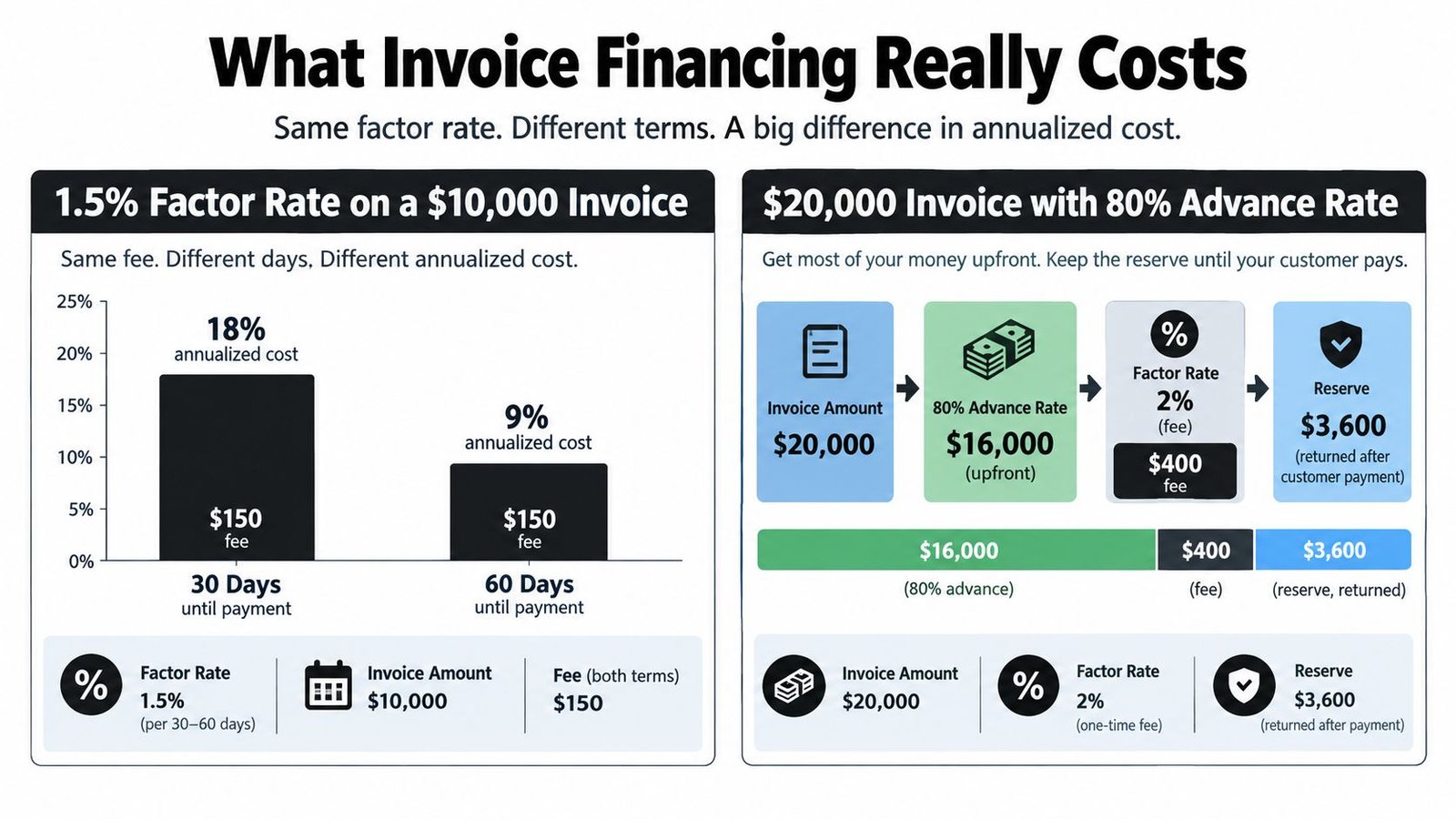
Suppose a provider charges a 1.5% factor fee on a $10,000 invoice. The fee is $150 whether the customer pays after 30 days or 60 days. Annualized over the payment period, however, the implied cost differs. A 30-day wait makes the fee equivalent to an 18% annualized cost, while a 60-day wait makes it equivalent to a 9% annualized cost, using a simple annualization.
The fee isn't the only variable. Review the offer for:
- Advance rate: How much of the invoice arrives immediately, and how much stays reserved?
- Payment duration: Does the fee increase when the customer pays late?
- Reserve timing: Is the reserve released immediately after payment, or after reconciliation?
- Recourse: Must you repay the advance if the customer doesn't pay?
- Dilution: Who absorbs credits, returns, offsets, deductions, and disputed amounts?
- Additional charges: Are there verification, service, minimum-volume, wire, audit, or termination fees?
A second example shows why reserves deserve attention. On a $20,000 invoice with an 80% advance, you receive $16,000 upfront. If the provider charges a 2% factor fee, the fee is $400, and the remaining reserve is $3,600 before settlement adjustments.
Your break-even question is simple: what will the financed cash produce? If the advance lets you accept a profitable project, retain a key customer, or avoid a costly operational interruption, the fee may be justified. If it only delays a recurring problem caused by weak payment terms, it may reduce your margin without improving the business.
Calculate cost against gross margin, not revenue. A fee that looks small beside the invoice can consume a meaningful share of the profit left after labor, materials, and delivery costs.
Model the result under several payment outcomes. Use the expected payment date, a late-payment case, and a dispute or partial-payment case. Then compare that cost with a line of credit, a term loan, a customer deposit, milestone billing, or a shorter contractual term. A broader discussion of invoice factoring rates can help you identify the questions to ask, but your own ledger and contract terms should drive the final calculation.
Eligibility Checks and Application Flow Made Simple
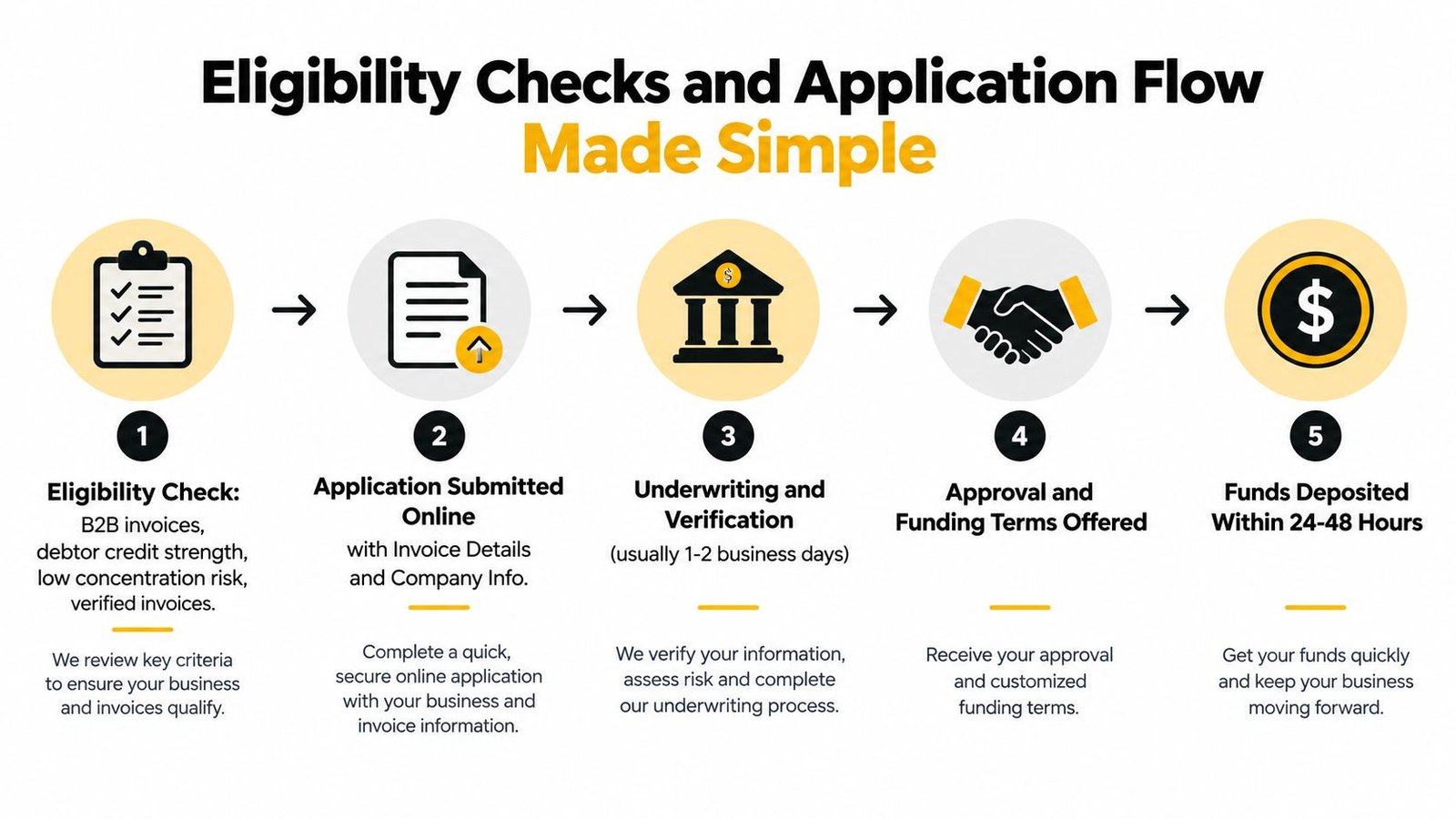
Providers usually care about the quality of the receivables as much as the age or size of your company. A clean invoice owed by a reliable business customer is easier to underwrite than an invoice with unclear acceptance terms, frequent deductions, or a customer who regularly pays late.
What providers examine
Expect questions about:
- Customer type: Providers commonly look for business or government debtors rather than consumer invoices.
- Invoice validity: The work, delivery, or service must be complete and supported by appropriate records.
- Payment history: The provider reviews whether customers pay reliably and whether overdue balances are growing.
- Concentration: Dependence on one customer can create a large exposure if that customer delays or disputes payment.
- Existing claims: Another lender may already hold security over the receivables.
- Disputes and credits: Repeated deductions can reduce the amount the provider considers eligible.
The UK government's 2025 Longitudinal Small Business Survey found that only 2% of SME employers used factoring or invoice discounting, a decline of 1 percentage point from both 2024 and 2023, according to the 2025 invoice finance benchmark report. The low adoption rate means many owners may not know what documentation or controls providers expect.
A smoother application
Prepare your sales ledger, outstanding invoice list, customer contact details, contracts, delivery evidence, proof of acceptance, bank statements, and information about existing finance. Keep your invoice numbering and payment records consistent. Clear documentation reduces uncertainty during verification.
The provider then reviews the ledger, contacts or verifies debtors where required, confirms the advance and reserve terms, and issues an agreement. Once approved invoices are submitted, funding follows the arrangement's timetable. Later, the customer payment triggers collection reconciliation and release of the remaining reserve, less fees or valid adjustments.
Don't treat approval as the end of due diligence. Check notice requirements, reporting frequency, minimum volumes, termination provisions, personal guarantees, dispute handling, and what happens when a customer pays late. Ask for an illustration using one of your actual invoices, not only a generic rate sheet.
Invoice Financing Versus Loans and Credit Lines
The best funding product depends on the expense you're trying to cover. Invoice financing fits a business whose main problem is the delay between delivering work and receiving payment. A term loan fits a durable asset or expansion project that needs a defined amount over a longer repayment period. A credit line fits recurring, uneven needs where you want to draw and repay as cash moves.
Payment timing can make receivables finance relevant. European Commission data report that average payment periods exceeded 60 days in both business-to-business and government-to-business transactions, and longer contractual terms were associated with longer actual payment periods in 87% of observed cases, as summarized in European payment-practices documentation.
Match the product to the cash need
| Cash need | Potentially suitable structure | Why it may fit |
|---|---|---|
| Payroll while completed invoices await payment | Invoice financing | Funding is linked to the receivables creating the gap |
| Equipment purchase | Term loan or equipment finance | Repayment can match the useful life of the asset |
| Uneven working-capital demands | Credit line | You can draw when needed instead of funding a fixed invoice pool |
| Multi-stage expansion | Term loan, line, or combination | The project may require capital beyond existing receivables |
| One disputed or concentrated invoice | Caution with receivables funding | The provider may reduce eligibility or require recourse |
Invoice financing can scale with eligible sales, but the cost follows the receivable and may rise when customers pay slowly. A loan gives you a fixed amount and repayment schedule, but it may create a longer obligation than a short payment delay requires. A credit line offers flexibility, yet approval and pricing may depend more heavily on the company's financial profile and available security.
Owners also overlook the operating basics. Clear invoices, accurate due dates, deposits, milestone billing, and timely reminders can shorten the cash cycle without financing. For practical help with billing workflows, an invoicing guide for solo service pros can be useful, especially if administrative delays are contributing to late payment.
The comparison should end with a cash-flow forecast. List when customers are expected to pay, when payroll and supplier bills fall due, and how much liquidity you need to protect. Then test each funding option against a late-payment scenario rather than assuming every customer pays on time.
Choosing Wisely and Avoiding Costly Traps
Invoice financing tends to make more sense when your business has repeat B2B invoices, clear delivery evidence, dependable customers, and a genuine gap between completing work and collecting cash. Manufacturing, transport, staffing, wholesale, and professional services may all encounter that pattern, but the product still needs to fit the specific ledger.
Recent U.S. B2B data shows that overdue invoices affect 43% of credit-based B2B sales, average payment terms are about 45 days, and nearly half of B2B sales are made on credit, according to the Atradius U.S. Payment Practices Barometer. Those conditions explain the need for liquidity, but they don't prove that financing every invoice is wise.
Run this decision check
- Fix the process first: Test deposits, milestone billing, shorter terms, late-payment follow-up, and electronic payment options.
- Review customer exposure: Identify how much of your receivables depends on each buyer and how often that buyer disputes or deducts amounts.
- Clarify recourse: Confirm who pays if a customer becomes insolvent, pays partially, or refuses an invoice.
- Model the reserve: Calculate the cash you receive now and the amount that remains unavailable until final settlement.
- Stress-test dependence: Ask whether the business can operate if advances stop or customers take longer than expected.
- Compare alternatives: Price a line of credit, loan, customer deposit, or internal cash plan against the same working-capital need.
Pay particular attention to the word non-recourse. It may shift certain customer-credit losses to the provider, but it doesn't necessarily eliminate responsibility for fraud, commercial disputes, delivery failures, credits, offsets, or other exclusions. A low headline fee may also hide reserve rules, minimum volumes, verification costs, or charges that apply when invoices remain outstanding.
Business Loan Warrior offers invoice financing alongside business loans, lines of credit, SBA processing, equipment financing, and other small-business funding options. Owners can use its single application to explore potential funding routes and compare the product with the underlying cash-flow need.
The right decision is usually visible after you separate three questions: Can the invoice be funded, should it be funded, and can the business comfortably manage the contract if payment goes wrong? If you've reviewed those answers and want to compare receivables funding with other working-capital options, visit Business Loan Warrior to explore available funding paths and start an application.