
The popular advice about business credit cards with no PG starts in the wrong place: form a company, get an employer identification number, then find a card that keeps your personal finances separate. Those steps don't answer the decisive question. Who must repay the debt when the business can't?
Searching for “business credit cards no PG” should lead to a contract review, not just an issuer comparison. A personal-guarantee waiver can be valuable, but it doesn't establish whether the financing is affordable, whether the limit will cover your needs, or whether the repayment schedule fits your cash flow.
Table of Contents
- Why No-PG Business Cards Are the Exception
- Where Personal Liability Hides in Business Credit
- Who Actually Qualifies for a No-PG Card
- Regulatory Limits and Contract Clauses to Review
- Comparing Card Structures and Alternative Financing
- Break-Even Costs and Matching Structure to Use Case
- Choosing Your Next Step with Business Loan Warrior
Why No-PG Business Cards Are the Exception
A business name on a card isn't evidence that the owner has avoided personal liability. In its report to Congress on small-business credit cards, the Federal Reserve explained that these cards typically required a personal guarantee, making both the company and its guarantor responsible for repayment.
The report described underwriting that considered the guarantor's personal credit alongside the company's age, size, industry, and business credit record. When a company had little established credit history, lenders relied more heavily on the guarantor's consumer history. That historical baseline explains why removing the guarantee requires more than changing the name on the application.
What Changes When the Guarantee Disappears
Without an owner's repayment promise, the issuer must evaluate whether the company can support the obligation independently. The relevant evidence shifts toward the business's financial strength, cash flow, assets, and commercial credit profile.
The distinction is easier to see by comparing the underwriting questions rather than the marketing labels.
| Decision point | Personally guaranteed business card | No-PG business card |
|---|---|---|
| Repayment support | Company obligation plus the guarantor's promise | Company-level repayment capacity |
| Central underwriting question | Can the business and guarantor support repayment? | Can the business support repayment independently? |
| Owner's contractual exposure | Determined by the guarantee | Must be checked for any separate personal obligation |
| Evidence that matters | Business information and guarantor credit | Business financial strength and applicable issuer criteria |
An established company has more evidence to present than a newly formed entity with no operating record. That doesn't establish a universal eligibility threshold. It explains why true no-PG arrangements are generally associated with financially established businesses rather than incorporation alone.
Practical rule: Treat “business card” as a description of purpose. Treat “no personal guarantee” as a contractual allocation of repayment risk.
Why This Matters Before Comparing Rewards
A guarantee changes the downside of borrowing. Rewards change the economics of spending. Those are different decisions, and the first deserves attention before the second.
Ask the issuer to identify the provision that excludes personal repayment liability, then read the surrounding definitions and incorporated documents. An application summary isn't enough if the signed agreement says something different.
The useful starting point isn't whether a card advertises a corporate identity. It's whether the business can qualify on its own and whether the documents preserve that arrangement.
Where Personal Liability Hides in Business Credit
The CFPB's explanation of business credit distinguishes issuance in a business's name from an entrepreneur's promise to repay. A lender may require that promise, exposing the guarantor's personal assets if the company defaults. The CFPB also explains that creditors differ in whether they report personally liable business accounts to consumer credit bureaus.
Legal liability, credit review, and credit reporting aren't interchangeable. An owner should verify each separately rather than assuming that an answer about one settles the others.
Follow the Contractual Chain
Start with the named borrower and follow every document the application incorporates. Check whether the signer acts only as an authorized company representative or also accepts an individual obligation.
The liability layers are useful review prompts, but the agreement determines the actual relationship.
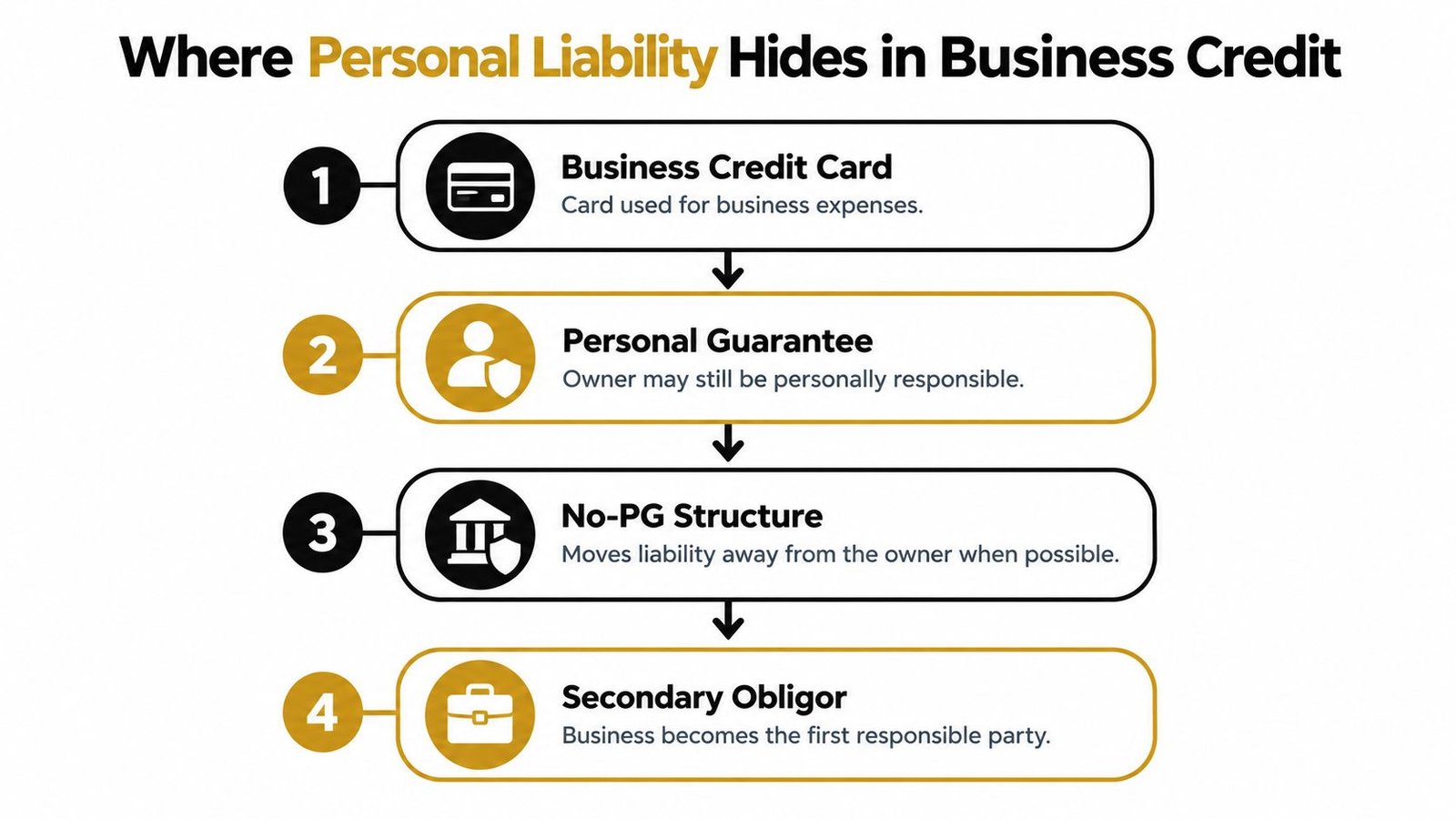
For precision, a conventional guaranteed arrangement can already make the business a primary obligor. A no-PG structure doesn't necessarily promote the company from secondary responsibility. The meaningful change is the absence of the owner's separate guarantee.
Use the distinction between business credit and personal credit to organize the review, then obtain issuer-specific answers.
- Personal obligation: Locate any unlimited or joint-and-several personal-liability language and ask counsel what it requires.
- Employee-card responsibility: Establish whether authorized users accept individual obligations or act solely for the company.
- Default remedies: Identify which parties and assets the issuer can pursue under the agreement.
- Consumer reporting: Ask what gets reported during ordinary repayment, delinquency, and default.
Don't Substitute a Credit-Check Answer for a Liability Answer
“No personal credit check” doesn't establish “no personal guarantee.” Conversely, an owner-credit review doesn't by itself establish that the owner guarantees repayment. Ask what the review authorizes and what the repayment provisions require.
The reporting question deserves the same discipline. A promise about routine account reporting may not answer what happens after delinquency, so request the policy for both circumstances.
Finally, ask what happens after closure, a change of ownership, or a request for different terms. Don't assume the initial approval describes every later contractual situation. The useful deliverable is a written map of obligations, not a verbal assurance that the product is business-only.
Who Actually Qualifies for a No-PG Card
Incorporation identifies the applicant. Repayment capacity is what gets underwritten.
The Federal Reserve's Small Business Credit Survey has repeatedly found that small business debt rarely rests on the company alone: personal guarantees, owners' personal assets, and business assets all appear routinely as forms of credit support, and firms that use cards often carry both personal and business cards. Those findings describe business debt in general rather than card-specific approvals, and the categories overlap. The conclusion worth drawing is narrow: owners' finances already sit inside most small business credit arrangements. Applying for a no-PG card is an attempt to reallocate that default exposure onto the company, and issuers underwrite it accordingly.
Build an Underwriting File, Not Just an Application
An issuer evaluating the company independently needs evidence that the expected payments fit its finances. Prepare documents that let the underwriter reconcile revenue, cash availability, existing obligations, and the requested spending capacity.
- Operating history: Present financial statements that explain how the business has performed through its operating cycle.
- Revenue quality: Distinguish collected revenue from invoices that haven't converted to cash.
- Liquidity: Identify cash available for repayment after payroll, taxes, suppliers, and existing debt.
- Commercial credit: Review the business's repayment record and investigate inconsistencies before applying.
- Asset position: Separate assets the business owns from assets already pledged or otherwise unavailable.
These are assessment categories, not universal minimum requirements. An issuer's actual thresholds must come from its current eligibility terms.
Approval should answer whether the company can sustain the repayment schedule, not merely whether it can produce the requested documents.
Test the Weakest Part of the File
A large revenue figure won't answer a liquidity problem. A strong bank balance won't explain whether that cash is committed to an imminent obligation. Review the file as an underwriter would: ask what could prevent payment when the balance comes due.
If the company has thin records, inconsistent cash generation, or limited independent credit history, ask which specific weakness blocks a no-PG approval. That produces an actionable response, such as improving documentation, lowering the requested limit, or waiting until the file strengthens.
There's also a cheaper question worth asking first. If the business plans to pay in full each cycle, the guarantee it is trying to avoid may never be called, while a no-PG structure can carry tighter limits or different pricing. If the plan involves revolving balances, the honest comparison runs between the card's interest cost and other financing the business could use instead.
Qualification matters, but sustainable qualification matters more. Don't reorganize necessary operating cash merely to make an application look stronger.
Regulatory Limits and Contract Clauses to Review
Business-purpose cards don't receive the same regulatory treatment as consumer cards. CFPB Regulation Z guidance on credit cards explains the general business-purpose exemption while preserving specified provisions, including protections concerning unauthorized use.
The applicable general unauthorized-use ceiling is typically the lesser of $50 or the amount obtained before notification, subject to the rule's conditions, as explained in that regulation. That protection isn't a cap on ordinary business debt, late fees, cash advances, or the company's obligations under its card agreement.
Review Remedies Before Pricing
Read the provisions that determine what the issuer can do when the account stops performing. Then compare pricing with those remedies in view.
- Personal-liability language: Confirm who signs, in what capacity, and which obligations survive termination.
- Setoff: Ask whether the issuer can apply funds from an account toward an unpaid balance, and identify the accounts covered.
- Arbitration and disputes: Establish how disputes must be brought and what procedures the agreement requires.
- Account suspension: Determine whether an account-level breach can interrupt all employee cards.
- Reporting and amendments: Request the reporting policy and the process for changing material terms.
A contract review should also identify the events that constitute default. Don't evaluate late-payment consequences without knowing when the issuer can invoke them.
Separate Unauthorized Use From Authorized Overspending
An employee's purchase can create a different issue from a stolen-card transaction. Ask the issuer how it treats employee spending that violates your internal policy but occurs through an authorized account.
That question belongs alongside controls for employee access, purchasing approvals, and card cancellation. Don't assume an internal spending rule automatically limits the company's contractual obligation.
Contract review question: What is the company's total exposure if payment fails, and what authority does the issuer have before the dispute is resolved?
The answer should include principal, interest where applicable, fees, employee-card balances, and operational consequences. Have counsel review uncertain liability provisions and have your finance team translate payment terms into a cash-flow schedule.
An advertised APR is only one input. The agreement determines the remedies, repayment requirements, and potential disruption that sit behind that price.
Comparing Card Structures and Alternative Financing
The Federal Reserve's Small Business Credit Survey questionnaire distinguishes personal guarantees, personal assets, and business assets as separate forms of credit support. That distinction prevents a common analytical mistake: treating “no PG” as synonymous with “unsecured.”
A business-backed deposit, an unsecured corporate obligation, and an owner-backed obligation allocate risk differently. Compare the proposed contracts using the same criteria rather than assuming their labels settle the question.
No-PG Card Structures Compared by Liability and Funding Fit
| Structure | Who Bears Repayment | Underwriting Focus | Best Fit |
|---|---|---|---|
| Unsecured corporate card without a PG | Business, subject to the agreement and any separate obligations | Company financial strength, liquidity, and repayment capacity | Spending the business can repay on the required schedule |
| Personally guaranteed business card | Business plus guarantor under the guarantee | Business information and guarantor credit | Applicants willing to accept personal exposure for offered terms |
| Secured card backed by a business deposit | Business, with the agreed deposit supporting repayment; verify whether a PG also applies | Deposit requirements and other issuer criteria | Businesses willing to commit cash to the arrangement |
| Line of credit, term loan, or invoice facility | Depends on guarantees, collateral, recourse, and other terms | Relevant cash flow, assets, equipment, or receivables | Funding needs better matched to a non-card repayment structure |
These are decision criteria, not product promises. A secured card still requires a liability review, and non-card financing isn't automatically guarantee-free. The same scrutiny applies when evaluating a business loan without a personal guarantee.
Compare Usable Funding, Not Headline Limits
For payroll, inventory, or construction spending, ask whether the proposed facility can fund the expenditure. Verify permitted uses, access to cash, payment timing, and any conditions attached to continued availability.
Then compare the funding period with the period over which the business expects to recover the expenditure. A purchase that supports the company over an extended period should prompt a comparison with financing designed around that repayment horizon.
For invoice-based funding, examine which receivables qualify and what happens if a customer doesn't pay. For equipment financing, inspect the asset-related security and repayment terms. Those questions keep the comparison focused on the obligation you're accepting.
- Capacity: Will the approved amount cover the actual funding gap?
- Availability: What conditions allow the provider to reduce, suspend, or withdraw access?
- Personal reporting: Does the proposed agreement affect the owner's consumer credit file?
- Repayment fit: Can expected collections support the required payments without creating another funding shortfall?
For a broader capital decision, AmbitionCFO's resource on choosing between loans and investors provides context beyond card selection. Consider that broader question when the underlying need is expansion capital rather than routine purchasing.
The strongest comparison may reveal that the company needs separate tools for spending and financing. There's no analytical reason to require the same product to perform both jobs.
Break-Even Costs and Matching Structure to Use Case
A no-PG arrangement can reduce owner-backed exposure while still being expensive financing. Experian reported that average small-business credit-card APRs exceeded 25% in Q2 2025, alongside a shift toward installment loans with structured repayment, in its Main Street Report. That's historical market evidence, not a current quote or a no-PG-specific rate.
Build the comparison from your actual statements, forecast, and proposed agreements.

Calculate Financing Cost Separately From Risk
Use this framework:
Expected financing cost = contractual interest + applicable fees + relevant cash-commitment costs − realizable rewards or credits.
Calculate interest using the issuer's balance and timing rules. Include the effect of a required deposit or cash commitment in your liquidity analysis, but keep assumptions explicit. Don't insert a supposed market value for avoiding a personal guarantee.
Test the agreement under full monthly repayment, 30-day revolving utilization, and stressed 90-day delinquency. These are planning scenarios, not claims about expected borrower behavior.
- Full repayment: Verify grace-period conditions, recurring fees, and the cash needed on each due date.
- Revolving balance: If revolving is permitted, calculate interest on the expected balance and repayment path. If it isn't permitted, mark this scenario unavailable rather than assigning an invented APR.
- Delinquency stress: Apply documented penalty pricing, returned-payment charges, employee-card exposure, and suspension provisions.
The embedded video provides an additional resource alongside your written comparison.
Identify What You're Paying to Avoid
Subtract the alternative facility's expected cost from the card's expected cost over the same funding period. If the card costs more, that difference is the additional financing expense you'd accept for its documented liability structure and other useful features.
It isn't automatically the value of avoiding a guarantee. The alternative may have different collateral, capacity, or repayment risks.
An established company paying in full may reasonably prioritize entity-level liability. A company carrying balances or financing equipment should examine whether a different repayment structure produces a stronger cash-flow outcome. A business line of credit versus credit card comparison can help organize that choice.
If the repayment scenario isn't feasible, a favorable liability provision doesn't make the financing workable.
Choosing Your Next Step with Business Loan Warrior
Choose the financing structure your business can sustain under the proposed terms, not the label you most want to qualify for. A no-PG card is a credible candidate when the company has independent financial strength, can meet the required payment schedule, and has verified the absence of a personal repayment guarantee.
For a company that expects to carry debt, the decision should remain open until competing offers are available. For a business funding a longer-lived asset or a substantial operating gap, the amount, repayment pattern, and conditions of access deserve at least as much attention as the guarantee.
Turn the Review Into a Decision File
Create a short approval memo for yourself, your finance director, or your management team. It should explain the funding need, identify the proposed source of repayment, and document the contractual exposure.
- Contract conclusion: Record the borrower, any guarantors, pledged assets, reporting terms, and material default remedies.
- Cash-flow conclusion: Attach the repayment scenarios and identify the point at which operating cash becomes insufficient.
- Alternative comparison: Evaluate offers over the same funding amount and period, with differences in collateral and guarantees stated plainly.
- Decision condition: State what must be confirmed before signing, including any unresolved legal interpretation or issuer clarification.
Keep written answers with the agreement. If an issuer's explanation and its documents appear inconsistent, resolve that discrepancy before proceeding.
Distinguish Pre-Approval From a Final Commitment
Use a pre-approval check to discover which financing structures your company's records may support. Don't use it as a substitute for reviewing the eventual agreement or confirming the final price, repayment schedule, and liability provisions.
The application process should help you compare offers, not pressure you into accepting the first available one. Prepare financial records before starting, and ask how bank-account access, credit inquiries, and subsequent underwriting will be handled.
A useful outcome may be a no-PG card, a personally guaranteed facility with acceptable economics, an asset-backed arrangement, or a decision not to borrow yet. The conclusion should follow from the company's numbers and your willingness to accept the documented exposure.
Avoiding a guarantee is a legitimate objective. It isn't a complete financing strategy. Review the contract, stress the payment schedule, and compare funding alternatives before committing company cash or personal assets.
Business Loan Warrior offers business loans, lines of credit, short-term financing, and invoice financing through a single, no-fee application that lets owners check pre-approval without affecting credit. Visit Business Loan Warrior to compare potential alternatives to a no-PG card, connect your bank accounts, and discuss underwriting questions before evaluating the final repayment and liability terms.