
MCA default rates averaged 22% across the U.S. industry in 2023, according to Gitnux's industry-statistics compilation. For an owner facing a failed withdrawal, though, the useful question isn't how many other businesses are struggling. It's which contractual remedy the funder can use next, and what you can still do before that happens.
Understanding what happens if you default on a merchant cash advance means following a sequence, not assuming one missed payment automatically costs you the business. Ignoring the first notice or blocking withdrawals without a plan can turn a manageable payment dispute into a harder legal problem.
Table of Contents
- Why Defaulting on an MCA Moves Faster Than a Loan
- How a Missed Debit Becomes a Court Judgment
- Which Business and Personal Assets Are Exposed
- Confession of Judgment and What It Can Cost
- Credit Damage, Bankruptcy and Personal Liability
- What to Do in the First Days After Default
- Choosing a Path to Settle or Restructure Before Court
Why Defaulting on an MCA Moves Faster Than a Loan
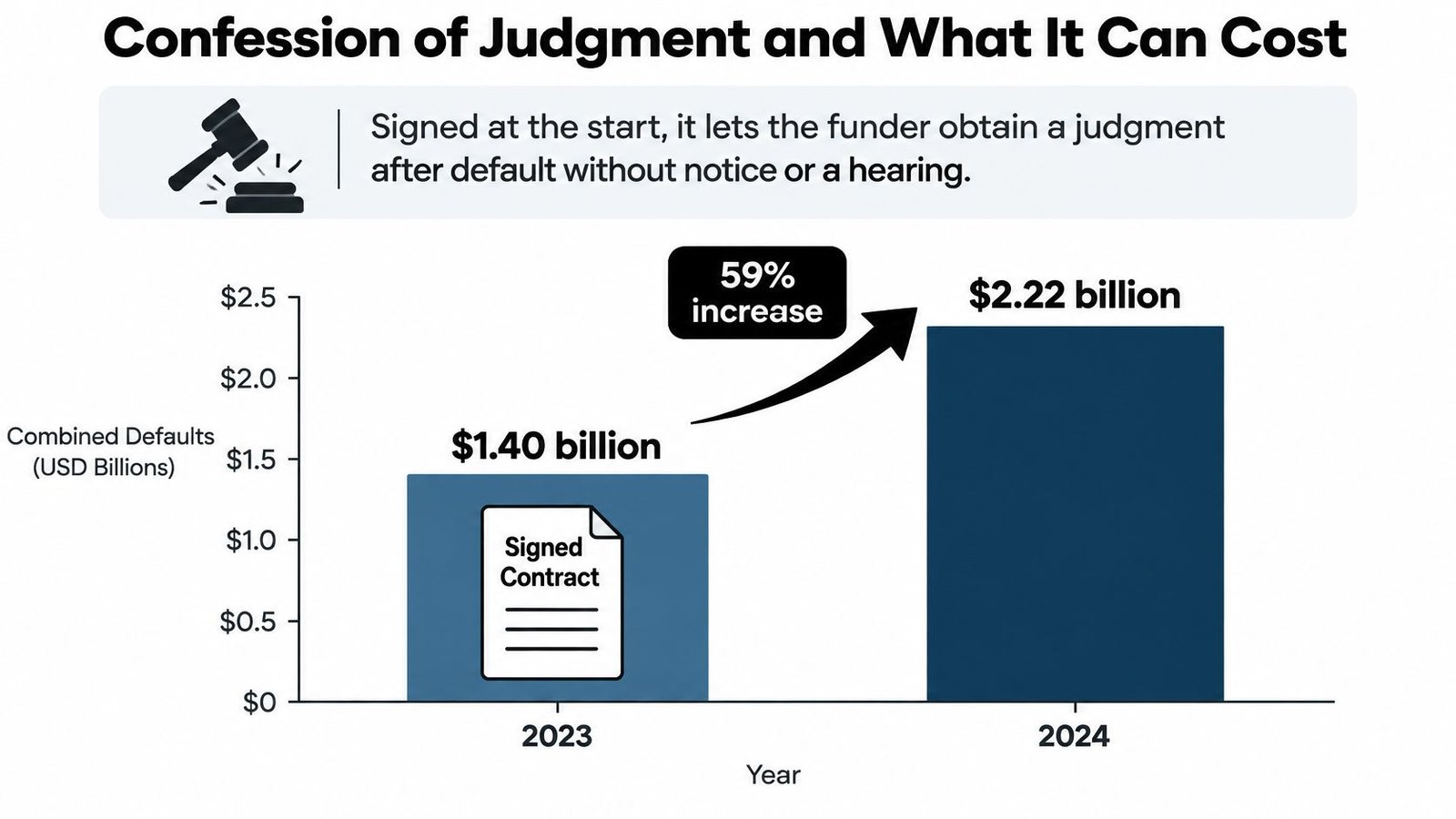
Major MCA providers reportedly recorded $2.22 billion in combined defaults in 2024, up from $1.40 billion in 2023, a 59% increase, according to ABNewswire's report. Those are reported provider totals, not a prediction of what your funder will recover or how it will handle your account.
The practical pressure starts with the collection mechanism. A conventional term loan feels like a scheduled bill. An MCA collected through automated withdrawals is closer to a debit card connected to your operating cash: the funder discovers a shortfall when it attempts the next withdrawal, not when you eventually discuss monthly results.
That makes cash-flow monitoring an immediate operating task.

What the agreement treats as default
A short or bounced ACH debit, stopped payment, or breached covenant can qualify as default under the agreement. Whether that lets the funder demand the entire claimed balance immediately requires reading the actual acceleration provision.
The collection package matters too:
- ACH authorization provides the mechanism for scheduled withdrawals.
- A personal guarantee may create a separate claim against an owner.
- A security interest identifies business collateral potentially available for enforcement.
- A confession of judgment, where lawful and properly used, can shorten the route to a judgment.
These provisions don't all produce the same remedy, and their presence doesn't prove every threatened collection action is lawful. They do explain why an MCA problem can move beyond payment scheduling into questions about collateral, court proceedings, and personal exposure.
Practical rule: Respond while the problem is still a payment discrepancy. Don't wait until you need emergency relief from an enforcement action.
Earlier action doesn't guarantee a concession. It gives you more opportunity to request reconciliation, correct the account, or negotiate before legal expenses enter the discussion.
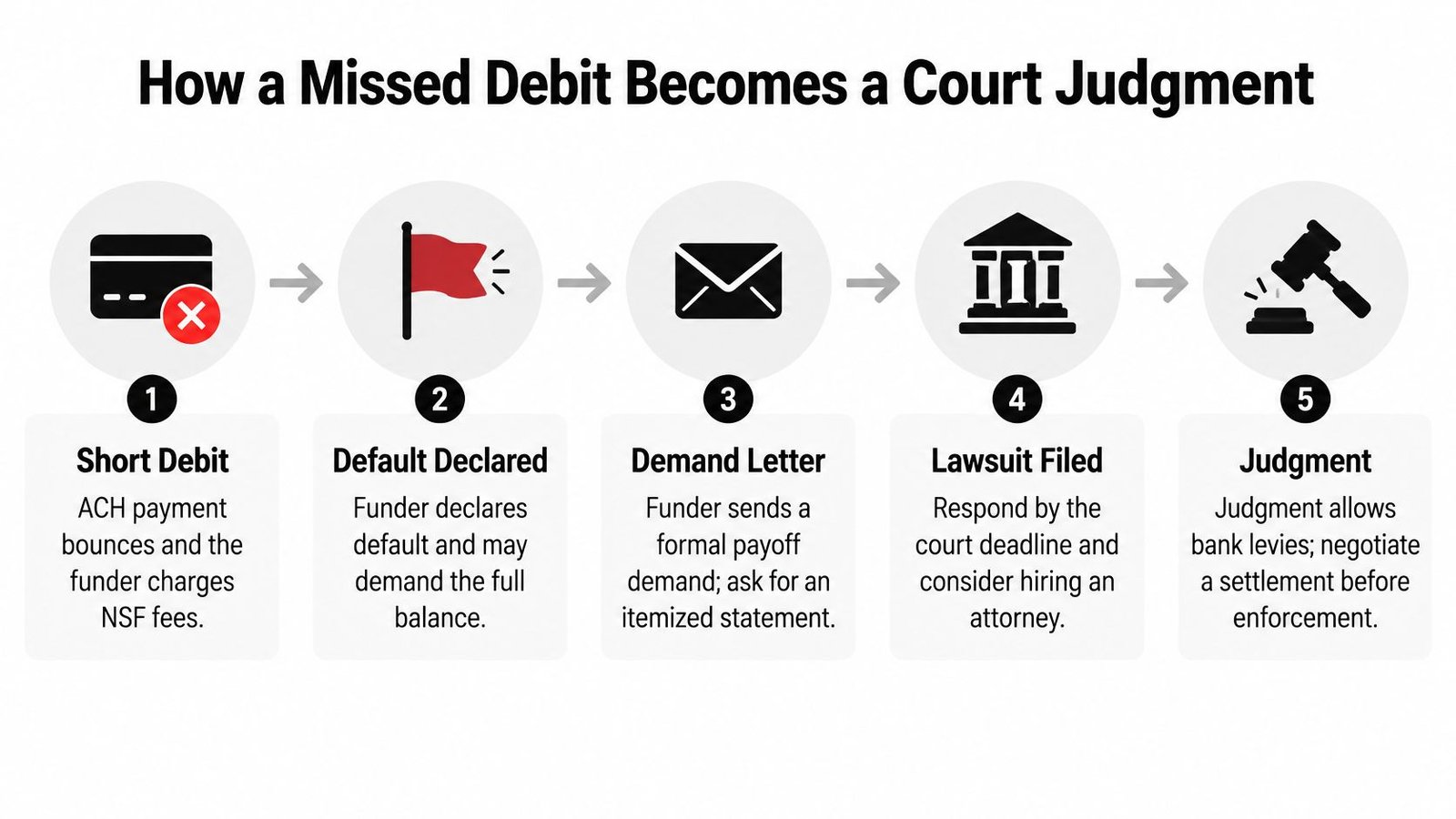
How a Missed Debit Becomes a Court Judgment
MCA default escalation stages
| Stage | Typical trigger | What the funder can do | Your leverage |
|---|---|---|---|
| Short or missed ACH debit | Balance too low for the scheduled debit | Attempt another debit and assess authorized contract fees | Request reconciliation before the next pull |
| Formal default notice | Missed debit, bounced debit, or breached covenant | Declare default and seek acceleration where permitted | Check notice requirements and any contractual cure period |
| Collection calls and demand letters | Default declared and balance accelerated | Demand payoff and threaten suit or guarantee claims | Answer in writing and keep a call log |
| Lawsuit or confession of judgment | Claimed unpaid obligation and an available legal basis | File suit or seek judgment where the clause is valid | Challenge enforceability and the amount through counsel |
| Judgment and enforcement | Entered judgment | Seek account restraints, asset levies, or guarantor enforcement under state rules | Ask counsel about a stay or grounds to vacate |
Treat this as a decision map, not a guaranteed timetable. A funder may combine notices, move directly to counsel, or pursue a remedy without completing every informal collection step.
The visual sequence helps identify where your file stands.
Work from the document, not the caller's tone
Say a restaurant's deposits fall while its scheduled debit stays the same. The first task is to determine whether the shortfall reflects lower receipts, a bank processing issue, or an incorrect withdrawal. Request the contractual reconciliation process rather than promising a catch-up payment the restaurant can't sustain.
When a default notice arrives, compare it with the agreement. Check how notice must be delivered, what breach it identifies, whether a cure opportunity exists, and how the payoff was calculated. A notice isn't proof that every asserted charge is enforceable.
During collection calls, ask for an itemized statement and written proposal. Keep the caller's name, date, requested payment, and threatened action in a log, then confirm substantive discussions by email.
A legal filing requires a different response. Settlement discussions don't replace a court response, and a collector's assurance that negotiations are continuing doesn't establish that your deadline has changed.
Write down the date of the first failed debit, the date you received each notice, and any court deadline shown on actual papers. Identify your present stage before deciding whether your next call should be to the funder, your bank, or litigation counsel.
Which Business and Personal Assets Are Exposed
Assets exposed after an MCA default
| Asset | How the funder reaches it | What must be true | Main risk |
|---|---|---|---|
| Operating bank account | Judgment-based levy or valid account-control rights | Applicable enforcement requirements or control rights are satisfied | Payroll and vendor payments become inaccessible |
| Future receivables | Contractual redirection of card or ACH receipts | An enforceable purchase or collection right covers those receipts | Incoming revenue is diverted |
| Equipment and inventory | Enforcement of a security interest identified in a UCC filing | A valid security interest covers the collateral and enforcement rules are followed | Loss of operating assets |
| Owner personal assets | Claim under a personal guarantee | The guarantee is enforceable and the claimed breach falls within it | Exposure of nonexempt savings or property |
| Payroll and tax accounts | Restraint or sweep affecting accounts holding those funds | Account ownership, control rights, and judgment scope permit the action | A separate payroll or tax cash crisis |
Default doesn't automatically authorize a funder to freeze every account or seize every asset. The Legal Philly explanation of MCA default remedies distinguishes a UCC filing from a judgment and explains why account restraints require a separate legal basis.
A filing isn't an account freeze
A UCC financing statement generally gives public notice of a claimed security interest. It isn't itself a judgment, and it doesn't establish unrestricted permission to withdraw bank funds.
Read the security agreement alongside the filing. A blanket lien may describe broad collateral, but breadth of collateral and the legal procedure for reaching it are separate questions.
For each threatened action, ask: What document creates this right, what event triggers it, and what procedure must the funder follow? That separates something the funder may seek from something it can execute immediately.
A collector saying it can take everything isn't the same as an enforceable order identifying what it can reach.
State law matters, especially when the contract selects a court outside your business's home state. Don't assume a confession-of-judgment provision is valid merely because it appears in signed paperwork, or invalid merely because another state restricts it.
Preserve payroll registers, tax-payment records, account titles, and deposit histories now. Those records help counsel explain the operational consequences of a restraint and evaluate available relief. They aren't a reason to conceal money or transfer collateral beyond a creditor's lawful reach.
Confession of Judgment and What It Can Cost
MCA companies obtained more than 5,500 New York court judgments against borrowers during the first five months of 2019, at approximately the same monthly pace as the previous year, according to the U.S. House Committee on Small Business hearing memorandum. A judgment threat deserves attention early. Ignoring a notice or blocking ACH debits without a plan can make the next steps harder to manage.
A confession of judgment is an advance agreement that may permit a judgment to be entered after a specified default, generally without the usual sequence of notice, hearing, and judicial review. Whether it can be enforced against your business depends on the applicable law and requires a current, jurisdiction-specific assessment.
The graphic shows a broader provider-default trend alongside the risks of a judgment.
The entered amount can exceed the balance you recognize
The appellate record in Merchant Funding Services, LLC v. Micromanos Corporation describes a $159,479.32 judgment. It lists $127,225 in principal, $31,806.25 in attorneys' fees, interest at 16%, and costs and disbursements.
Breakdown of a confession-of-judgment award
| Component | Amount | Note |
|---|---|---|
| Principal balance | $127,225.00 | Claimed purchased-receivables balance |
| Attorneys' fees | $31,806.25 | Equivalent to 25% of principal |
| Interest at 16%, costs and disbursements | $448.07 | Remainder after principal and fees, covering interest, costs, and disbursements not broken out separately |
| Total judgment | $159,479.32 | Amount described in the appellate record |
The $448.07 is the remainder after the listed principal and fees; the record does not separately allocate it among interest, costs, and disbursements. The fee award in this case does not establish a standard rate for MCA collections.
Request a complete payoff calculation before agreeing to a payment or settlement. It should show the starting balance, payments credited, interest calculation, contractual fee provision, legal expenses, and any adjustments. A single payoff figure is not enough to assess what you owe or challenge an error.
For additional context on the topic, the following video is available.
Check the signed documents for a confession-of-judgment affidavit or related provision. If judgment has been entered, obtain the docket, judgment, supporting affidavit, and proof of filing or service where applicable.
Ask counsel to identify any grounds and deadline for seeking a stay, opening the judgment, or moving to vacate it. Payoff negotiations do not necessarily suspend enforcement or preserve procedural rights, so confirm the effect before relying on them.
Credit Damage, Bankruptcy and Personal Liability
Don't measure the damage only by whether your credit score changes. A collection dispute can interfere with underwriting, banking relationships, and refinancing even when you haven't confirmed any credit-bureau reporting. Before applying elsewhere, identify outstanding judgments, security interests, and guarantee demands so a prospective lender isn't the first person to raise them.
Personal liability requires its own review. A business loan personal guarantee can illustrate the distinction between a company obligation and an owner's separate promise, but the actual MCA guarantee controls your exposure. Read what conduct triggers it, rather than assuming every guarantee covers every business loss.
Bankruptcy isn't an automatic cancellation
A federal bankruptcy-conference paper on MCA loans in bankruptcy addresses the continuing disputes over transaction classification and enforcement. The central issue can be whether the funder purchased receivables or instead holds a claim arising from a transaction functioning as a loan.
The relevant questions include:
- Contingency of payment: Does the obligation truly change with collected receivables?
- Collection risk: Does the funder bear a meaningful risk of receiving less?
- Usable reconciliation: Can the merchant obtain an adjustment in practice?
- Operational control: Does the merchant retain control of its business?
Those aren't boxes an owner can check to declare a contract unenforceable. Counsel must apply them to the agreement, payment history, and governing law.
Before filing: Identify who would file, who signed the guarantee, and who claims ownership of incoming receipts. Those may be different parties.
Will filing stop withdrawals and discharge the balance?
The automatic stay may stop collection activity, but counsel must evaluate its application to the debtor and the disputed receivables. A funder asserting ownership of purchased receipts presents a different issue from a creditor seeking repayment.
Discharge is also a separate question. Debtor type, contract language, guarantees, and any fraud allegations can affect the result; filing doesn't automatically erase liens or settle priority disputes.
A company bankruptcy also doesn't automatically protect a nonfiling owner who guaranteed performance. Get bankruptcy advice before changing payment arrangements or filing, not after assuming the filing will solve both business and personal exposure.
What to Do in the First Days After Default
Start with evidence and cash control, not an improvised promise to pay. The New York Supreme Court's analysis of receivables-purchase arrangements explains why meaningful reconciliation and allocation of collection risk matter when assessing whether an agreement functions as a loan.
A fixed debit during declining sales warrants investigation. It doesn't, by itself, establish a defense or authorize nonpayment.
Use the review process to prepare a documented request.

Build a file someone can act on
Preserve the complete record. Save signed agreements, amendments, bank statements, debit records, emails, and notices in a single folder. Keep original files, not just screenshots of selected transactions.
Match withdrawals to receipts. Compare each collection period with the receivables covered by the agreement. Separate sales from transfers, owner contributions, and other deposits so you don't overstate eligible revenue.
Request contractual reconciliation in writing. Cite the clause, attach the required documentation, and identify the adjustment you're requesting. Follow its delivery instructions and keep proof that the request was sent.
Don't block ACH debits without a coordinated plan. Revocation or stop-payment action may breach the contract and trigger escalation; the FTC's MCA enforcement account also demonstrates why unauthorized withdrawals must be taken seriously. Dispute unauthorized or noncontractual debits promptly with the bank and funder, and obtain advice about protective steps.
Document the revenue decline. Assemble processor statements, sales reports, canceled orders, and deposit histories. A supported explanation is more useful than saying business has been slow.
Flag the clauses that govern your next move. Mark default, ACH authorization, collateral, guarantee, reconciliation, and forum provisions. For initial organization, LegesGPT's AI legal assistant for business owners can help prepare questions, but it shouldn't replace licensed counsel's assessment of remedies or deadlines.
Plan payroll and tax cash handling lawfully. Identify the accounts and funds needed for upcoming obligations. Separate funds only after counsel confirms the contract, existing restraints, and applicable law permit the proposed movement.
Get advice before signing a workout. Have counsel review new acknowledgments, waivers, guarantees, and default terms. A smaller debit isn't necessarily a better agreement if you surrender a valuable defense to obtain it.
The immediate objective is a reliable account of what happened, what the contract requires, and what the business can afford. That lets you negotiate from documents rather than pressure.
Choosing a Path to Settle or Restructure Before Court
Settlement and restructuring options compared
| Option | Works best when | Main trade-off | Typical result |
|---|---|---|---|
| Reconciliation adjustment | Revenue fell and the contract permits adjusted debits | Requires documented receivables | Reduced debit and possible resolution of the alleged default |
| Payment modification | A temporary cash dip has a credible recovery path | Additional charges may continue if agreed and lawful | Written payment pause or reduction |
| Lump-sum settlement | Funds are available for a negotiated payoff | Requires cash and a complete written release | Agreed discounted payoff |
| Refinance into a term loan | The business qualifies for sustainable replacement financing | Qualification, closing costs, and possible collateral | MCA retirement and a fixed payment schedule |
| Reverse consolidation | Immediate debit relief is needed | New financing can increase total repayment and leave old obligations outstanding | Temporary relief with additional funding risk |
A reported average recovery rate of 55% for defaulted MCAs appears on Zipdo's industry-statistics page. That reported average isn't a settlement entitlement, a recommended offer, or proof your funder will accept a particular discount.
Match the proposal to available cash
If revenue has fallen and the agreement provides reconciliation, start with that contractual process. Don't offer extra consideration for an adjustment you may already be entitled to request.
A payment modification fits a temporary shortfall only when you can explain the recovery. Provide a cash forecast showing payroll, taxes, essential vendors, and the proposed payment. A promise based on hoped-for sales merely postpones the next breach.
For a lump-sum settlement, negotiate the paperwork before sending money. Require clear treatment of the remaining balance, guarantees, security interests, pending litigation, and any entered judgment. Confirm what happens if a settlement installment arrives late.
Compare total cash out, release terms, and failure consequences, not just the size of tomorrow's debit.
Be careful about replacement financing
Refinancing can work when the new obligation is affordable and actually retires the MCA. Compare net proceeds after fees with the written payoff, then test the replacement payment against conservative operating cash flow.
Reverse consolidation isn't necessarily a payoff. Some arrangements provide money to service existing withdrawals rather than extinguishing the old contracts. Verify where the proceeds go, which obligations remain, and how much the business must repay in total.
A practical MCA debt relief checklist should help organize those comparisons, not substitute for contract review. If judgment already exists, legal relief takes priority over shopping for another advance.
Before making an offer, confirm which situation you're in: a documented reconciliation claim, a temporary shortage, an available settlement fund, or an enforcement emergency. Then choose a proposal the business can complete.
Business Loan Warrior helps business owners compare term-loan, SBA, and other funding options that may support an affordable exit from MCA obligations. Visit Business Loan Warrior to explore financing against your documented payoff and cash-flow needs, while keeping court deadlines and settlement terms with qualified counsel.