

You've got lender interest, the use of funds makes sense, and the numbers work. Then the loan officer slides over one more document. It isn't the note, and it isn't the security agreement. It's the personal guarantee.
That's the point where a business financing decision stops being purely commercial and becomes personal. If the company misses payments or fails, the lender may not be limited to business assets. Your cash, your brokerage account, your home equity, and your future income may be part of the recovery discussion.
A lot of owners sign that document too quickly. Some assume every lender requires the same thing. Others think an LLC or corporation keeps the risk contained. Neither assumption is safe. A business loan personal guarantee is common, but common doesn't mean harmless. It needs to be read, negotiated where possible, and matched to the risk of the deal.
Table of Contents
- Understanding the Business Loan Personal Guarantee
- Types of Personal Guarantees and Liability
- The SBA Personal Guarantee Rules Explained
- Negotiating Your Personal Guarantee Terms
- Alternatives and Risk Mitigation Strategies
- Practical Checklist for Signing the Guarantee
Understanding the Business Loan Personal Guarantee
The loan looks fine until the guarantee shows up. Terms may be acceptable, cash flow may support the payment, and the collateral package may already be on the table. Then the lender asks the owners to back the debt personally, and the discussion shifts from business risk to household risk.

A business loan personal guarantee is a separate legal promise from an owner or key principal to repay the debt if the business does not. It sits beside the note and security documents. Once it is signed, the lender has recourse against the individual signer, not just the company.
That point matters even more in SBA lending. SBA rules often require personal guarantees from owners above certain ownership thresholds, but the SBA requirement does not answer every practical question in the deal. It does not tell you whether the guarantee can later be released, how broad the default language is, or whether a lender will negotiate related terms elsewhere in the package. Owners who miss that distinction often assume the form is fixed when parts of the risk allocation are still open for discussion.
Why lenders ask for it
Lenders ask for personal guarantees because many small businesses cannot support a credit decision on collateral and operating history alone. From the lender's side, the guarantee aligns the owner with the repayment risk and gives the bank another recovery path if the business fails.
In conventional lending, that is often an underwriting choice. In SBA lending, it is often tied to program rules first, then shaped by lender policy second. That creates a useful negotiating frame. If a lender says, "the SBA requires this," ask which part is driven by SBA rules and which part is the bank's own credit preference.
Where owners get tripped up
The first mistake is assuming the LLC or corporation keeps this loan fully inside the business. It does not. A signed guarantee overrides that assumption for this obligation.
The second mistake is focusing only on approval and interest rate. The guarantee language can matter just as much as pricing, especially if the loan is large relative to personal net worth or the business is entering a volatile stretch.
The third mistake is blending personal credit with personal liability. They overlap, but they are not the same issue. This guide on business credit vs personal credit is a useful refresher before you sign.
Practical rule: Ask two questions before signing. What is required by SBA or lender policy, and what can still be negotiated in the documents?
Where the tension lies in the deal
A personal guarantee is often the price of getting growth capital, a working capital line, or an SBA-backed loan that the business could not obtain on an unsecured basis. The problem is not the existence of the guarantee by itself. The problem is signing broad liability without measuring it against the upside of the financing and the fallback options if the business hits a rough patch.
Before signing, pin down these points:
- Scope of the obligation: Is the guarantee tied only to this loan, or does it cover future advances and other obligations with the same lender?
- Default triggers: Does enforcement begin only after payment default, or can covenant breaches and other technical defaults trigger action?
- Exit path: Under what conditions, if any, can the guarantee be reduced or released after performance improves?
- Personal exposure: Which assets are realistically at risk, and what does that mean for the owner's broader financial plan?
That is the decision owners need to make clearly. You are not only borrowing for the company. You are deciding how much of your personal balance sheet will stand behind the loan, and in SBA deals, whether you will accept the program rules as written or use the parts around them to negotiate smarter terms.
Types of Personal Guarantees and Liability
A founder closes on a loan, skims past the guarantee page, and assumes every owner will share the downside evenly if the business stumbles. Then the company misses payments, one partner has stronger personal assets, and the lender pursues that signer first. I have seen that surprise get expensive fast.
Unlimited versus limited
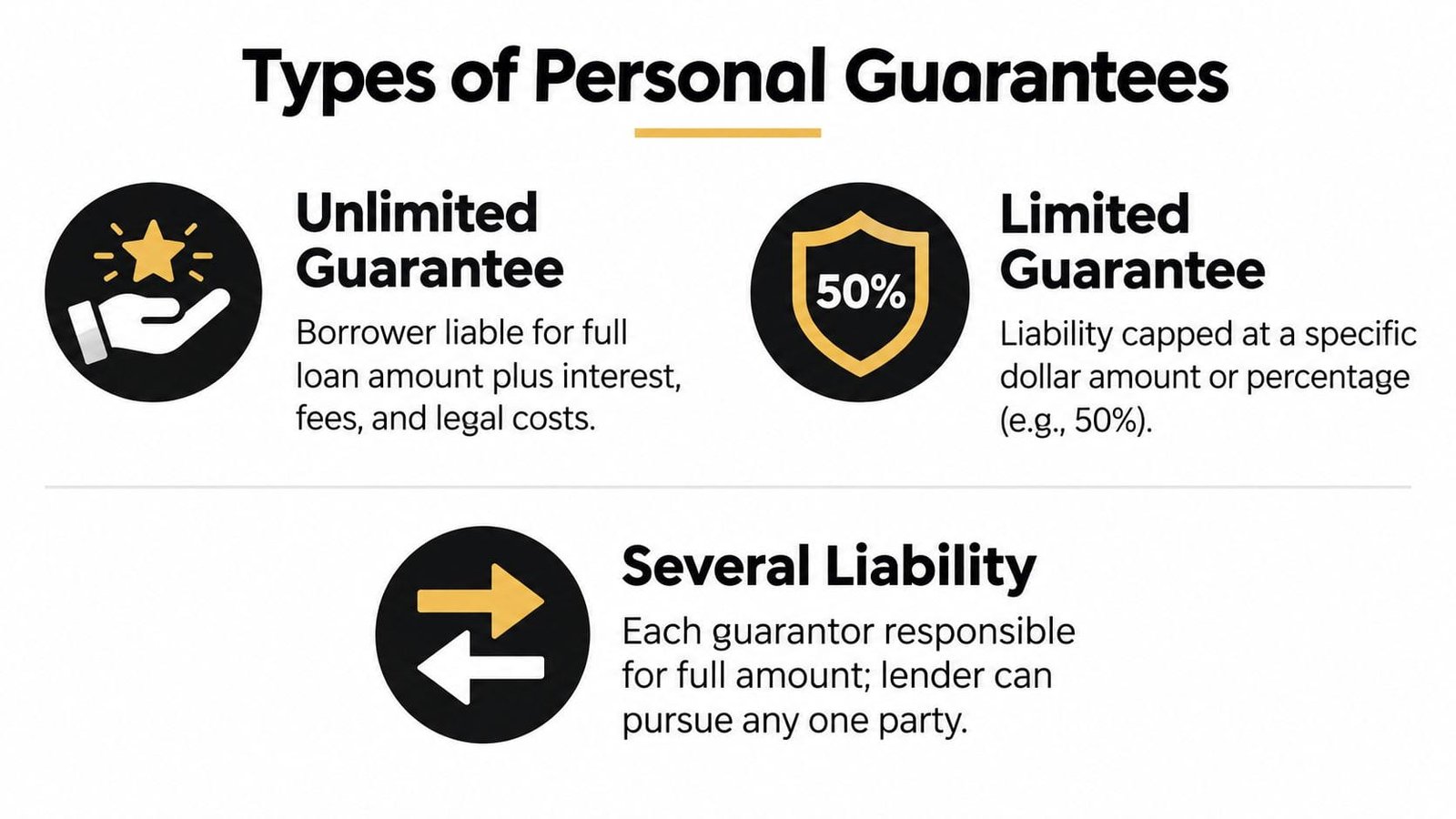
An unlimited guarantee makes the signer responsible for the full unpaid debt, plus collection costs and other amounts allowed in the loan documents. For an owner, that is the highest-risk version because the contract sets no dollar cap on personal exposure.
A limited guarantee restricts liability to a stated amount, percentage, or formula. That limit matters. It gives owners something concrete to measure against the loan benefit, and it creates a clearer starting point for negotiation if the business has multiple guarantors, meaningful collateral, or clean financial performance.
Here is a clearer way to compare them:
| Guarantee type | What it means for the owner | Typical negotiation point |
|---|---|---|
| Unlimited | Full personal exposure if the business defaults | Harder to revise when the lender views the deal as thin |
| Limited | Exposure capped by amount or formula | More achievable when cash flow, collateral, or competing offers improve the file |
| Several or joint-style exposure | One signer may be targeted more aggressively depending on the wording | Allocation among co-owners needs to be addressed before signing |
For SBA borrowers, this distinction matters even more than it does in a conventional deal. SBA rules may determine who must sign. The documents still determine how far that liability reaches, and that is where careful review and negotiation matter.
Several, joint, and joint-and-several liability
Owners often lump these together, but the wording changes the risk.
A several guarantee usually assigns each guarantor a defined share. A joint guarantee can tie guarantors together as a group. A joint and several guarantee gives the lender the broadest collection option, because it may pursue one guarantor for the full amount and leave that person to sort out contribution claims against the others later.
That last point gets missed all the time. Equal ownership does not guarantee equal pain.
If three partners own one-third each, but one has real estate, one has modest savings, and one has little collectible personal wealth, the lender will usually focus on the signer with the best recovery profile. That is a contract issue and a collection reality issue.
The corporate veil problem
An LLC or corporation helps separate business liabilities from personal liabilities. A signed guarantee cuts through that separation for the debt covered by the guarantee.
Funded Deal explains this distinction well in its discussion of personal guarantees in commercial loans. A UCC-1 filing reaches identified business collateral. A personal guarantee can let the lender pursue personal assets under a separate contract. Owners who rely on the entity structure alone often realize too late that they protected the company form but gave that protection back on the loan side.
If the business defaults, the lender may collect from company collateral first, but the guarantee can open a second path into the guarantor's personal balance sheet.
How common guarantees have become
This issue is not limited to startups or distressed borrowers. Analysts in the Pepperdine analysis of personal guarantees in small business lending found substantial growth in guarantee use across several loan categories from 1987 through 2014, and by 2014 guarantees were required on almost half of loans across five loan types.
That pattern matters for negotiations. Owners should not waste time arguing that guarantees are rare or unusual. A better approach is to identify what can still be shaped: the cap, the release terms, the carve-outs, the notice requirements, and the way liability is allocated among signers.
Why legal review matters
If another person is being asked to sign with you, review the guarantee as if the business will hit a rough patch, not as if everything will go according to plan. The consumer warning from Morgan Morgan Attorneys at Law P C makes the core point clearly. The person taking the risk often does not control the future borrowing decisions, payment discipline, or workout strategy.
That problem gets sharper in SBA deals. The program may require certain owners to sign, but it does not eliminate the need to negotiate the surrounding terms or coordinate expectations among co-owners in writing.
Owners should read for specific traps: future advances, cross-default clauses, confession-style remedies where allowed, survival after ownership changes, and release language that gives the lender full discretion. Those are the provisions that turn a standard guarantee into a much broader personal liability than many borrowers expected.
The SBA Personal Guarantee Rules Explained
Two founders get to closing on an SBA loan and then hit the surprise that stalls the deal. One owns 80%. The other owns 20% through a holding company and assumed the business, not the individual, would be on the hook. The lender sends over the guaranty package and both names are on it.
That result is usually predictable under SBA rules. The mistake is waiting until documents go out to address it.
Who has to sign under SBA rules
For SBA loans, the baseline rule is straightforward. Owners of 20% or more are generally expected to provide an unlimited personal guaranty, consistent with SBA loan program requirements and lender servicing standards reflected in SBA guidance. If the ownership chart is messy, the lender will still work through who owns what.
That matters early, especially with spouses, family ownership, trusts, and passive investors. A cap table that looks clean in a pitch deck can become a closing problem once the lender matches ownership, tax returns, and personal financial statements.
The practical point is simple. Sort out guarantor status before the application is deep in underwriting.
Why the SBA still requires it
The SBA guaranty protects the lender only up to the program terms. It does not remove the lender's credit risk, servicing risk, or liquidation risk. That is why personal guaranties remain part of the structure even though the loan is government-backed.
Borrowers sometimes treat the SBA backstop as if it should reduce personal exposure automatically. In practice, SBA rules often make the guaranty requirement more rigid than a conventional deal. The lender has less room to waive required guarantors because the file still has to comply with SBA eligibility and closing standards.
That is the trade-off. You may get better access to capital or longer terms through an SBA program, but the ownership-based guaranty rules are harder to negotiate away.
How to read the SBA guarantee package
Read the guaranty with two questions in mind. First, who must sign because SBA rules require it? Second, what terms did the lender add around that SBA requirement?
Use this review sequence:
Confirm the guarantor list against actual ownership
Check the operating agreement, stock ledger, trust documents, and any recent transfers. If someone is at or above the threshold, expect the lender to ask questions until the file is consistent.
Separate SBA-required signers from lender-added protections
The SBA may drive who signs. The lender often controls other terms, such as notice language, cross-default wording, and how broadly the guaranty covers related obligations.
Read for unlimited liability
In many SBA deals, required guarantors sign unlimited forms. If there is a limit, a burn-down, or a release trigger, it must be written clearly in the documents.
Check how ownership changes are handled
A sale, divorce, estate transfer, or partner buyout does not automatically release a guarantor. Release usually requires lender approval and, in many cases, a structure that still satisfies SBA rules after the change.
Review the personal financial disclosure trail
Lenders underwrite the guarantor as well as the business. Before signing, review what you submitted in your SBA personal financial statement and make sure it matches the final credit file.
Collateral and secondary support
An SBA guaranty and collateral package often work together. If business collateral is weak, the lender may look harder at outside support, available equity, or insurance tied to key owners. That does not replace the guaranty. It affects how the lender judges the total risk in the file.
For a practical example of how lenders think about secondary support, see this discussion of using life insurance for SBA loans. It helps explain why lenders sometimes ask questions that feel outside the narrow loan request.
Where owners make avoidable mistakes
The most expensive mistakes are usually procedural, not legal theory. Owners wait too long to identify who must sign. They assume a last-minute ownership tweak will remove someone from the guaranty. Or they focus on the note amount and ignore the guaranty language that survives changes in ownership or management.
A better approach is to treat SBA compliance and negotiation as two separate tracks. Accept the signer requirements the program is likely to impose. Then press on the terms around release, scope, collateral interpretation, and any ownership-change mechanics that could trap a departing partner later.
That is how experienced borrowers handle SBA guaranties. They do not argue with the rule itself. They control the parts of the risk that can still be shaped.
Negotiating Your Personal Guarantee Terms
Many owners think guarantee terms are fixed. Some are. Some aren't. The difference usually comes down to lender policy, deal strength, and whether you know what to ask for.

What you can usually negotiate
A personal guarantee is easiest to shape before credit approval is final. Once documents are out and closing is scheduled, flexibility shrinks.
Focus on terms that change downside risk.
- Release language: Ask whether the guarantee can terminate after a sustained performance period, refinance, ownership buyout, or paydown to a stated level.
- Liability cap: If full removal isn't possible, ask for a stated ceiling.
- Burn-down structure: Some lenders will consider reduced exposure as the principal amortizes and the company proves itself.
- Carve-out scope: Narrow the guarantee to a specific facility instead of broader present and future obligations.
SBA versus conventional deals
In SBA transactions, required guarantees tied to ownership thresholds are much harder to remove because they're embedded in program expectations. Your negotiation room is usually around collateral interpretation, timing, documentation, and sometimes future release after refinance or ownership changes approved through the right channels. Borrowers need to be realistic.
Conventional lenders can be more flexible, especially if the company has strong cash flow, meaningful business collateral, or competitive term sheets. They may still ask for a guarantee, but they're often more open to structure changes if the deal is otherwise attractive.
Here's the practical comparison:
| Deal type | Guarantee flexibility | Best borrower leverage |
|---|---|---|
| SBA-backed loan | Lower flexibility on required guarantors | Clean financials, strong collateral support, refinance path |
| Conventional bank loan | Moderate flexibility depending on credit profile | Competing offers, operating history, lower leverage |
| Nonbank commercial loan | Varies widely by lender and product | Speed, collateral quality, sponsor strength |
What lenders respond to
Lenders don't relax guarantee terms because a borrower objects emotionally. They respond when the file gives them another way to get comfortable.
Strong arguments include:
- The business has identifiable collateral
- The company has stable operating history
- The owners are contributing meaningful equity
- Another lender is willing to compete for the credit
- The requested guarantee is broader than the actual risk of the facility
Don't say, “I don't want to sign this.” Say, “Here's why the business and collateral already support a narrower guaranty package.”
What usually fails
A few approaches almost never help:
- Threatening to walk when you have no alternative source of capital
- Arguing that your LLC should be enough without showing strong balance-sheet support
- Asking for removal of the guarantee while also seeking a high-risk, lightly collateralized loan
- Waiting until docs are prepared to raise basic structure issues
Talking points that are worth using
If you're negotiating directly with a bank or brokered lender, keep the conversation concrete:
- Ask if the guarantee can convert from unlimited to limited after a clean payment history.
- Ask whether all future obligations are included, or only this loan.
- Ask whether a departing owner can be released after a buyout and underwriting update.
- Ask whether additional business collateral would support narrower recourse.
Negotiation doesn't mean you'll win every point. It means you stop treating personal liability as untouchable boilerplate.
Alternatives and Risk Mitigation Strategies
A borrower closes an SBA loan to buy equipment, signs the required guaranty, and assumes the next refinancing will solve the personal exposure. Two years later, the business is healthier, but the same guaranty is still in place because no one set up a release path when the loan was approved.
That mistake is avoidable.
Alternatives that may reduce personal exposure
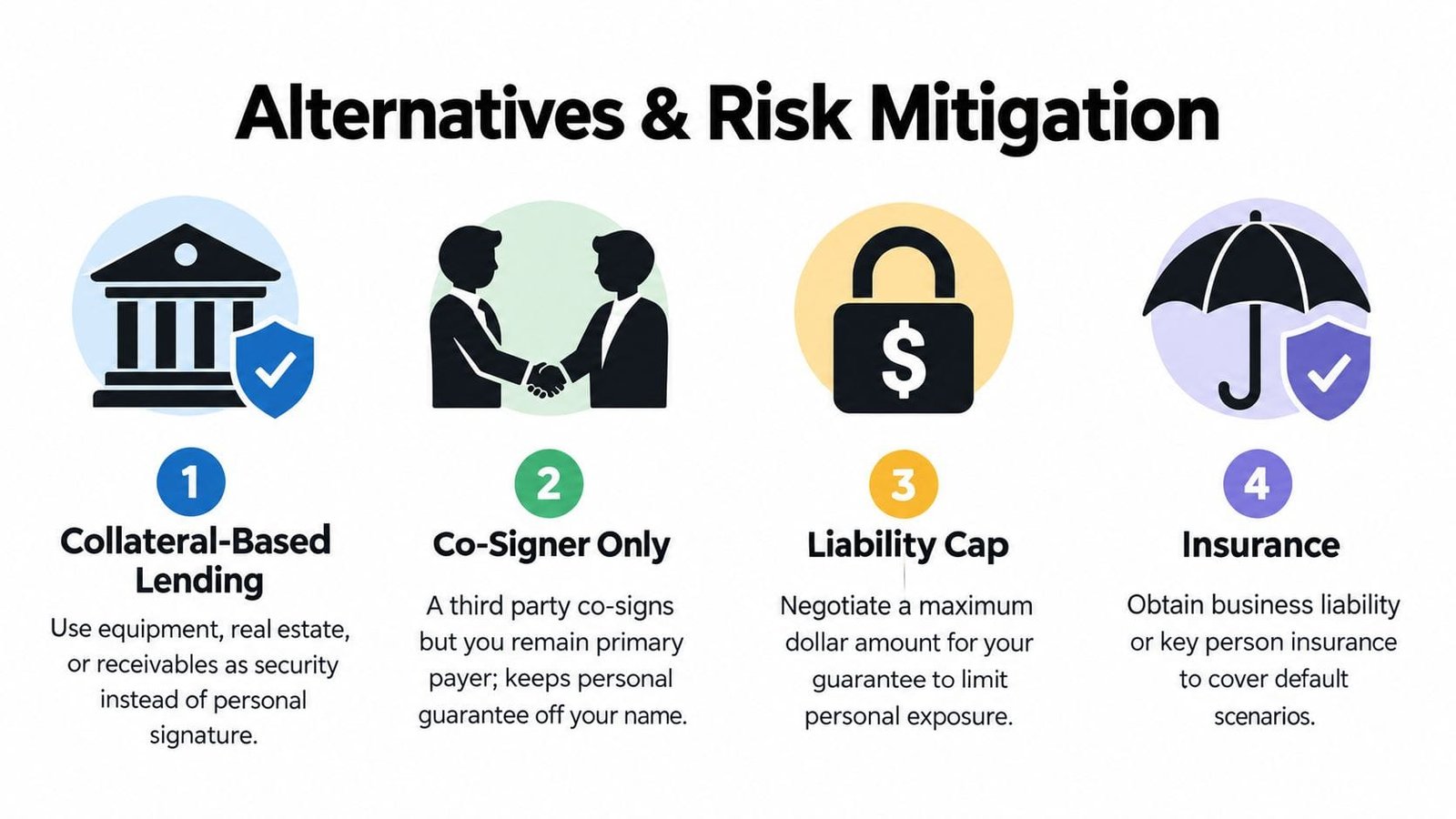
The cleanest way to limit personal liability is to choose debt that underwrites primarily to the asset, the receivable, or the operating cycle instead of the owner.
Options worth testing include:
- Collateral-based lending: Equipment, receivables, inventory, or real estate can support credit based on business assets and liquidation value.
- Invoice financing: This works best when customers pay reliably but on stretched terms, and the lender can see a clear repayment source.
- Trade credit and vendor terms: Supplier financing often creates less personal spillover than using recourse debt for routine working capital.
- Established business credit strategy: Stronger company credit can expand your choices over time. If that is the route you want, start with this guide to a business loan without personal guarantee.
These options are not interchangeable. Asset-based products can cost more. Vendor terms can tighten without warning. Invoice financing depends on customer quality, not just your own.
SBA-specific risk reduction that owners often miss
SBA rules limit how much freedom a lender has on guaranties, especially on 7(a) loans. If an owner meets the SBA ownership threshold, the guaranty is usually required. That does not mean you are out of moves.
One of the better tactics is to discuss collateral substitution before closing. If the loan starts with mixed collateral, ask how the bank would handle a later swap, such as replacing depreciating equipment with cash, marketable business assets, or stronger liens as the company grows. The practical goal is to create a cleaner future file for a guaranty release, ownership change, or refinance request. Banks respond better when the release request comes with improved collateral coverage instead of a bare request for relief.
Ask the lender to explain three things in writing:
- What collateral can be substituted later without rewriting the entire credit.
- What underwriting standard would apply if an owner seeks release after a buyout or partial paydown.
- Whether the bank will re-evaluate the guaranty after a defined performance period under SBA servicing rules.
That conversation belongs in the approval stage, not after a dispute or partner exit.
Here's a useful explainer before the next point:
If you must sign, reduce the blast radius
The best mitigation plan is operational. A lender is far more likely to consider any later release, substitution, or refinance if the file stays clean and easy to underwrite.
- Keep business records lender-ready: Timely financials, aging reports, and tax returns make it easier to support a modification request later.
- Carry insurance with a credit purpose in mind: Key person, property, liability, and business interruption coverage can protect repayment capacity after a shock.
- Write owner exit terms before there is tension: Buy-sell agreements should address who replaces a departing guarantor and how the debt will be handled.
- Get legal review organized efficiently: If your internal team is stretched, some owners use outside support such as virtual legal assistants companies to help organize documents before attorney review.
A guaranty gets harder to manage when the business outgrows its original loan structure, but the documents never catch up. Good borrowers plan the exit path early.
Practical Checklist for Signing the Guarantee
The right time to inspect a guarantee is before you're under closing pressure. Once vendors are waiting, payroll is approaching, or the seller expects funding, borrowers start overlooking terms they would have challenged a week earlier.
Read the guarantee as its own contract
Don't treat the guarantee like a rider behind the note. Pull it out and review it line by line.
Use this checklist:
- Identify the exact obligor: Make sure the correct borrower entity is named and that your own name matches your legal identity.
- Check the scope of debt covered: Is this one facility only, or does it reach future loans, renewals, and amendments?
- Look for continuing liability: Some guarantees stay alive longer than owners expect, especially after ownership changes.
- Review cost language: Liability may extend beyond unpaid principal into lender expenses allowed under the agreement.
Test the downside, not the sales pitch
A lender or broker will naturally focus on approval, speed, and use of proceeds. Your job is to pressure-test failure scenarios.
Ask these questions in writing:
- If the business sells, what releases the guarantee?
- If one owner exits, what replaces or removes that person's liability?
- If the loan refinances, does the old guarantee terminate automatically?
- If there's a default, must the lender first pursue business collateral, or can it proceed directly against guarantors?
Owners catch the ugly clauses here. Cross-default language, broad future-advance language, and waiver provisions don't feel important when revenue is rising. They feel very important when the company hits a cash crunch.
Match the guarantee to the purpose of the loan
Not all debt deserves the same personal risk. A short-term bridge for inventory timing is different from a strategic expansion with durable revenue behind it. If the purpose is temporary and uncertain, your guarantee posture should be tighter.
A simple decision table helps:
| Loan purpose | Better guarantee posture |
|---|---|
| Stable equipment purchase | Push for collateral-first structure or capped recourse |
| Working capital under pressure | Be cautious about unlimited open-ended guarantees |
| SBA growth financing | Expect formal guarantor requirements and plan around them |
| Multi-owner expansion | Clarify release, allocation, and exit rights early |
Bring the right professionals in at the right time
Legal review should happen before final signing, not after concern sets in. Accounting input also matters because guarantee exposure can affect owner distributions, reserve decisions, and future borrowing capacity.
Final check: If you can't explain the guarantee to your spouse, co-owner, or CPA in plain English, you're not ready to sign it.
Know your exit strategy before entry
The strongest borrowers don't just ask how to get approved. They ask how to get out of personal recourse later.
That usually means planning for one of these outcomes:
- Refinance into stronger business-only credit
- Pay down principal to a level that supports release discussions
- Replace personal support with business collateral as the company matures
- Restructure ownership so guarantor obligations are aligned with actual control
A business loan personal guarantee can be a useful tool. It can also become the most expensive line in the package if you sign it casually. The owners who handle it well don't panic and they don't posture. They read, ask, negotiate, document, and only then commit.
If you're weighing a loan offer and need help understanding how guarantee terms fit into the bigger funding picture, Business Loan Warrior can help you compare options, review likely lender requirements, and pursue financing that matches your risk tolerance. Visit Business Loan Warrior to explore funding paths, pre-approval options, and practical guidance before you put personal assets behind a business loan.