
You've got revenue coming in, customers who pay, and a real reason to borrow. Then a lender comes back with a smaller offer than you asked for, or no offer at all, and the explanation is vague. That moment is where business credit history stops being an abstract score and starts controlling your options. It isn't a single ladder from bad to good. Your company can be invisible, thin file, or poor credit, and each condition needs a different response.
Table of Contents
- Why Business Credit History Matters When You Need Funding
- What Counts as Business Credit History
- How Business Credit Scores Are Calculated
- Three Conditions Every Owner Should Recognize
- Practical Steps to Build Business Credit From Scratch
- How Cash Flow Data Is Reshaping the Picture
- Monitoring, Repair, and Fixing What Is Already There
- Putting It Together and Common Questions Answered
Why Business Credit History Matters When You Need Funding
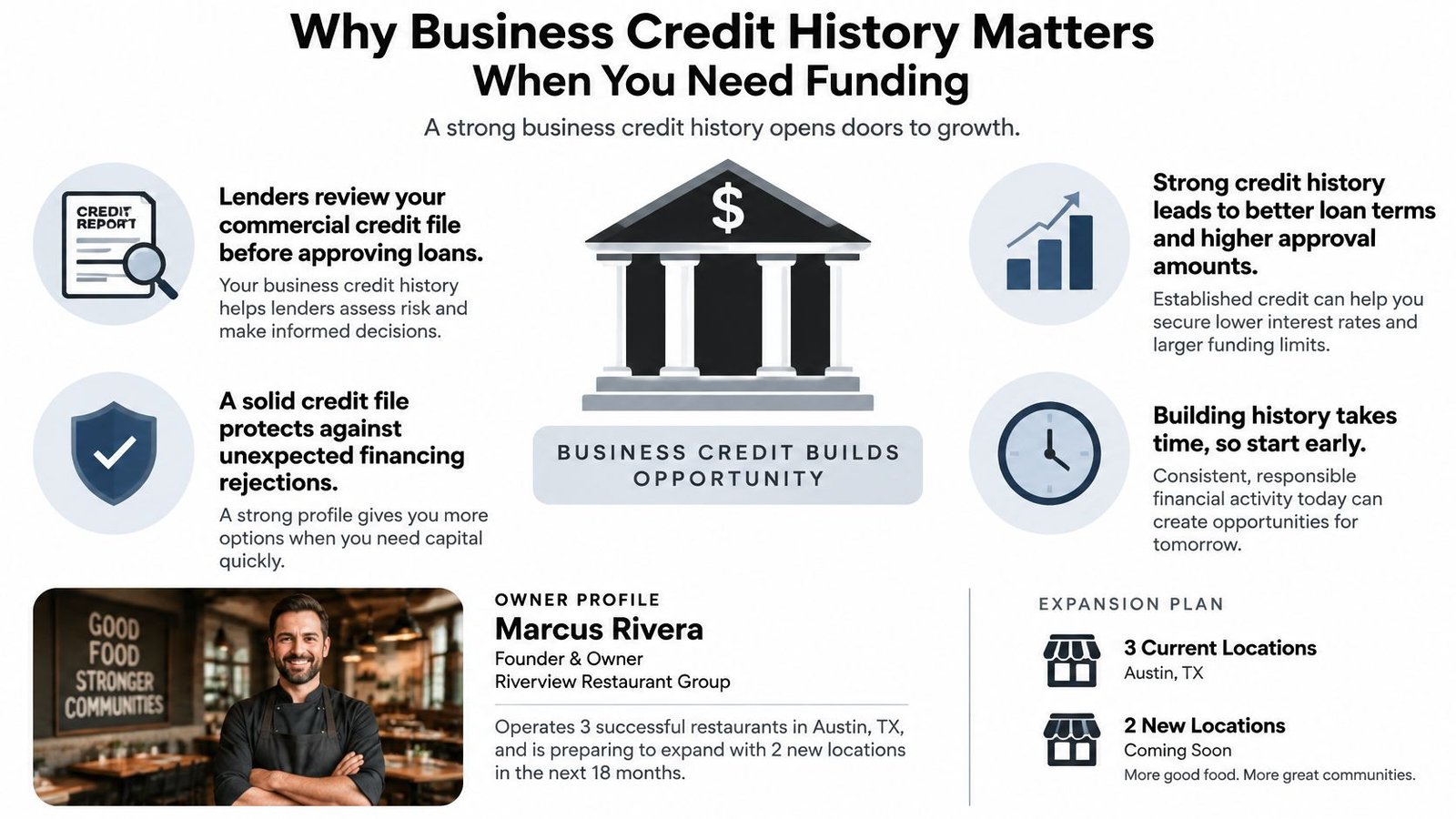
A restaurant group plans a second location. Sales look healthy, the lease makes sense, and the owner has never missed a personal payment. The loan answer still disappoints. The lender couldn't find enough reported business activity to support the full request, so it approved less and asked for more personal support.
That outcome surprises owners because they confuse operating performance with documented repayment history. A lender doesn't just ask whether your business earns money today. It asks whether suppliers, lenders, and public records show a pattern of the business itself paying obligations on time.
The stakes are visible in approval data. In 2023, 37% of U.S. small employer firms applied for a loan, line of credit, or merchant cash advance during the prior 12 months, and low credit risk firms were approved for at least some requested financing by 83% of small banks and 76% of large banks, while medium or high credit risk firms had approval rates of just under 50% at both types of banks, according to the Federal Reserve consumer and community context report.
What the Gate Controls
- Approval amount: A weak or sparse file can shrink the amount offered even when the business qualifies for something.
- Price and terms: Stronger documented history supports better limits and terms, though cash flow, collateral, and lender policy still matter.
- Speed: Clean records reduce follow up questions. Messy records invite them.
Keeping your own payment records tidy helps you answer those questions fast. If you're sorting out how past bills are documented, ELECTE invoice history help is a useful reference for understanding invoice and payment history in one place before you compare it with what a bureau shows.
A lender funds evidence it can verify, not confidence it can't check.
That's why business credit history works as a risk gate. It doesn't guarantee funding, and it doesn't replace cash flow. It determines how much trust a lender or supplier extends before it sees the rest of your application. Building that evidence after you've already signed a lease or ordered equipment puts you under pressure you could have avoided by starting earlier.
What Counts as Business Credit History
Business credit history is the commercial record attached to your company, not to you personally. It gathers how the business has handled obligations in its own name, using its legal identity and identifiers. Think of it as a file other companies help write every time they report whether you paid, how much you owed, and whether public records changed.
Your personal credit history follows you as an individual. Your business file follows the company. Lenders often look at both, especially for smaller firms, but a clean personal file doesn't automatically create a strong business history.
What Goes Into the File
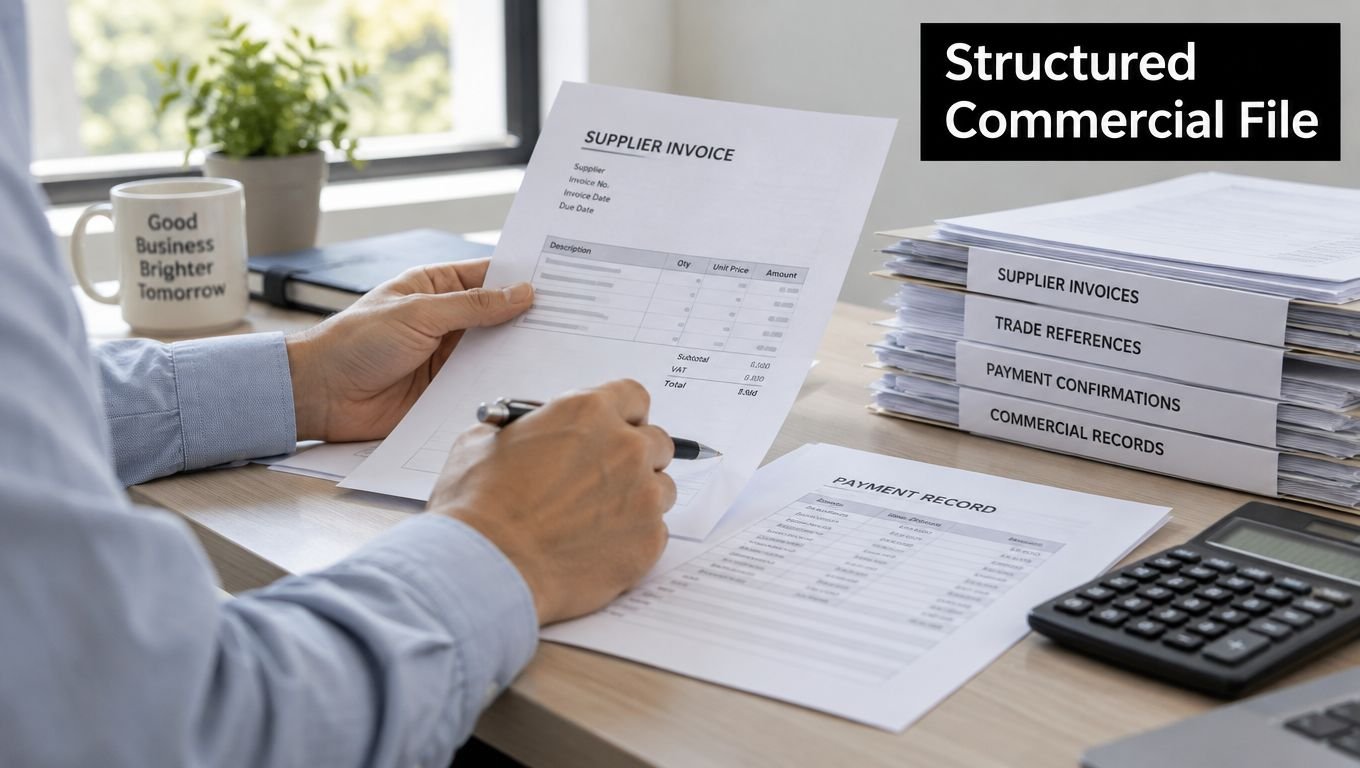
- Trade experiences: Supplier and vendor accounts, including payment behavior and outstanding balances.
- Financial accounts: Loans, lines of credit, and business cards that the lender reports to commercial bureaus.
- Public records: Collections, liens, judgments, bankruptcies, and UCC filings that show a lender's interest in business assets.
- Company identity: Legal name, registration details, industry classification, business age, and company size.
Commercial reports combine payment histories from suppliers and lenders with collections, legal filings, corporate registration information, and comparative industry data, as described in Experian's overview of business credit reports. The point isn't just to summarize past transactions. It's to estimate the risk of seriously late or derogatory payment behavior in the future.
Who Collects It
The three main U.S. commercial bureaus owners encounter are Dun & Bradstreet, Experian, and Equifax. They don't all receive the same data, because not every supplier or lender reports to every bureau. That's why one report can look fuller than another for the same company.
It's also why lenders may pull more than one report. If your largest vendor reports to one bureau and your card issuer reports to another, a single pull gives an incomplete picture. Your job isn't to memorize each bureau's model. It's to make sure your legal name and identifiers stay consistent, so the activity you do generate lands in one recognizable file instead of scattering across variations.
How Business Credit Scores Are Calculated
A score compresses that file into a risk estimate. Owners often assume it's mostly about paying on time. Payment behavior matters a lot, but it's not the whole model, and treating it that way leaves other levers untouched.
The diagram below groups the main inputs into trade activity, company context, and public records.
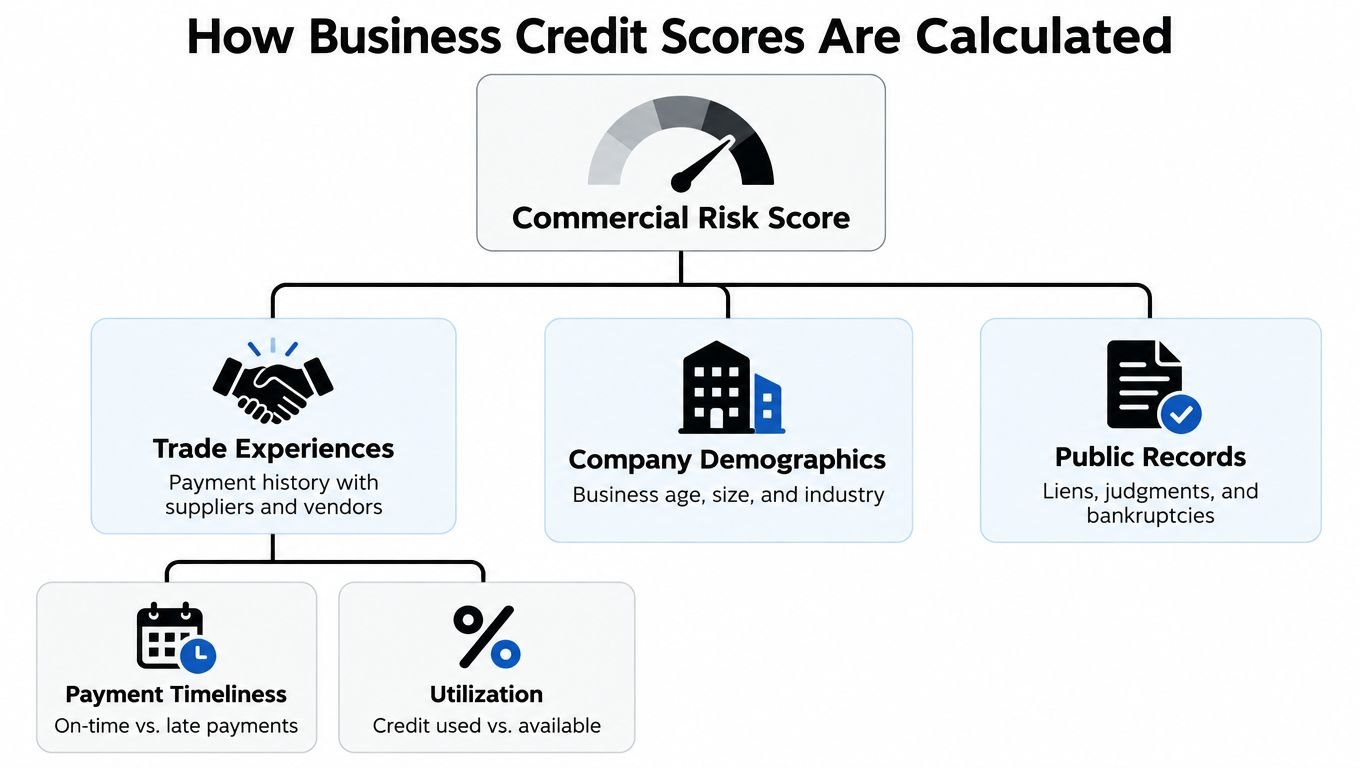
Experian's methodology incorporates the number of reported trade experiences, outstanding balances, payment behavior, credit utilization levels, utilization trends, public records, UCC filings, business age, industry classification, and company size, with liens, judgments, and bankruptcies weighted partly by recency, frequency, and dollar amount, per Experian's small business reports FAQ.
Levers You Can Move
Payment behavior shows whether you pay as agreed. Balances and utilization trends show whether you're leaning harder on credit over time or bringing balances down. If you're unclear on the utilization concept itself, this guide to how credit utilization works explains the ratio in plain terms.
You can also influence the amount of evidence available. More reported trade experiences, paid as agreed, give a bureau more observable proof of repayment capacity. Thin or inconsistent reporting does the opposite.
Levers You Cannot Move Quickly
Business age, industry classification, and company size provide context. A bureau can compare your payment behavior with similar firms instead of judging it in isolation. You can't make a young company older, but you can stop hindering it with maxed out starter accounts and preventable late payments.
Public records work differently. A recent lien or judgment generally weighs more heavily than an older one, and frequency and dollar amount matter too. That's why resolving an inaccurate filing isn't clerical housekeeping. It changes an input the model is actively weighting.
This short video walks through the score calculation in visual form if you prefer to see the pieces connected.
The practical lesson is simple. A younger company with clean utilization and several reporting accounts can present a stronger risk profile than an older company whose file shows rising balances and unresolved public records.
Three Conditions Every Owner Should Recognize
Most advice tells every owner to build business credit, as if everyone starts from the same place. They don't. A company with no file, a company with a sparse file, and a company with a damaged file face different underwriting problems. Using the wrong fix wastes time.
Revenue alone doesn't settle the question. Urban Institute research found that only 57% of small businesses had a business credit score, and startups and very small firms were less likely to appear in business credit data at all, according to the Urban Institute study of CDFI borrowers. A financially healthy company can still have no usable file.
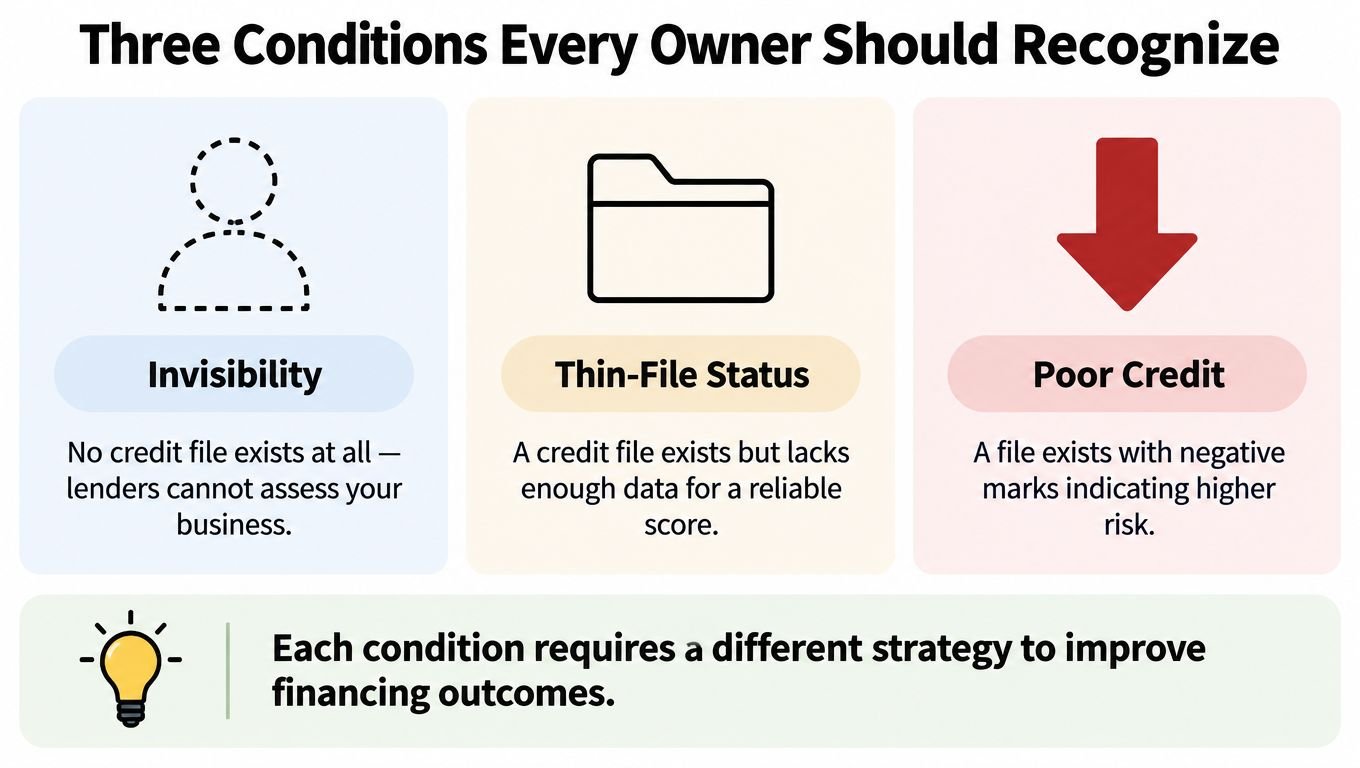
Condition One Is Invisibility
No meaningful bureau file exists. The business may pay every vendor promptly, but if those vendors don't report, the bureau sees nothing. The lender then leans on the owner's personal credit, bank statements, tax returns, and other documentation. Your task is creation, not repair. You need reporting accounts and consistent identifiers so a file can form.
Condition Two Is Thin File Status
A file exists, but it holds too few reported experiences for a lender to rely on it confidently. One card and one vendor may not tell a convincing story. Your task is depth. Add reporting relationships gradually, keep balances manageable, and document cash flow, deposits, revenue, and debt service capacity to supplement what the bureau can't yet show.
Diagnostic question: Is the lender seeing bad behavior, or is it seeing almost no behavior at all?
Condition Three Is Poor Credit
Here the file contains negative evidence, such as late payments, collections, high utilization, or public records. Adding more accounts won't fix that by itself. Your task is correction and demonstrated change. Pay down balances, stop new delinquencies, dispute inaccuracies, and let a cleaner pattern replace the old one.
An established company preparing for equipment or a new location should diagnose first. If you're invisible, a lender needs alternative evidence now and reporting accounts for later. If you're thin, you need breadth. If your credit is poor, you need repair before you expand the file. Same destination, three different routes.
Practical Steps to Build Business Credit From Scratch
Building from scratch works best in order. Each step makes the next one easier to get and easier for a bureau to record correctly.
Step One Separate the Business Identity
Register the business properly, get an EIN, and open a business bank account in the company's legal name. Use that exact name and address consistently across registrations, bank accounts, vendor applications, and bureau profiles. Inconsistent names are a common, quiet reason activity fails to consolidate into one file.
Step Two Open Accounts That Report
Ask before you apply whether the vendor reports to commercial bureaus, and which ones. A supplier who never reports may still be a good supplier, but the account won't build your file. Many owners start with vendor trade lines, including the type explained in this guide to a net 30 account for a new business, then pay as agreed so positive behavior is what gets recorded.
Don't open several accounts in a rush just to look established. Open what you'll actually use, pay on time, and confirm the activity appears. If it doesn't appear, ask the vendor whether reporting occurred and check that your identifiers match.
Step Three Add Revolving Credit Carefully
A business credit card can add a reported account and show utilization behavior. Use it for ordinary expenses you'd pay anyway, keep the balance well below the limit, and avoid maxing out a starter card. A high balance on your first revolving account tells a risky story even if you never miss a payment.
Step Four Graduate to Installment or Line Credit
Once trade and card activity show a pattern, a small term loan or line of credit that reports can broaden the file. Platforms such as Business Loan Warrior let owners submit one application, connect bank accounts, and review loan, line of credit, and equipment financing options, which is one route among banks, credit unions, and direct lenders.
The table below shows how Federal Reserve surveys group risk, pairing business scores with personal score ranges. It helps explain why lenders often weigh both files together for small firms.
| Risk Band | Business Credit Score | Personal Credit Score |
|---|---|---|
| Low credit risk | 80 to 100 | 720 or higher |
| Medium credit risk | 50 to 79 | 620 to 719 |
| High credit risk | 1 to 49 | Below 620 |
Expect this to take sustained, repeated reporting rather than a single account opening. You're building observable evidence over time, and lenders trust a pattern more than a snapshot.
How Cash Flow Data Is Reshaping the Picture
Connected bank account data gives lenders another way to judge a business whose bureau file is invisible or thin. Instead of relying only on reported trade accounts, a lender can review deposits, spending, overdrafts, and net cash flow over time. For a company with real revenue but few reporting vendors, that can reveal repayment capacity the bureau file misses.
Federal Reserve analysis notes that cash flow information can improve underwriting speed, accuracy, and access, but alternative data also carries measured risks and may include transaction level information such as sales, expenditures, overdrafts, and net cash flow, as discussed in the Federal Reserve analysis of alternative data. That caution matters. More data isn't automatically fairer data.
Where Cash Flow Data Helps
It can surface what the Federal Reserve describes as invisible prime borrowers, meaning businesses that repay reliably but lack a traditional score. It also speeds review, because a lender sees current operating activity rather than waiting for a bureau file to mature. For contractors paid by project or retailers with strong deposits, that current picture may be more informative than a sparse trade history.
Where It Can Mislead
Seasonality is the obvious trap. A restaurant in its slow season, a landscaper in winter, or a contractor between invoices can show a temporary dip that looks like structural weakness to an automated model. Irregular invoicing creates the same problem. A single late customer payment can distort a short review window.
Before you share bank data, reconcile it with your own statements so you can explain the story the numbers tell.
There's also a privacy and explainability question. Transaction data is sensitive. Ask what data the lender will use, which variables mattered if you're declined or offered less, and how you can correct a wrong interpretation. Annotate seasonal swings, one time expenses, and delayed receivables in writing. Don't assume the reviewer will infer them.
Cash flow evidence doesn't replace business credit history. It supplements it, and it works best when both tell the same story. A thin bureau file plus clean, explainable bank activity is far stronger than either one presented without context.
Monitoring, Repair, and Fixing What Is Already There
A file you never read can work against you. Balances post incorrectly, payments land under a name variation, and public records linger after resolution. Monitoring turns those surprises into tasks you handle before a lender sees them.
Pull your reports from Dun & Bradstreet, Experian, and Equifax, then reconcile reported balances and payment dates against your accounting records. Check the legal name, address, and identifiers first. Identity errors upstream create reporting errors downstream.
A Repeatable Review Routine
- Compare balances: Match each reported balance to your books and flag accounts you don't recognize.
- Check payment dates: Confirm late marks against proof of payment, and read this explainer on whether late payments affect a credit score if you need the mechanics.
- Review public records: Look for liens, judgments, collections, and UCC filings that are inaccurate, duplicated, or already resolved.
- Dispute with documentation: Send the bureau and the furnisher the records that prove the error, then track the correction until it posts.
The urgency is real. The 2024 Small Business Credit Survey reported that 48% of U.S. businesses applying for loans, lines of credit, or merchant cash advances received less than the full amount requested, and 36% of reported denial explanations were attributed to insufficient credit history, according to the Chicago Fed summary of the 2024 survey. Owners also pointed to low credit scores, excessive existing debt, and weak sales.
Before you apply for financing, gather bank statements, financial statements, proof of resolved public records, and a short written explanation for any temporary utilization spike. Hand the monitoring routine to your bookkeeper with a quarterly cadence. Repair is far cheaper before a sudden need than during one.
Putting It Together and Common Questions Answered
Start with diagnosis. Decide whether you're invisible, thin file, or poor credit, because that answer sets your order of operations. Create a file if none exists, add depth if it's thin, and repair negative patterns before adding accounts if it's poor. Then monitor quarterly and align each financing request with the story your file and cash flow now tell.
Three questions come up repeatedly. How long does building take? Long enough to show a repeated pattern across reporting accounts, so start before you need capital. Can strong personal credit substitute for missing business history? It can support an application, and lenders often review both, but it doesn't create a business file. Do vendors who don't report harm you? They don't hurt the file directly, but they don't build it either, so relying only on them can leave you invisible.
If you've diagnosed your condition and you're ready to see what your current profile can support, Business Loan Warrior lets you check options through a single application, connect your bank accounts, and compare business loans, lines of credit, and equipment financing in one dashboard. Bring your cleaned up reports and cash flow documentation, review the terms you're offered against the evidence you've built, and choose the financing that strengthens your file instead of straining it.