
You can have a healthy sales month and still feel short on cash the minute the supplier invoice hits. That’s the hole a lot of new owners fall into, you pay for inventory, tools, or office supplies today, then wait on customers to pay you back later. A Net 30 account for new business is useful because it gives you breathing room without pretending the business has cash it doesn’t have yet.
The catch is simple, approval isn’t the win. The win is getting a tradeline that reports, then using it without creating a mess in your books. If you treat Net 30 like a random vendor signup, you waste time. If you treat it like part of your credit file setup, it becomes one of the cleanest ways to start building business credit while protecting working capital.
Table of Contents
- What a Net 30 Account Actually Does for a New Business
- The Setup Stack You Need Before You Apply
- Choosing Vendors That Actually Build Credit
- Applying, Getting Approved, and Confirming the Account Reports
- Payment Habits That Protect a Thin Credit File
- Common Net 30 Mistakes That Cost Owners More Than They Save
- Turning Net 30 Tradelines Into Loan Readiness
What a Net 30 Account Actually Does for a New Business
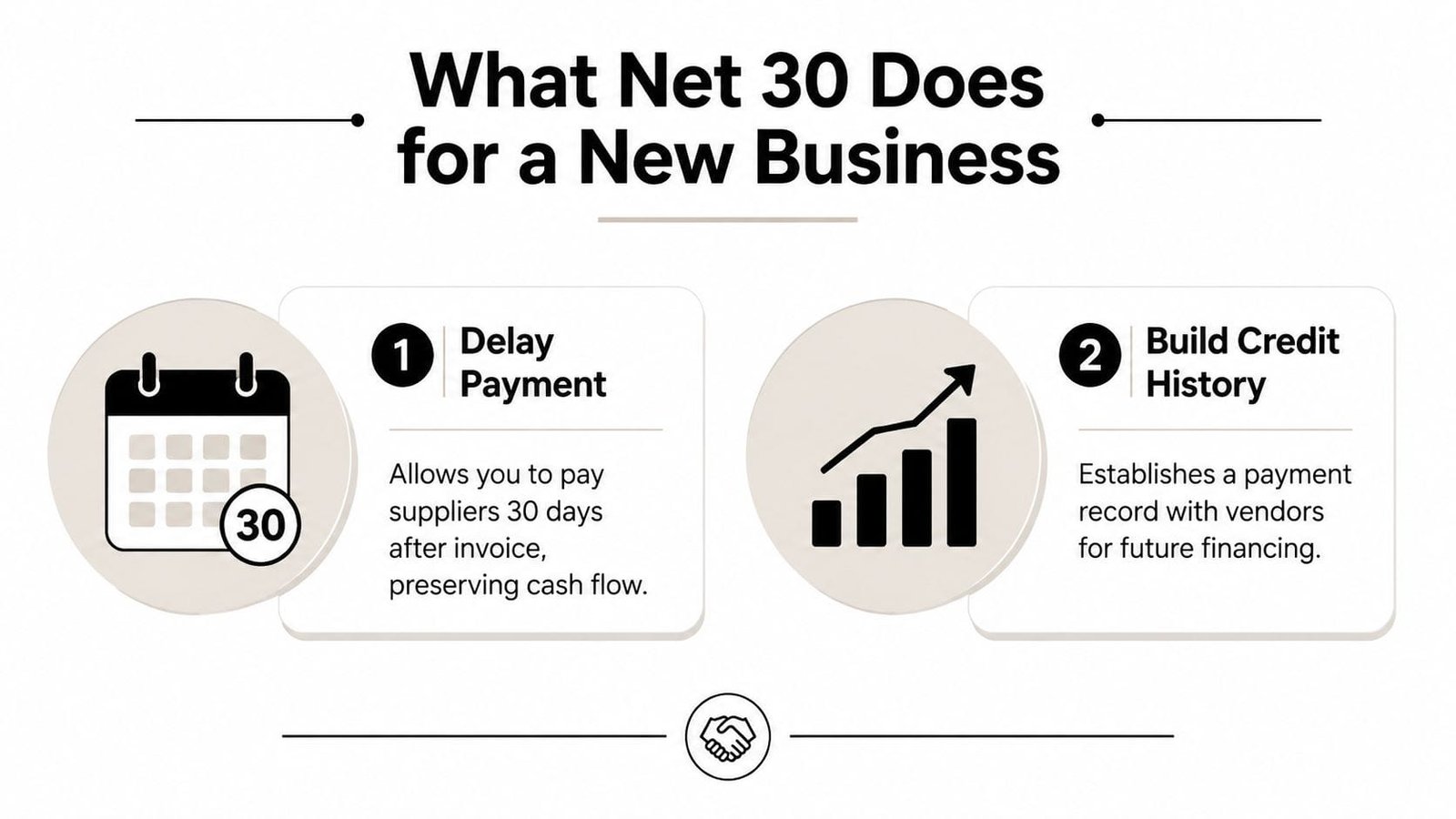
A brand-new owner usually meets Net 30 at the exact wrong moment. You’ve already spent money on inventory, maybe setup costs, and now a vendor wants payment before the business has fully settled into its cycle. Net 30 changes that timing. It lets you receive goods or services now and pay the invoice about a month later, which major banks describe as a standard trade-credit arrangement, not a niche financing trick. Trade credit is common in B2B commerce, with Net30 offered on roughly 55% to 65% of B2B invoices in North America and Net60 on about 15% to 25% Clearly Payments review.
Cash flow first, credit second
That timing matters because the job of a Net 30 account is to delay cash outflow without delaying operations. If you’re buying packaging, supplies, or inventory, you can keep money in the bank for another billing cycle while still getting what you need to serve customers. That’s why a lot of founders use Net 30 as a cash-flow tool before they ever think of it as a credit-building tool.
The credit side only works if the vendor reports your payment history. Business credit educators also point out that the major bureaus treat tradelines differently, so the same account can help one file and barely move another. If you want the broader mechanics of trade credit itself, this trade credit guide is a clean starting point.
Why lenders pay attention
Lenders care because payment behavior is a signal. A new business doesn’t have a long operating history, so every reported invoice becomes part of the story. On-time payment against Net30 terms is one of the easiest ways to show that the company can handle obligations on schedule.
That’s also why the payment data in B2B trade credit should temper your expectations. The same 2026 review found that only 52% to 58% of Net30 invoices are paid on time, while 20% to 25% are paid 1 to 30 days late and 10% to 15% go more than 30 days past due Clearly Payments review. In plain English, most companies use trade credit, but a lot of them handle it badly. Your advantage as a new business is that you can be the one that gets it right.
For freelancers and small operators who share expenses with clients or subcontractors, what freelancers should know about Net 30 is a useful companion read. It’s the same payment term, but the cash-flow pressure can feel different when one slow invoice throws off your whole month.
The Setup Stack You Need Before You Apply
The biggest mistake new owners make is applying too early with half-finished business setup. Vendor approvals are easier when the business looks real on paper, and the bureaus need data they can match cleanly. The practical order is blunt. Form the legal entity first, get the EIN second, open the business bank account third, then line up a D-U-N-S number in parallel if you want bureau matching to go smoothly.
Practical rule: if the business still looks like a personal side project in its paperwork, don’t expect clean tradeline reporting later.
Entity, EIN, and bank account are not optional
A legal entity gives the vendor a business to underwrite, not just a person with a mailing address. The EIN separates business identity from personal identity, which matters for credit file setup and tax records. The dedicated business bank account then gives the vendor a place to evaluate payment behavior and gives you a clean way to pay invoices without mixing funds.
If you’re starting a software company or another lean service business, this starting a software company guide is a good parallel read because the setup discipline is the same even when the operating model is different. I’ve seen owners skip the bank account step, then wonder why vendor applications stall or reporting is inconsistent. They created a business account in name only, which helps nobody.
Don’t confuse readiness with activity
The D-U-N-S number matters because bureau matching gets messy when business identity data is thin or inconsistent. Business-credit guides also recommend a legal entity, EIN, separate bank account, and D-U-N-S number before applying, especially if the goal is to create a profile that bureaus can recognize. If you want a clean contrast between the business file and the personal file, this business credit vs personal credit guide lays out the difference clearly.
Skipping ahead and applying with personal information only can create a false start. You might get approved, but the tradeline may not help the business file the way you expected. The rule is simple, get the foundation in place before you chase approvals. Otherwise you’re building on sand.
A vendor can approve you and still fail to help your credit file if the setup is sloppy.
Choosing Vendors That Actually Build Credit
Most lists of Net 30 vendors are lazy. They hand you a pile of names, but they don’t tell you which bureaus matter, which products fit a real operating need, or which vendors are worth the paperwork. That’s the decision. Not “who approves easiest,” but “who reports where I need the file to grow.”
Bureau coverage is the filter that matters
If a vendor reports only to one bureau you’re not tracking, the account may be useful for cash flow but weak for credit-building. Business-credit guides consistently point to Dun & Bradstreet, Experian Business, and Equifax Business as the core coverage targets, with some vendors also using other commercial reporting networks Tipalti’s Net 30 guide. I’d rather see three small accounts that report cleanly than ten signups that never show up in the file.
| Common Net 30 Vendor Categories by Bureau Coverage | Typical Bureau Reporting | Best For |
|---|---|---|
| Office supplies and general business merch | Often D&B, Experian, or Equifax, depending on the vendor | General office use and early file building |
| Industrial and maintenance supply vendors | Often D&B or Experian | Businesses buying recurring operational supplies |
| Digital services and subscription-based tradelines | Often multiple bureaus, depending on provider | Founders who need low-friction reporting |
| Specialized category vendors | Often one bureau only | Filling a specific purchasing need while adding a tradeline |
Fit beats approval count
A Net 30 vendor should sell something you'd buy anyway. If you don't need the products, you're just adding admin work and possibly minimum-order friction. A vendor with easy approval but lousy reporting is a dead end. A vendor with tighter approval but reliable bureau coverage can be worth the effort if the product fits your spend.
The other filter is whether the vendor will work with a 30-day-old to 90-day-old business, because many do. That's enough history for a young company to start, but not enough to carry sloppy behavior. If you're reviewing options, the net 30 vendor guide from Business Loan Warrior is one place to compare tradeline thinking with actual funding strategy.
Approval is not the final test
You also need to look at minimum orders, membership fees, and repeat-purchase expectations. A vendor that forces you to buy things you don't need just to keep the account active is a bad deal. The right account is the one that fits your normal operating rhythm and still reports where your file needs help.
My rule: if the vendor doesn't report and doesn't match your actual buying habits, skip it.
Applying, Getting Approved, and Confirming the Account Reports
The application itself is usually the easy part. The harder part is making sure the account shows up in the business credit file after you pay it. I've seen owners celebrate approval, then discover months later that nothing reported because they never checked.

What vendors usually check
Most vendors want to see that the business is real, operational, and bankable enough to handle a small trade line. That often means the legal entity, EIN, bank account, business address, and sometimes a basic look at business age or payment history. Some will do a soft pull, some won't. The bigger issue is not the approval itself, it's whether the vendor has a reporting relationship that will help your file.
You want the first order to be modest and tied to actual operating needs. One or two recurring purchases are enough at the start. A new business does not need to manufacture fake activity just to “use” the account.
How to verify reporting
After the first invoice is paid, watch the business credit files. That means checking Dun & Bradstreet, Experian Business, and Equifax Business within the first 30 to 90 days after the payment lands, because that's the window when reporting should start showing up if the vendor reports promptly Aspire net 30 workflow. If you're using D&B, make sure the file is tied to the right business identity, not just an old mailing record.
The rule here is not fancy. Pay, wait, verify, and document. If the tradeline doesn't show, ask the vendor directly before you assume the bureaus missed it. A lot of new owners never ask, which is how non-reporting accounts stay hidden for months.
Don't keep buying from an account that isn't reporting just because it was easy to get.
Payment Habits That Protect a Thin Credit File
A thin business credit file can take a hit fast. If you only have a couple of tradelines and one of them goes bad, the damage is concentrated. That's why the first few Net 30 accounts deserve near-paranoid attention.
Early payment is the safer habit
Cash flow permitting, pay early. Business-credit guidance commonly recommends paying 5 to 10 days early, and sometimes 10 to 20 days early, because on-time payment is what supports bureau reporting and early payment reduces the chance of a first-payment miss SBA legacy cash-flow guidance. I agree with that advice. New owners should not try to be clever with due dates.
Set the invoice date the minute the order is placed, then track the due date in your bookkeeping software or calendar immediately. If you wait until the reminder email shows up, you're already too late. On a thin file, one sloppy payment is a louder signal than you think.
A short founder mistake that costs months
I watched one owner treat a first vendor invoice like a low-stakes bill and let it drift past due. The account was only one of two tradelines, so the late mark outweighed the rest of the profile. Six months later, when the owner tried to apply for a larger line of credit, the lender saw a thin file with a stumble in it and passed.
That story is common because people think the file will “average out.” It doesn't. A weak profile rewards consistency, not excuses. Keep utilization modest, avoid maxing out any account, and don't let every vendor invoice land at the same time if your cash cycle is tight.
Clean rule: a thin file needs boring, repeated on-time payments more than it needs a big number of accounts.
Common Net 30 Mistakes That Cost Owners More Than They Save
Net 30 gets sold as easy credit, but easy approval isn't the same as good value. Some accounts help. Some are dead weight. A few cost more than they're worth because owners chase volume instead of utility.
The expensive mistakes
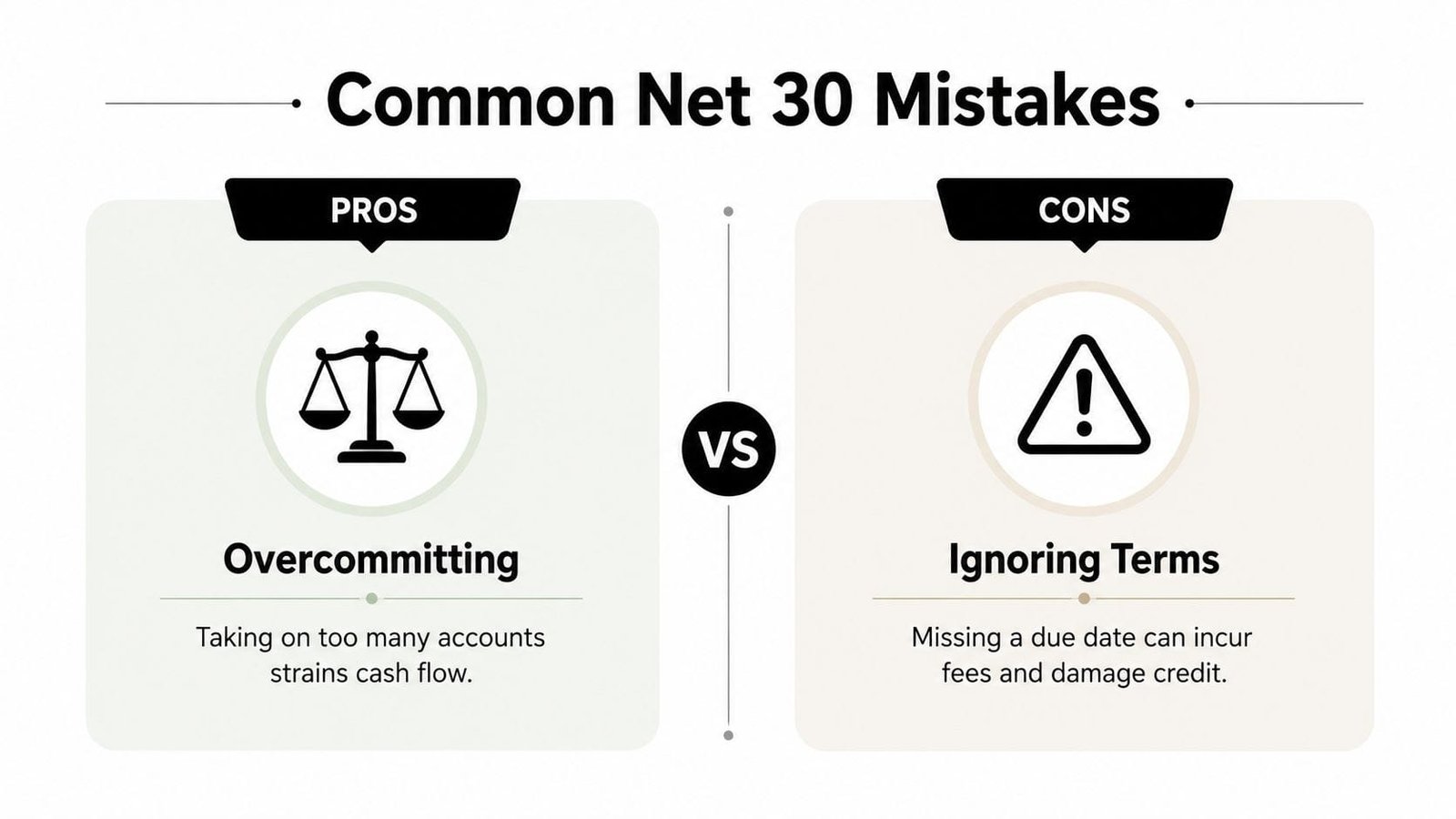
The first mistake is opening accounts that don't report. You get the illusion of progress, but the credit file stays thin. The second is buying items you wouldn't otherwise buy just to create activity. That turns a working-capital tool into unnecessary spend.
The third mistake is stacking too many accounts before the books are stable. That creates more due dates, more chances to miss one, and more room for reporting errors. The fourth is ignoring minimum order rules, membership fees, and repeat-purchase requirements, which can eat margins while adding little to the file.
Why account count is the wrong obsession
More accounts do not automatically mean stronger credit. A small set of well-run accounts usually beats a pile of marginal ones. The target is bureau coverage and clean payment history, not vanity approval counts.
Business-credit educators also advise staying below roughly 30% to 50% utilization, paying early when possible, and keeping Net 30 activity aligned with normal operating purchases Startupsavant Net 30 guide. That matches what I see in practice. Use the account because it improves your cash cycle and credit file, not because you want another vendor login.
If you've already signed up for a bad-fit account, don't keep feeding it. Cut the waste, keep the tradeline that matters, and move on. The account only earns its place if it improves the business's actual operating position.
Turning Net 30 Tradelines Into Loan Readiness
The point of building tradelines is not to collect vendor badges. It's to make the next funding conversation easier. Clean Net 30 history gives an underwriter something concrete to review, especially when the business is still young and the owner's personal credit is doing too much of the heavy lifting.
What matters to lenders
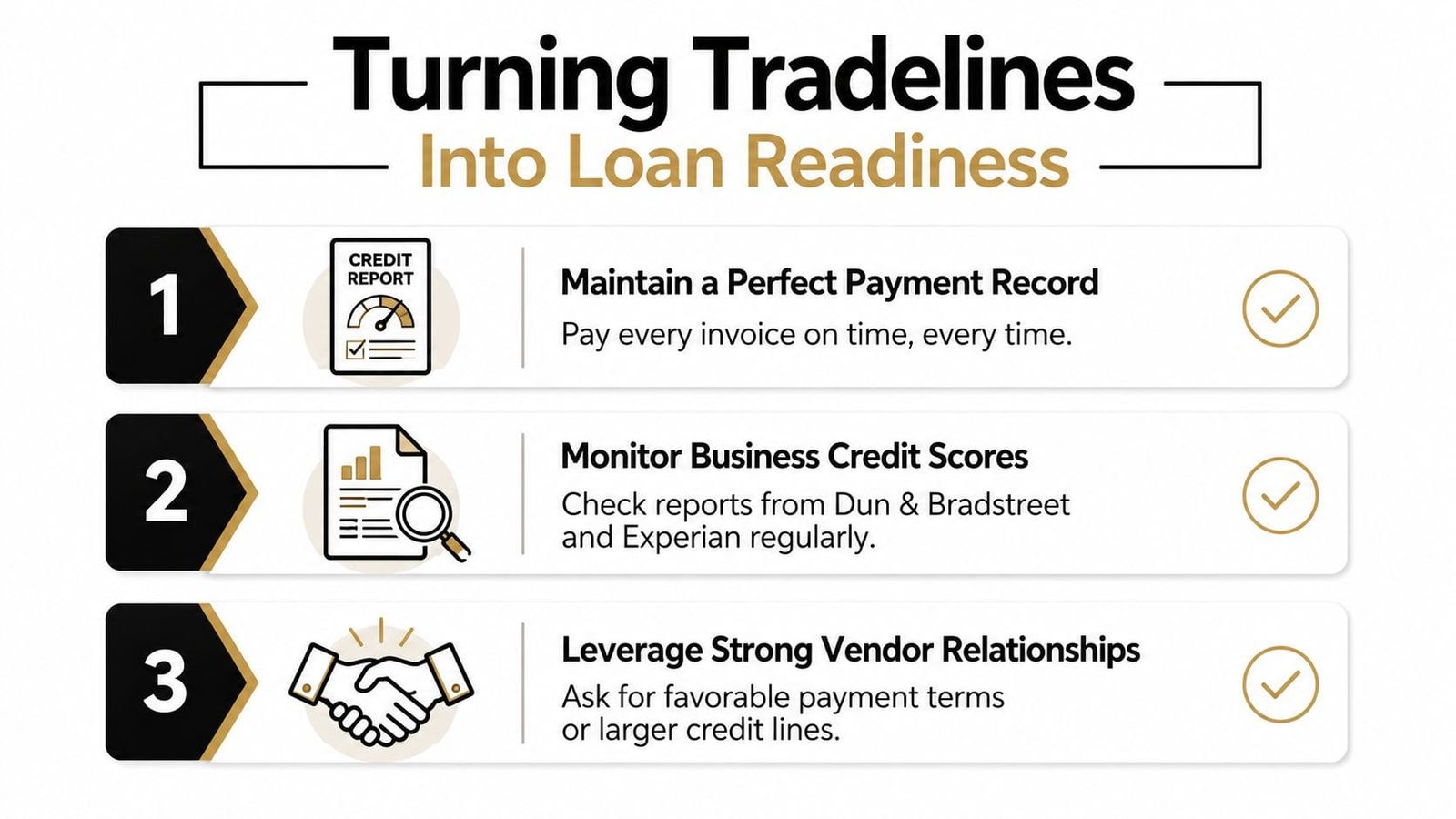
Underwriters care about consistency, not drama. They want to see invoices paid on time, files that match across bureaus, and a business that has learned how to handle trade credit without confusion. Six to twelve months of clean history changes the tone of a loan application because the story stops being “new company, no track record” and starts becoming “company that pays its obligations.”
The bureaus still matter here. D&B and Experian Business are often the first places lenders look, and Equifax Business can matter depending on the lender and product. If you've built tradelines that report, you've given the lender data instead of excuses.
The next 90 days should look like this
- Keep every reported invoice current: Don't let the first tradelines wobble.
- Check bureau files on a schedule: Verify that the accounts appear where they should.
- Keep the purchases ordinary: Buy the supplies or services you need.
- Ask for better terms only after consistency: Good payment history earns negotiating power.
If you want a deeper look at how tradelines fit into the funding path, this tradelines resource is worth reading before you start asking for larger credit limits. There's also a useful Video guide below if you want to see the concept from another angle.
Net 30 is not a magic trick, and it's not free money. It's a controlled way to buy time, build a reporting history, and prove the business can handle trade credit without slipping. Use it with purpose, verify the reporting, and keep the file clean.
Business Loan Warrior helps owners compare funding options and organize the credit signals lenders review, including trade credit and business borrowing paths. If you're setting up a Net 30 account for new business and want a smarter route from vendor approval to real funding options, visit Business Loan Warrior and see how its platform fits into your credit-building plan.