
You're probably staring at a messy reality right now. Maybe you've got two locations that should've become one six months ago, three vendor contracts that all renew on different dates, and a debt stack that eats cash before payroll even hits. That's where consolidation of business stops being a theory and starts being a survival move, or a growth move if you handle it with discipline.
The word gets used loosely, so let's be precise. For owners, consolidation usually means one of three things, combining companies through a merger or acquisition, folding back-office functions into one operating system, or rolling multiple debts into one payment. The right move depends on whether your biggest problem is market position, operational waste, or monthly cash drain.
Table of Contents
- What Consolidation of Business Actually Means for Owners
- The Three Main Types of Business Consolidation
- Legal and Financial Mechanics Owners Must Understand
- Financing Options Tailored to Small Business Consolidation
- Real-World Mini Case Studies of Consolidation Done Right and Wrong
- A Decision Checklist Before You Commit to Consolidation
- Next Steps and How to Put Your Consolidation Plan Into Action
What Consolidation of Business Actually Means for Owners
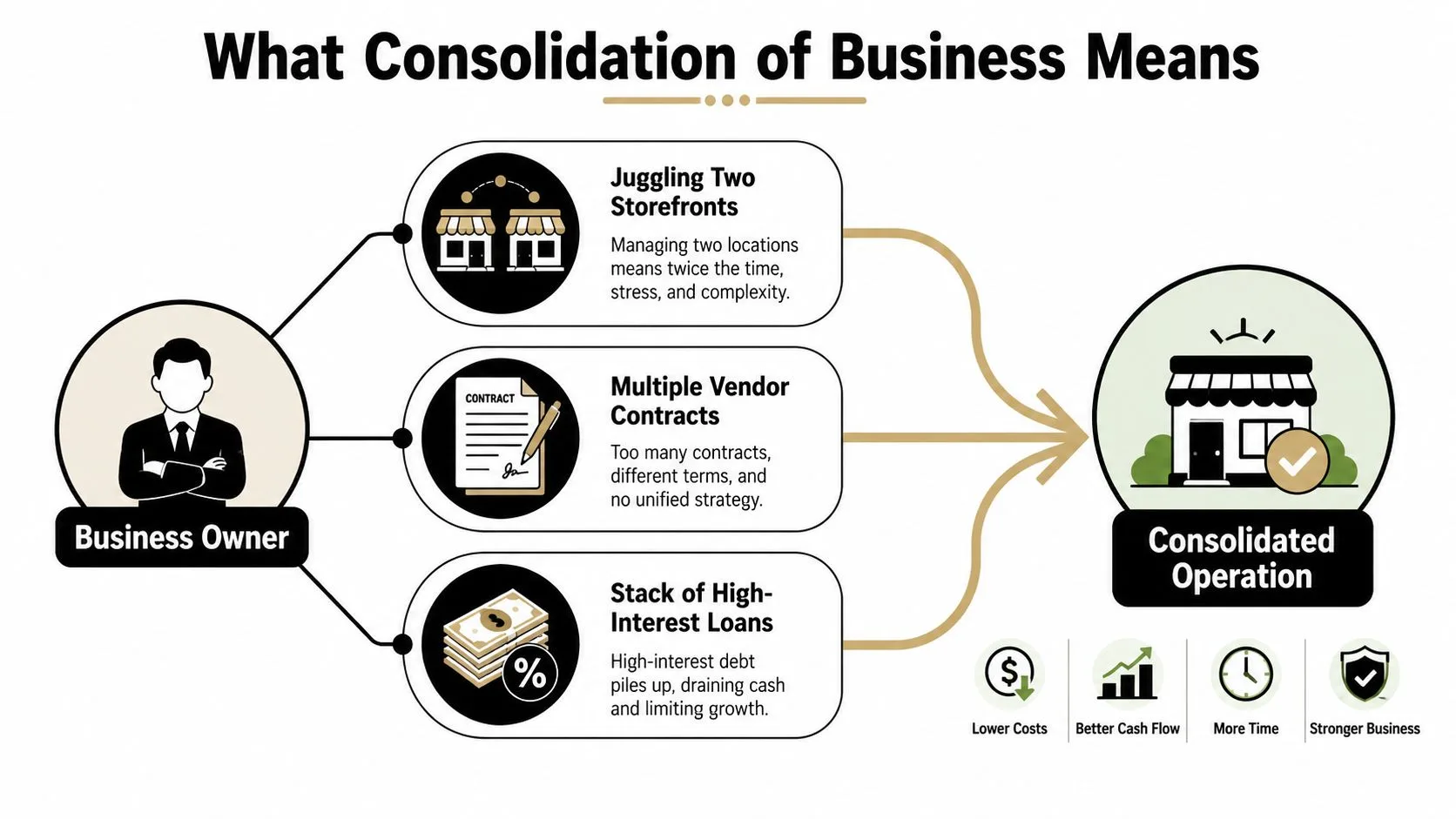
If you're running one company that feels like three, consolidation is already on your desk. One storefront is profitable, the other drains attention, and both have separate books, separate software, and separate habits that never quite line up. Add a lender asking for cleaner numbers and a supplier asking for faster payment, and the pressure gets real fast.
Consolidation of business means combining something fragmented into something easier to run, finance, or measure. In plain English, it's about taking scattered pieces and turning them into one system with fewer leaks. A strong guide to synergy value in deals is useful here because owners often hear “synergy” without being told whether the savings are real or just investor jargon.
The three forms owners confuse
The first form is merger or acquisition, where one business buys another or two businesses combine under one roof. The second is operational consolidation, where you keep the business entity intact but merge payroll, accounting, IT, inventory, or customer service. The third is debt consolidation, where you replace several obligations with one payment structure so cash flow gets easier to manage.
Practical rule: if the pain shows up in your market share, think acquisition. If the pain shows up in your back office, think operational consolidation. If the pain shows up every time you open the bank app, think debt consolidation.
The key mistake is treating all three as the same thing. They aren't. A business can consolidate accounting without buying a competitor, or consolidate debt without changing operations, or do all three in stages if the numbers justify it.
Owners should care now because waiting usually makes the math worse. Fragmentation adds hidden work, and hidden work becomes payroll, delays, and mistakes. If your current setup needs constant manual fixing, consolidation isn't a corporate-fnance abstraction, it's a cleaner way to protect margin and reduce chaos.
The Three Main Types of Business Consolidation
A useful analogy is the kitchen. One owner has two kitchens, two pantries, and two sets of recipes, but only one person can watch the stove. Another owner has one kitchen but still pays for duplicate appliances and duplicate staff schedules. A third owner isn't changing the kitchen at all, just paying off three credit cards with one lower-friction payment.
Mergers and acquisitions
This is the most visible form of consolidation, and it's the one owners usually overestimate. You buy a competitor, merge with a complementary brand, or roll up a small player that fills a gap in territory, customers, or capability. The goal is to gain revenue, cut overlap, or strengthen your position before someone else does.
This fits owners who already have stable operations and can support due diligence, integration, and lender scrutiny. It works best when the target brings customers, distribution, specialty staff, or a local foothold you can use. If you can't explain the post-close operating model in one page, you're not ready.
Operational consolidation
This is the quieter, more practical move. You keep the legal entities as they are, but you merge accounting, payroll, scheduling, purchasing, or IT into one process. That's often the smart first move for multi-location operators who want less mess without taking on the full risk of an acquisition.
Debt consolidation
This is the cash-flow move. It's for owners carrying multiple obligations with different due dates, different rates, and different terms, and who need a cleaner monthly payment to breathe again. Debt consolidation doesn't create growth by itself, but it can buy time, lower administrative friction, and make the business financeable again.
| Type | What It Means | Typical Trigger | Primary Goal |
|---|---|---|---|
| Merger or acquisition | One business buys or combines with another | Expansion opportunity, competitor pressure, strategic fit | Grow revenue, gain market share, remove overlap |
| Operational consolidation | Back-office functions are merged into one system | Duplicate processes, slow reporting, rising admin burden | Reduce waste, improve control, simplify management |
| Debt consolidation | Multiple debts are rolled into one structure | Cash flow strain, too many payments, high admin complexity | Free up cash flow and stabilize monthly obligations |
The decision cue is simple. If you're trying to own more market, you're in deal territory. If you're trying to stop wasting time, you're in operations territory. If you're trying to stop bleeding cash every month, you're in debt territory.
Legal and Financial Mechanics Owners Must Understand
Consolidation gets messy when owners skip diligence and jump straight to excitement. That's where the trouble starts, because the deal may look neat in a spreadsheet and still be toxic in practice. You need to know what's being bought, what's being assumed, and what paperwork can blow up the timeline.
Due diligence is not optional
Due diligence means reviewing the target's books, contracts, liabilities, tax history, and operating risks before you sign anything. In a small-business deal, that means asking for clean financial statements, customer concentration details, lease terms, employment agreements, debt schedules, and anything that creates a hidden claim on future cash. Contract review matters here, and the kind of structured document review discussed in devPulse's contract review case studies is a good reminder that missed clauses become real money after closing.
A deal dies faster from a surprise liability than from a bad valuation multiple.
Asset purchase or stock purchase
In an asset purchase, you buy selected assets and usually leave the old entity behind. Owners like this because it can ring-fence some risk and let them choose what they want to take on. In a stock purchase, you buy the company itself, meaning you inherit more of its history, obligations, and baggage.
The right structure depends on risk, taxes, contracts, and whether critical relationships can be transferred. If a target's customers, licenses, or leases can't easily move, structure matters more than price. If you ignore that, you can buy a business you can't operate the way you planned.
Valuation is part math, part judgment
Owners usually hear three approaches: earnings multiples, comparable sales, and discounted cash flow. In practice, that means asking what similar businesses sold for, what the target earns now, and how much future cash the business can realistically produce. If the target's numbers are inflated by one-time events or owner add-backs that don't survive closing, the price is too high even if the headline multiple looks acceptable.
What shows up in the statements
Consolidation changes the income statement and balance sheet differently depending on structure. Revenue and expenses may combine, debt may rise, and goodwill can appear if you pay above the fair value of acquired assets. For an owner, the key issue is whether the combined business can support payroll, debt service, and reinvestment without constant rescue work.
If you need a cleaner working definition of borrowing capacity before you move forward, this overview of what a credit facility is helps frame how lenders think about flexibility versus fixed borrowing.
Financing Options Tailored to Small Business Consolidation
Funding makes or breaks consolidation. Owners love the strategy part, then discover the lender cares more about cash flow, collateral, and paperwork than ambition. That's fair, because the financing structure has to survive a bad month, not just a good pitch.
Match the loan to the deal
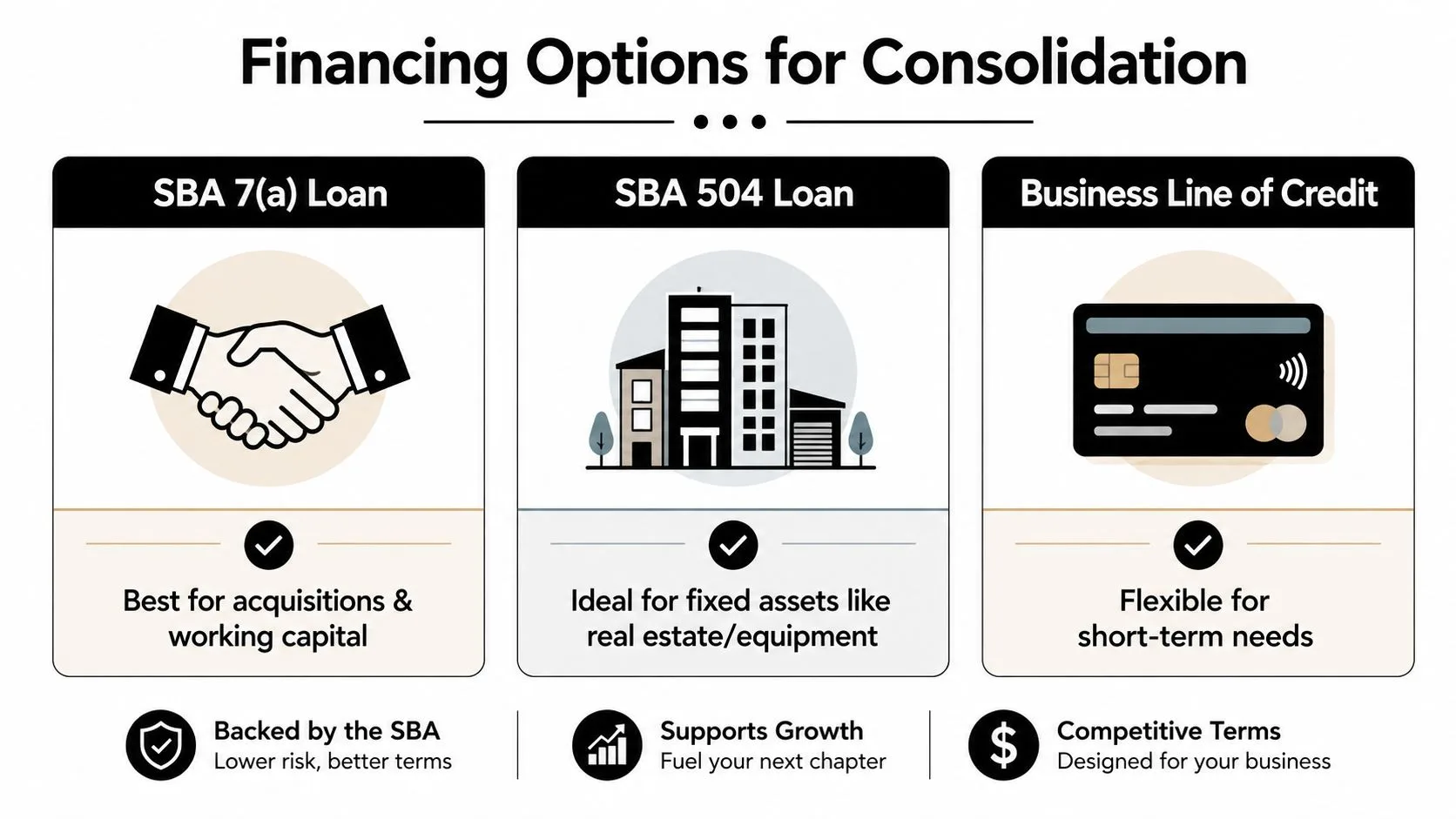
For acquisitions, SBA 7(a) is usually the most flexible option because it can support ownership changes and working capital needs in one package when the file is clean. For deals centered on fixed assets, SBA 504 fits better because it's built around long-term asset-heavy purchases. For owners who need speed, an alternative-lender business acquisition loan can move faster, but the trade-off is usually tighter terms or higher cost.
A business line of credit is not the same thing as acquisition financing. It's the smoother for short-term swings, integration expenses, inventory gaps, and payroll timing while the new structure settles. A debt-consolidation loan works best when the goal is to replace a messy pile of obligations with one payment that's easier to manage and underwrite.
How owners should think about speed and paperwork
SBA-backed financing typically asks for a heavier file, more patience, and more documentation. That's the cost of getting a structure that can support real consolidation instead of patching over it. Alternative lenders usually want clearer recent performance, faster access to the books, and a stronger story for repayment.
Blunt advice: don't chase the fastest money if the payment will strangle the integration. A deal that closes quickly and then wrecks cash flow is a bad deal.
Where each option shines
- SBA 7(a): Best when you need acquisition funding plus some working capital cushion.
- SBA 504: Best when real estate, equipment, or other fixed assets are central to the deal.
- Business acquisition loan: Best when timing matters and the target is stable enough to support faster underwriting.
- Business line of credit: Best when you expect integration friction and need flexible access to working capital.
- Debt-consolidation loan: Best when your main problem is too many payments, not a broken core business.
The cleanest rule is this. If consolidation changes ownership, you need a funding structure that can survive diligence and post-close turbulence. If it changes only the back office, you may need less capital but more discipline. If it's mostly debt relief, your lender will care a lot about repayment timing and less about your strategic story.
If you're comparing product fit and underwriting language, the business acquisition loan overview is a useful reference point for what lenders expect in a purchase scenario.
Real-World Mini Case Studies of Consolidation Done Right and Wrong
A regional service company bought a smaller rival mainly to simplify vendor management. Before the deal, it was juggling duplicate contracts, overlapping routes, and too many handoffs between offices. The owner used acquisition financing, then immediately consolidated purchasing, scheduling, and payroll so the combined team stopped doing the same work twice.
The result was not magic, just relief. Cash flow improved after the new operating rhythm settled, because the owner cut duplication and stopped paying for parallel systems. The lesson was simple, buy only when you know exactly which expenses are going away and who owns the transition.
A growing retailer took the opposite path. It merged with a complementary brand, assumed the story would sell itself, and underpriced the covenant risk. Revenue softened, the payment structure got tight, and the owner had to refinance under pressure instead of operating from strength.
The deal wasn't doomed because the brands were wrong for each other. It was doomed because the financing assumption was too optimistic and the downside case wasn't treated as real. Owners get hurt when they treat covenant language as a formality instead of a hard boundary.
Good consolidation removes friction. Bad consolidation imports someone else's problems and puts your name on them.
The contrast is brutal but useful. One owner used consolidation to simplify the machine. The other used it to chase growth without enough room for a bad quarter. The difference was not vision, it was discipline around debt, integration, and margin protection.
A Decision Checklist Before You Commit to Consolidation
The fastest way to avoid a bad consolidation is to ask better questions before anyone signs. Owners don't need more enthusiasm. They need a hard filter that kills weak deals early.
The questions that matter
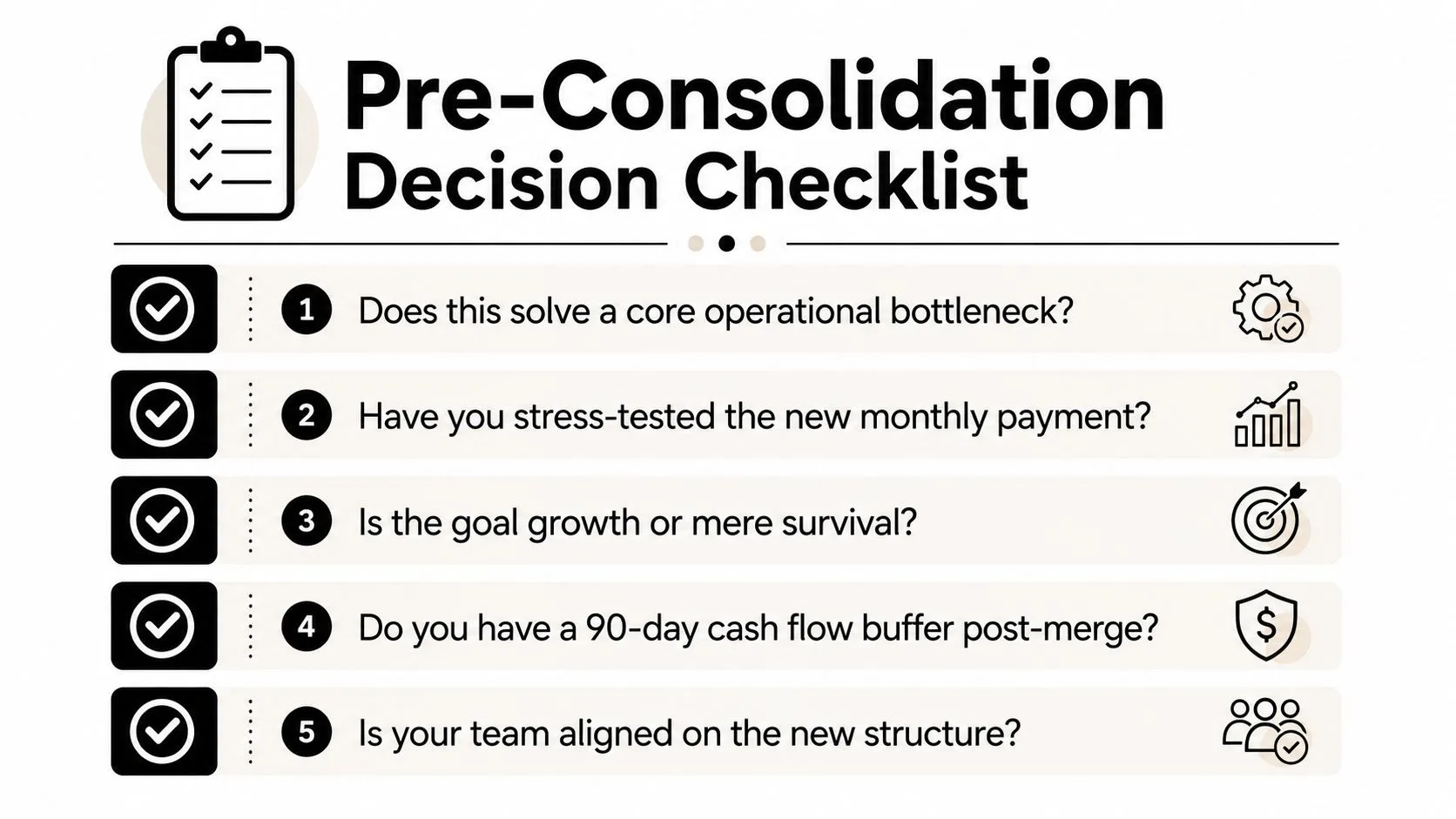
- Does this solve a core operational bottleneck? If it doesn't, you're paying for complexity, not value.
- Have you stress-tested the new monthly payment? If the payment only works in a perfect month, it doesn't work.
- Is the goal growth or mere survival? If the answer is survival, the structure should be conservative.
- Do you have a 90-day cash flow buffer post-merge? If not, the integration is undercapitalized.
- Is your team aligned on the new structure? If the managers aren't aligned, the back office will drift fast.
A practical way to frame this is to act like a lender before you act like an owner. That mindset, discussed in Escrow Consulting Group's practical guide, is useful because it forces you to look at downside, documentation, and repayment before excitement takes over.
Revenue size changes the checklist
If you're under $5M in revenue, keep the plan narrow. Focus on documentation, simple financing, and one obvious operational win. If you're between $5M and $20M, the file gets more complex, so you need stronger reporting, tighter controls, and a clean integration owner.
If you're in the $20M to $50M range, lenders and advisors will expect a more formal package, cleaner financials, and a stronger rationale for consolidation. That's also where valuation support starts to matter more, which is why a business valuation services page is relevant when you need a defensible price, not just a hopeful one.

If two or more answers on that checklist are shaky, pause. Weak deals don't get better because the paperwork is longer. They get worse because the costs are now real.
Next Steps and How to Put Your Consolidation Plan Into Action
Spend the next 30 days on paperwork, not speeches. Pull tax returns, current debt schedules, recent profit and loss statements, balance sheets, bank statements, lease copies, and any contracts tied to the entity or target. Then build a one-page memo that says what you're consolidating, why it matters, what the combined payment looks like, and how the business absorbs a bad month.
If you're under $5M, keep the package lean and talk to a lender early. If you're between $5M and $20M, compare SBA-backed options against alternative financing so you don't overpay for speed. If you're between $20M and $50M, bring a tighter narrative, a clearer integration plan, and a valuation approach that won't fall apart in underwriting.
Before you sign anything, do a soft pre-qualification so you can see likely options without damaging credit. That's the smart move because it tells you whether the structure is realistic before you lock yourself into a bad month for the next few years.
If you're ready to turn a messy consolidation idea into a fundable plan, visit Business Loan Warrior and compare the financing routes that fit your deal, your revenue, and your timeline. A single application can help you match the right consolidation product without wasting time on the wrong lender.