

Your crew finished the work, the progress billing went out, and the general contractor acknowledged the invoice. Yet the bank balance still looks uncomfortably small. Payroll is due, a supplier wants payment, and another project needs mobilization cash. The revenue has been earned, but it hasn't become usable cash.
Construction invoice factoring addresses that timing gap by converting an eligible receivable into earlier working capital. It isn't a reward for poor management, and it isn't automatically the right answer. The important question is whether the invoice is properly documented, accepted by the party that owes it, and worth funding after fees, reserves, and risk are considered.
Table of Contents
- When Construction Invoices Become a Cash-Flow Trap
- What Construction Invoice Factoring Actually Is
- Factoring Versus Financing Versus Loans
- How Fees, Advances, and Reserves Are Calculated
- Why Construction Pay Applications Are Not Ordinary Invoices
- Eligibility Checks and the Fix-the-Billing-First Question
- Step-by-Step Onboarding With a Construction Factor
- Benefits, Risks, and When to Use Factoring
When Construction Invoices Become a Cash-Flow Trap
A concrete subcontractor completes a scheduled phase on a commercial project. The crew has installed the specified work, the superintendent has reviewed it, and the subcontractor submits a pay application. On paper, payment is due under the contract. In practice, the subcontractor may still wait while the general contractor reviews quantities, processes waivers, resolves a change order, and waits for upstream funding.
That delay creates a dangerous mismatch. Labor, materials, insurance, equipment, and fuel have already consumed cash, while the invoice remains an asset on the books rather than money in the operating account. The subcontractor may be profitable on the project and still lack enough liquidity to start the next one.
A pay application is the construction industry's structured request for payment for completed work. The obligor is the party expected to pay, often a general contractor, developer, or project owner. Retainage is the portion withheld until specified completion or acceptance conditions are met. These terms matter because a factor won't treat every dollar in a pay application as immediately collectible.
Practical rule: Treat an approved, well-documented receivable as a potential funding asset, not as cash you already have.
A 2022 survey of 519 U.S. construction companies found that nearly 90% offered customers payment terms of 30 days or less, yet fewer than 40% reported receiving payment within 30 days on average, and only 12% said they were always paid on time, according to Levelset's construction cash-flow and payment report. The gap between contract language and actual collection is why a stated Net 30 term can feel much longer in the field.
Good receivables management starts before a factoring application. Contractors can also review practical receivables guidance from GRIT Virtual Assistants and compare broader cash-flow improvement methods. By the end of this guide, you'll be able to judge whether factoring is a sensible bridge, what documentation controls the advance, and when fixing the billing process should come first.
What Construction Invoice Factoring Actually Is
Think of a homeowner who is owed money under a signed agreement but doesn't want to wait for the due date. The homeowner could sell the right to collect that specific debt to another party for less than its full value. The buyer pays sooner, then collects from the person who owes the money.
Factoring works on the same basic idea. A contractor sells an eligible accounts-receivable invoice to a factor at a discount. The factor advances part of the approved amount, holds a reserve, and generally collects from the customer under the original payment arrangement. The contractor receives earlier working capital, while the obligor still pays the amount it owes.
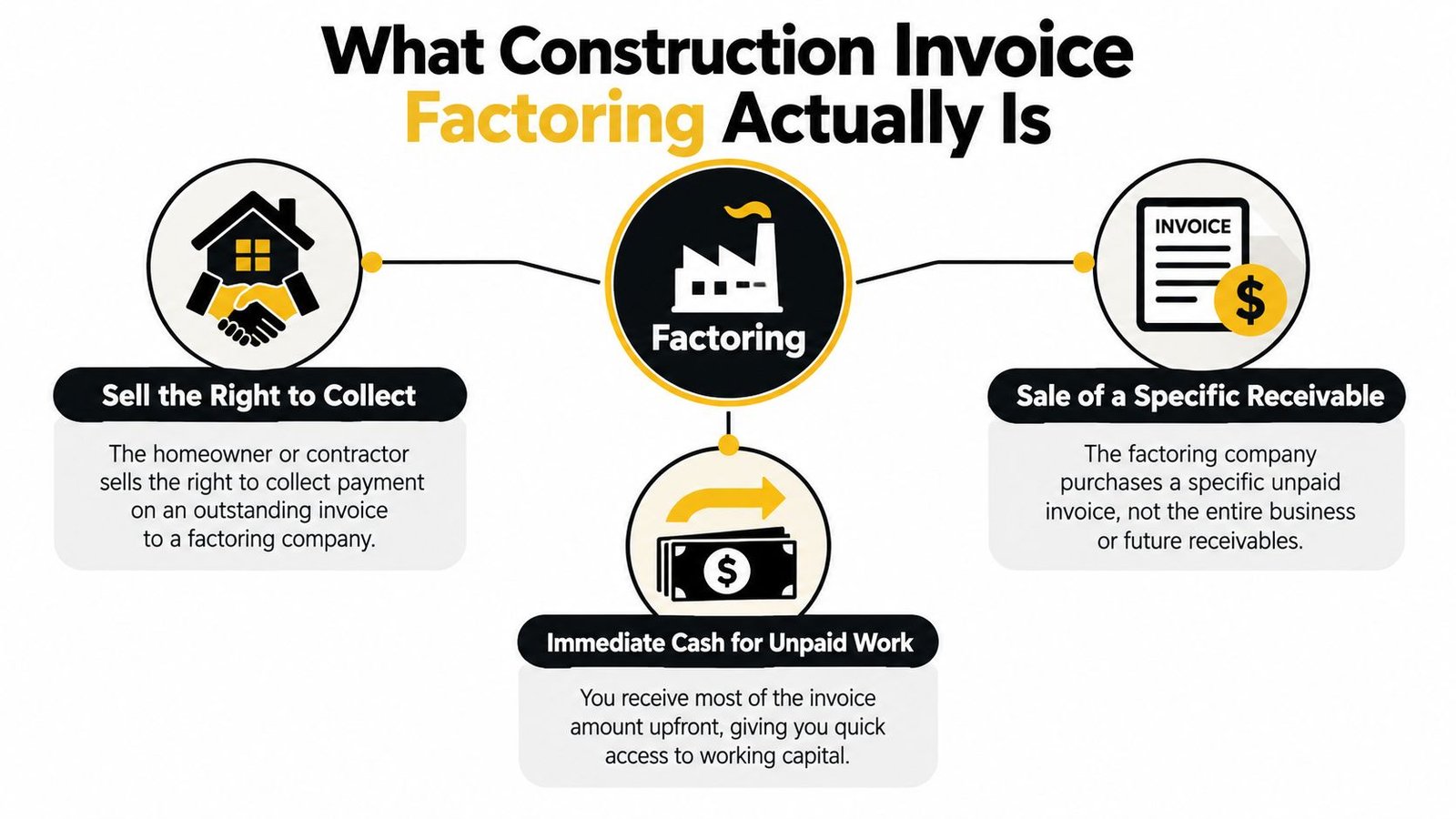
Three parties sit at the center of the transaction:
- The contractor: The business that completed the work and owns the receivable before the sale.
- The factor: The company that purchases or funds against the receivable, verifies the file, sends the advance, and manages collection.
- The obligor: The general contractor, owner, developer, or other customer responsible for payment.
The factor isn't looking at the contractor's invoice design. It wants evidence that the work was performed, the amount was approved, the contract permits the arrangement, and the obligor has a credible payment history. A signed pay application can be more valuable than a large but disputed invoice.
The product also has a long history. The International Chamber of Commerce Academy reports that factoring began in the United States as early as the 17th century, initially supporting trade through agents who bought and collected receivables, as described in this construction industry finance whitepaper. Construction invoice factoring applies that established receivables mechanism to progress billings, final invoices, and other project-related amounts.
For a broader explanation of the underlying product, compare this guide to invoice factoring. The key distinction is simple: factoring is tied to a specific receivable and the customer expected to pay it, not merely to the contractor's general promise to repay borrowed money.
Factoring Versus Financing Versus Loans
These products can all improve liquidity, but they don't operate the same way. The cleanest way to separate them is to ask two questions: Who owns the receivable after the transaction? And who bears the loss if the customer doesn't pay?
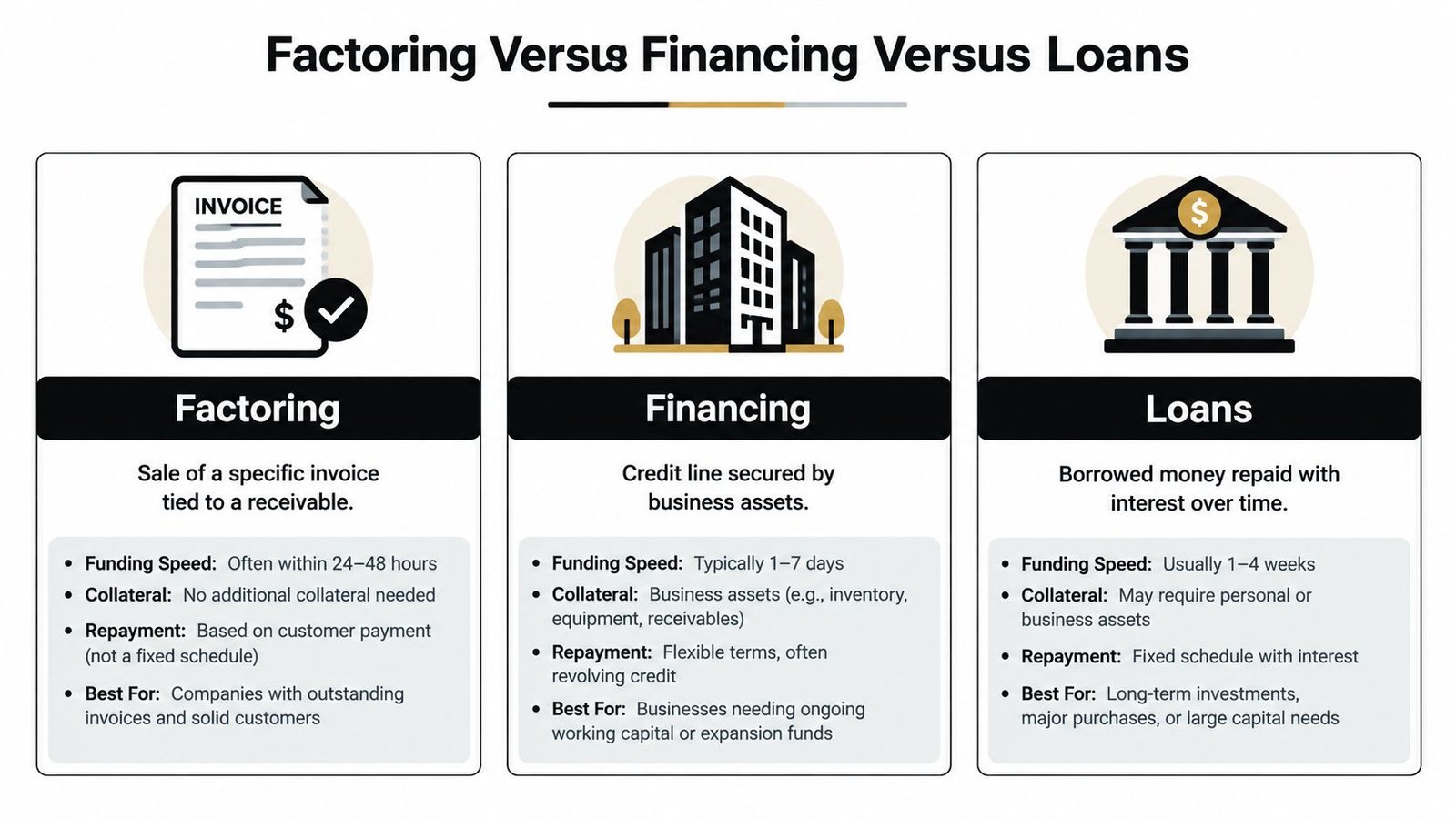
| Product | What supports the transaction | What happens if the customer doesn't pay |
|---|---|---|
| Factoring | Sale of a specific eligible receivable | Depends on recourse terms and defined non-payment events |
| Invoice financing | The invoice serves as collateral for a credit facility | The contractor generally remains responsible for the debt |
| Traditional loan | The business's broader credit profile and collateral | The borrower must repay under the loan agreement |
With factoring, the factor evaluates the obligor and the receivable. In a true non-recourse structure, the factor absorbs specified credit-loss events, although the contract may still return responsibility to the contractor for disputes, fraud, documentation defects, or other exclusions. Recourse factoring generally costs less, but the contractor may have to repurchase or replace an unpaid invoice.
With invoice financing, the contractor usually keeps ownership of the receivable. The lender advances money against it, and the contractor repays the facility. The invoice supports the borrowing, but it doesn't automatically transfer collection responsibility or payment risk.
A traditional business loan is different again. The lender underwrites the company's overall ability to repay, which can include revenue, cash flow, credit history, collateral, and guarantees. The loan proceeds aren't necessarily tied to one project or customer.
Businesses that lease equipment or compare other structured commercial products may also encounter different SME leasing contract categories. Those arrangements can help acquire assets, but they don't replace the receivables analysis required for a construction pay application.
Before signing, ask whether the agreement is a purchase, a secured borrowing arrangement, or a hybrid structure. This comparison of invoice financing and factoring can help frame the conversation, but the contract's definitions of default, dispute, reserve, and recourse control the actual outcome.
How Fees, Advances, and Reserves Are Calculated
A factoring quote has several moving parts. The advance is the amount sent before the obligor pays. The factor fee is the charge for purchasing or funding the receivable. The reserve is the balance held until collection, less the agreed fee and any permitted deductions.
Construction receivables often require a more conservative calculation because retainage, disputed quantities, back-charges, and conditional payment terms can reduce the amount that is immediately collectible. Consider a $500,000 invoice with 10% retainage. The immediately collectible face value is $450,000 before any additional reserve or fee calculation, as explained in this analysis of construction accounts-receivable challenges.
A quote that says “advance against the invoice” isn't enough. Ask the factor to show the calculation using the eligible amount, not merely the invoice total.
| Component | Typical Range | Who It Benefits |
|---|---|---|
| Advance | 80% to 90% of eligible invoice value | Contractor receives working capital earlier |
| Factor fee | 1% to 5% per 30-day period outstanding | Factor is compensated for time and collection risk |
| Reserve | Remaining eligible balance after advance | Protects against fees, disputes, and non-collection |
These ranges are transaction terms to verify, not guaranteed pricing. The actual quote depends on the obligor, project documents, invoice quality, payment history, and structure. A receivable that remains unpaid for longer keeps generating time-based cost when the agreement charges by period.
For example, if an eligible amount is $450,000 and the advance is 80%, the initial advance would be $360,000. If the fee is 3% per 30-day period and collection takes 60 days, the fee calculation must be confirmed in the agreement. Some contracts apply a flat fee, while others continue charging until the factor receives payment. Don't assume that the reserve is pure profit waiting to be released.
Slow payment has a large economic effect. Industry evidence cited by construction accounting sources estimates that slow payments cost U.S. construction approximately $273 billion in 2023, equivalent to about 14% of total construction costs, according to TG&CCPA's accounts-receivable guidance for contractors. Compare the total factoring charge with the cost of interrupted payroll, supplier penalties, missed mobilization, or emergency borrowing.
Why Construction Pay Applications Are Not Ordinary Invoices
A retail invoice usually describes a completed sale of a defined product. A construction pay application often represents a partial claim against a changing project budget. The amount can depend on scheduled values, stored materials, inspections, approved change orders, retainage, waiver status, and payment flowing through several parties.

A factor typically wants to trace the billing from the contract to the work performed and then to the amount the obligor accepted. That chain may include:
- Scheduled value: What the contract says the work package is worth.
- Completed work: What the contractor performed.
- Approved amount: What the reviewer accepted for payment.
- Retainage: What the contract withholds until later conditions are met.
- Waivers and notices: Documents that protect the payment chain and lien position.
- Payment conditions: Language that may make payment dependent on upstream funding.
A disputed change order is a common fault line. The contractor may have performed extra work, but if the owner or general contractor hasn't approved the change, the factor may exclude it. Missing lien waivers can create another problem because the obligor may delay payment or require corrective documents before releasing funds.
A large pay application isn't automatically a large financeable receivable. The factor funds the documented payment right, not the contractor's estimate of what the project should eventually pay.
Retainage also needs separate treatment. It may depend on final completion, acceptance, correction of deficiencies, and other contractual conditions. A factor may advance against the current approved billing while holding back or excluding the retainage portion.
Recent industry survey data shows that 43% of subcontractors wait more than 90 days for final payment and retainage, while 67% spend at least 11 hours per month preparing and tracking pay applications, according to the survey cited by Contractor Magazine. Those administrative demands explain why documentation quality can influence funding as much as the contractor's production capacity.
The following video provides another visual explanation of the construction payment process. Use it as general education, then check the language in your own contract and project documents.
Factoring can become expensive when it hides a documentation problem. Selling a receivable before resolving a disputed change order, missing waiver, or conditional-payment issue may lead to exclusion, recourse, or delayed reserve release.
Eligibility Checks and the Fix-the-Billing-First Question
Many contractors expect a factor to begin with the owner's personal credit score. Construction-focused underwriting often starts elsewhere. The factor wants to know whether the obligor pays reliably, whether the project is active and legitimate, and whether the contractor has a clear legal right to collect.
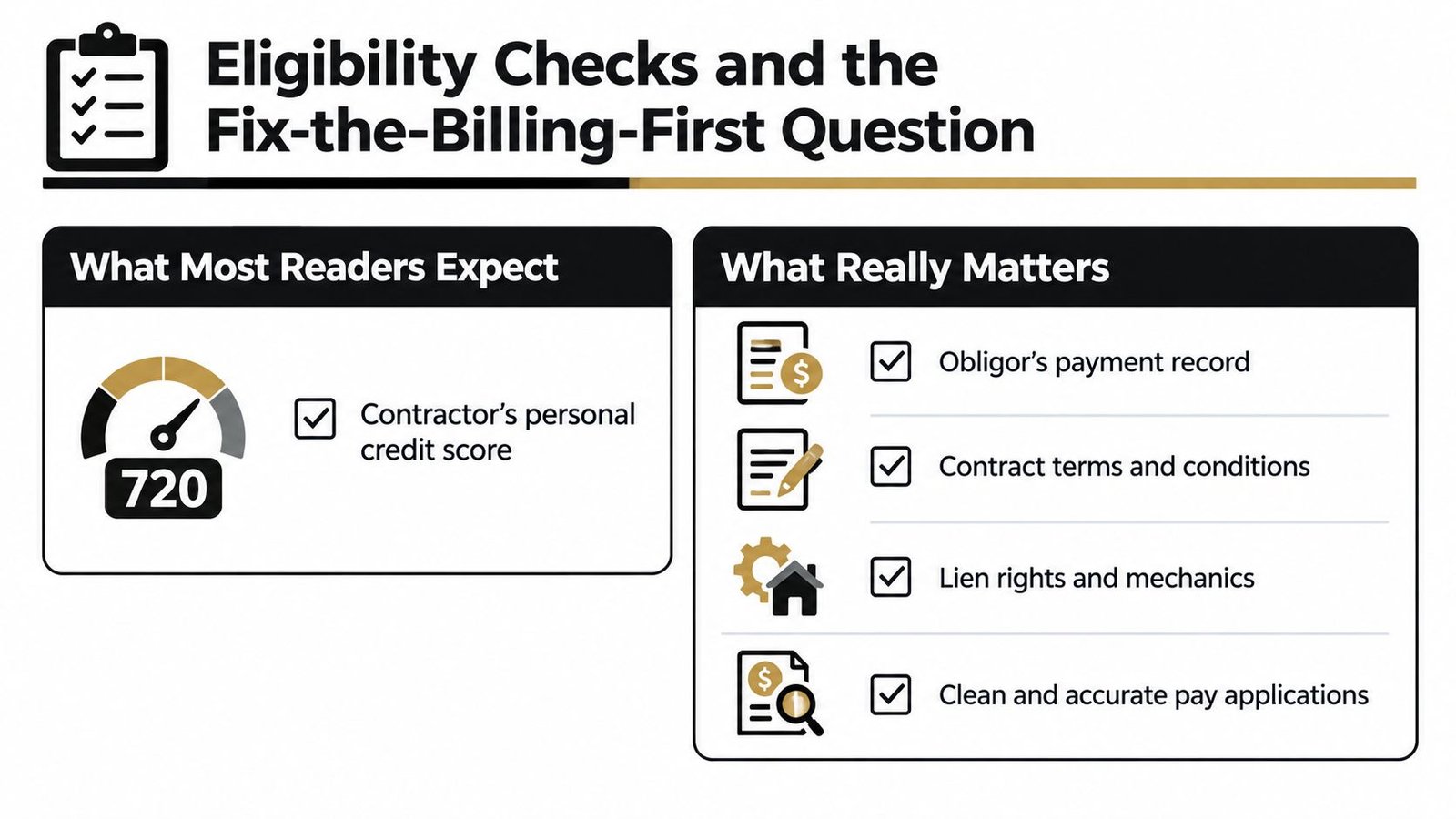
A project-level review commonly asks for:
- Payment history: Does the general contractor, owner, or developer pay comparable vendors?
- Contract terms: Does the prime contract permit assignment, and does it contain conditional-payment language?
- Project status: Has the billed milestone been completed and accepted?
- Lien position: Are notices, waivers, and mechanic's-lien deadlines being handled correctly?
- Billing accuracy: Do quantities, change orders, retainage, and signatures match the project record?
That checklist turns factoring into a management test. If the invoice is approved, the obligor is credible, and the paperwork is complete, factoring may bridge a temporary timing problem. If the invoice is repeatedly rejected because of missing forms or inconsistent quantities, financing may only conceal a process that needs repair.
A 2026 industry survey found that subcontractors using purpose-built billing software were more likely to be paid within 46 days than those using other processes, 44% versus 37%, according to Siteline's survey discussion. The point isn't that software guarantees payment. It is that cleaner submissions can reduce avoidable friction.
When the bridge makes sense
Factoring is more defensible when the work is complete, the amount is approved, the obligor has a dependable payment record, and the contractor needs cash before the contractual collection date. The fee then buys time and operating capacity rather than compensating for an unresolved dispute.
When billing should come first
Pause before factoring if the customer routinely contests basic quantities, the change orders remain unsigned, lien deadlines are at risk, or the team can't distinguish current billing from retainage. Fixing the pay-application workflow, assigning responsibility for notices, and renegotiating problem terms may cost less than repeatedly financing defective receivables.
Step-by-Step Onboarding With a Construction Factor
A construction factor usually starts by reviewing the business and the specific customers behind its receivables. Prepare a clean file rather than sending only an invoice. The stronger the connection between the contract, completed work, approval, and payment obligation, the fewer unanswered questions the factor has to resolve.
Prepare the project file
Gather the prime contract, amendments, approved change orders, current pay applications, acceptance records, schedules of values, retainage details, signed waivers, and relevant correspondence. Include a customer list showing who owes each receivable and how the customer has paid historically.
The factor may also request company financial information, banking details, existing borrowing arrangements, insurance records, and evidence that the business is authorized to perform the work. If a project has conditional-payment language, flag it instead of hoping it won't surface during review.
Review the assignment process
The agreement explains which receivables are eligible, how advances are calculated, when fees accrue, and whether the structure is recourse or non-recourse. A notice of assignment generally tells the obligor that future payments on the assigned receivable should go to the factor.
That notice can feel uncomfortable for a contractor worried about customer perception. It is a standard administrative step in many factoring arrangements, but the contractor should coordinate the wording and timing with the factor and the customer relationship owner.
Submit and fund each receivable
Once approved, the contractor uploads the pay application and supporting documents. The factor verifies the invoice with the obligor, confirms eligibility, and sends the advance under the agreed schedule.
After the obligor pays the factor, the factor releases the remaining reserve after deducting the applicable fee and any contractually permitted adjustment. The contractor should reconcile that release against the original invoice, retainage treatment, and fee calculation.
Most first-funding delays come from preventable gaps: an unsigned waiver, an unapproved change order, a mismatch between the pay application and the schedule of values, or unclear payment instructions. Create a repeatable submission packet for every project so the finance process doesn't depend on one person's memory.
Benefits, Risks, and When to Use Factoring
Factoring is useful when the contractor has earned revenue but can't wait for the customer's payment cycle. Earlier liquidity can support payroll, materials, equipment costs, insurance, and mobilization for another job. It can also place more emphasis on the obligor's payment capacity than on the contractor's personal credit profile.
The tradeoff is that the contractor pays for that speed. A receivable that remains outstanding for a long period can generate a larger total charge, depending on the fee structure. Recourse can return the collection problem to the contractor, and a notice of assignment changes the way the customer pays.
There is also an operational risk. If the contractor factors every invoice without correcting recurring billing errors, the business may finance the symptom rather than solve the cause. A disputed pay application can create fees, reserve uncertainty, and repayment exposure while the original project problem remains unresolved.
Use this decision test before signing:
- Is the project creditworthy? The obligor should have a credible payment record and a clear obligation to pay.
- Is the receivable documented? Confirm approval, change-order status, retainage, waivers, notices, and assignment language.
- Is the cost justified? Compare the all-in charge with the cost of delayed payroll, supplier disruption, missed mobilization, or a less expensive billing-process fix.
- What happens under non-payment? Read recourse triggers, dispute exclusions, repurchase duties, and reserve-release rules.
- Can the process scale? Make sure your team can submit consistent files across multiple projects without weakening lien protection.
Factoring is strongest as a bridge for a healthy project with a temporary collection delay. It is weakest when the invoice is disputed, the customer is unreliable, or the contractor's own documentation creates the delay. If you need to compare invoice factoring with other working-capital options, Business Loan Warrior offers invoice factoring and other business funding products through a single application process. Review the project documents first, then request terms that show the eligible amount, advance, fee, reserve, and recourse obligations in plain language.