
Your contractor is ready to schedule work on your new location, and the bank has approved the financing. Then an invoice arrives, and you discover that approval doesn't mean the money is available to spend.
A construction loan works like a tap connected to a tank: the lender opens the tap as the build progresses, rather than emptying the tank into your account at closing. You generally pay interest on what has flowed out, while the loan documents control when you can draw more.
Table of Contents
- Construction Loan Terms at a Glance
- How Draws and Retainage Release Your Money
- Rates, Points and Fees to Compare
- Build Timeline, Interest Reserve and Maturity
- First-Year Cash Flow Model and Draw Readiness
- DSCR and Amortization on the Permanent Loan
- Borrower Obligations and Stress Tests Before You Sign
Construction Loan Terms at a Glance
The most useful way to read construction loan terms is to ask what each term does to your cash. Some determine how much the lender will commit. Others govern payment timing, your obligations during construction, or how you'll repay the balance.
Keep the commitment letter, approved budget, loan agreement, and promissory note together when reviewing an offer. A favorable term in one document won't necessarily cancel a restriction in another.
Core construction loan terms
| Term | Plain meaning | Where it appears |
|---|---|---|
| Draw schedule | Dates, milestones, and amounts for releasing money after work is verified | Loan agreement and budget |
| Retainage (holdback) | Part of an approved payment withheld until completion conditions are met | Draw approval and loan agreement |
| Interest reserve | Budget allocation used to pay loan interest during construction | Closing budget |
| Loan-to-cost (LTC) | Loan amount divided by eligible total project cost, including approved land, hard costs, and soft costs | Underwriting file |
| Loan-to-value (LTV) | Loan amount divided by appraised value, generally based on the completed project | Appraisal and underwriting file |
| DSCR | Net operating income divided by annual debt service on the permanent loan | Permanent loan underwriting |
| Amortization | Repayment schedule used to calculate principal and interest payments | Permanent loan note |
| Maturity | Deadline for paying the outstanding loan balance | Promissory note |
| Takeout | Permanent financing or sale proceeds intended to repay construction debt | Commitment letter |
| Points | Upfront loan fees expressed as a percentage of the loan amount | Fee schedule or closing statement |
Read the definitions in your agreement
Don't assume every budget item qualifies for financing. A lender may exclude a particular soft cost, limit credit for land equity, or require you to contribute cash before releasing loan proceeds. Ask for the eligible-cost definition and the equity-funding order in writing.
LTC and LTV also impose separate constraints. A project can fit the approved cost budget yet support less debt if the appraisal comes in below expectations. Your financing needs to satisfy both tests.
Start with access to cash: Retainage affects what arrives, the interest reserve affects what remains available for construction, and takeout determines how you leave the loan.
Those terms deserve attention before you focus on the advertised rate. They connect the contractor's payment schedule, your business's available cash, and the lender's repayment deadline.
How Draws and Retainage Release Your Money
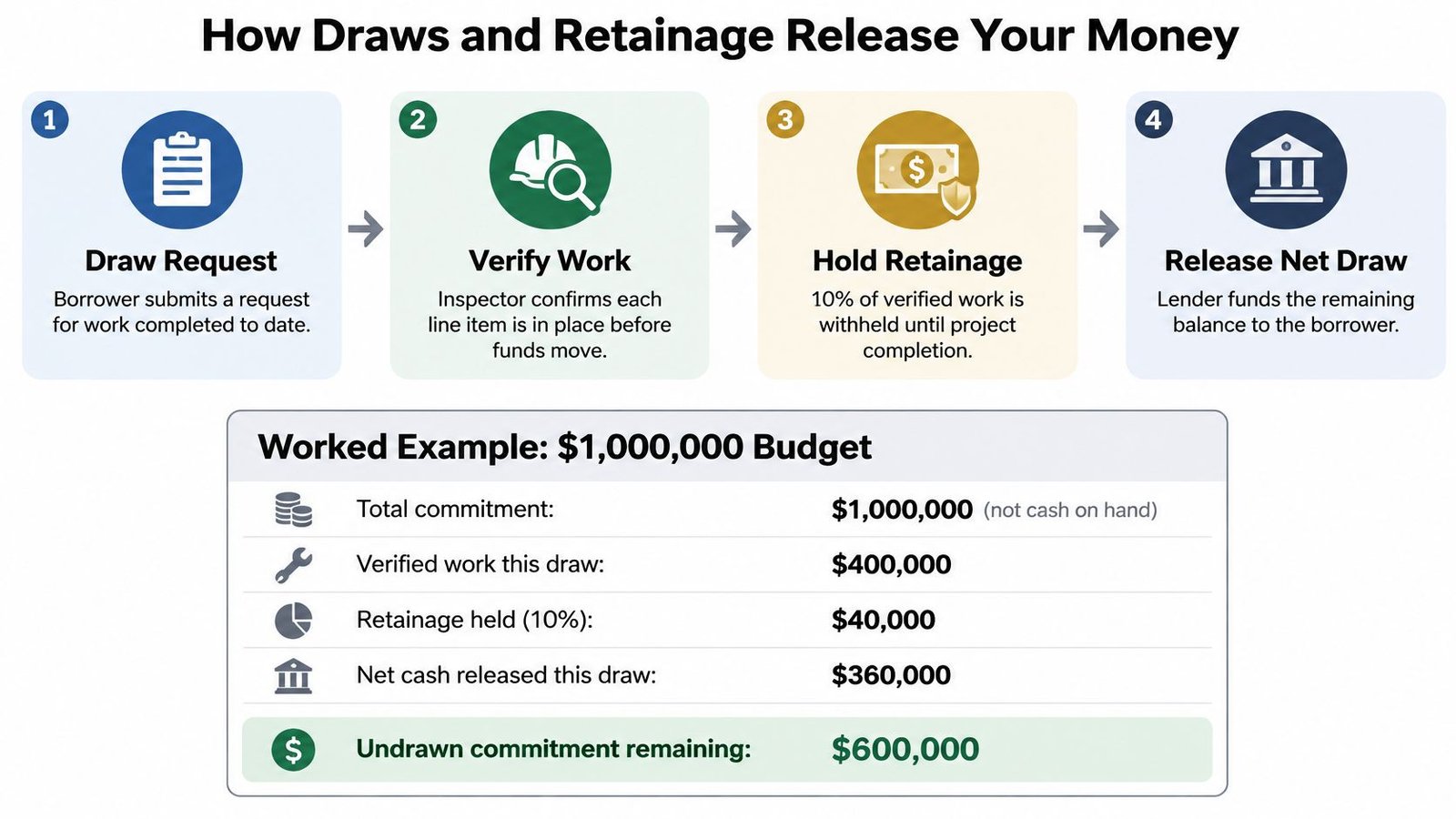
Say you're reviewing a hypothetical project with a $1,000,000 budget. The contractor submits $400,000 of completed work, and the agreement requires a 10% holdback. Before other adjustments, the lender would release $360,000 and retain $40,000.
That illustrates a structure described in the FDIC examination manual: typical monthly disbursements total 90% of applicable value, with 10% retained until completion, within a supervised funding framework that includes standard payment plans and progress-payment plans.
The draw process below shows why a contractor's invoice doesn't immediately become a bank deposit.
Follow the draw through approval
Your lender's exact sequence may differ, but a draw package commonly moves through these checkpoints:
- The contractor submits a pay application. It shows completion by budget line, rather than presenting only a total invoice. The lender needs to match the request to approved work.
- The lender verifies progress. An inspector checks the site and reports whether the claimed work is in place. Ask how the lender treats stored materials and deposits before ordering them.
- You collect lien documentation. Subcontractor and supplier waivers help establish that earlier payments reached the intended recipients. Use the conditional or unconditional forms appropriate to payment status and local law.
- The title company checks for liens. New claims can interrupt funding while the parties resolve who is owed money.
- The lender approves the net payment. Retainage, equity requirements, and budget adjustments can make the wire smaller than the requested amount.
- You resolve any funding gap. An overrun or ineligible cost may require additional borrower funds before another advance.
Use a construction loan draw schedule to align contractor billing with the lender's submission requirements, inspection process, and approval calendar.
Confirm what unlocks the last payment
Retainage isn't automatically released when the contractor says the building is finished. The agreement may require final inspections, final lien releases, a certificate of occupancy where applicable, and resolution of unfinished work.
Ask whether the lender releases holdbacks by trade or only after the entire project meets completion conditions. Then make sure the construction contract doesn't promise payment earlier than your financing can deliver it.
Rates, Points and Fees to Compare
Start by identifying the rate structure. A fixed rate provides a stated borrowing rate for the agreed period; a variable rate typically combines a benchmark index with a lender's spread. For a variable offer, ask about reset dates, a rate floor, and any cap.
Then separate the contract rate from the broader financing cost. NAHB's figures for the fourth quarter of 2024, presented in congressional testimony on acquisition, development, and construction financing, reported the following average contract and effective rates, including 7.75% and 12.98%, respectively, for pre-sold single-family construction.
Contract versus effective rates by project type, Q4 2024
| Loan type | Average contract rate | Effective rate with points |
|---|---|---|
| Land acquisition | 8.48% | 10.79% |
| Land development | 8.28% | 12.12% |
| Speculative single-family construction | 8.34% | 12.86% |
| Pre-sold single-family construction | 7.75% | 12.98% |
These are historical builder-financing figures, not a quote for your commercial expansion. Their practical lesson is that a lower contract rate doesn't necessarily produce a lower effective cost. Pre-sold construction had the lowest contract rate in the table but the highest effective rate.
Ask for an itemized fee schedule
Have each lender identify whether these charges apply, who receives them, and when you must pay:
- Origination charges and points. Usually paid by the borrower at closing or deducted from proceeds. Ask what amount the lender uses to calculate them.
- Appraisal and valuation. The borrower generally pays for the lender-ordered appraisal, including the completed-project valuation.
- Inspection and reinspection. Usually a borrower expense. Confirm whether an unsuccessful site visit triggers another charge.
- Title and legal work. Borrower-paid lender costs may include title insurance, document preparation, and counsel's review.
- Draw and wire charges. Ask whether each funding request creates a separate administrative or transfer fee.
- Extension and exit fees. The borrower pays these if the agreement imposes them when extending or repaying the facility.
Don't treat a fee financed through the loan as free. It uses borrowing capacity that might otherwise pay project costs.
Compare offers using the same construction schedule, draw assumptions, and repayment date. Otherwise, you're comparing different projects rather than different loans.
A guide to construction loan rates can help you organize the pricing questions. Your final comparison should show expected interest, required fees, and cash needed outside the loan, not just the headline rate.
Build Timeline, Interest Reserve and Maturity
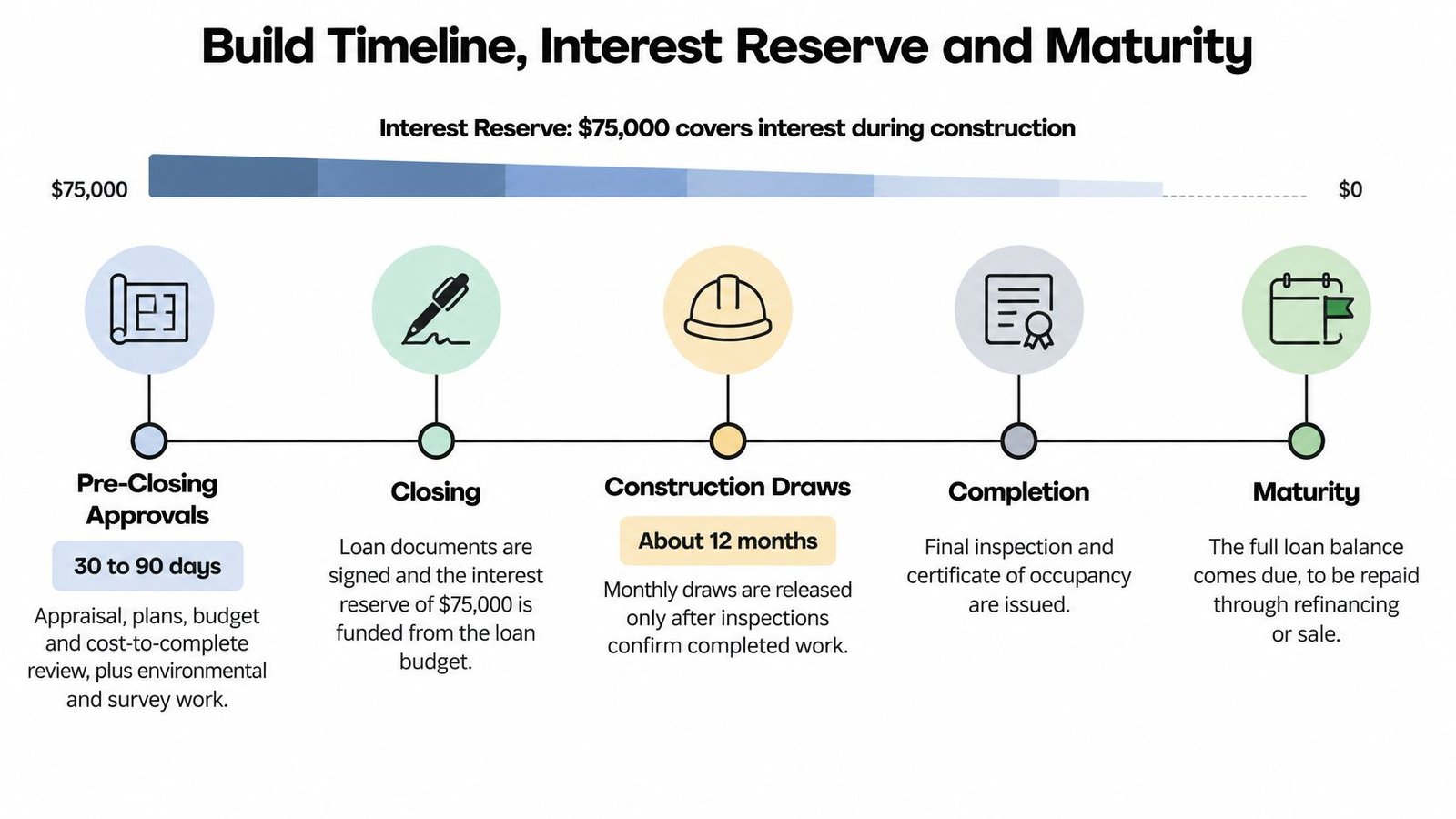
A workable schedule starts before closing. The lender needs acceptable plans, a construction budget, an appraisal, contractor information, and any required environmental or survey work. Don't promise a mobilization date based only on receiving a favorable term sheet.
At closing, confirm how the interest reserve is established. It may be an allocation within the loan budget rather than cash deposited into an account you control. Ask whether interest payments are advanced automatically, require approval, or must initially come from your own funds.
This timeline illustrates the funding stages; its durations and reserve amount are examples, not terms to assume in your offer.
Build the reserve around actual draws
Interest during construction generally follows the disbursed balance. Early site work may require relatively little borrowing, while mechanical systems, equipment installation, and finishes can leave a much larger balance outstanding near completion.
For a clearly hypothetical reserve calculation, assume:
- Loan commitment: $2,000,000.
- Average drawn balance: 60% of the commitment, or $1,200,000.
- Assumed interest rate and period: 9% over a 12-month build.
- Estimated interest: $1,200,000 × 9% = $108,000.
- Illustrative delay cushion: Adding 15% produces $124,200.
That shortcut is useful for an initial check, but a monthly model is better. Apply the assumed rate to the projected outstanding balance for each period, including financed interest if the agreement adds it to principal. A flat average can hide expensive delays late in construction.
Your reserve also isn't a general contingency fund. Don't assume you can move money from interest to construction costs without approval, or that unused construction funds can automatically cover interest.
Work backward from repayment
Say, in a hypothetical schedule, construction finishes in October and permanent financing closes in November. The intervening period still requires interest, insurance, utilities, and possibly operating expenses. Completion and repayment aren't the same event.
The OCC's commercial real estate lending handbook notes that commercial real estate loans may be underwritten over 15–30 years but commonly mature in roughly three to five years. That broader commercial lending pattern illustrates why a long repayment calculation doesn't eliminate refinancing risk.
For construction, use the maturity date written in your note. Check whether an extension is a contractual option or requires fresh approval, whether you must meet completion or liquidity tests, and whether pricing changes.
The video offers another way to review how construction financing fits together.
When coordinating architects, engineers, and contractors, HireArchitects' resource on project management for design professionals can help you organize responsibilities and handoffs. Give each inspection, approval, and closeout document a named owner.
If the reserve runs out, you may need to pay interest from cash, contribute equity, or negotiate an amendment. Obtain the lender's response process before you need it, not after an interest payment becomes due.
First-Year Cash Flow Model and Draw Readiness
Build your forecast in Excel or Google Sheets using the approved budget, contractor billing schedule, and lender's draw checklist. Separate money the lender has committed from money you can use today.
Cash and readily realizable, unencumbered assets can support liquidity planning, but they aren't interchangeable. An asset that takes time to sell won't necessarily cover a contractor payment due immediately.
Build a monthly funding worksheet
Use a row for every month of the first year, then extend the worksheet through takeout. This template shows the fields to complete without assuming a particular project size.
| Period | Planned spend | Draw requested | Draw released | Reserve interest paid | Equity needed | Closing cash balance |
|---|---|---|---|---|---|---|
| Opening month | Approved costs due | Eligible request | Expected receipt | Projected interest | Funding gap | Available cash less payments |
| Each middle month | Costs by budget line | Documented request | Receipt after approval lag | Updated interest | Borrower contribution | Prior cash plus inflows less outflows |
| Completion month | Closeout costs | Final eligible request | Expected final funding | Remaining interest | Unfunded closeout costs | Cash after completion payments |
| Takeout month | Carrying and closing costs | Remaining eligible items | Available proceeds | Interest through payoff | Payoff shortfall | Cash after refinancing or sale |
Apply these checks to each monthly row:
- Match costs to eligibility. Identify deposits, stored materials, professional fees, and other items needing special approval.
- Model the payment lag. Put the invoice and expected draw receipt in their actual periods, not automatically in the same month.
- Add delay events. Move receipts when change orders, missing waivers, or incomplete work could prevent approval.
- Track separate balances. Maintain distinct totals for operating cash, required equity, contingency, and the interest reserve.
- Review remaining work. Reconcile the unspent budget with the lender's cost-to-complete calculation.
Draw-readiness test: Before submitting a request, confirm that someone owns every missing document and that your cash forecast still works if approval slips.
The result should identify when the business needs outside cash without quietly consuming funds intended for payroll, inventory, or its existing location.
DSCR and Amortization on the Permanent Loan
Permanent financing introduces a different question: can the finished property generate enough income to support its payments? Debt service coverage ratio, or DSCR, compares net operating income with scheduled debt service.
DSCR = annual net operating income ÷ annual debt service
For property underwriting, net operating income generally means income after property operating expenses but before loan payments. It isn't gross rent, and it isn't necessarily the same as your company's accounting profit. Owner-occupied business projects may also require analysis of operating-company cash flow.
Test payment terms before committing to the build
Consider a hypothetical $1,500,000 permanent loan at a fixed 7% rate, with level monthly payments and $180,000 of annual net operating income. The calculated payments below exclude fees and assume full amortization over the stated period.
Illustrative payment and DSCR on a $1.5 million loan at 7 percent
| Amortization | Monthly payment | Annual debt service | DSCR at $180,000 NOI |
|---|---|---|---|
| 25 years | About $10,602 | About $127,220 | 1.41x |
| 15 years | About $13,482 | About $161,789 | 1.11x |
In this example, shortening amortization raises the scheduled payment without changing the property's income. If the hypothetical lender required 1.20x coverage, the longer schedule would pass that test and the shorter schedule wouldn't.
That isn't a universal lending threshold. Obtain the permanent lender's actual minimum, permitted amortization, income adjustments, and treatment of reserves before relying on a projected takeout amount.
CEFCore's calculator lets you check loan repayment capacity while comparing assumptions. Pair the calculation with an explanation of what makes a good debt service coverage ratio so you're evaluating the lender's definitions, not just producing a favorable result.
Use income the lender can support
For a rental property, base stabilized income on achievable rents, realistic occupancy, and documented operating expenses. Show the lease-up period separately rather than assuming full occupancy immediately after the certificate of occupancy.
For an owner-occupied expansion, distinguish the building's financing needs from the business's additional staffing, inventory, and startup expenses. A completed building doesn't guarantee that the expanded operation can immediately carry its permanent debt.
Borrower Obligations and Stress Tests Before You Sign
A budget that works only when everything happens on schedule isn't enough. Read the term sheet for obligations that could require additional cash or expose assets outside the project.
Identify what you're promising
Discuss negotiable items before paying for extensive underwriting:
- Repayment guarantee. Identify who guarantees the debt, the scope of recourse, and any release conditions. Negotiate limits and release triggers early.
- Completion guarantee. Determine who must fund overruns and finish the work if the original budget proves insufficient.
- Minimum liquidity. Confirm qualifying assets, measurement dates, and cure rights. The definition matters as much as the required balance.
- Equity injection. Negotiate the amount and timing, including whether approved land equity counts.
- Budget and change approval. Establish who can authorize changes and how emergency work is handled.
- Lien waivers. Agree on acceptable forms, payment sequencing, and responsibility for collecting them.
- Insurance. Confirm builder's risk coverage, the lender's required status, and contractor liability and workers' compensation documentation with your insurance adviser.
- Permits and reporting. Assign responsibility for inspection scheduling, financial statements, progress reports, and completion evidence.
The federal real estate lending standards require written institutional policies addressing construction lending and interest-reserve usage. Your lender's documentation requirements are therefore part of its credit controls, not merely administrative preferences.
For legal preparation, Coto & Waddington, Attorneys at Law's guide titled commercial loan requirements for 2026 offers another checklist to discuss with counsel. Have your own attorney review guarantees, default provisions, and extension rights.
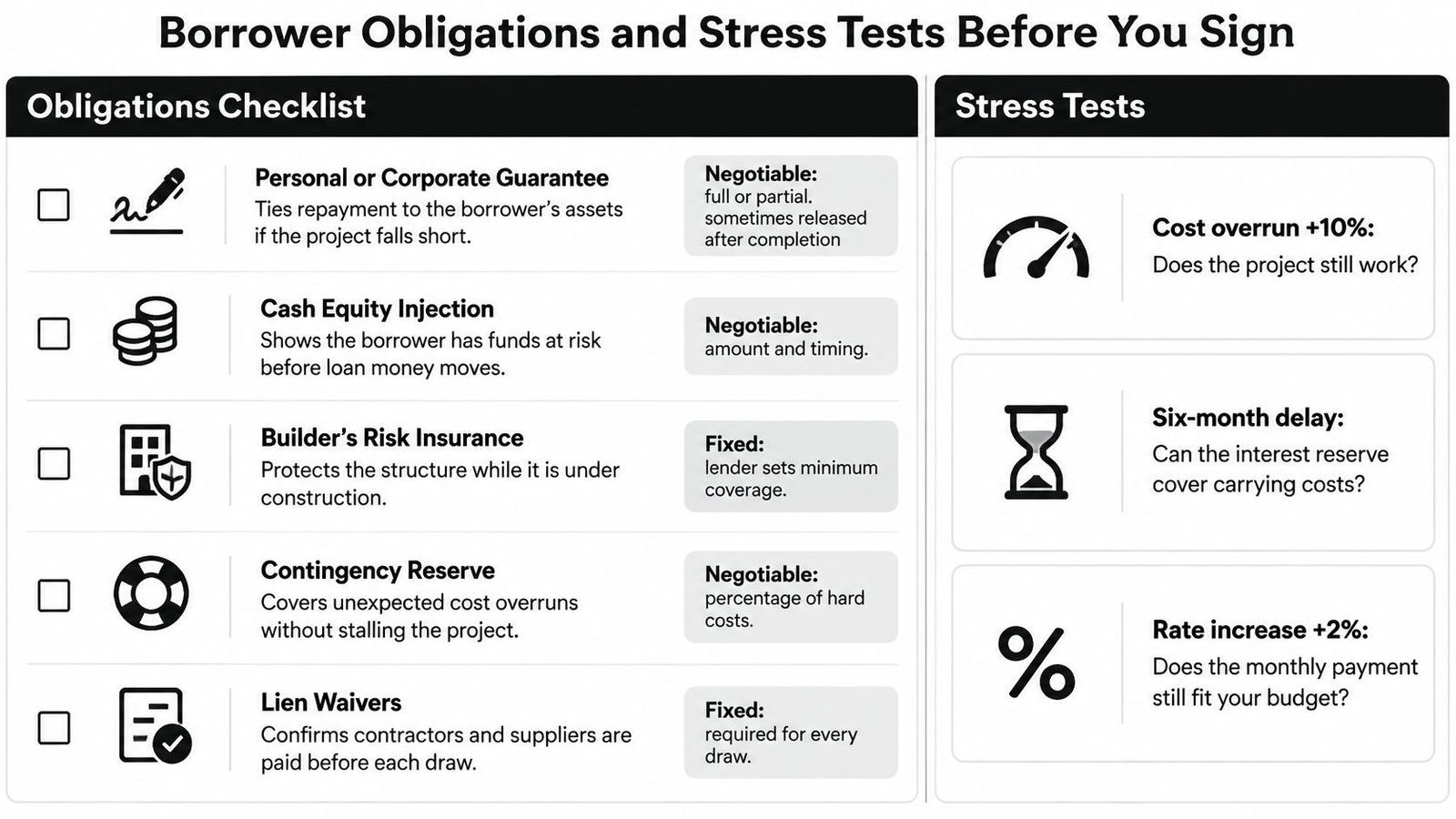
This visual provides illustrative challenges to discuss, rather than lender requirements.
Challenge the base case
Use the following hypothetical stress tests, adjusting their severity to your project.
Stress tests to run on any construction loan term sheet
| Scenario | What changes | What to check |
|---|---|---|
| Base case, budget and draws on schedule | No change to the plan | Interest reserve covers the planned funding period |
| Three-month delay | Extra interest accrues on the drawn balance | Reserve sufficiency and maturity date |
| 10 percent cost overrun | Added equity or approved contingency funding needed | Equity availability and loan-to-cost headroom |
| Slower lease-up or sale | Takeout starts late | Extension fee, rate reset, and carrying costs |
| Lender cuts loan-to-cost by 5 points | Smaller loan amount | Extra equity required at closing |
| Permanent rate rises by 1.5 percentage points | Takeout payments increase | DSCR and any reduction in refinance proceeds |
The Federal Reserve's July 2025 lending survey reported modest net shares of banks tightening construction and land-development lending standards. Don't assume an established operating business will receive flexible construction terms without demonstrating contractor quality, sponsor liquidity, and a credible repayment plan.
Ask every lender the same closing questions: How quickly are complete draws funded? What releases retainage? What permits an extension? How are liquidity, recourse, and takeout requirements measured? Compare the answers alongside price.
Business Loan Warrior offers construction financing options and a single application for exploring business funding. Visit Business Loan Warrior to discuss your project and compare funding terms against your draw schedule, cash needs, and repayment plan.