
You closed Saturday with a full ticket stack and a card batch that looked fine. Monday's deposit is smaller. Nothing on the guest check named the cut, so it feels like the processor reached into the till after you locked the door.
That gap is what credit card company fees do to a sale. Think of the ticket as the menu price and the deposit as what is left after the door charge. This guide splits those charges into two jobs. One is what your business pays to accept a card. The other is what a cardholder pays the issuer for keeping the account, paying late, taking cash, or buying in another currency. That cardholder might be a customer, or it might be you when operating costs ride on a business card.
You'll follow one sale to the bank that issued the card, the card network, and the firm that deposits your money. Then you'll judge whether to absorb the cost, add a surcharge, or change how cards are taken. The fee usually leaves gross sales before funds hit the account, which is why the deposit never matches the tape.
Table of Contents
- Why Credit Card Company Fees Hit Your Margin
- Where Each Dollar of a Card Sale Goes
- Cardholder Fees Beyond the Stated APR
- What the Same Sale Costs in Real Numbers
- When a Credit Card Surcharge Helps or Hurts
- How to Cut Avoidable Processing Costs
- What to Do After You Know Your True Fees
Why Credit Card Company Fees Hit Your Margin
Picture the Friday dinner rush at a 40-seat restaurant. A four-top runs $186. The server closes the check on a rewards card, the guest adds a tip, and the point-of-sale system shows a clean batch. Three days later the bank deposit for that night is short of the sales report. The missing piece isn't a comp or a walkout. It's the acceptance cost taken before settlement.
Owners often blame "the processor" as if one company sent one bill. The short deposit is usually a bundle. Part pays the cardholder's bank. Part pays the network that routed the authorization. Part pays your acquirer, gateway, and processor. Until those names are on the statement, the cut feels arbitrary, and you can't tell which slice you can negotiate.
Two payers, two bills
Keep the two bills separate or the math gets muddy.
- Acceptance cost: You pay this so a customer can use a credit card. It reduces the cash you receive from that sale.
- Cardholder cost: The issuer charges this on a statement. Annual charges, late charges, foreign charges, and cash-advance pricing sit here, not in your batch report.
- Working-capital overlap: When you put inventory, ads, or payroll on a card, you can pay both. You pay to accept other people's cards, and you pay your own issuer if you revolve a balance or miss a date.
The fee is not a bill that arrives next month. It is money that never arrives.
That timing is why margin feels the hit immediately. A 20% food cost and a 30% labor cost were priced against the menu, not against a deposit that is already lighter. If you only look at the APR on a card offer, or only at a blended "swipe fee" on a processor quote, you miss half the picture.
The rest of this guide answers four questions. Who receives each part of a card sale? What shows up on a card statement beyond interest? What does a year of card volume cost in dollars? And when does passing the cost to the guest help, versus when it chases the guest away? Absorbing the cost, surcharging, or changing how you take cards are the three levers. You don't have to pick one before you can see the split.
Where Each Dollar of a Card Sale Goes
Your customer pays $100 for dinner, but your business receives less than $100. The processor deducts the merchant discount, a split shared by the card issuer, the card network, and your payment providers. Seeing those slices helps you understand which charges are set by others and which you may be able to negotiate.
Interchange goes to the bank that issued the customer's card. It compensates the issuer for handling transactions and taking on risks such as fraud and unpaid balances. The 2025 Federal Reserve Bank of Philadelphia working paper describes interchange as one part of the cost of accepting cards. Your total acceptance cost also includes network assessments and charges from your acquirer, gateway, and processor. Those are separate parts of the bill, not interchangeable estimates of the same fee.
The smaller slices
A network assessment goes to the card network that routes the transaction. Your acquirer, gateway, and processor also charge for their services. Those charges may include a percentage, a per-transaction amount, and monthly fees. Together, these pieces make up the merchant discount taken from your sale.
Rewards help explain why interchange matters. The Philadelphia Fed paper reports that CMSPI found five large banks generated $70.8 billion in interchange and related fee income in 2022, while spending $53.1 billion on cardholder rewards, roughly 75% of that fee income. Card points and perks have a funding source: merchant fees help pay for them. When you build acceptance costs into menu or shelf prices, customers who pay with cash may also contribute to that pool without earning card rewards.
Your sales rep can discuss the processor's markup, gateway, and monthly charges, but networks set most interchange rates. You may have more room to negotiate provider charges than the issuer's share. Debit cards can have different pricing from credit cards, so compare debit card fees separately rather than assuming the same rates apply.
| Fee component | Who receives it | Relative size | What the merchant can change |
|---|---|---|---|
| Interchange | Card-issuing bank | Usually the largest share of the discount | Little. Networks set most of it. Card type and how you take the card can move you between rate categories. |
| Network assessment | Card network | Small versus interchange | Almost nothing on the rate itself. Clean data can still avoid downgrades. |
| Acquirer, gateway, and processor charges | Your processor and gateway | The negotiable markup, plus cents and monthly fees | Pricing model, markup, gateway, equipment, and add-on fees |
Card rewards work like a transfer: merchant fees help fund the perks, and prices may pass some of that cost along to customers. To see where your money goes, match each statement line to the table. If your processor shows only one blended rate, ask for interchange, assessments, and markup on separate lines.
Cardholder Fees Beyond the Stated APR
The last section followed your cut of a sale. This one follows the charges a person, or your business, sees on a card statement. The APR on the offer is the interest rate. It is not the full price of holding the card, missing a date, or pulling cash.
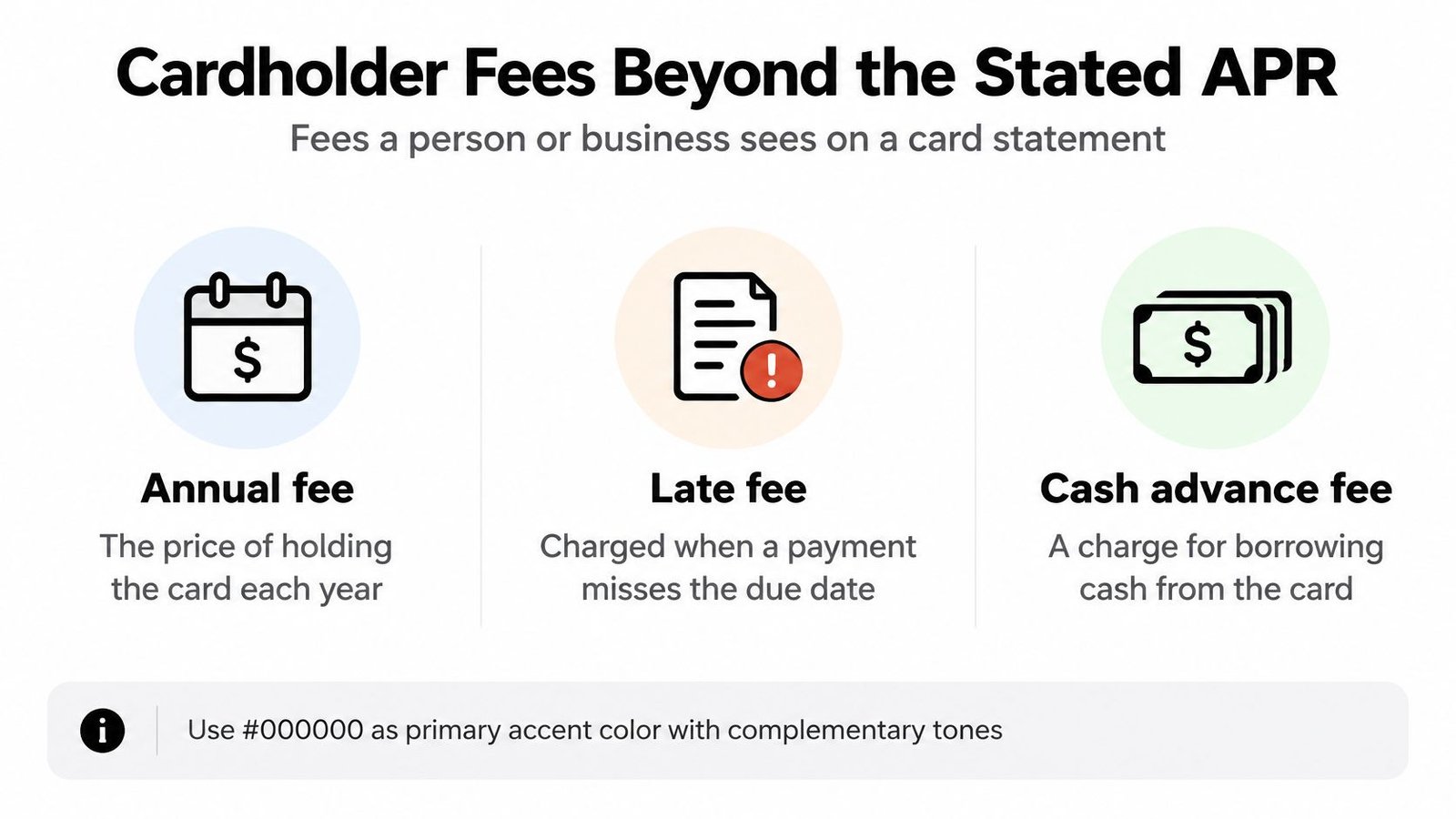
Treat the stated rate like a sticker price. The issuer can still add charges that never appear in that percentage.
What shows up besides interest
Annual fees are the price of keeping the card for a year. A rewards card can earn its keep if the perks beat that charge. If the card mostly buys inventory you could have funded another way, the annual charge is rent on an account you barely use.
Late fees are the painful one. In March 2024, the Consumer Financial Protection Bureau said the credit-card industry collected more than $14 billion in late-fee revenue a year, more than five times issuers' collection costs. A proposed rule would have cut the typical late fee at the largest issuers, those with more than 1 million open accounts, from about $32 to $8, unless the issuer could show a higher amount matched real collection costs. About one in five adult Americans, an estimated 52 million people, said they paid a credit-card late fee in the prior year. Among large issuers, annual late-fee charges totaled $17.0 billion in 2024, 17% higher than in 2022.
A fixed late fee hits a small balance hardest. Thirty-odd dollars on a $90 balance is a different kind of pain than the same dollars on a $9,000 balance. Miss again and penalty pricing can stack on top of the fee.
Foreign transaction charges are a percent added when a purchase is processed abroad or in another currency. A supplier invoice billed overseas can trigger them even if you never leave town.
Cash-advance and penalty pricing sit outside a promotional rate. Cash from the card often starts interest immediately, with its own fee, and a penalty APR can replace the teaser after a missed payment.
If the business card covers operating bills, compare grace periods, what triggers a penalty APR, and whether at least the minimum payment is automated. A promo rate does not save you if the due date slips.
What the Same Sale Costs in Real Numbers
Start with one year, not one ticket. Say the business runs about $1 million a year on credit cards. Acceptance fees are paid mostly by merchants and generally total about 1.5% to 3% of each transaction, according to a Federal Reserve note on merchant payments. On that volume, the range is roughly $15,000 to $30,000 a year before contract extras, chargebacks, equipment, or odd account charges.

The same note says interchange can be about 70% to 90% of total credit card processing costs. You already know that slice goes to the issuing bank. The new point is the dollar drag, and the fact that it is pulled from the sale before you can spend the deposit.
Same card, two lanes
Tuesday's $80 phone order and Saturday's $80 counter sale are not the same cost, even when the plastic is identical.
- Card present, full data. The guest taps or inserts. Address, security code, and authorization fields go through. You are more likely to land in a cheaper category.
- Keyed or card-not-present. Staff type the number, or the guest pays on a link. Fraud risk is higher, so the category is usually more expensive. A pricing pattern of a percentage plus a fixed amount makes small remote tickets worse, because the cents don't shrink when the sale does.
Card type, merchant category, and whether security data is complete move the rate again. A rewards card at a restaurant and a basic card at a retailer do not share one effective rate. That is why a single "our rate is X" quote misleads. You need the mix.
If you want a faster read than a spreadsheet, you can estimate your commerce fees from the year's card volume and a rate you see on statements. Then set that annual drag next to a simple break-even analysis so you know how many extra sales it takes to cover the cut.
A short walk-through of how processors quote these rates is worth ten minutes before you renegotiate:
Pull last month's statement and split card-present dollars from keyed and online dollars. If the remote pile is large, that is the first place the effective rate is hiding.
When a Credit Card Surcharge Helps or Hurts
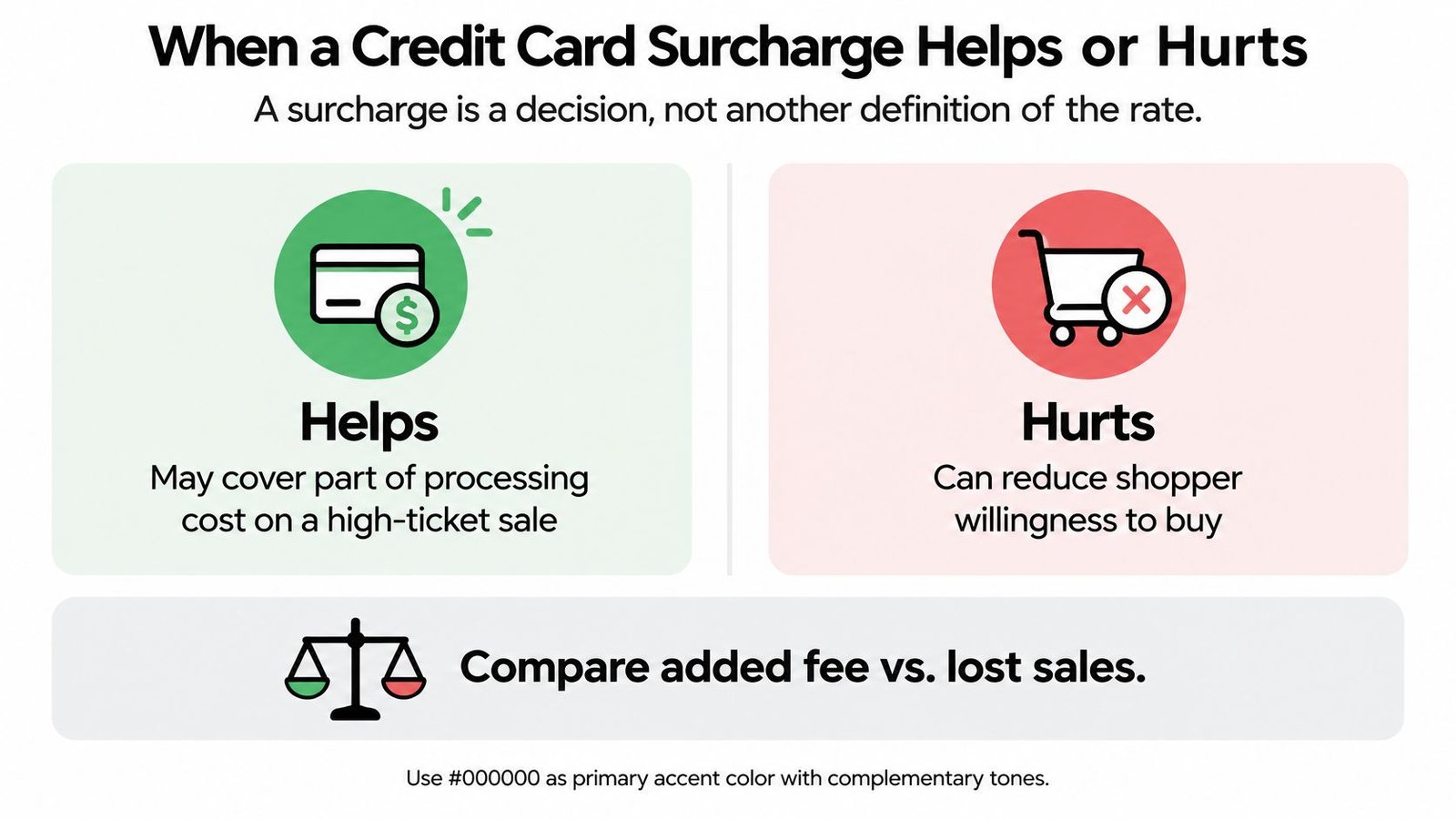
A surcharge is a choice about demand, not a second definition of the rate. More merchants are making it. A 2025 J.D. Power merchant study found that 34% of U.S. merchants were adding surcharges to credit-card purchases, and Payments Dive reported that the surveyed population included 3,841 small businesses. Shoppers are pushing back. A March 2025 Morning Consult survey, cited with those findings, found that 66% of adults were less likely to shop at a retailer or restaurant that added a card surcharge.
A break-even you can do on a notepad
Say you add a surcharge near your card-acceptance cost, on the order of a few percent, and only on credit. On a ticket that still happens, you recover processing you used to eat. The sale has to still happen. Set recovered dollars against four leaks.
- Lost return visits: A guest who feels nickeled may not book the next Friday.
- Smaller tickets: People drop the dessert or the add-on when the total jumps at the last second.
- Substitution: Some switch to cash or debit. You may pay less to accept those, but you also give up the credit sale you thought you saved.
- Staff time and complaints: Every "why is this higher?" at the host stand has a cost, even when the guest stays.
Recovered processing is not profit if the guest walks or shrinks the check.
Restaurants, retailers, and service shops feel this fastest. Customers compare the final price in seconds, often on a phone next to a competitor who baked the cost into the menu instead.
Disclose the add-on before payment, not on the receipt after the card is gone. Keep it on credit. Card-brand rules and several state laws treat debit and prepaid differently, and blurring them is how a "simple fee" becomes a complaint or a chargeback. Post the credit total where people can see it, and let an online buyer cancel after the surcharge appears. Record the surcharge as its own line in the books so it doesn't masquerade as sales.
Run the test for a month. Compare recovered fees with lost conversion, average ticket, complaint count, and the admin time to explain the line. If recovered dollars don't clear those costs, drop the surcharge and price the menu instead.
How to Cut Avoidable Processing Costs
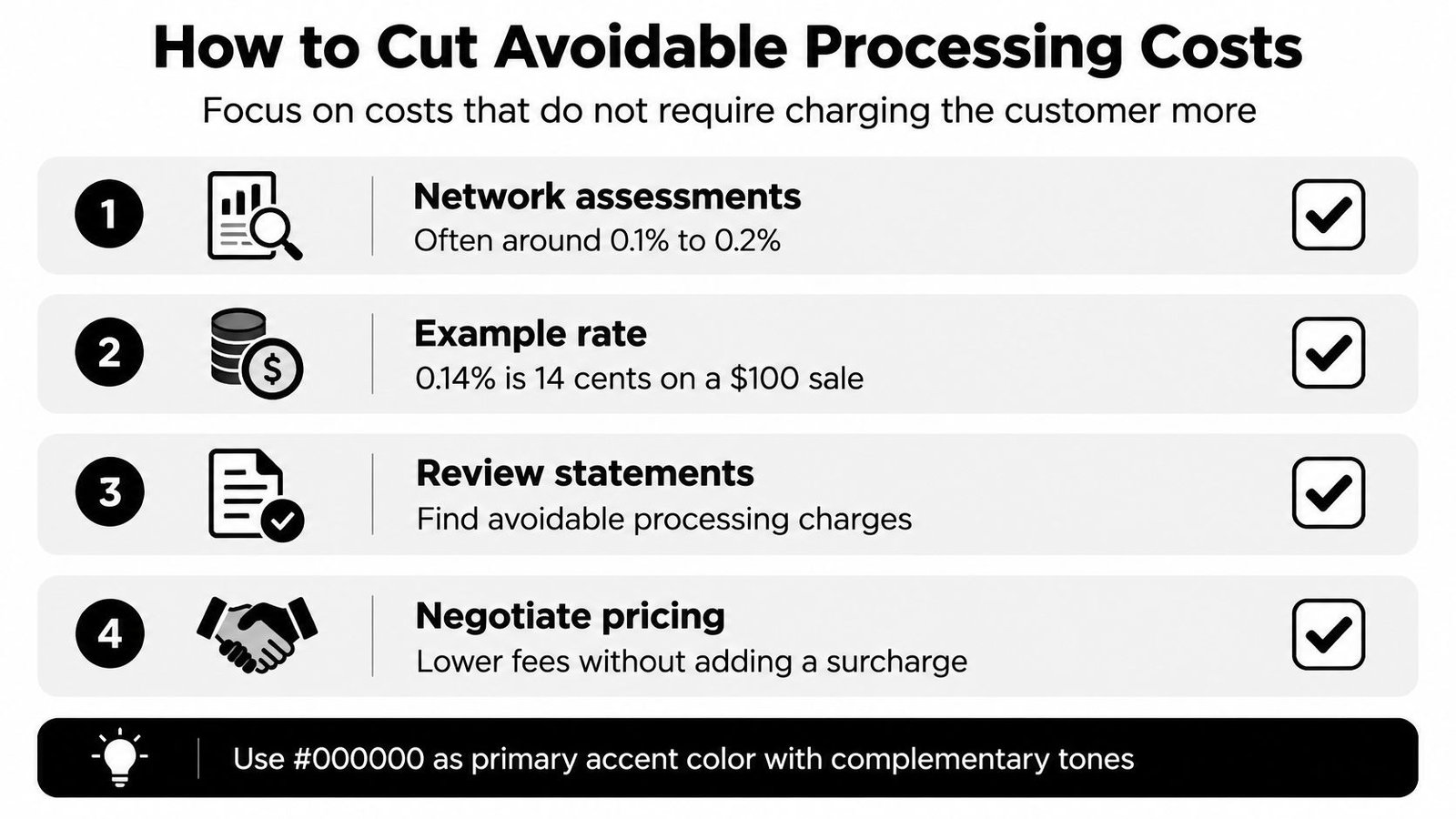
Some costs fall without charging the guest more. Network assessments are commonly around 0.1% to 0.2%. A 0.14% assessment is $0.14 on a $100 sale, a small toll next to interchange, as a Congressional Research Service brief describes the pricing stack. The same brief notes a typical pattern of a percentage plus a fixed amount, for example 2.3% plus $0.10, and that the rate moves with card type, channel, merchant category, and whether the sale is swiped, keyed, or card-not-present. Interchange stays mostly in the networks' hands. Everything around it is within your control.
Levers that don't touch the menu
Keyed sales are the expensive habit. If staff type card numbers because the reader is flaky, fix the reader. Complete authorization data, including security codes and address checks on remote orders, keeps more sales out of downgrade categories. Tokenization lets a repeat guest pay again without you storing the raw number, which also keeps a breach from becoming your most expensive week.
Then read the bill like overhead, not like a mystery. Gateway fees, PCI fees, statement fees, and terminal leases often dwarf a tenth of a percent. Fold them into how you calculate overhead cost so a "low rate" quote can't hide a high monthly nut. Ask the processor for interchange-plus pricing with markup on its own line. If they won't separate it, you can't tell a network toll from their margin.
Chargebacks are a cousin cost. Each one adds a fee and can push your account into a pricier risk tier. Looking at chargeback prevention costs for ecommerce merchants is a practical way to see whether fighting disputes costs less than eating them.
When another card is the wrong tool
If card balances are funding payroll or inventory, acceptance tweaks won't fix the interest and late-fee stack on the statement. A no-fee application through Business Loan Warrior lets an owner check pre-approval without a credit hit, connect accounts, and review loans, lines of credit, SBA processing, equipment, invoice, and short-term options in one dashboard. That is one funding path among banks, credit unions, and other online lenders. Compare the total payback with the card costs after fees, not with a teaser APR. Cheaper capital beats a card when the balance is really a cash-flow gap.
What to Do After You Know Your True Fees
You don't need another tour of who gets paid. You need a sequence you can finish this week.
Pull one recent processing statement and one card statement if the business revolves a balance. On the processing statement, label three piles: issuing bank, card network, and processor or gateway. If the statement won't separate them, that is the first renegotiation ask.
From the same week, pick one card-present sale and one card-not-present sale of similar size. Note the effective rate on each. The gap tells you whether the problem is volume or how the card is captured.
If you already add a customer fee, check three things only. Was it disclosed before payment? Does it hit credit and not debit or prepaid? Do complaints and smaller tickets wipe out what you recover? If any answer is wrong, pause the surcharge before you tune the rate.
If day-to-day bills are sitting on a card because deposits arrive short, stop treating another rewards card as the fix. Price the acceptance drag, price the statement fees, and then look at a loan, a line, or invoice funding that matches the gap instead of rolling it at penalty pricing.
Label the statement, compare the two sale types, and test the surcharge. Then decide whether the business needs cheaper capital more than a lower markup.
That order keeps you from arguing about a tenth of a point while a late fee and a keyed-entry habit cost more every month. One statement, two sales, one yes-or-no on the surcharge. Then make the funding call.
Business Loan Warrior helps owners replace expensive card balances with a loan, line of credit, SBA processing, equipment financing, or invoice option that matches the cash-flow gap behind those fees. A single no-fee application lets you check pre-approval without a credit hit and talk with an underwriter about terms that fit how your deposits land. Visit Business Loan Warrior and see what the gap costs to fund without another swipe.