
You've got revenue coming in, but it arrives in uneven waves. Meanwhile, a merchant cash advance withdraws money every day, a business credit card demands a payment, equipment financing has its own schedule, and another lender is waiting for funds next week. The problem isn't always that the business lacks sales. Often, too much cash is leaving through too many short-term obligations.
Debt consolidation for small business can solve that problem, but only when it improves the company's liquidity without hiding an unsustainable capital structure. Replacing several expensive debts with one properly matched facility can give you clearer forecasting, fewer payment points, and more operating cash. It can also create a longer, more expensive obligation that delays the restructuring your business needs.
The right question isn't, “Can I lower this month's payment?” It's, “Will this new structure leave enough reliable cash to run the business, service debt, and withstand a weak revenue period?”
Table of Contents
- The Shift Toward Strategic Liquidity Management
- Comparing Your Consolidation Options
- Executing a Creditor-Ready Consolidation Plan
- The Hidden Costs of Extending Amortization
- Navigating Eligibility and Credit Impacts
- Your Strategic Action Plan for Debt Relief
The Shift Toward Strategic Liquidity Management
Many owners still treat consolidation as a last resort. That view is outdated. A business can be profitable on paper and still become unstable because daily or weekly debt withdrawals consume the cash needed for payroll, inventory, rent, taxes, and customer acquisition.
The shift toward liquidity management is visible in borrowing behavior. In Canada's 2025 Small Business Credit Condition Trends report, 24% of small businesses that requested debt financing said they would use the funds for debt consolidation, the highest share in 10 years. The comparable figure was 17% in 2024 and 2% in 2021, according to Canada's small-business debt consolidation trend analysis. That change points to a broader use of consolidation, businesses are using it to replace fragmented obligations and protect working capital, not only to respond to a crisis.
Practical rule: Consolidation is strategic when it improves the timing, predictability, and total cost of your cash commitments at the same time.
From payment reduction to cash-flow control
Suppose your business has several short-tenor debts. Each may have seemed manageable when you accepted it, but the combined withdrawals can leave your operating account thin before customer payments arrive. A single structured facility can align repayments with the revenue cycle, giving you one scheduled obligation instead of several competing claims on daily cash.
That only works if you understand your cash flow first. Build a rolling forecast that shows expected collections, payroll, taxes, inventory purchases, rent, supplier payments, and debt service. The cash-flow management guide is useful background, but the key discipline is practical: forecast cash by week or payment cycle, not just by month.
Consolidation also reduces administrative risk. Multiple lenders mean different portals, due dates, automatic withdrawals, and covenant requirements. One missed payment can trigger fees or damage relationships even when the business has enough money overall. Simplification has value, but it isn't a substitute for affordability.
When debt becomes an anchor
Your current debt is a strategic lever if it funds assets, inventory, or marketing that produces dependable cash and the repayment schedule matches that cash generation. It becomes a structural anchor when repayments consume operating cash regardless of sales timing, when you repeatedly borrow to meet prior obligations, or when tax and supplier arrears are growing alongside loan balances.
The data on formal restructuring reinforces that distinction. In Australia, small-business restructuring appointments rose from 448 in 2022–23 to 1,425 in 2023–24, with about 3,000 expected in 2024–25, according to reporting on the maturing restructuring regime. Consolidation can help a business with a timing problem. It won't repair a business whose underlying earnings can't support its obligations.
Comparing Your Consolidation Options
The best facility depends on what you're replacing and how your business earns cash. A term loan may suit equipment debt with a predictable balance. A line of credit may suit seasonal inventory needs. A balance transfer card may handle a limited, temporary balance, but it's a poor answer for a business already dependent on revolving credit.
Start by calculating the blended all-in cost of your existing obligations. Include interest or factor charges, origination fees, renewal fees, prepayment penalties, collateral requirements, personal guarantees, and the cost of leaving cash trapped in frequent repayments. Then compare that total with the proposed facility over its full repayment period.
| Option | Best Use Case | Typical Terms | Collateral |
|---|---|---|---|
| Traditional term loan | Replacing several fixed business debts with one scheduled payment | Fixed or variable repayment over an agreed term | May be unsecured or secured by business assets |
| SBA refinancing | Businesses with established financial records seeking structured refinancing | Longer-term structure may be available, subject to program and lender rules | May involve business assets and a personal guarantee |
| Business line of credit | Seasonal working capital, inventory, or uneven customer collections | Revolving access with payments based on usage and lender terms | May be unsecured or secured |
| Balance transfer card | A contained credit-card balance that can be repaid within the promotional conditions | Promotional terms followed by the card's standard pricing | Usually unsecured, with personal liability often relevant |
Match the vehicle to the liability
A traditional term loan is usually the cleanest option when you're replacing several fixed obligations and can demonstrate stable repayment capacity. It gives you a defined payoff date and predictable scheduled payments, but extending the term can increase lifetime interest even if the monthly payment falls.
An SBA refinancing route may be appropriate when the business has solid documentation and can tolerate a more involved application process. Review the details in this guide to SBA loan refinancing before assuming an SBA-backed product can refinance every liability or fit every business situation.
A line of credit is different. It can preserve flexibility, but it shouldn't become a permanent parking place for debts that never decline. Use it for a defined working-capital cycle, then establish a repayment plan tied to collections.
Balance transfer cards can look attractive because they may reduce immediate interest during a promotional window. They're only sensible when you've mapped the payoff schedule and can clear the balance under the applicable terms. Moving a large, persistent business obligation onto another revolving account just changes the container.
For owners comparing broader alternatives, the Everglow Prosperity debt restructuring guide offers useful context on how consolidation differs from renegotiation and formal restructuring. The central decision remains yours: choose the facility that improves both cash timing and total economics, not merely the one with the smallest advertised payment.
Executing a Creditor-Ready Consolidation Plan
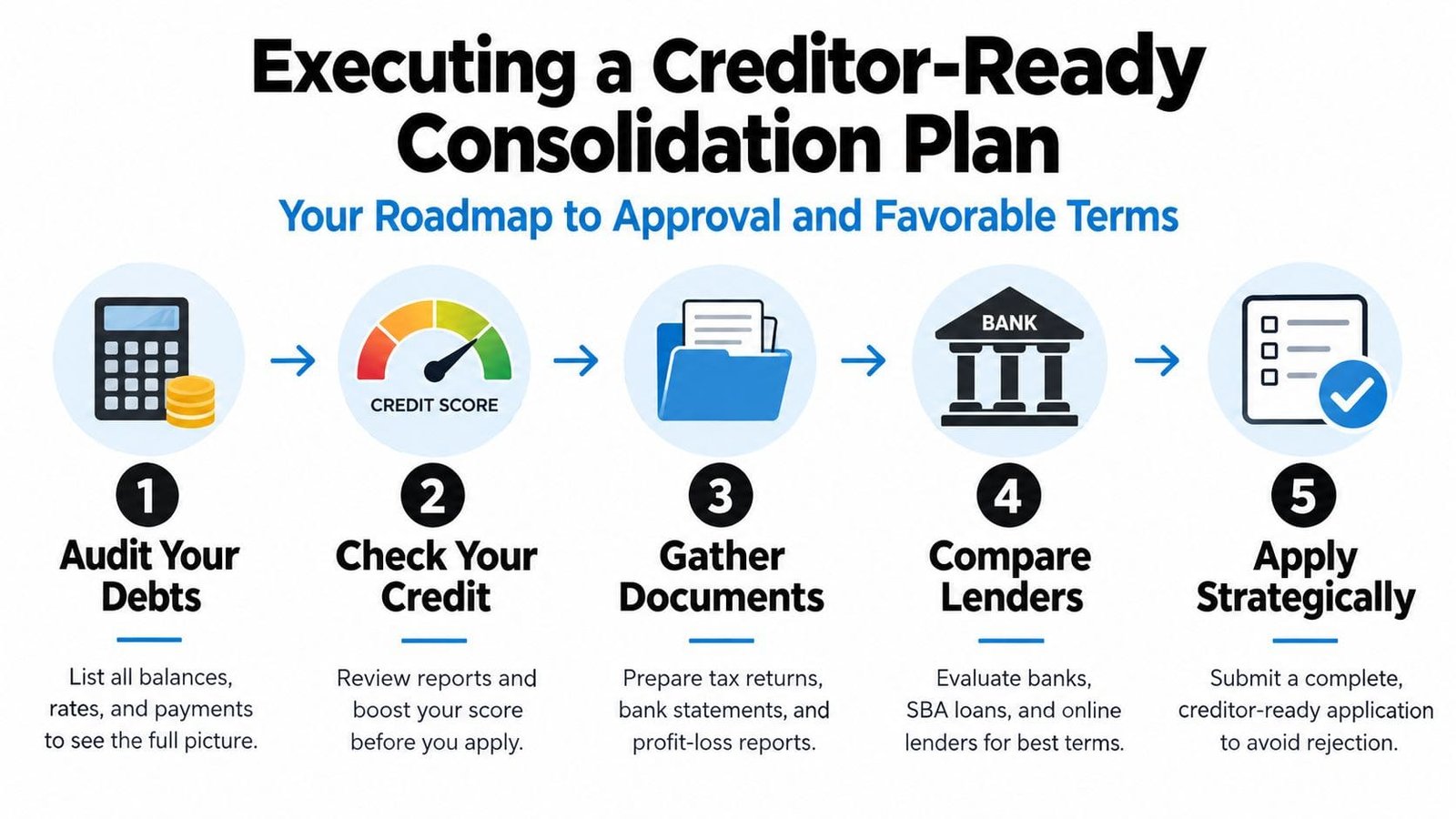
A lender doesn't approve your explanation. It approves evidence that the new obligation can be serviced. Apply before your records are organized, and you'll either face rejection or accept terms that solve this month while damaging the next several years.
Build the file before contacting lenders
First, create a debt schedule. List every creditor, outstanding balance, APR or factor rate, remaining term, payment frequency, payment amount, origination charges, prepayment terms, collateral, guarantees, and any default triggers. Don't rely on memory or a bank-app summary. Request payoff statements where necessary.
Next, separate debts that should be consolidated from debts that should remain in place. A low-cost equipment loan secured by an asset may be better left alone if replacing it would increase the rate or release a collateral trigger. High-cost short-term obligations are more obvious candidates, but only if the new facility reduces the total burden rather than spreading it over a longer, more expensive period.
Then prepare the operating evidence:
- Tax compliance: Gather filed business tax returns, current tax obligations, payment arrangements, and evidence that required filings are current.
- Bank activity: Organize business bank statements and explain unusual deposits, transfers, overdrafts, or owner contributions.
- Financial statements: Provide current profit-and-loss statements, balance sheets, accounts receivable, accounts payable, and inventory information.
- Cash-flow forecast: Show expected collections and every major cash requirement, including payroll, taxes, suppliers, rent, and the proposed debt payment.
- Debt purpose: State exactly which accounts the new facility will pay off and how much operating cash the new structure should preserve.
The business loan document checklist can help you identify missing records. Your objective is to make the lender's review easy and your own assumptions impossible to ignore.
Test the plan under pressure
Run the forecast using conservative sales assumptions and delayed collections. If the proposed payment works only when every customer pays on time and no unexpected expense appears, the facility is too aggressive.
ASIC's review of Australia's small-business restructuring process illustrates why preparation affects conversion. From 2022 to 2024, 3,388 appointments produced 3,227 proposed plans, about 87% were sent to creditors, and 87% of those plans were approved, according to ASIC-related analysis of plan outcomes. Yet only 79% of FY24–25 commencements transitioned to plan stage, compared with 88% in FY22–23. The lesson applies beyond formal restructuring: documentation and early cash-flow validation determine whether a proposal can move forward.
Use the video below as a practical supplement while you assemble your records.
Submit applications strategically. Ask lenders whether an inquiry is a soft or hard credit check, provide a complete package, and compare written offers using the same assumptions. Never accept a facility until you've confirmed how payoff funds will reach existing creditors and obtained written confirmation that each old account is closed or paid as agreed.
The Hidden Costs of Extending Amortization
A smaller payment can be useful, but it can also be cosmetic. If you turn expensive short-term debt into a much longer obligation, you may improve this month's cash balance while increasing the total interest paid over the life of the facility.
Calculate the break-even point before signing. Add the proposed interest, origination costs, closing costs, broker charges, and any existing prepayment penalties. Compare that figure with the remaining cost of each debt you plan to replace. Then test whether the monthly cash released is large enough to protect payroll, taxes, inventory, and essential supplier payments.
The cheapest monthly payment isn't necessarily the cheapest financing.
A lower payment needs a job
Cash released through consolidation should have a defined purpose. It may protect inventory purchases during a seasonal dip, keep payroll stable while receivables convert, or fund a marketing campaign with a measurable sales process. If the cash disappears into general spending, consolidation has postponed the problem.
Set a repayment policy before the new loan closes. Direct surplus cash toward the facility, maintain a minimum operating reserve appropriate to your business, and stop using the old credit lines unless you have a documented reason. A consolidation loan followed by new borrowing recreates the same structure with an additional payment.
Know when the tool is wrong
Formal restructuring becomes more relevant when the business can't meet obligations even under a realistic forecast, creditors are already demanding concessions, tax compliance is deteriorating, or new borrowing is required to make old payments. Direct renegotiation may be better when one creditor creates the bottleneck and a revised schedule can solve it without refinancing the entire capital structure.
Industry matters. Hospitality and construction represented 49.6% of recent Australian small-business restructuring appointments, according to sector reporting on restructuring appointments. These sectors often carry high fixed costs and cyclical revenue, so a lower payment won't solve a margin or demand problem. The same reporting states that 20% of first-time administrations in 2024–25 were restructurings, compared with 1% in 2021–22, a sign that formal restructuring is becoming a more visible option when consolidation no longer fits.
Navigating Eligibility and Credit Impacts
A lender evaluates repayment capacity before it evaluates your preferred payment structure. Strong revenue doesn't automatically mean strong eligibility. Underwriters typically review personal and business credit, time in operation, revenue quality, bank activity, available collateral, existing obligations, and the consistency of cash generation.
Your most important internal test is debt service coverage. Calculate the cash your business can realistically generate for debt service, then compare it with the proposed payment and other obligations that will remain. Use a conservative operating forecast, not a record sales month. If the ratio works only before taxes, owner draws, maintenance, or inventory purchases, the application isn't ready.
Protect the owner as well as the company
Many small-business facilities require a personal guarantee, particularly when the business lacks sufficient collateral or operating history. Read the guarantee carefully. Ask what events trigger liability, whether the guarantee is limited or unlimited, and what happens after a default, sale, closure, or restructuring.
Secured consolidation can reduce pricing, but it gives the lender rights over pledged assets. Don't secure a broad refinancing facility with assets that are essential to producing revenue unless the improved economics justify that exposure. A lower rate is not a bargain if losing the collateral would shut down operations.
Credit effects also depend on behavior and reporting. Applying can lead to a hard inquiry, and opening a new facility may affect both business and personal credit profiles. Timely payments can support credit history when the lender reports them, while missed payments can cause damage. Before you authorize a credit pull, ask the lender exactly what it reports and to which bureaus.
Shop without creating unnecessary damage
Start with lenders that offer a prequalification or pre-approval process without a hard inquiry, then move to a formal application only after you've compared structure and eligibility. Review the proposed rate, fees, payment frequency, collateral, guarantee, term, and payoff mechanics together.
Fintech platforms can make document collection and offer comparison faster, but speed shouldn't replace underwriting discipline. A quick approval for a high-cost facility may be worse than a slower approval for a structure that matches your revenue cycle. Your goal is not to obtain any loan. It's to obtain a facility that preserves debt service coverage after ordinary business expenses.
Your Strategic Action Plan for Debt Relief
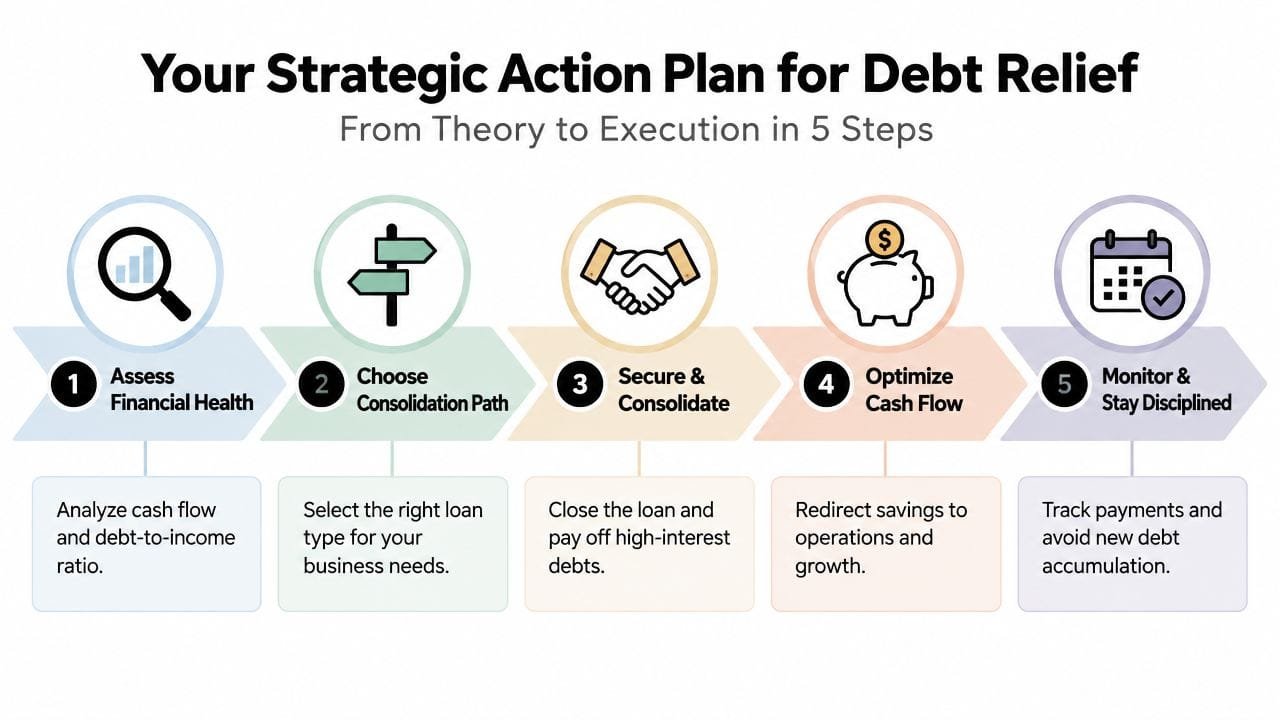
Start with a decision, not an application. If the business generates enough cash to service a properly structured facility and the main problem is fragmented timing, consolidation may improve survival. If one creditor is creating the pressure, negotiate directly. If the business can't support its obligations even after realistic cost and revenue assumptions, seek formal restructuring advice instead of adding debt.
Use this operating sequence
- Audit every liability. Record balances, rates, fees, payment frequency, remaining term, collateral, guarantees, and payoff amounts.
- Model the cash flow. Forecast collections and required spending, then add the proposed payment. Stress the forecast with slower customer payments and weaker sales.
- Choose the least damaging path. Compare consolidation, individual refinancing, direct creditor negotiation, and formal restructuring based on total cost and survivability.
- Secure written terms. Confirm the all-in cost, payment schedule, collateral, guarantee, prepayment rules, and exactly how existing accounts will be paid off.
- Prevent relapse. Close or restrict replaced credit, track weekly cash, and direct the released liquidity toward operating stability rather than new discretionary debt.
Decision test: If the new facility creates cash today but leaves the business unable to meet obligations during a normal weak period, it isn't relief. It's delayed restructuring.
Once consolidation closes, keep a separate payoff file with lender confirmations and account closures. Review cash flow regularly, monitor tax and supplier obligations, and maintain communication with creditors before a missed payment occurs. If your situation involves legal exposure, guarantees, or formal insolvency options, a practical resource such as 2026 Utah business debt help can provide additional context, but it shouldn't replace advice specific to your contracts and jurisdiction.
The strongest outcome isn't just one monthly payment. It's a capital structure that gives the business room to operate, preserves debt service capacity, and reduces the chance that you'll need another emergency facility.
Business Loan Warrior helps small-business owners compare funding options for consolidation, refinancing, working capital, and SBA financing through a single application. Visit Business Loan Warrior to review your options and move forward with a debt structure built around your actual cash flow.