
A client payment is late, two vendor invoices are due, and payroll won't wait. You know the work is coming in, but the cash hasn't landed yet. Borrowing could bridge the gap, or it could add payments that make next month harder.
That is the actual decision behind debt for business: not whether debt is good or bad, but whether a specific financing offer fits a specific need and the business can repay it under pressure. Before signing, match the product to the purpose, calculate the all-in cost, and test the payment against a bad month.
Table of Contents
- Why Smart Business Owners Borrow on Purpose
- The Main Categories of Business Debt
- Debt Versus Equity and When Each Makes Sense
- The True Cost of Borrowing Beyond the Headline Rate
- Matching the Right Debt Product to the Right Use Case
- Stress Testing Debt Service Before You Sign
- Common Debt Traps and When to Walk Away
- Your Pre Borrowing Checklist and Next Steps
Why Smart Business Owners Borrow on Purpose
A service-business owner with payroll due Friday might use a business line of credit to cover wages while waiting for a reliable client payment. That can be sensible if the receivable is real, the payment will arrive soon, and the owner has a clear plan to repay the draw. The same line becomes dangerous if it's routinely covering a cash shortfall that the business can't close.
Debt can also pay for an asset or opportunity that produces revenue, such as equipment that increases capacity or inventory ordered for confirmed demand. But a loan doesn't make a weak business model stronger. If the return from the spending is uncertain and the repayment schedule is fixed, borrowing can turn a problem into a larger one.
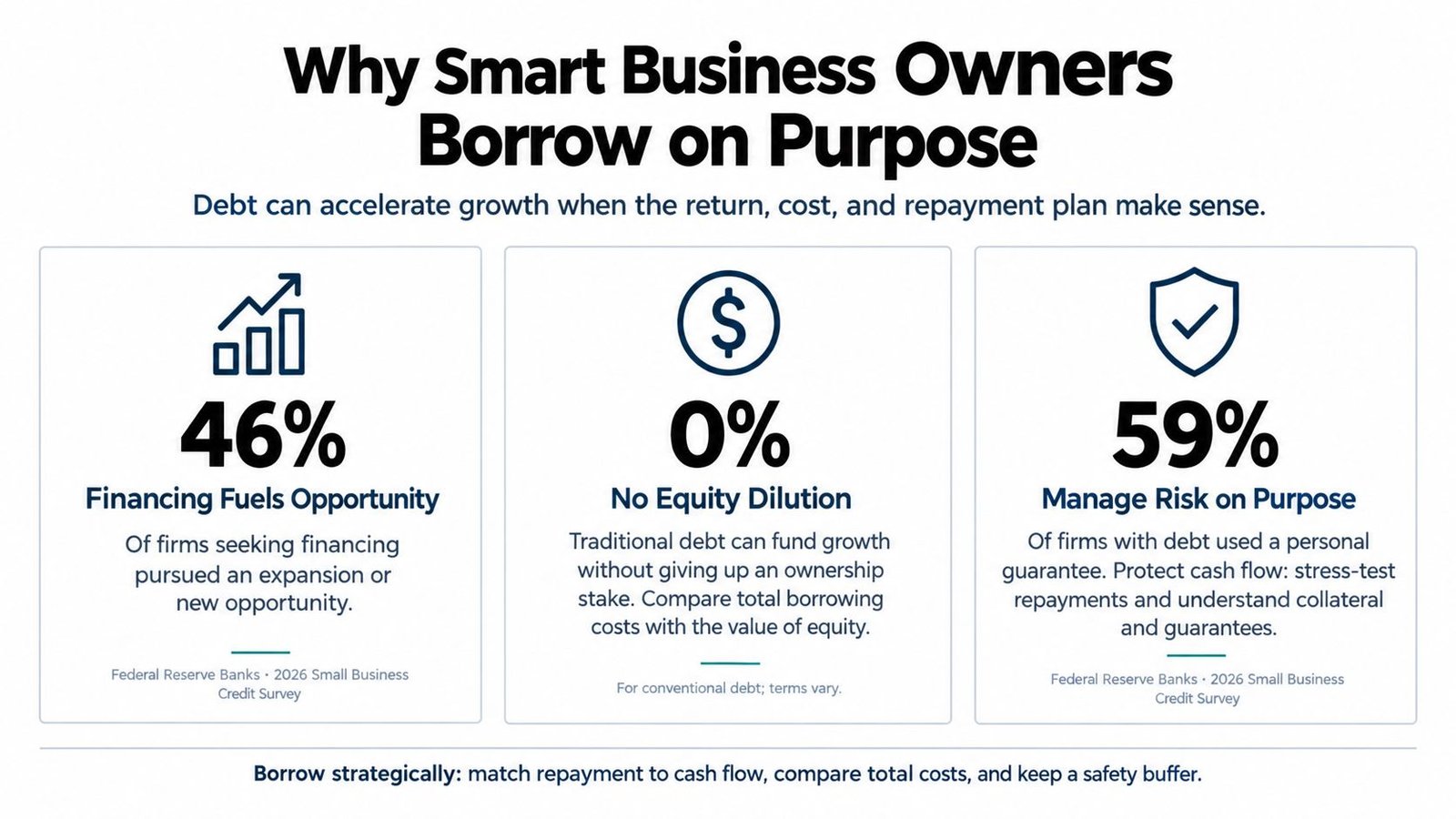
The Federal Reserve's 2025 Report on Employer Firms found that 59% of surveyed small employer firms sought new financing in the previous year. Among applicants, 56% sought financing to meet operating expenses, while 46% sought it for expansion or a new business opportunity. Only 41% received all the financing they requested, and 24% received none, according to the Federal Reserve's report on employer firms.
| Purpose | Share of applicants | Best debt fit |
|---|---|---|
| Meeting operating expenses | 56% | Line of credit for temporary timing gaps |
| Expansion or a new opportunity | 46% | Term loan or SBA loan, depending on the project |
The figures overlap because firms can seek financing for more than one purpose. The practical lesson is to borrow for a defined use, not only because a lender has offered a limit. A financing plan should name what the money will pay for, how that spending supports cash flow, and which incoming funds will cover repayment.
The Main Categories of Business Debt
Think of debt as rented capital. You receive money or an asset now, then repay it under agreed terms. The product determines how you access the funds, how often you pay, and what the lender can claim if you don't.
Lump-sum and revolving options
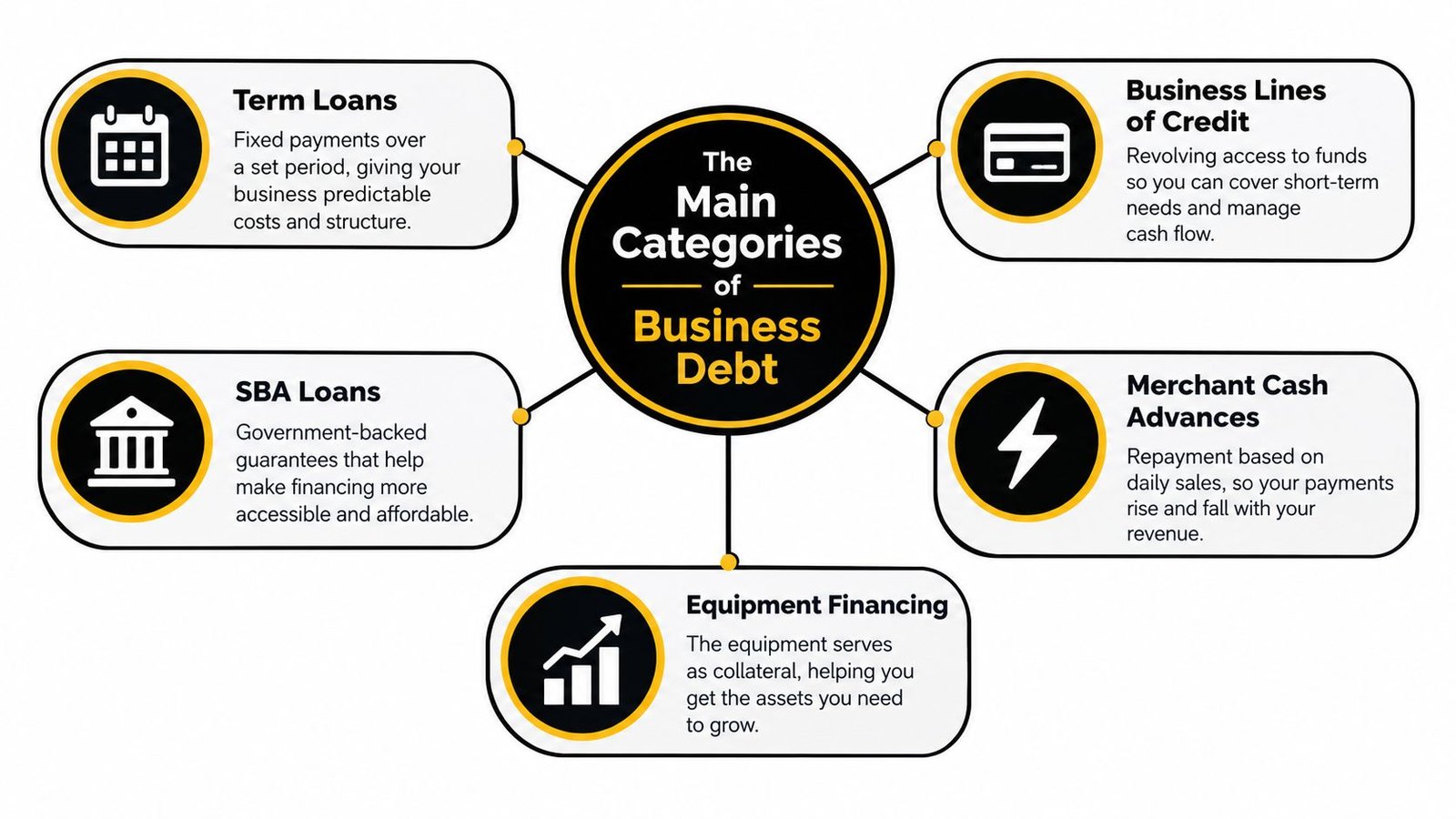
A term loan works like a fixed mortgage for the business: the lender advances a lump sum, and the business repays principal and interest on a schedule. It can suit a defined project with costs that can be estimated in advance. Check whether the rate is fixed or variable, and whether a personal guarantee or collateral is required.
A business line of credit is closer to a controlled, revolving credit card. You draw what you need, repay it, and may be able to borrow again up to the approved limit. It's useful for temporary working-capital gaps, but it's a poor substitute for sustainable revenue if the business stays close to its limit.
An SBA loan is made by a participating lender with a government-backed guarantee on part of the loan, subject to the program's rules. It can offer a longer-term structure for eligible businesses and projects, but the application and documentation process can take more work than some alternative financing.
Financing tied to sales or assets
A merchant cash advance (MCA) provides funds in exchange for a portion of future sales or an agreed repayment amount. Payments may be collected frequently, sometimes as a share of card receipts. The speed can appeal to a business with urgent needs, but the cost and payment mechanics deserve close scrutiny.
Invoice financing lets a business access funds tied to outstanding invoices. It can help when customers pay slowly, but fees, recourse terms, and customer-notification rules vary. Equipment financing supports an equipment purchase, with the equipment often serving as collateral. That can align the repayment with the asset's useful life, but default may put the asset at risk.
Don't select by product name alone. Ask how funds are disbursed, what triggers repayment, what secures the obligation, and whether the agreement includes a personal guarantee.
Debt Versus Equity and When Each Makes Sense
Debt and equity solve the same immediate problem, getting capital into the business, but they charge you in different ways. Debt is a rental agreement with a lender: you keep ownership, but you owe payments and interest. Equity is selling pieces of the house: there's no scheduled loan repayment, but you give up some ownership and may share control and future upside.
| Decision point | Debt | Equity |
|---|---|---|
| Ownership | Owners generally retain their shares | New investors receive an ownership stake |
| Cash pressure | Scheduled payments can strain cash flow | No standard loan payment, though investors expect progress and returns |
| Control | Lenders may impose covenants or guarantees | Investors may seek influence over major decisions |
| Best fit | Established cash flow and a defined repayment plan | High-growth potential, uncertain near-term cash flow, or strategic investor value |
A stable business with recurring revenue may be able to borrow for equipment or a planned expansion and repay from operating cash flow. A young company investing heavily before revenue is predictable may find equity more suitable, especially if an investor brings useful expertise or connections. The trade-off is that equity can be expensive over time if the business grows substantially.
Tax treatment matters, but don't let a possible interest deduction decide the financing choice. Tax rules depend on the business and loan structure, and a deduction doesn't erase the cost of interest or fees. Ask a qualified tax professional how a particular arrangement applies to your company.
Decision rule: Use debt when the business can make payments from realistic cash flow. Consider equity when repayment would put operations at risk and the investor's contribution justifies dilution.
The True Cost of Borrowing Beyond the Headline Rate
A quoted rate is not the same as the amount your business will pay. A factor rate, origination fee, frequent debit, or prepayment restriction can change the economics substantially. Compare offers using the total dollars repaid, the timing of each payment, and the amount of usable cash that reaches the business.
For example, a factor rate multiplies the advance to set the repayment total. If a lender advances $100,000 at a 1.18 factor rate, the scheduled repayment is $118,000 before any other fees. That's a simple illustration, not an annualized rate: the actual annualized cost depends on how quickly the lender collects payments, how the balance declines, and what fees apply. Don't compare that factor figure directly with a loan's annual percentage rate.
The Federal Reserve's 2025 Small Business Credit Survey found that 60% of firms borrowing from online lenders said their actual borrowing costs were higher than expected, while 4% said costs were lower than expected, according to the Federal Reserve's online-lender findings. That gap is a reason to ask for a complete written repayment schedule before accepting an offer.
| Cost element | What to check | Why it matters |
|---|---|---|
| Fees | Origination, underwriting, closing, and other charges | Fees reduce the cash you receive or increase total repayment |
| Repayment frequency | Daily, weekly, or monthly debits | Frequent withdrawals can strain working cash |
| Prepayment terms | Penalties, discounts, and payoff calculation | Early payoff may not reduce the cost as expected |
| Guarantees and collateral | Personal guarantee, lien, or asset pledge | Default can reach beyond the business's cash flow |
For a useful reminder that project costs extend beyond a single headline figure, see this Dubai business setup fee breakdown. The same discipline applies to financing: list each charge, the repayment schedule, and the obligations attached to the offer. For a closer look at borrowing expense, review this guide to the cost of debt.
Matching the Right Debt Product to the Right Use Case
Start with the expense, then choose the financing. A product that fits equipment can be a poor choice for payroll, and a revolving facility can become costly if you use it to fund a long-term project without a payoff plan.
Match the repayment to the business need
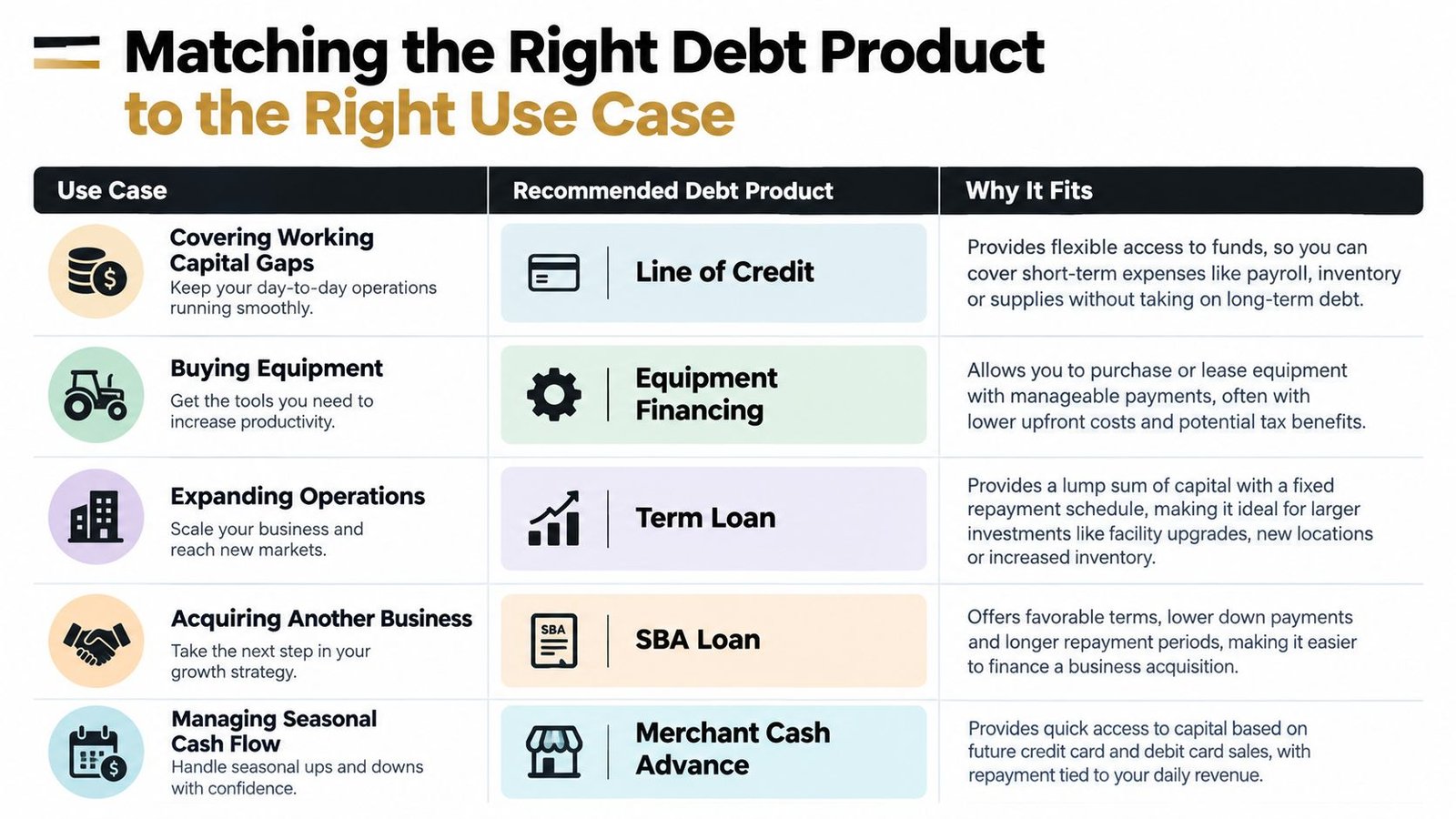
- Working-capital gaps: A line of credit can bridge a short delay between paying suppliers and collecting from customers. If the gap repeats because the business routinely spends more than it earns, borrowing won't fix the underlying problem.
- Equipment purchase: Equipment financing may fit when the asset supports revenue or efficiency and its useful life lines up with the loan term. Confirm what happens if the equipment breaks, becomes obsolete, or can't be used.
- Expansion: A term loan or SBA loan may suit a location build-out or planned capacity increase when the business can support longer-term payments. For a construction or office project, commercial office project budgeting help can help owners think through project costs before arranging financing.
- Business acquisition: An SBA loan or conventional term loan may be worth exploring, depending on eligibility, the purchase structure, and the acquired company's cash flow. Don't base repayment on optimistic projections alone.
- Higher-cost debt consolidation: Consolidation can simplify payments or lower the cost only if the new agreement is genuinely better after fees. A longer term may reduce each payment while increasing total interest and keeping the business in debt longer.
| Use case | Product to consider | Main caution |
|---|---|---|
| Short-term cash-flow gap | Line of credit | Don't leave the balance permanently drawn |
| Equipment | Equipment financing | The asset may secure the debt |
| Expansion | Term or SBA loan | Forecast the ramp-up period carefully |
| Acquisition | SBA or term loan | Validate cash flow and purchase assumptions |
| Seasonal sales pattern | Short-term financing or MCA | Check payment frequency against receipts |
A line of credit versus installment loan comparison can help clarify how revolving access differs from a fixed repayment schedule.
For a visual overview of how common needs map to financing choices, see the video below.
Stress Testing Debt Service Before You Sign
A payment that works in a good month may fail when sales soften or customers pay late. Before borrowing, calculate whether available cash can cover all existing debt service plus the proposed payment, not just the new loan by itself.
The debt-service coverage ratio (DSCR) is cash flow available for debt service divided by annual principal and interest. If a business has $180,000 available for debt service and annual principal and interest obligations of $150,000, its DSCR is 1.2. That means projected cash flow exceeds scheduled debt service, but it doesn't guarantee the business has enough liquidity for every expense or surprise.

Model a downside, not just the forecast
Run the calculation under your base forecast, then under a case where revenue falls, margins tighten, or a variable rate rises. Use assumptions drawn from your own business: a slower collection cycle, fewer booked jobs, supplier price increases, or a seasonal dip. If the payment only works when every assumption goes right, the loan is too large or the term is too short.
The Federal Reserve's survey of small employer firms found that 41% of firms denied financing attributed the denial to high debt, up from 22% in 2021, as described in its small-business pandemic recovery findings. Existing obligations can limit both repayment capacity and access to future credit.
Build a debt schedule listing every payment, rate, maturity, and security interest. Include credit cards, equipment notes, merchant advances, and leases if you treat them as debt in your cash planning. This guide to a debt schedule can help organize the information.
A lender's approval tells you the lender is willing to offer the money. It doesn't prove the payment is comfortable for your business.
Common Debt Traps and When to Walk Away
Fast funding can be useful, but speed doesn't make an offer affordable. An advance may help a contractor buy materials for a confirmed project or a retailer stock inventory for a predictable seasonal rush. It's far less defensible when the business is borrowing to cover a recurring operating shortfall with no clear source of repayment.
Watch for the debt treadmill: renewing a high-cost advance to pay off the previous one, stacking short-term products to cover a structural cash gap, or using personal credit cards for ongoing business expenses. Each move can create more frequent payments without fixing the mismatch between collections and spending. Before taking new money, identify the specific inflow or savings that will repay it.
Rising debt isn't automatically a sign of growth. The OECD reported that global corporate bond debt reached approximately $35 trillion at the end of 2024, and that debt-to-GDP ratios rose in 30 of 38 OECD countries between 2008 and 2024, with a median increase of 9 percentage points, in its Global Debt Report 2025. For U.S. small employer firms, the share reporting more than $100,000 in outstanding debt was 39% in 2023, compared with 31% in 2019, according to the Cleveland Fed's small-business debt survey release.
Walk away if the lender won't provide a clear repayment schedule, the total cost is hard to calculate, or the business has no credible repayment source. Also pause if the offer depends on refinancing again later. Borrowing should fund a defined outcome, with a realistic payoff or refinance plan, not an indefinite chain of renewals.
Your Pre Borrowing Checklist and Next Steps
Use this sequence before signing. If you can't answer each point clearly, don't rush the application.
- Name the use. Write down what the funds will pay for and what business outcome they're expected to support.
- Match the product. Choose a repayment structure suited to the timing of the expense and the cash it should generate.
- Calculate all-in cost. Ask for the net proceeds, total repayment, every fee, payment frequency, and prepayment terms in writing.
- List every obligation. Include existing loans, cards, advances, and other payments that affect available cash.
- Stress-test the payment. Check debt service under your normal forecast and a realistic downside case.
- Review guarantees and collateral. Know what assets or personal commitments are exposed before you accept.
Questions owners should ask
How much business debt is too much? There's no universal balance that fits every company. Debt is too high when realistic cash flow can't cover scheduled payments while leaving enough for payroll, suppliers, taxes, and routine operating needs.
Will I always need a personal guarantee? No, but many small-business lenders require one, especially when the company has limited assets or credit history. Ask what the guarantee covers and whether it applies to the full obligation.
What will underwriters expect? Be ready to explain the purpose of the loan and provide financial statements, business and personal tax returns, bank statements, a debt schedule, and projections. Requirements vary by lender and product, so prepare a clear account of how the business will repay.
When does SBA financing beat a conventional bank loan? It may be worth pursuing when the business qualifies and the SBA structure offers a more workable term or access to financing that a conventional loan won't provide. Compare the full cost, eligibility requirements, collateral terms, and timeline before choosing. Founders setting up abroad can also review renn's guide for expat founders when planning a business launch in Spain.
Your next step is simple: gather your current debt statements, build a repayment schedule, and compare any new offer against your downside cash-flow forecast. If the business can't make the payments without relying on another loan, wait or seek a different structure.
Business Loan Warrior helps small businesses compare financing options, from lines of credit and term loans to SBA, equipment, and acquisition financing, through a single application with no application fee. If you're weighing a loan against your cash-flow needs, visit Business Loan Warrior to explore funding options and review what may fit your business.