
You've found two commercial properties that both look workable on paper. The warehouse has dependable utility, the retail endcap has visible traffic, and your lender says either deal could pass underwriting. Then the equity requirement arrives, and the decision stops being about which property you prefer. It becomes a question of which check your business can write without damaging payroll, inventory, or operating reserves.
That's the core issue behind down payment commercial property financing in 2026. The required equity isn't a fixed percentage. It moves with the loan program, property type, owner-occupancy, cash flow, appraisal, and your financial profile. Conventional commercial loans commonly require 20% to 35% equity, while an owner-occupied SBA 504 structure can begin near 10%, subject to program and risk factors (The Credit People, Crestmont Capital).
The practical question is simple: What amount of cash must you bring, and what will remain after closing? The sections below map that answer across SBA 504, SBA 7(a), conventional, and construction financing, then account for the costs hidden behind the headline down payment.
Table of Contents
- The Moment the Down Payment Becomes the Deal
- What Down Payment Really Means in Commercial Property
- Typical Down Payments by Loan Program
- Factors That Move Your Required Down Payment
- The Hidden Cash You Still Need Beyond the Down Payment
- Smart Strategies to Lower Your Upfront Cash
- Putting It Together and Choosing Your Next Step
The Moment the Down Payment Becomes the Deal
A business owner recently comparing commercial properties might see a $1.4 million warehouse and a $900,000 retail endcap. Both properties may support the business plan. Both may have acceptable inspections, defensible valuations, and a lender willing to discuss terms. Yet the cheaper property isn't automatically the safer choice, and the warehouse isn't automatically the better investment.
The deciding factor is often the equity check. A conventional lender working within a 65% to 75% LTV range could require roughly 25% to 35% down, depending on the asset and borrower profile (Fidelity Commercial). Applied to either purchase, that difference can consume cash needed for hiring, equipment, tenant improvements, or a slow leasing period.
The deal has to survive both underwriting and the wire transfer.
Many buyers focus first on the interest rate. That's understandable, but the rate usually isn't the first constraint to break a purchase. The initial equity requirement is. A loan with attractive pricing can still be wrong for your company if funding it leaves no operating cushion.
Four variables set the target
Your required down payment changes according to:
- Loan program: SBA structures can reduce the borrower's equity requirement for eligible owner-occupied property, while conventional financing usually demands a larger contribution.
- Property use: An operating company occupying the building is evaluated differently from an investor buying a property solely for rental income.
- Asset class: Industrial, retail, office, hospitality, and special-use properties create different levels of collateral and cash-flow risk.
- Borrower profile: Liquidity, credit history, business experience, and debt-service capacity influence the lender's willingness to extend credit.
The rest of the analysis should start with the amount your business can safely contribute, not the maximum loan a lender advertises. A property purchase is successful only when the business can close, operate, absorb ordinary surprises, and continue servicing debt afterward.
What Down Payment Really Means in Commercial Property
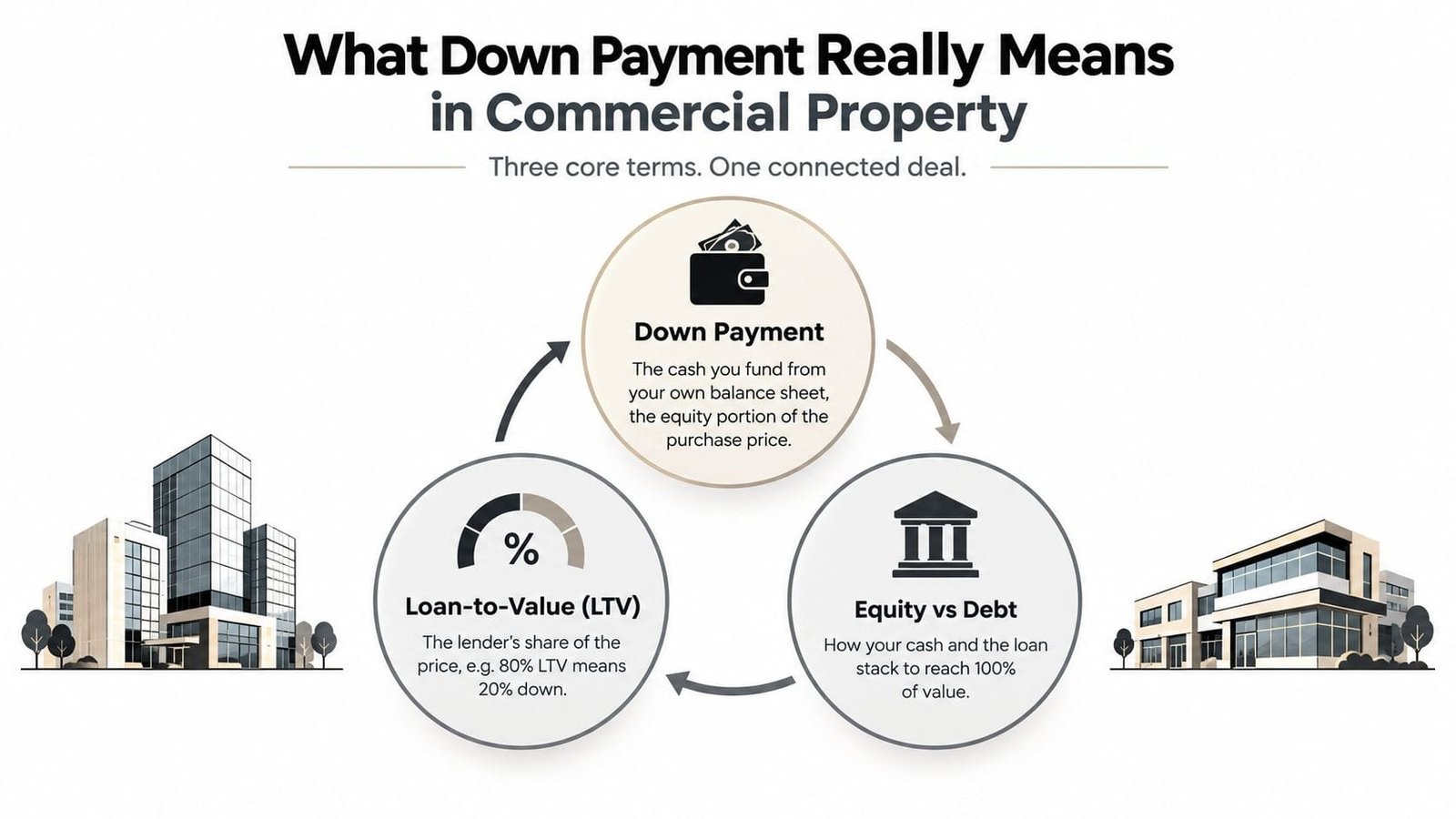
Commercial borrowers often use down payment, LTV, and equity injection as though they mean the same thing. They don't.
The down payment is the portion of the purchase price funded from your balance sheet. Loan-to-value, or LTV, compares the loan amount with the property's value. At 75% LTV, a $1 million property supports a $750,000 loan and requires $250,000 of purchase-price equity. The remaining value is your ownership stake in the collateral.
Equity injection is broader. It can include the down payment, eligible transaction expenses, project costs, and other cash the lender requires you to contribute. The distinction matters because the purchase-price calculation can look manageable while the total cash requirement remains uncomfortable.
A simple way to calculate the layers
Take an owner-occupied office valued at $1 million. At 75% LTV, the down payment is $250,000. The actual equity injection can be higher once appraisal, title, legal, environmental review, recording, and lender charges enter the closing statement.
The exact total depends on the transaction. That's why you should build a cash-to-close schedule before making an offer, rather than treating the LTV calculation as the entire funding plan.
Earnest money is different again. It's a deposit paid under the purchase contract and held according to the agreement, usually credited toward the purchase at closing if the transaction proceeds. It isn't the same as the permanent equity contribution, and its treatment depends on the contract and lender documentation. For a practical explanation of how earnest money works, review these earnest money details.
Commercial lenders also focus heavily on debt-service coverage ratio, or DSCR. They want the property's cash flow, or the operating business's supported cash flow in an owner-user deal, to cover the proposed debt. That's different from a residential mortgage decision, where personal income and household obligations often dominate. The lender calibrates commercial equity to the asset's ability to withstand weaker revenue, vacancy, repairs, or a lower appraisal.
Typical Down Payments by Loan Program
The down payment is set by the loan program, property type, and borrower profile. Start with three questions: Will your business occupy the property, what asset class are you buying, and does the projected cash flow support the debt? Those answers narrow the realistic equity range faster than a generic percentage.
For an eligible owner-occupied project, the standard SBA 504 structure uses 50% bank financing, 40% CDC/SBA financing, and 10% borrower equity. The borrower contribution can rise to 15% or 20% when the project involves higher risk, such as a startup, a special-purpose property, or both (SBA 504 equity requirements). Review the SBA 7(a) versus 504 comparison before choosing between 504's lower-equity potential and 7(a)’s broader flexibility.
SBA 7(a) can finance eligible owner-occupied commercial real estate, often with a borrower contribution in the 10% to 20% range. Lender policy, business strength, project risk, and deal structure determine the actual requirement (Skip the Agent). Conventional financing generally requires more equity. Major-market examples commonly place LTV around 65% to 75%, which implies approximately 25% to 35% down.
| Loan Program | Typical Down Payment | Typical LTV | Best Fit | Key Trade-off |
|---|---|---|---|---|
| SBA 504 | 10%, rising to 15% or 20% in higher-risk cases | Up to roughly 90% in the standard structure | Owner-occupied real estate and long-term business use | Eligibility, documentation, and property-use rules are strict |
| SBA 7(a) | Often 10% to 20% | Varies by lender and deal | Smaller or flexible business acquisitions involving eligible real estate | Terms and equity requirements can vary materially by lender |
| Conventional commercial | Commonly 20% to 35% | About 65% to 75% in many major-market examples | Established borrowers and stabilized properties | Larger equity check, especially for riskier assets |
| Construction or heavy rehabilitation | Often requires substantial cash and project equity | Varies by project and lender | Ground-up development or major renovation | Draw controls, completion risk, and conversion risk add complexity |
Mixed-use property financing requires separate review of the business-use portion and the investment component. Use this guide to mixed use property loans to organize questions before requesting term sheets.
Choose the program by matching the equity requirement to occupancy, asset class, DSCR, and execution timeline. The smallest advertised down payment can still produce the wrong loan if the property fails eligibility or the cash flow leaves too little room for weaker performance.
Factors That Move Your Required Down Payment
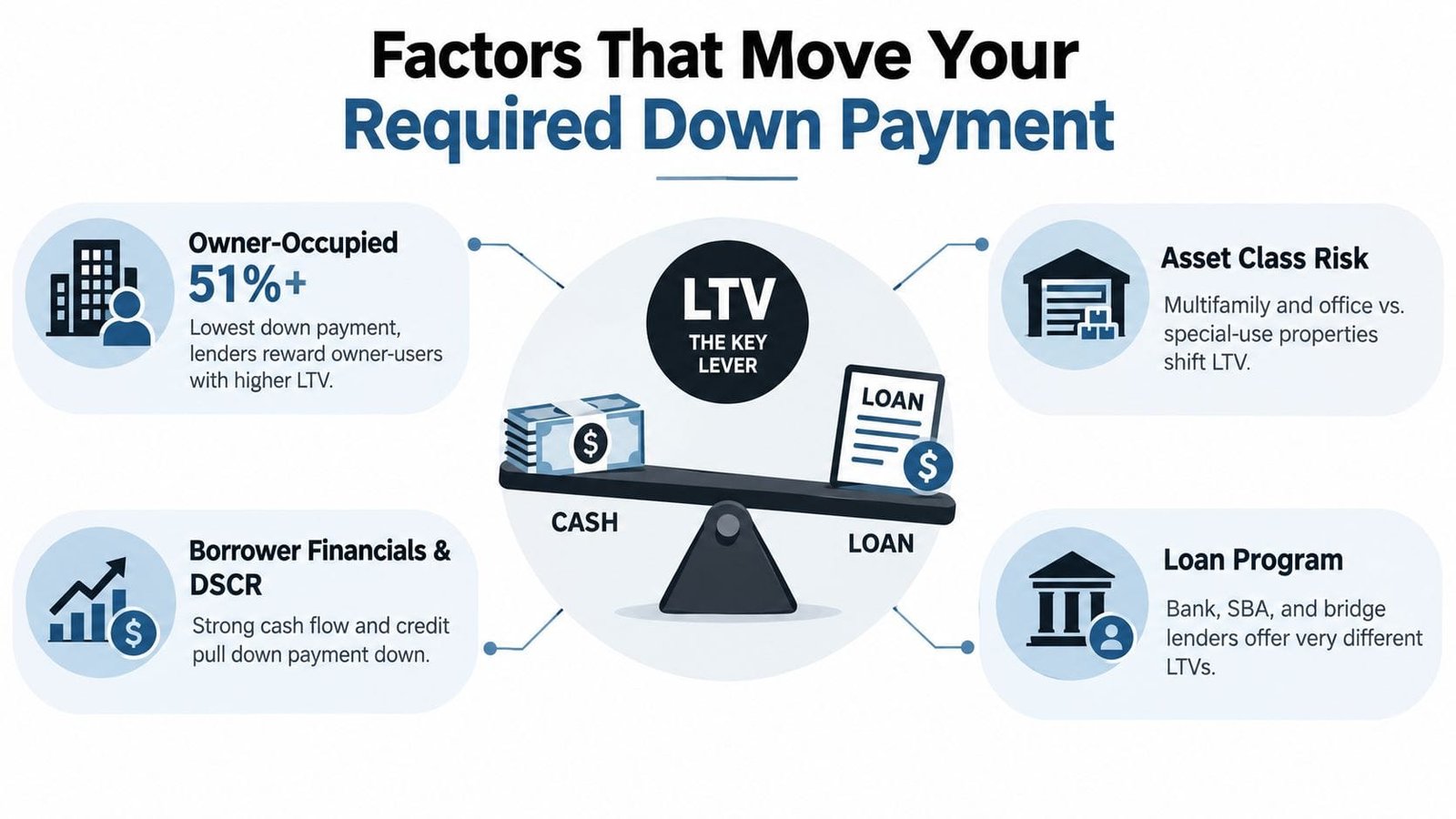
The down payment is a moving target. The loan program, property type, owner-occupancy plan, and borrower profile determine the equity your lender will require. Start with those four inputs, not a generic percentage.
Owner-occupancy usually sets the first branch of the decision. If your operating company will use the required portion of the building, SBA financing may be available for eligible real estate. A pure investor buying a non-owner-occupied property generally enters conventional underwriting and may need more equity. Labeling an investment purchase as a business facility will not fix an occupancy problem.
Property risk changes the equity check
Asset class affects the lender's recovery risk. A functional industrial building with clear commercial use may be easier to finance than a specialized facility with few alternative users. Hospitality, restaurants, special-use properties, undeveloped land, and projects that depend on future leasing can receive tighter financing.
Office and retail commonly support 70% to 75% LTV, while specialized assets may fall toward 60% to 65% LTV. That difference directly changes the cash you must bring. The lender is assessing whether the property can produce enough income and whether it can be sold efficiently after a default, not judging its appearance.
Your file can move the number too
Your liquidity, net worth, credit quality, business experience, and operating history all affect the equity decision. Strong liquidity and consistent cash flow give the lender more protection. Committing every available dollar to the purchase makes the file harder to approve, even when the property itself looks sound.
DSCR is the next decision point. Durable tenancy and comfortable cash flow support a different structure from a startup operation with little room for weaker performance. The lender and program set the exact threshold, but the direction is consistent. Stronger coverage can support better terms, while weak coverage can lead to more equity, additional collateral, or a decline.
Before requesting a quote, prepare the inputs that control the answer:
- Occupancy plan: Document who will use the space and how much the operating company will occupy.
- Property condition: Identify deferred maintenance, environmental concerns, and functional obsolescence before underwriting.
- Appraisal support: Prepare for an appraisal gap if the contract price exceeds defensible market value.
- Financial capacity: Organize business statements, personal financial information, liquidity evidence, and debt schedules.
- Valuation analysis: Review this commercial real estate valuation resource to examine the income, sales, and cost factors supporting the requested financing.
The practical decision tree is clear: confirm occupancy, classify the asset, test DSCR, then match the loan program to the resulting equity requirement. That process gives you a lender-ready number instead of relying on a headline percentage.
The Hidden Cash You Still Need Beyond the Down Payment
The headline percentage is only the first line of the funding plan. You may have the required purchase-price equity and still fail to close because the lender, seller, or your operating plan requires additional liquidity.
The cash stack usually includes four separate categories:
- Closing expenses: Legal work, title, appraisal, environmental review, recording, lender charges, and other transaction costs.
- Build-out and improvements: Tenant improvements, equipment installation, code work, signage, and repairs may sit outside the core property loan.
- Reserves: The lender may want cash remaining after closing for debt service, taxes, insurance, repairs, or operating volatility.
- Operating cushion: Your company still needs working capital after the property closes. A fully funded real estate purchase that starves the business is a failed financing plan.
Why the cash-to-close schedule matters
Conventional lenders may allow certain project contributions or credits to be treated differently from SBA lenders. SBA injection rules can be stricter, so a cost that appears to reduce your cash need in a conventional structure may not satisfy the required borrower contribution in an SBA file.
Special-use assets create an even wider gap. Neutral commercial financing guidance indicates that standard deals often require 20% to 35% down, while hotels or undeveloped land can require 30% to 50% or more (Axiant Partners). That is before accounting for reserves, improvements, and stabilization needs.
| Cost Category | Typical Range | SBA vs Conventional |
|---|---|---|
| Down payment | Varies by program, property, and borrower | SBA may permit lower equity for eligible owner-occupied property |
| Closing costs | Transaction-specific | SBA and conventional lenders may treat eligible costs differently |
| Improvements and build-out | Depends on condition and use | May be financed, limited, or funded separately |
| Reserves and operating liquidity | Determined by lender and business risk | Both structures may require post-close liquidity |
Plan the transaction around total liquidity, not the smallest down-payment headline.
A disciplined buyer builds a sources-and-uses schedule showing purchase equity, closing expenses, improvements, reserves, and working capital separately. Then stress-test the business under weaker revenue and higher property expenses. If the deal only works when every assumption is perfect, the equity requirement is already too high for that business.
Smart Strategies to Lower Your Upfront Cash
The right way to lower upfront cash is to match the financing structure to the property, occupancy plan, and borrower profile. Start with the program, then test whether the resulting equity requirement leaves enough liquidity for operations.
Start with the program that fits the use
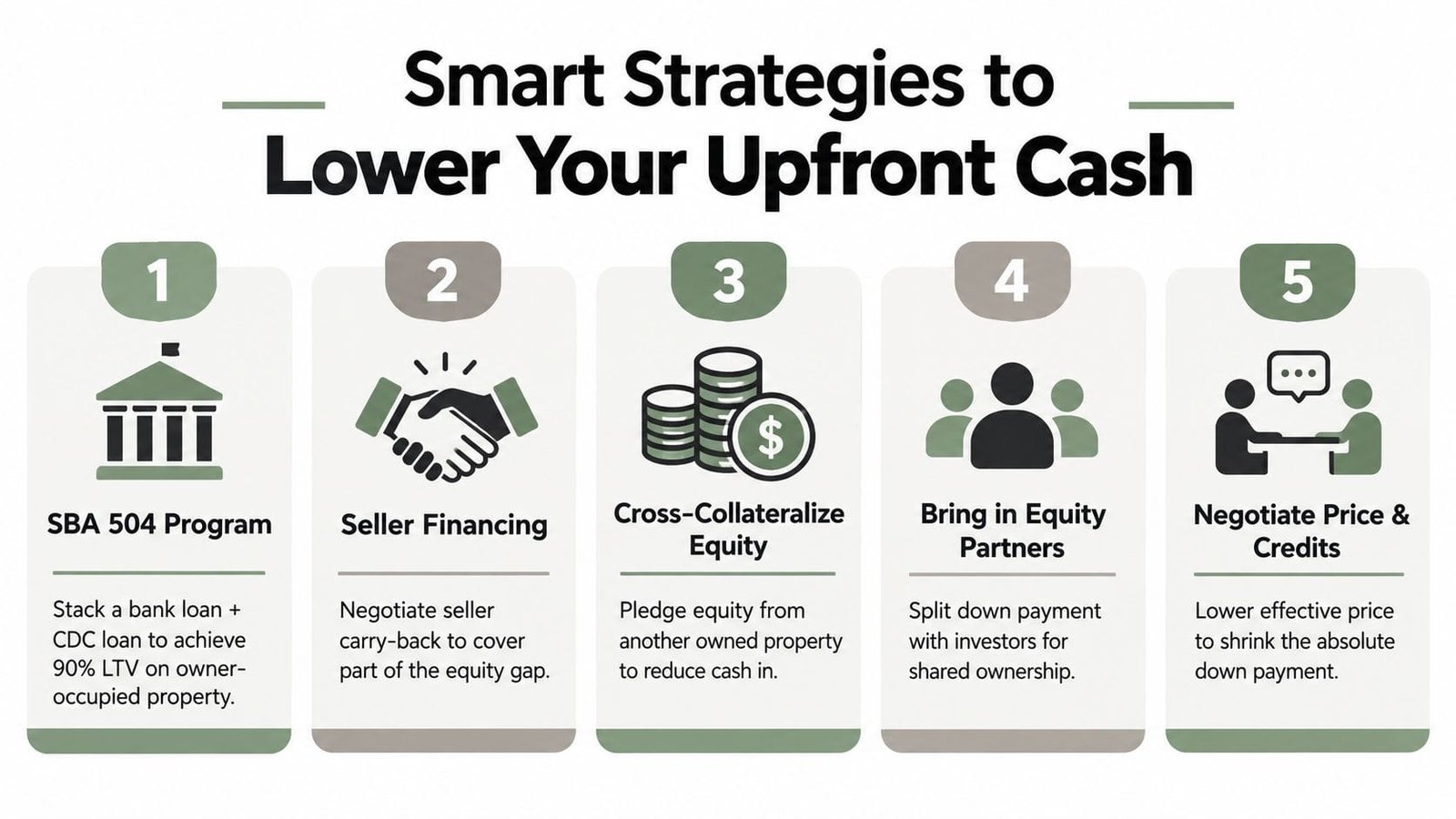
For an eligible owner-occupied purchase, SBA 504 deserves the first review. Its standard structure can place 10% borrower equity alongside 50% bank financing and 40% CDC/SBA financing. Eligibility, occupancy, documentation, and project requirements still apply, so a lower equity contribution does not mean a simpler approval.
SBA 7(a) may fit better when the transaction needs a broader business-purpose package. Its flexibility can help combine real estate with other eligible uses, while the lender's equity requirement and underwriting approach may differ. Ask lenders to underwrite the same property under both programs before choosing.
Use negotiated capital carefully
Seller financing can cover part of an equity gap through a seller-held second mortgage or another negotiated structure. It preserves cash at closing, but adds repayment obligations, intercreditor requirements, and possible personal recourse. Cross-collateralization may also reduce the cash contribution while placing another property at risk if the deal struggles.
Other tools include:
- Portfolio lenders: A community bank or credit union that holds loans may offer more flexibility than a rigid secondary-market execution. Pricing and relationship requirements can differ.
- Equity partners: A partner can provide the injection when you bring operating expertise but have limited liquidity. The cost is shared ownership, reduced control, and a share of future profits.
- Seller credits: Credits may reduce certain closing or repair burdens when properly documented. They do not automatically replace required borrower equity.
- Phased improvements: Separate urgent work from discretionary upgrades. Complete the required scope at closing, then fund later improvements from operating cash flow when the business can support them.
- Leaseback structures: A seller leaseback can preserve occupancy for the seller while giving the buyer an occupied asset. The lease must withstand underwriting and market review.
Watch the video below for another perspective on structuring commercial property financing.
Before accepting owner financing, review repayment mechanics, lien priority, default remedies, and transfer restrictions. This definition of owner financing provides useful terminology for that discussion. Compare the full cost, not only the cash required at closing.
Putting It Together and Choosing Your Next Step
The right commercial property financing structure follows a decision sequence. It doesn't begin with a generic percentage copied from a lender website.
Run the deal through four questions
- Confirm the use. Will your operating company occupy the required portion of the property, or is this an investment acquisition? Identify the asset class and any special-use concerns.
- Map the programs. Compare SBA 504, SBA 7(a), conventional, and construction options against the equity you can contribute without weakening the business.
- Stress-test the cash flow. Model debt service, vacancy, repairs, taxes, insurance, and working capital needs. Review DSCR under less favorable assumptions, not just the base case.
- Close the equity gap responsibly. Evaluate seller financing, partners, credits, collateral, and phased improvements. Every solution has a cost, whether it appears as interest, recourse, dilution, or reduced control.
Your immediate checklist is short:
- Pull the last twelve months of business financial information and current debt schedules.
- Request two lender quotes on the same property, not two quotes on different assumptions.
- Prepare a pro forma that separates down payment, closing costs, reserves, build-out, and post-close working capital.
- Confirm the appraisal basis, occupancy plan, property condition, and required borrower liquidity.
- Compare total cash-to-close before you negotiate the final purchase price.
Business Loan Warrior can help business owners evaluate funding paths for property purchases and compare potential financing options through a single application process. Visit Business Loan Warrior to review commercial property funding options, prepare your borrower profile, and identify a lender path before you commit to a purchase contract.