
You're weighing two very different ways to become a business owner. One path starts with an idea, a blank customer list, and months or years of uncertainty. The other starts with an operating company that already has customers, employees, suppliers, processes, and revenue, then asks you to improve what's already there.
That second path is entrepreneurship through acquisition, often shortened to ETA. Instead of building a company from scratch, you buy an existing small or medium-sized business and become the operator responsible for its next stage. The appeal is straightforward, but the work is demanding. You must find a suitable company, finance the purchase, complete diligence, earn the trust of the seller and employees, and create value after closing.
The most important distinction is that ETA doesn't end when the transaction closes. The purchase agreement transfers ownership, but it doesn't automatically transfer relationships, judgment, institutional knowledge, or cash-flow discipline. This guide follows the full journey, from choosing an ETA model and screening targets to valuing a business, arranging financing, and managing the transition after acquisition.
Table of Contents
- Introduction to entrepreneurship through acquisition
- Core concepts and models of ETA
- Why entrepreneurs choose acquisition over startups
- Real-world ETA case studies
- Identifying target businesses and key financial metrics
- Step-by-step path to launch your ETA search
- Due diligence valuation and financing strategies
- Post-acquisition integration risk mitigation and next steps
Introduction to entrepreneurship through acquisition
Starting a company gives you maximum freedom, but it also gives you maximum uncertainty. You must test the product, win the first customers, establish operating routines, hire people, and fund the business before its economics are proven. Buying a company reverses that sequence. You inherit an operating foundation and then decide where careful changes can produce better results.
That foundation might include a recognizable brand, recurring customer relationships, trained employees, vendor agreements, equipment, and financial records. None of those assets guarantees success, but they can reduce the amount of invention required before you reach the operating stage. ETA is best understood as buying a platform for entrepreneurship, not buying a passive investment.
The model usually attracts people who want to run a company but don't have a startup concept, don't want to wait years for a new venture to mature, or want a direct route into leadership. A former operations manager might acquire a specialty distributor. A sales executive might buy a business-to-business service company. An industry specialist might purchase a small manufacturer from an owner preparing to retire.
The basic ETA sequence
The process has several connected parts:
- Choose a structure. Decide whether a traditional search fund, self-funded acquisition, independent sponsor arrangement, or another model fits your resources and goals.
- Define the target. Set practical criteria around industry, geography, customers, profitability, capital needs, and your own operating strengths.
- Search systematically. Build relationships with owners, brokers, lenders, investors, and advisors rather than waiting for one perfect listing.
- Underwrite the opportunity. Test earnings quality, customer durability, working capital, legal obligations, and the assumptions behind the asking price.
- Finance and close. Combine the right mix of equity, debt, seller financing, and liquidity reserves.
- Operate deliberately. Protect the relationships that make the business valuable before introducing major changes.
Stanford's 2024 Search Fund Study examined 681 funds formed since 1984. Among concluded searches, 63% acquired a company, with a median purchase price of $14.4 million and a median of 16 investors per acquisition. Across the dataset, the reported aggregate result was a 35.1% internal rate of return and 4.5x return on investment. Those figures help explain why ETA has become a recognized path to operator-led ownership, while also showing why investors scrutinize selection and execution. Stanford's 2024 Search Fund Study
The opportunity is attractive, but it isn't automatic. A buyer can overpay, misunderstand the seller's role, underestimate working capital, or damage the business by changing too much too quickly. ETA rewards people who treat acquisition and operations as one continuous discipline.
Core concepts and models of ETA
Entrepreneurship through acquisition means buying an existing small or medium-sized business and using operating improvements to increase its value. The buyer isn't limited to collecting dividends or holding an asset. The buyer becomes responsible for customers, employees, delivery, pricing, hiring, cash management, and strategic decisions.
A useful analogy is housing. A startup is like designing and building a house on an empty lot. ETA is like buying a completed house, inspecting its foundation, renovating the rooms that matter, and managing the property afterward. The completed house gives you a head start, but hidden defects still matter.
Search funds
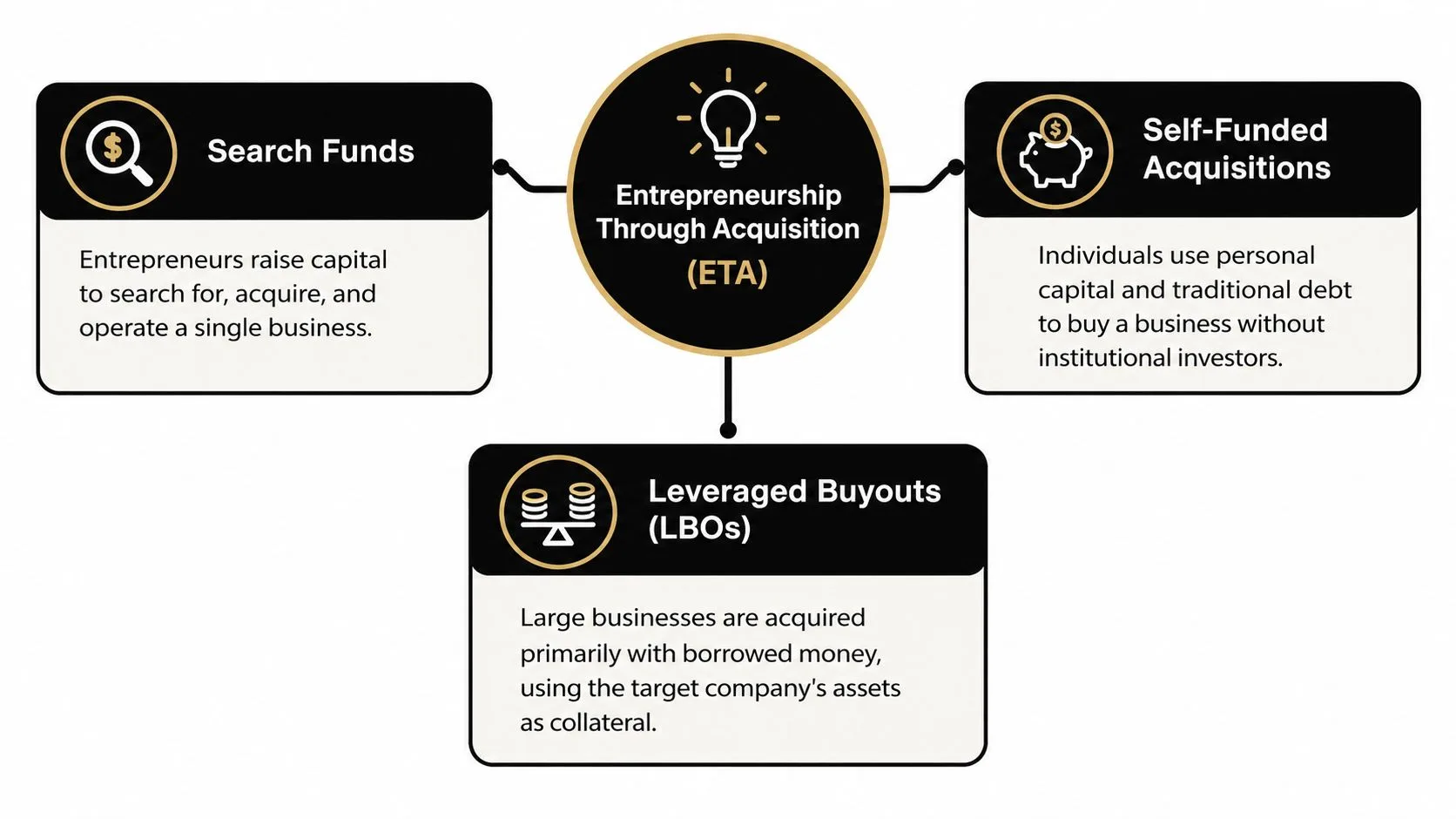
A search fund raises capital before the buyer identifies the company. Investors provide funding for the search period, and the searcher uses that runway to locate, evaluate, negotiate, and acquire one business. The investors may later participate in the acquisition financing, while the searcher becomes the operating leader after closing.
Think of this as a guided tour. You have financial backers, experienced investors, and a defined process around you. That support can help a first-time CEO evaluate targets and avoid preventable mistakes. The trade-off is shared governance. Investors often have approval rights and influence over the purchase, financing, and major decisions.
The long-term economics can be compelling, but the searcher must accept uncertainty, investor oversight, and the possibility of spending a long period searching without closing.
Self-funded acquisitions
A self-funded acquisition uses the buyer's personal capital and transaction-specific financing. The buyer might invest savings, bring in a small group of partners, obtain bank debt, or negotiate seller financing after identifying a target.
This resembles a self-drive road trip. You choose the route, make decisions quickly, and retain more control, but you're also responsible for the vehicle, navigation, repairs, and costs. The model can suit an experienced operator who values autonomy and wants a concentrated ownership position.
The risks are personal as well as commercial. Search expenses may come out of the buyer's pocket, and loan guarantees or insufficient liquidity can create pressure after closing. A self-funded buyer needs a strong advisory team because independence shouldn't mean operating without review.
Leveraged buyouts
A debt-funded acquisition acquires a company primarily with borrowed money. The target's cash flow supports repayment, and the company's assets and earnings may support the financing structure.
An LBO is closer to a highly debt-financed expedition. Debt can magnify equity returns when the business performs as planned, but it also reduces room for error. A sales slowdown, customer loss, margin compression, or unexpected equipment repair can make scheduled payments harder to manage.
The model is more common in larger or more financially complex transactions, but its central lesson applies to every ETA deal: debt should support a resilient operating plan, not compensate for an excessive purchase price.
Stanford's 2024 dataset reported a 63% acquisition rate among concluded searches, a $14.4 million median purchase price, and a 35.1% aggregate pre-tax IRR. The study's selected observations illustrate the historical strength of the search-fund model, but they shouldn't replace deal-specific underwriting.
Why entrepreneurs choose acquisition over startups
Acquisition can shorten the distance between ownership and operations. A purchased company may already have a product customers understand, employees who know how to deliver it, and a sales process that produces revenue. A startup must create those systems while also discovering whether the market wants what it's selling.
The comparison looks like buying a functioning restaurant versus inventing a menu, finding a location, hiring a kitchen team, and waiting for customers to arrive. The existing restaurant still needs management, but you can study what works before you renovate.
Where acquisition has an advantage
- Existing demand: A buyer can evaluate real customer relationships and historical sales rather than relying only on a forecast.
- Operating infrastructure: Accounting, scheduling, production, fulfillment, and vendor routines may already exist.
- Faster leadership responsibility: The buyer can become the decision-maker without waiting for a new venture to reach scale.
- Known constraints: Due diligence can reveal customer concentration, aging equipment, weak pricing, or owner dependence before closing.
- Multiple value levers: Pricing, sales discipline, labor planning, procurement, technology, and working-capital management can all affect performance.
The advantage isn't that acquisition removes risk. It changes the type of risk. A startup often carries product-market and customer-acquisition uncertainty. ETA shifts more attention toward valuation, financing, succession, culture, and operational execution.
What you give up
Buying a company can require substantial equity, lender approval, seller negotiation, and investor oversight. The business may also come with outdated systems, employees who distrust new ownership, or customers who are loyal to the seller rather than the company. A founder can change direction freely. An acquisition entrepreneur must first understand why the existing model works.
You may also sacrifice some theoretical upside. A startup can grow from a small base into a very large company, while an established business often offers a more defined set of improvement opportunities. That trade-off can appeal to buyers who prefer controllable progress over untested potential.
Practical rule: Buy the business you can operate through difficult conditions, not the business that looks most exciting in a presentation.
The search-fund dataset reported a 4.5x return on investment, a result that supports the importance of active management rather than simple buy-and-hold ownership. The Stanford study summary connects the outcome to disciplined selection and post-close improvements. For an individual buyer, that means the value-creation plan should be visible before signing, even if the details evolve after the transition.
Real-world ETA case studies
ETA stories are often told as if the acquisition itself created the result. In practice, the outcome usually turns on a series of smaller decisions: how the buyer evaluates the seller's role, what the financing can tolerate, which systems receive attention first, and whether the new owner earns credibility with employees.
Consider a search fund that acquires a niche manufacturing company. The business has capable employees and repeat customers, but production scheduling depends on spreadsheets and the owner's personal knowledge. The searcher doesn't begin by replacing the workforce or pursuing every possible market. Instead, the first priority is documenting workflows, introducing production visibility, and automating repetitive steps.

The lesson isn't that robotics automatically creates value. Automation only helps when the process is understood, the capital cost is justified, employees are prepared, and customers continue receiving reliable service. The buyer's real achievement is building a repeatable operating system that doesn't depend on one person remembering every exception.
A different story involves a self-funded buyer who purchases a service company at an aggressive price. The buyer focuses on reported revenue and assumes existing customers will renew, but doesn't fully test collections, labor requirements, or the seller's involvement in winning new business. After closing, revenue remains active while cash becomes tight because payroll, receivables, debt payments, and transition costs arrive on different schedules.
The first six months expose the problem. The seller's relationships don't transfer automatically, a key employee leaves, and the buyer discovers that reported earnings required more hands-on owner involvement than expected. The purchase wasn't necessarily doomed, but the financing left too little room to fix the operating gaps.
The transferable lessons
- Test owner dependence: Identify which customers, employees, suppliers, and decisions rely personally on the seller.
- Protect continuity first: Don't redesign every process before you know which ones customers value.
- Model cash, not just earnings: Profit on an income statement doesn't guarantee liquidity for payroll, inventory, debt, and repairs.
- Make improvement specific: “Modernize operations” is too vague. Name the process, owner, cost, expected benefit, and implementation risk.
- Treat employees as sources of knowledge: The people who run the business often know where bottlenecks are.
A successful transition usually looks less dramatic than a turnaround story. The buyer listens, documents, measures, and improves in sequence. That discipline is what converts an acquired company into an owner-operated enterprise.
Identifying target businesses and key financial metrics
A good ETA target isn't just a profitable company. It's a company whose cash flow, customer relationships, operating complexity, and transition needs match the buyer's capabilities and financing capacity.
Start with qualitative filters. Look for understandable products or services, repeat or recurring demand, manageable capital requirements, defensible customer relationships, and an owner who is ready to transfer control. A company may be attractive on paper but unsuitable if the seller remains the only salesperson, technician, estimator, or relationship holder.
The financial questions that matter
Review revenue quality before celebrating revenue volume. Ask whether customers return, whether prices have kept pace with costs, whether gross margins vary by customer, and whether receivables convert into cash. Then examine operating profit, add-backs, owner compensation, maintenance capital expenditure, inventory needs, and working capital.
A buyer should also separate reported EBITDA from sustainable EBITDA. An expense may be removable after closing, but it might also represent a real cost required to replace the owner, maintain equipment, or preserve service quality. For a practical framework on organizing statements, normalizing earnings, and interpreting financial reports, use this guide to financial data analysis. Buyers who want a deeper explanation of earnings before interest, taxes, depreciation, and amortization can also review this explanation of EBITDA.
The requested target-profile table can be useful as a screening template, but the brief provides no verified figures for typical revenue bands, EBITDA ranges, or median purchase prices by industry. Rather than invent benchmarks, use the table to organize the information you gather from comparable transactions and advisors.
| Business Type | Annual Revenue | EBITDA Range | Median Purchase Price |
|---|---|---|---|
| Healthcare services | Obtain from current comparables | Obtain from current comparables | Obtain from current comparables |
| Specialty manufacturing | Obtain from current comparables | Obtain from current comparables | Obtain from current comparables |
| B2B distribution | Obtain from current comparables | Obtain from current comparables | Obtain from current comparables |
Build a target scorecard
Use a simple scorecard to prevent one attractive feature from dominating your judgment:
- Demand quality: Are customers recurring, diversified, and economically stable?
- Owner transition: Can the seller document relationships and train a successor?
- Operational efficiency: Is there a credible improvement opportunity without requiring a complete reinvention?
- Capital intensity: Will the business consume cash through equipment, inventory, or expansion?
- Financing fit: Can normalized cash flow support the proposed debt while preserving a liquidity cushion?
- Personal fit: Do your skills match the company's daily realities?
The best target often looks “boring” in a good way. Stable service, clear financial records, manageable operations, and a realistic succession plan can create a stronger foundation than a fast-growing company with fragile margins and heavy owner dependence.
Step-by-step path to launch your ETA search
A disciplined search begins before you contact an owner. Write down the business you can operate, the risks you won't accept, the capital you can access, and the role you want after closing. This prevents every attractive listing from becoming a new investment thesis.
Build the search thesis
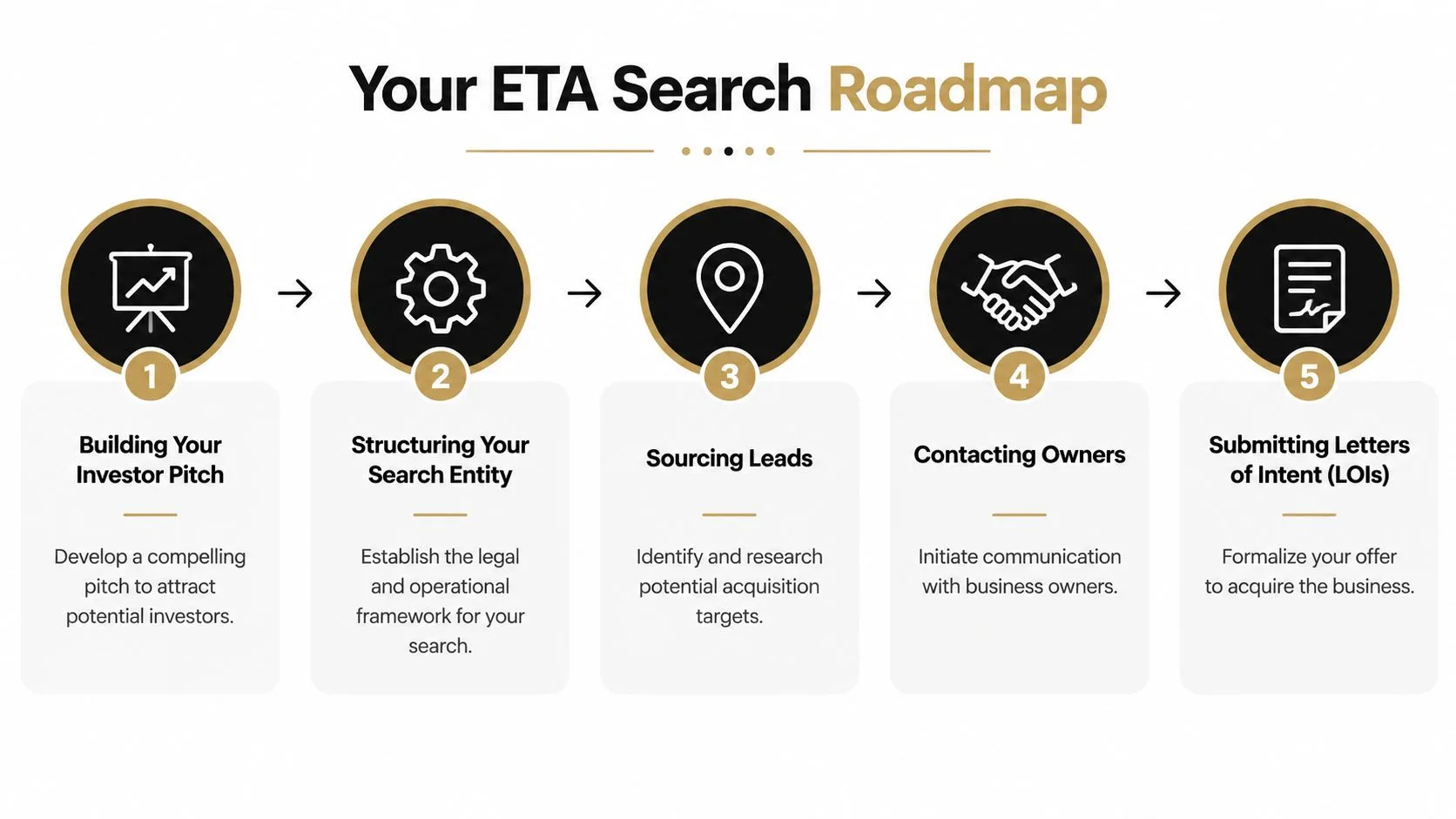
Your thesis should cover industry, geography, business size, customer type, operating model, seller motivation, and disqualifying conditions. Explain why your background gives you credibility with the target's customers and employees. Investors and sellers need more than ambition. They need evidence that you understand the company's work.
If you're raising search capital, prepare a concise investor presentation that explains your biography, acquisition criteria, sourcing plan, financial assumptions, governance expectations, and post-close operating approach. If you're self-funded, prepare the same material for lenders and transaction partners. The audience changes, but the logic shouldn't.
Set up the search infrastructure
Create a legal entity with qualified counsel, open dedicated banking arrangements, establish secure document storage, and use a customer relationship management system to track every lead. A spreadsheet can work at the beginning, but the system must record owner contact details, source, industry, last interaction, qualification status, next action, and reason for rejection.
The search can be lengthy and volume-driven. Search-fund market summaries report that successful searchers often review 200 to 300 targets, meet 50 to 100 owners, and submit 5 to 15 letters of intent, with an average search duration around 20 months. The search-fund statistics overview shows why consistent outreach matters more than occasional bursts of activity.
Move from conversations to offers
Contact owners respectfully and lead with relevance. Explain why you understand their industry, why you're interested in owning and operating the business, and how you'd approach confidentiality. Don't send a generic acquisition email that treats a founder's life's work like a spreadsheet entry.
Use initial conversations to learn:
- The owner's motivation: Is the seller seeking retirement, a partner, liquidity, or relief from daily management?
- The operating reality: What does the owner do every week that isn't visible in the financial statements?
- The customer base: Which relationships are durable, and which depend on personal trust?
- The investment needs: What equipment, hiring, technology, or compliance work has been deferred?
- The transition plan: How long and in what capacity can the seller support handover?
For a practical overview of acquisition mechanics, review how to purchase a small business. When an opportunity fits your criteria, submit an LOI that clearly addresses price, structure, financing assumptions, diligence access, exclusivity, working capital, seller transition, and the conditions required to close.
Due diligence valuation and financing strategies
Valuation, diligence, and financing must be analyzed together. A price that looks reasonable under an EBITDA multiple may become unattractive once you account for customer concentration, owner replacement, inventory requirements, deferred maintenance, or debt-service capacity.
Begin with normalized earnings. Rebuild the income statement by removing nonrecurring items, adjusting owner compensation to a market replacement cost, separating personal expenses from legitimate business costs, and identifying capital expenditures required to keep operations running. Then compare several valuation perspectives, such as market multiples, a discounted cash-flow analysis, and the value of assets or contracts where relevant.
Diligence should test the operating story
Review financial statements, tax filings, bank records, accounts receivable aging, inventory, customer contracts, employee arrangements, insurance, litigation, licenses, supplier terms, technology, and cybersecurity. Speak with the people who perform critical work. Reconcile what the seller says with what the business does.
A focused diligence checklist can help teams organize requests, assign owners, and identify unresolved issues. Resources on streamlining investment deal reviews can support that process, but no checklist replaces judgment or direct conversations with employees, customers, lenders, and advisors.
Match financing to resilience
A typical capital stack might combine buyer equity, bank or SBA debt, seller notes, and outside equity. Each source changes the risk profile. Senior debt may lower dilution but impose scheduled payments. Seller financing can align the seller with a smooth transition. Outside equity can reduce personal exposure but introduces governance and return expectations.
The key question is not, “How much can I borrow?” It's, “How much debt can the business service while still funding payroll, inventory, maintenance, hiring, and unexpected problems?” Build downside cases around slower collections, customer loss, margin pressure, and delayed operational improvements. A business acquisition loan may be one financing avenue, but the final structure should reflect the company's cash conversion and the lender's underwriting requirements.
Recent findings summarized from Stanford reported that funds launched between 2021 and 2024 had a 48% acquisition rate, while the aggregate results were a 33.9% IRR and 4.75x ROI as of December 31, 2025. The latest selected observations reflect a competitive environment where disciplined financing remains essential. Strong historical returns don't justify weak underwriting.
Post-acquisition integration risk mitigation and next steps
Closing day can create false confidence. The wire transfers, signatures, and ownership documents are complete, but the company still has to serve customers the next morning. Employees may be uncertain, the seller may be emotionally disengaged, and the buyer may discover that informal routines carried more weight than the manuals suggested.
A 2025 scoping review found that ETA research still says relatively little about the holding and growth phase. Stanford-linked analysis also reports that 31% of search funds don't complete an acquisition, while some funds that do close later face liquidity and financial problems. The review of ETA research reinforces the central warning: post-close execution can be harder than dealmaking.
Use the first operating period to stabilize before expanding:
- Communicate early: Meet employees, customers, and suppliers, and explain what will remain consistent.
- Map critical processes: Document how sales, delivery, billing, purchasing, scheduling, and complaints work.
- Protect liquidity: Track cash weekly, review receivables, and delay discretionary spending until the operating picture is clear.
- Create a short dashboard: Monitor sales, gross margin, cash balance, collections, customer retention, staffing, and service quality.
- Sequence changes: Fix urgent control problems first, then pursue improvements that employees and customers can understand.
Before pursuing a deal, assemble an acquisition attorney, accountant, lender, insurance advisor, and operating mentor. Prepare a target scorecard, financing plan, diligence request list, transition calendar, and first-month cash forecast. If you're ready to evaluate acquisition funding and build a financing path around a real target, visit Business Loan Warrior to explore appropriate business acquisition and growth funding options. Their platform can help you organize the capital conversation while you focus on finding and operating the right company.