
A supplier overseas wants bank-backed assurance before shipping. At the same time, payroll is due, inventory needs replenishing, and your domestic customers won't pay for several weeks. You ask your banker about a line of credit and a letter of credit, expecting two versions of the same solution.
They aren't.
A line of credit gives your business controlled access to cash. A letter of credit gives another party confidence that a bank will pay if specific conditions are met. One is a liquidity tool. The other is a risk-transfer tool.
That difference determines when cash moves, who receives protection, what consumes your borrowing capacity, and what can go wrong. The practical question is not whether the transaction is domestic or international. It's whether you need money for your own operations or assurance for someone else's decision to ship, perform, or extend terms.
Table of Contents
- Why This Choice Trips Up Smart Business Owners
- Line of Credit and Letter of Credit Explained
- Side-by-Side Comparison of the Two Instruments
- The Hidden Cost Both Options Carry
- Real-World Scenarios and the Right Tool for Each
- Decision Checklist and How to Apply
- Frequently Asked Questions and Next Steps
Why This Choice Trips Up Smart Business Owners
Consider a growing importer with an established U.S. customer base. Its overseas supplier won't release a shipment without bank-backed payment protection. Meanwhile, the company needs working capital for payroll, freight, and inventory that is already committed to domestic orders.
The owner sees both products listed under commercial financing and assumes either one could bridge the gap. That assumption creates expensive confusion. A line of credit can fund payroll and inventory, but it doesn't automatically reassure an unfamiliar supplier. A letter of credit can protect the supplier, but it isn't a general-purpose cash account for the buyer.
The protection goes to different people
A revolving line protects the borrower from timing problems. The business draws money when bills arrive, repays it when customers pay, and can generally draw again during the commitment period. The bank is primarily evaluating whether the borrower can repay and whether the facility remains within its collateral, covenant, and borrowing-base requirements.
An LC protects the named beneficiary. The issuing bank promises to pay when the beneficiary presents documents that comply with the credit's terms. The applicant may ultimately reimburse the bank, but the immediate commercial value goes to the supplier, landlord, project owner, surety, or other counterparty demanding assurance.
The decision in one sentence: Use a line when your business needs flexible cash. Use an LC when another party needs bank-backed assurance.
What this guide will help you decide
By the end, you should be able to answer four practical questions:
- Who needs protection? Your operating account, or a counterparty that doesn't fully trust your promise?
- When should cash move? At your direction through draws, or only after a compliant presentation or qualifying default?
- What capacity will the bank reserve? Funded debt, contingent exposure, collateral, cash margin, or some combination?
- Can your team execute the process? A line requires financial discipline. An LC also requires accurate documents and deadline control.
The strongest choice isn't the product with the lower visible fee. It's the instrument that solves the actual risk without restricting the capital you need for everything else.
Line of Credit and Letter of Credit Explained
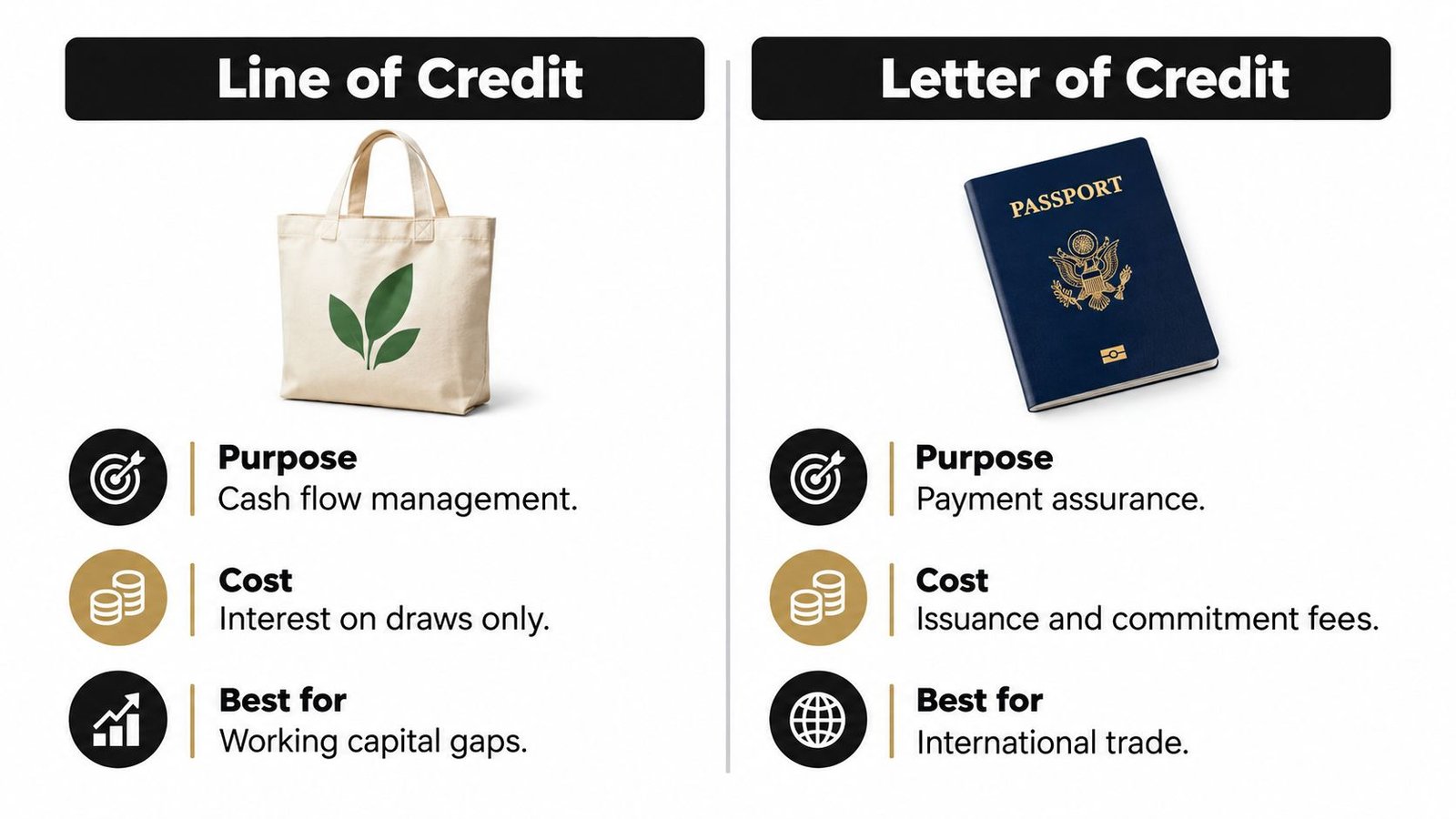
Start with the recipient of the bank's protection. A line of credit puts borrowing capacity under the business's control. A letter of credit, or LC, protects a named counterparty by giving that party a bank-backed payment or performance commitment.
How a line of credit works
A line of credit is a revolving borrowing facility. The lender approves a maximum amount, and the borrower draws only what it needs. As principal is repaid, availability generally replenishes during the commitment period. Interest typically accrues on the outstanding balance rather than unused availability, subject to the agreement's pricing and fees.
The Federal Reserve's explanation of bank lines of credit describes this structure and reports that 77.6% of commercial and industrial loans were made under loan commitments in February 2009. That figure is a historical structural benchmark, not a current small-business lending statistic. It shows how established commitment-based borrowing was before the financial crisis, but it should not be read as a 2026 market measure.
The parties are straightforward:
- Borrower: The business receiving and repaying drawn funds.
- Lender: The bank or financial institution approving the facility.
- Collateral or guarantors: Assets or people supporting repayment where required.
A line works like a reusable business fuel tank. The company draws when expenses arrive, repays from incoming cash, and can generally draw again while the facility remains available. The flexibility has a direct cost: every draw increases funded debt and interest expense.
For owners comparing revolving facilities, a draw-and-repay credit for commercial assets illustrates how reusable borrowing differs from a one-time loan. A conventional business line of credit usually fits recurring working-capital needs better than a single asset purchase.
How a letter of credit works
A letter of credit, or LC, is a bank's conditional undertaking to pay a named beneficiary up to a stated amount when the beneficiary presents documents that comply with the credit's terms. The applicant requests the LC, the issuing bank issues it, and the beneficiary relies on the bank's undertaking rather than only on the applicant's promise.
The main parties are:
- Applicant: The business asking its bank to issue the LC.
- Issuing bank: The bank making the conditional payment undertaking.
- Beneficiary: The supplier, project owner, landlord, surety, or other protected counterparty.
- Advising or confirming bank: Another bank that may transmit or add assurance to the credit, depending on the arrangement.
A commercial LC commonly supports a shipment of goods. The beneficiary presents shipment or title documents, and the bank examines those documents against the credit. A standby LC serves a different purpose. It usually remains unused unless the applicant fails to perform or pay and the beneficiary makes a qualifying demand.
An LC works like a bank-issued passport for a transaction. It validates the business for one defined obligation, not for everyday spending. The beneficiary receives the protection, while the applicant may still have reimbursement obligations and reserved borrowing capacity even before the bank pays.
Under ICC UCP 600 rules for documentary credits, an LC subject to those rules creates an irrevocable obligation for the issuing bank, and banks examine presentations based on documents alone. Documentary accuracy and deadline control therefore determine whether the instrument works as intended.
Side-by-Side Comparison of the Two Instruments
The cleanest way to compare a line of credit vs letter of credit is to ask what the bank is being asked to do.
A line advances money to the borrower. An LC lends the bank's credibility to a transaction involving a third party. The first gives the business control over liquidity. The second gives the beneficiary confidence that payment or performance assurance exists.
Line of Credit vs Letter of Credit at a Glance
| Criterion | Line of Credit | Letter of Credit |
|---|---|---|
| Primary purpose | Flexible access to business cash | Payment or performance assurance for a beneficiary |
| Who receives the main protection | The borrower managing cash flow | The supplier, owner, landlord, surety, or other beneficiary |
| When cash moves | When the borrower draws | Usually only after compliant documents or a qualifying demand |
| Cost structure | Interest on drawn funds, plus agreement-specific fees | Issuance, commitment, amendment, confirmation, collateral, or margin costs |
| Reusability | Draw, repay, and generally redraw during the commitment period | Tied to the stated transaction, amount, beneficiary, and expiry |
| Main controls | Repayment capacity, covenants, collateral, borrowing base | Documentary compliance, presentation timing, expiry, reimbursement ability |
| Typical operational use | Inventory, payroll timing, recurring working-capital gaps | Goods shipment, contract assurance, payment protection |
| Main failure risk | Rising debt, interest expense, covenant pressure | Discrepancies, missed deadlines, unexpected reimbursement obligation |
Sharpest differentiator: A line funds your needs. An LC substitutes the bank's creditworthiness for your promise to a third party.
Cash movement changes the business decision
With a line, the owner decides when to draw. That flexibility is valuable when revenue and expenses arrive on different schedules. It also creates a direct obligation. The drawn amount appears as funded debt, interest accrues, and continued use can increase borrowing levels or covenant utilization.
With an LC, the business may not receive cash at issuance. The bank instead creates a contingent obligation in favor of the beneficiary. That can preserve cash in the short term, but it doesn't make the exposure disappear. The bank may reserve capacity, require collateral or cash margin, and demand reimbursement if it pays.
Control is operational, not merely financial
A line's controls focus on the borrower. The lender may review financial statements, accounts receivable, inventory, collateral values, and covenant compliance.
An LC's controls focus on the transaction documents. Commercial banks can reject or delay payment when documents don't comply with the credit, even if the buyer believes the goods are satisfactory. A business that chooses an LC must have someone responsible for document review, shipment timing, amendments, and communication with the bank and beneficiary.
The Hidden Cost Both Options Carry
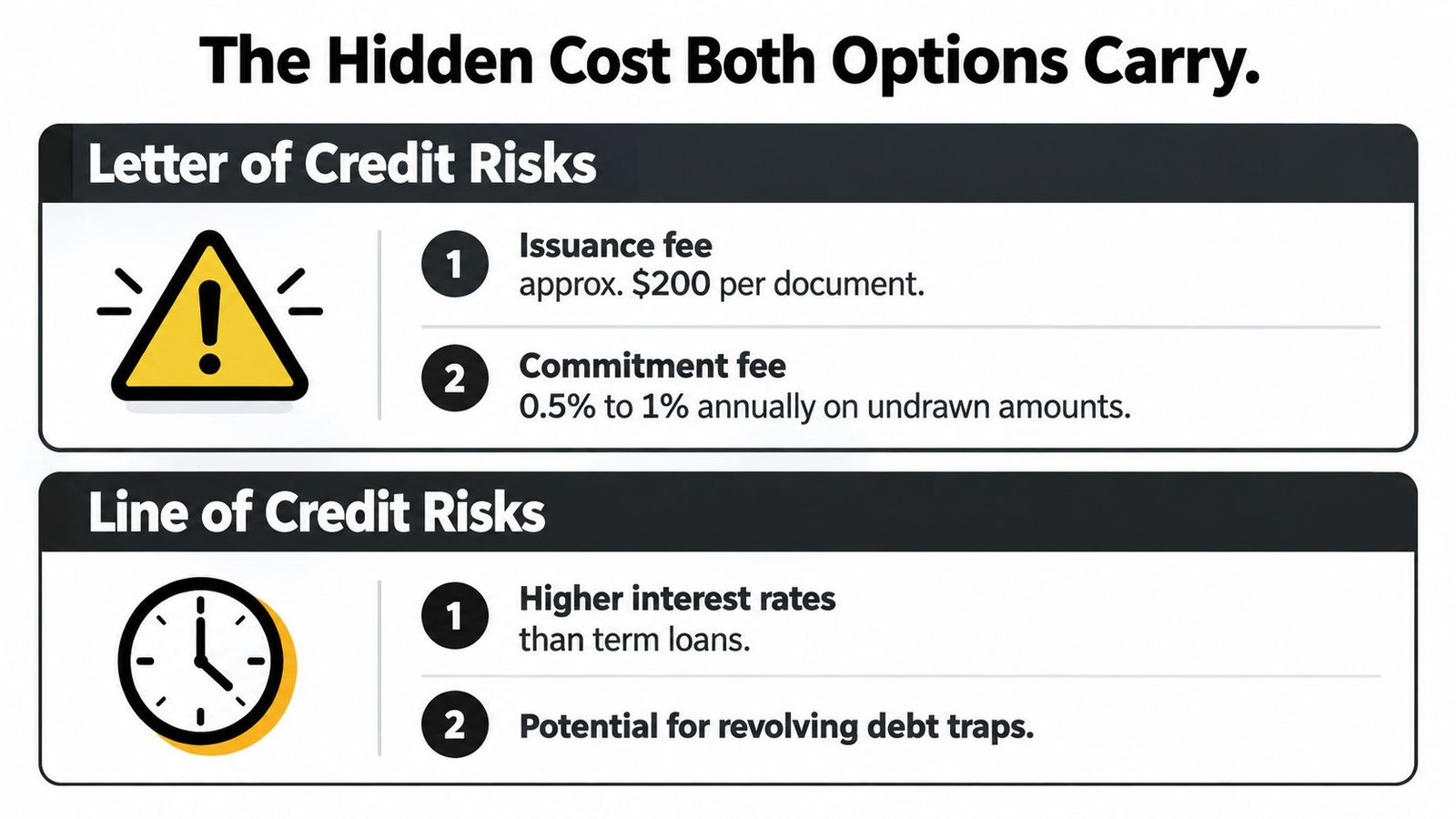
The most overlooked LC question is simple: Does an undrawn letter of credit use borrowing capacity? In many banking relationships, the practical answer is yes.
The bank may treat the face amount as contingent exposure even when the beneficiary hasn't demanded payment. It may charge issuance or commitment fees, require collateral or cash margin, and reduce the availability of another facility. An LC that never gets drawn can still limit how much the business can borrow elsewhere.
The undrawn LC still has an economic footprint
Compare total capacity, not just the visible price.
A line creates an interest expense when drawn. An LC may avoid immediate funded interest but consume approval capacity and introduce separate fees. If the company needs its revolving line for payroll or inventory later, an LC reservation can become an opportunity cost.
The bank is asking a reasonable question: if it pays the beneficiary, can the applicant reimburse it? The answer affects underwriting, collateral, guaranty requirements, and availability. The owner should ask for the bank's treatment of the LC in the borrowing-base and covenant calculations before signing.
For a plain-language explanation of how lenders charge for reserved availability, review this guide to commitment fees and unused credit. The key issue isn't whether the fee looks small. It's whether the facility prevents the business from using capital for a more important need.
Documentary compliance can decide payment
An LC is document-driven. Banks examine the presentation, not the underlying quality of the goods or the full commercial dispute between buyer and seller. A shipment can arrive with a quality problem, yet the bank may still pay if the presented documents comply with the credit.
The reverse problem is just as serious. A minor discrepancy can delay or prevent payment. Under the trade-finance rules described by ICC Thailand's UCP 600 materials, the standard post-shipment presentation period is 21 days unless the credit specifies otherwise. The team must manage that deadline, the expiry date, required documents, names, quantities, dates, and transport details.
Lines carry their own pressure
A revolving line gives control, but that control can encourage repeated borrowing. Variable-rate pricing can make the cost harder to predict. Bank survey data reported that variable-rate lines represented about 91% of reported credit-line usage in late 2025, while median usage was approximately 40.1% in the fourth quarter, according to the Federal Reserve Bank of Kansas City's small-business lending survey.
The right framework is risk transfer versus liquidity. Choose the line when you need flexible access to money. Choose the LC when the transaction needs a bank's promise. Don't select an LC merely because it avoids an immediate draw, and don't use a line to fund a deposit when the supplier is specifically demanding bank-backed assurance.
Real-World Scenarios and the Right Tool for Each
The product choice becomes clearer when you follow the cash and the protection through an actual business situation.
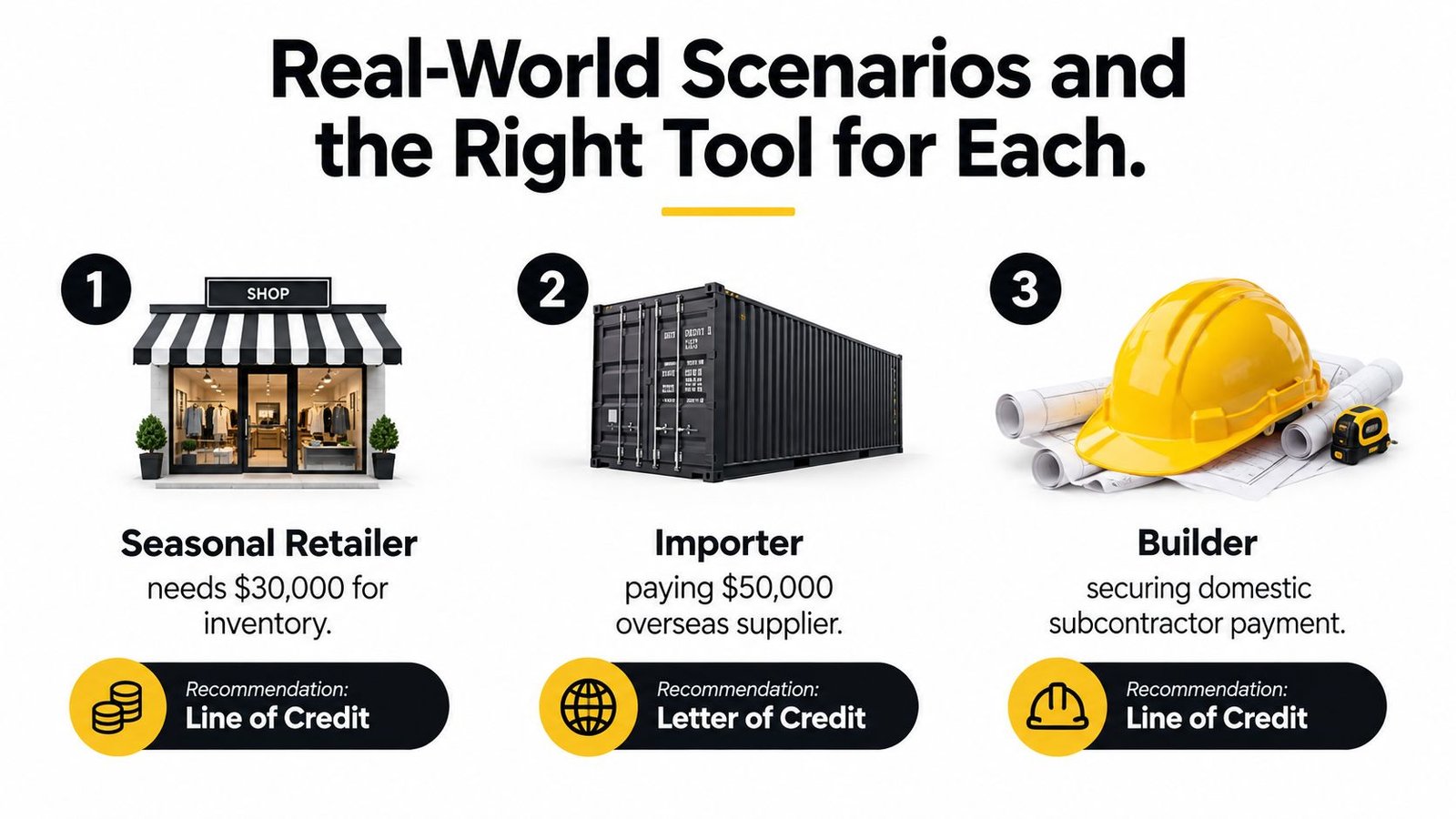
A seasonal retailer needs operating liquidity
A retailer builds inventory before its busy selling period. It pays vendors before customers complete their purchases, and payroll continues while sales fluctuate. The retailer doesn't need a bank to reassure a specific beneficiary. It needs a reusable source of working capital controlled by management.
A line of credit fits. The owner can draw for inventory, use collections to repay the balance, and draw again when another shortfall appears. A letter of credit would add transaction conditions without solving the retailer's general cash-flow timing problem.
The same logic applies to a contractor paying labor and materials before a customer pays an invoice. If no counterparty requires an LC, the business should not add documentary trade-finance machinery to an ordinary liquidity need.
An importer faces an unfamiliar overseas supplier
An established company is buying equipment or materials from a supplier that doesn't know its payment history. The supplier wants confidence before it ships. Here, the main problem isn't the buyer's access to cash. It's the seller's credit and jurisdiction risk.
A commercial LC can fit because the bank's undertaking gives the seller a defined payment path when the required documents comply. World Bank research reported that LCs covered about 13% of global trade in 2011, based on SWIFT data, and that they financed approximately 43% of China's imports and 27% of the Republic of Korea's imports, as summarized in this overview of Uniform Customs and Practice for Documentary Credits.
That doesn't make an LC automatically cheaper or safer. The buyer still needs a separate plan for freight, duties, payroll, and other operating costs. The LC solves supplier assurance. A line may still be needed for the buyer's broader working capital.

A contractor needs performance assurance
A builder bidding on a project may face a requirement from the project owner, surety, or contracting authority for bank-backed performance assurance. The business may have enough operating cash and may not need a funded advance.
A standby LC is the more natural instrument. It remains a contingent promise that can be called if the applicant fails to perform or pay according to the agreed terms. A line of credit would put cash in the borrower's hands, but it wouldn't necessarily satisfy the counterparty's requirement for a bank undertaking.
If the project also requires upfront materials or payroll before progress payments arrive, the contractor may use both instruments. The standby LC supports the contract. The line supports execution.
For purchase-order-driven companies, it can help to compare this structure with financing options for purchase orders. The question remains the same: are you financing fulfillment, or assuring the party that issued the order?
Decision Checklist and How to Apply
Make the decision in the right order. Start with the commercial requirement, then examine the bank's pricing and capacity treatment.
Ask these questions before contacting the bank
- Who requested the instrument? If a supplier, owner, landlord, or surety specifically requires bank-backed assurance, a line may not satisfy the requirement.
- Where will the money go? Payroll, inventory, freight, and ordinary operating expenses usually point toward a line. A named beneficiary and defined transaction point toward an LC.
- Can your team manage documents? If shipment papers, presentation dates, amendments, and expiry terms will be handled casually, don't choose a commercial LC.
- What happens to capacity? Ask whether the bank reserves the LC's face amount, reduces revolver availability, requires cash margin, or counts the exposure against covenants.
- What is the reimbursement plan? If the bank pays, determine how quickly the business must reimburse it and from what source.
- Which flexibility matters more? A line offers borrower-controlled draws. An LC offers counterparty assurance. Don't confuse the two.
What the bank will review
For a line, expect the lender to focus on repayment capacity, cash flow, receivables, inventory, existing debt, collateral, guarantor support, and covenant performance. The lender wants to know whether the business can repay the balance and whether collateral remains sufficient as availability changes.
For an LC, the bank still evaluates the applicant's financial strength because it may have to reimburse a payment. It also needs the beneficiary's legal name, amount, currency, expiry, governing rules, required documents, shipment terms, presentation timing, and any confirmation or advising instructions.
The application process should produce a written term sheet or facility summary. Review the interest rate and unused fees for a line. Review issuance charges, amendment fees, confirmation costs, collateral, margin, reimbursement terms, and capacity treatment for an LC.
When both instruments make sense
Growing companies often need both, but for different jobs. A commercial LC can support an overseas purchase while a revolving line covers domestic payroll, freight, and inventory. A standby LC can satisfy a contract requirement while a line funds the work needed to perform.
Ask the same bank to model the combined relationship. One facility may affect the availability or covenant calculations of the other. The best structure keeps the LC's contingent exposure visible and preserves enough liquid capacity for the operating cycle.
Frequently Asked Questions and Next Steps
Does an LC use borrowing capacity if nobody draws it?
Often, yes. A bank may reserve exposure for the stated amount, charge issuance or commitment fees, require collateral or cash margin, and reduce other availability. Ask the lender to show exactly how an undrawn LC affects total economic capacity before accepting the facility. The beneficiary receives the protection, while your business may still carry the borrowing-capacity cost.
Should I use a line to fund a deposit or ask for an LC?
Use the line when the seller accepts your payment and you need cash to make the deposit. Request an LC when the seller specifically requires bank-backed assurance, especially when supplier, jurisdiction, or performance risk makes an ordinary deposit unacceptable.
Match the instrument to the commercial need. A line puts money in your account. An LC gives the counterparty a conditional bank promise. If you need help preparing a clear financing request, writing effective business inquiries can help you present the transaction, timing, and requested structure without burying the lender in unnecessary detail.
Is an LC worthwhile if it never gets drawn?
Yes, when its assurance changes the deal. An LC can help an unfamiliar supplier ship, support a contract award, or protect a beneficiary that will not rely on the applicant alone. The value lies in the risk reduction the beneficiary receives, which is why an undrawn LC can still justify its fee.
Open-account trade may be simpler and cheaper when the buyer is financially strong and has a trusted supplier relationship. Do not pay for bank-backed assurance that nobody needs.
Can one bank provide both products?
Usually, a business can discuss both instruments with the same banking relationship. One bank may simplify reporting and coordination, but it does not remove capacity trade-offs. Ask for combined pricing, collateral treatment, covenant impact, and the LC's effect on revolver availability.
Business Loan Warrior offers a single no-fee application, pre-approval checks without credit impact, lines of credit and other business funding products, plus a secure dashboard with direct underwriter contact. Per the company's own reporting, the platform serves 2,000+ businesses and has delivered $100M+ in funding.
Business Loan Warrior can help you compare a revolving line with other working-capital options and evaluate whether a bank-backed LC belongs in the structure. Visit Business Loan Warrior to submit one no-fee application, check potential fit without affecting your credit, and discuss the right financing path with an underwriter.