
The most popular advice about no doc loans is also the most misleading: “You can get business funding without providing financial documents.” In today's U.S. market, that usually means either an expensive product with shallow underwriting or a legitimate alternative-documentation loan marketed with overly casual language.
True zero-documentation lending has largely disappeared because lenders now have to establish repayment capacity and manage risks that became obvious during the housing crisis. For small business owners, the practical question isn't whether you can avoid every document. It's which small set of reliable records can prove revenue, cash flow, assets, or collateral without forcing you through a traditional bank's paperwork maze.
Table of Contents
- The Truth About No Doc Loans Today
- Understanding the Documentation Spectrum
- Risks and Costs of Reduced Documentation Lending
- How to Qualify With Minimal Paperwork
- Alternative Financing Options for Small Businesses
- How Business Loan Warrior Simplifies Funding
- Your Action Plan for Securing Business Capital
The Truth About No Doc Loans Today
The original no-doc model relied on borrowers providing little or no proof of income, employment, or assets. That approach spread well beyond a niche market before the financial crisis. From 2000 through 2007, the share of Alt-A mortgages lacking full documentation of income, assets, or both rose from 60% to 80%, while low- or no-documentation subprime loans increased from 20% to 38% before easing to 33% by 2007, according to the U.S. Government Accountability Office mortgage-market analysis.
The Financial Crisis Inquiry Commission paper tells the more important part of that story. Serious delinquencies on no- and low-doc mortgages rose from 5% to more than 25% between 2005 and 2008, compared with an increase from 5% to about 20% for fully documented loans, as reported in the mortgage-defaults research paper. Reduced verification didn't merely save time. It weakened a lender's ability to distinguish a stable borrower from a risky one.
What borrowers actually find today
Search for “no doc business loans” and you'll typically encounter two categories:
- High-cost lenders: These providers may advertise minimal paperwork but compensate with aggressive pricing, frequent payments, short terms, personal guarantees, or broad control over business cash flow.
- Legitimate alt-doc lenders: These lenders still verify repayment capacity, but they use bank statements, payment records, accounting data, assets, or collateral instead of relying only on tax returns and traditional financial statements.
In the U.S., modern mortgage rules still require lenders to assess a borrower's ability to repay using reliable evidence. Current “no-doc” products therefore function as niche non-QM or reduced-documentation structures, where assets, reserves, debt obligations, cash flow, and collateral replace some conventional income paperwork, as explained in this overview of modern no-income-verification mortgages.
Practical rule: A lender claiming it needs absolutely nothing from you isn't offering a shortcut. It's offering a reason to investigate the lender.
For business owners, “no doc” should mean minimal traditional paperwork, not an undocumented approval. Expect a lender to ask for enough information to verify revenue and repayment ability. That's the modern version that can get funded without putting your company into an opaque, high-cost debt cycle.
Understanding the Documentation Spectrum
Documentation isn't an on-or-off switch. It's a spectrum, and each point on that spectrum trades paperwork for some combination of cost, speed, collateral, repayment pressure, or underwriting flexibility.
A conventional bank or SBA application sits at the full-documentation end. The lender may request tax returns, financial statements, debt schedules, ownership records, licenses, personal financial information, and a business plan. A larger SBA request can involve a thick application package and detailed review because the lender is evaluating both the business and the owner's ability to repay.
Low-documentation financing reduces the historical paperwork burden but still relies on recognizable records. A lender might review business bank statements, a basic profit and loss statement, a merchant-processing report, and a short description of how you'll use the funds. Alt-doc financing goes further by connecting to digital sources such as accounting platforms, payment processors, or bank feeds. The lender isn't accepting an unsupported promise. It's analyzing a different evidence trail.
Comparing the main tiers
| Loan Type | Documentation Required | Typical Loan Amount | Approval Timeline |
|---|---|---|---|
| Traditional bank loan | Tax returns, financial statements, debt schedule, ownership records, licenses, and often a business plan | Varies by lender and borrower profile | Usually slower than alternative products |
| SBA-backed loan | Detailed financial, ownership, identity, and business records, plus lender-specific forms | Varies by program and lender | Usually requires extensive review |
| Low-doc working capital loan | Recent bank statements, basic business information, and revenue evidence | Varies by product and underwriting | Often faster than bank financing |
| Alt-doc financing | Bank feeds, payment-processor records, accounting exports, or asset and collateral records | Varies by cash flow and collateral | Often streamlined when records connect digitally |
| Merchant cash advance | Bank statements and card-processing or revenue records | Varies by sales volume | Often faster, with repayment tied to receivables or sales |
A $500,000 SBA loan and a $50,000 merchant cash advance aren't just different sizes of the same product. They're underwritten for different purposes, by different risk models, with different expectations around documentation and repayment. The advance may need only a short operating history of bank and card-processing records, while the SBA lender must investigate the company's broader financial condition.
Before applying, review the documents lenders commonly request for business financing. Organizing those records early prevents a rushed submission and helps you choose the product that matches your actual documentation strength.
Technology can reduce the administrative work. A practical step-by-step documentation AI setup can help organize records, extract information, and make recurring financial files easier to retrieve. That won't eliminate underwriting, but it can make your evidence cleaner and more consistent.
Risks and Costs of Reduced Documentation Lending
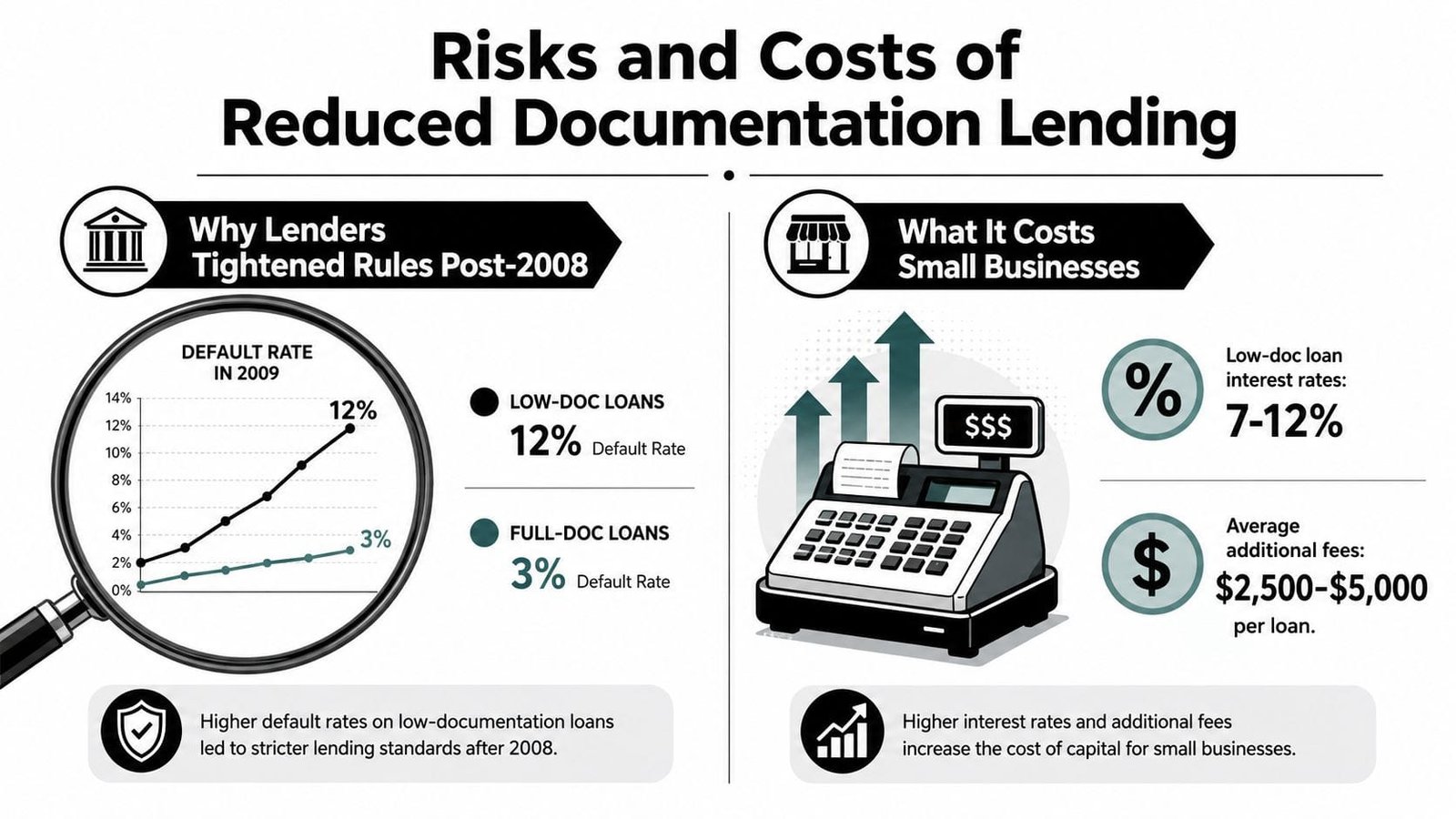
Reduced documentation raises a basic underwriting problem. If the lender sees less reliable information, it has less confidence in the borrower's true income, obligations, and ability to absorb a weak month. The lender responds by rejecting more applicants, demanding stronger collateral or reserves, or charging more for the risk it accepts.
A peer-reviewed finance study found that most of the excess default risk associated with pre-recession low-doc loans came from borrowers who could verify income but chose not to. The finding points to adverse selection. A no-doc channel can attract applicants who prefer less scrutiny because they have incentives to overstate earnings, as discussed in this study of low-documentation mortgage risk.
The cost doesn't stop at the interest rate. Reduced-documentation business products can create repayment pressure through frequent debits, short maturities, origination fees, personal guarantees, blanket liens, or a requirement to direct receivables to the lender. A product can look affordable when presented as a single factor or payment figure, yet become expensive once you calculate the full repayment obligation against the cash the business receives.
The risks I want owners to inspect
- Cash-flow compression: Frequent repayment can drain the same account used for payroll, inventory, rent, and taxes.
- Personal exposure: A personal guarantee can put personal assets and credit at risk if the business defaults.
- Contract traps: Review confession-of-judgment language, default triggers, renewal provisions, and automatic withdrawals with counsel before signing.
- Misleading pricing: Compare total repayment, fees, and timing rather than accepting a headline rate or factor as the full cost.
- Debt stacking: A second short-term product may cover the first payment temporarily while making the overall cash-flow problem worse.
The crisis data explains why lenders tightened verification. It also explains why borrowers shouldn't interpret a fast approval as proof that a product is safe. Speed is a process feature, not a measure of affordability.
Recent research adds another warning for alt-doc borrowers. KBRA reported that Alt Doc loans defaulted at rates 12.9% higher on average than Full Doc loans, making the source particularly relevant for anyone evaluating current non-QM or reduced-documentation structures. You can review the KBRA research on non-QM defaults before treating flexibility as a free benefit.
How to Qualify With Minimal Paperwork
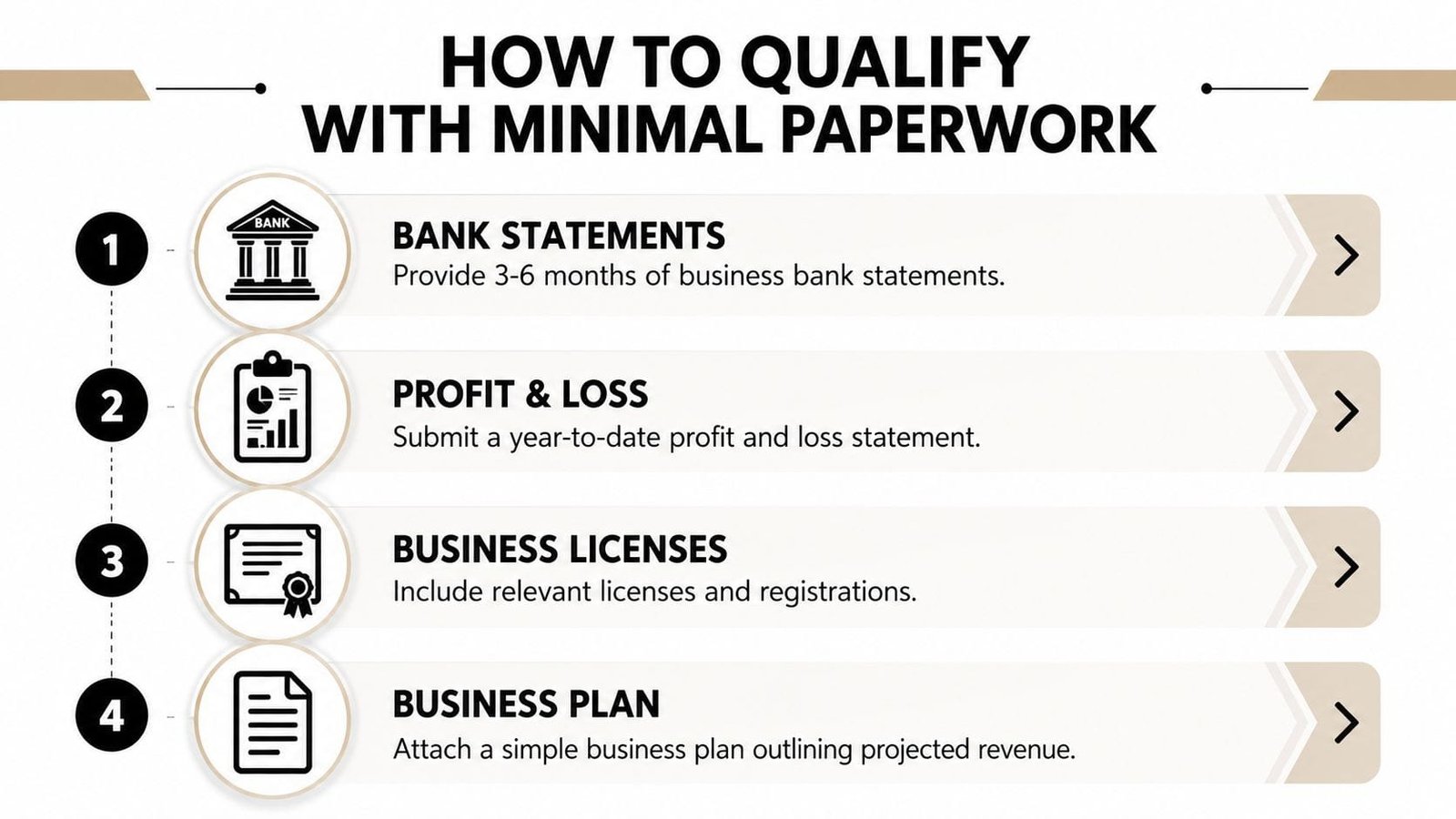
The strongest low-paperwork applications replace volume with quality. You don't need to upload every record your company has, but the records you submit must tell a consistent story about revenue, deposits, expenses, and available cash.
Start with business bank statements. Many alt-doc lenders use recent operating history to assess deposit patterns, average balances, overdrafts, returned payments, and existing debt withdrawals. Payment-processor records can strengthen the file for restaurants, retailers, service businesses, and online sellers because they show actual transaction activity rather than only an annual tax position.
Build an approval-ready file
- Separate business and personal activity. Use a dedicated business account and avoid mixing household spending with operating deposits. Clean separation makes cash flow easier to interpret.
- Connect reliable revenue records. Prepare bank feeds, processor reports, invoices, or accounting exports. A lender should be able to reconcile sales activity with deposits.
- Clean up banking behavior. Reduce unnecessary transfers, avoid returned payments, and keep required funds in the operating account. A lender sees account behavior as part of the credit story.
- Prepare a current profit and loss statement. It doesn't need to resemble an audited report, but it should reconcile with your deposits and show whether revenue produces usable operating income.
- Explain unusual items before underwriting asks. A seasonal dip, owner distribution, one-time expense, or recent expansion can make sense when you explain it clearly.
Don't chase invented qualification thresholds. Lenders vary widely by product, industry, time in business, revenue consistency, credit profile, collateral, and debt obligations. A stronger application usually comes from matching the evidence to the product, not from trying to force a business into a loan category designed for a different cash-flow pattern.
For owners handling a high volume of receipts, tools such as the ReceiptsAI receipt scanning picks can make financial records easier to classify and retrieve. Better organization won't change weak economics, but it can prevent missing documents and contradictory figures.
Seasonal companies should show the full operating cycle instead of hiding slower periods. Include a short narrative explaining when demand peaks, how inventory is funded, and how the requested capital converts into sales. For a lender, context can turn an unexplained fluctuation into an understandable business pattern.
A concise guide to minimal documentation for a fast small business loan can help you assemble the file before requesting quotes.
Alternative Financing Options for Small Businesses
The right alternative depends on how your business collects money. A retailer with steady card sales has a different financing profile from a contractor waiting for commercial invoices to be paid. Choosing based only on speed is how owners overpay.
| Financing Type | Docs Required | Funding Speed | Typical Cost Range | Best For |
|---|---|---|---|---|
| Revenue-based financing | Bank, accounting, or payment data | Often faster than bank financing | Varies by revenue share and contract | Businesses with recurring or high-volume sales |
| Merchant cash advance | Bank statements and card-processing records | Often fast | Can be expensive, especially with short repayment periods | Businesses with consistent card receipts and urgent needs |
| Short-term working capital loan | Bank statements, revenue records, and basic business information | Often fast | Varies by lender, term, and risk | A defined cash gap with a clear repayment source |
| Business line of credit | Financial records, bank activity, and credit information | Varies | Varies by limit, draw, and lender | Recurring working-capital needs |
| Invoice factoring | Outstanding commercial invoices and customer information | Often fast after invoice verification | Varies by invoice quality and payment timing | B2B firms waiting on customer payments |
| Equipment financing | Equipment quote, business information, and repayment evidence | Varies by asset and lender | Varies by equipment, collateral, and borrower risk | Vehicles, machinery, technology, and other identifiable assets |
Match the repayment structure to the cash cycle
Revenue-based financing and merchant cash advances can fit businesses that receive frequent customer payments. They can hurt a company with uneven sales because repayment may continue when operating cash is already tight.
Invoice factoring makes more sense when creditworthy commercial customers owe invoices and the delay, not the quality of the sales, creates the funding gap. The factor focuses heavily on the receivables and the customers expected to pay them.
Equipment financing can reduce the need for broad financial documentation because the asset provides collateral. It still isn't free money. If the equipment won't produce enough additional cash flow to cover the obligation, the collateral doesn't solve the underlying problem.
A line of credit usually offers more flexibility than a one-time short-term loan because you draw what you need, but approval can require stronger financial evidence. For a broader review of alternative business loans, compare repayment mechanics, not just application length.
Owners financing an acquisition should also separate purchase financing from working capital. This guide to financing options for SMB buyers provides useful context for acquisition-specific structures. The key question remains the same: does the repayment schedule follow the way the business generates cash?
How Business Loan Warrior Simplifies Funding
The practical advantage of a platform like this is not the promise of zero paperwork. It's the ability to collect the essential evidence once, screen for a plausible lender match, and avoid sending the same incomplete file to every provider.
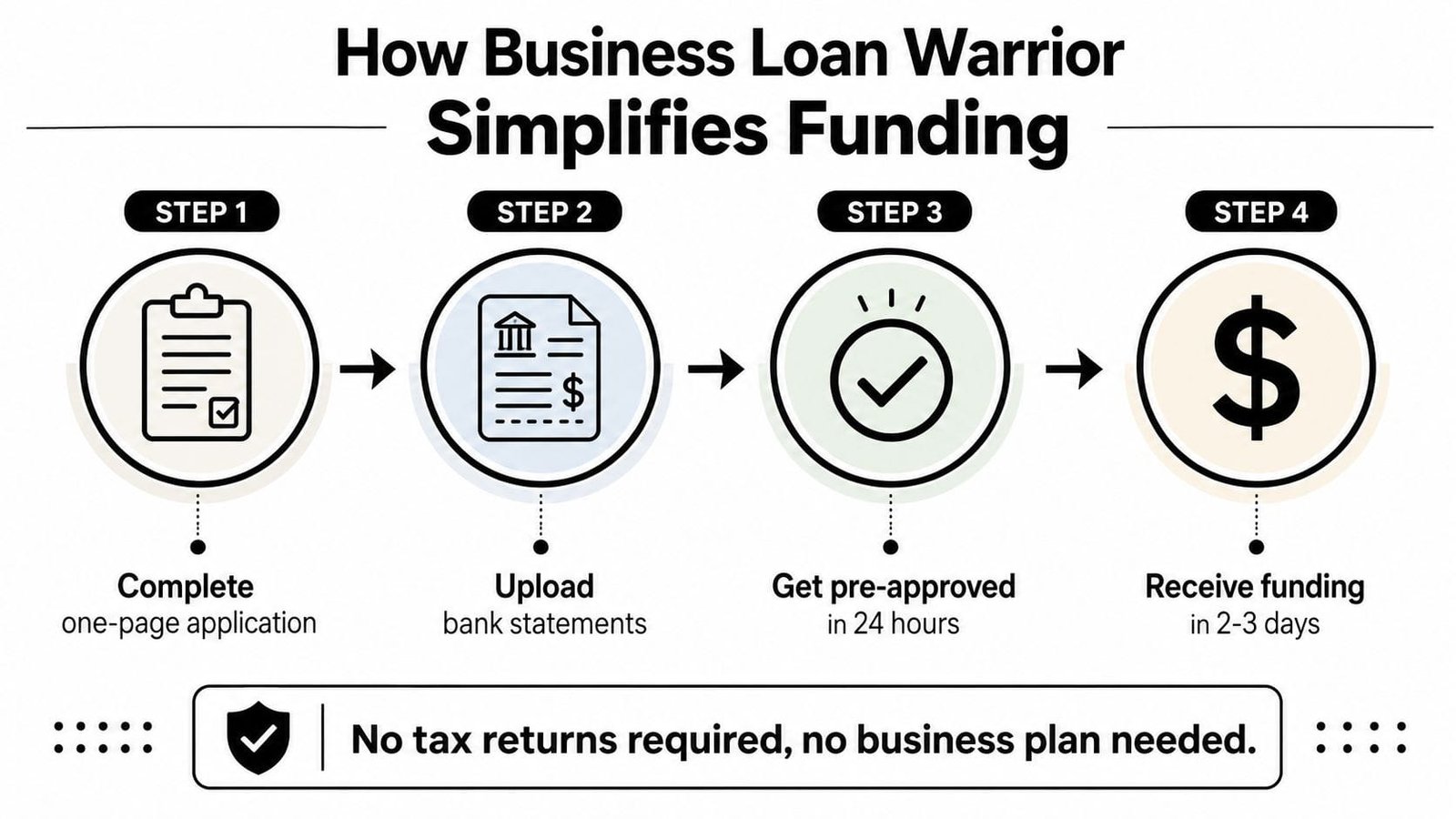
Business Loan Warrior uses a single application process for small business funding and asks applicants for recent business bank statements alongside core business information. That approach fits the modern alt-doc model. The lender still needs evidence, but the owner may not need to begin with a full traditional package of tax returns, audited statements, and a lengthy business plan.
What a sensible screening process should do
- Review revenue consistency and account activity.
- Identify whether a line of credit, term loan, equipment product, invoice financing, or another structure fits the need.
- Use pre-qualification where available before moving to a hard credit inquiry.
- Present repayment obligations, fees, and term details before commitment.
- Flag terms that deserve legal or accounting review.
That last point matters most. A fast application is useful only when the borrower understands the total obligation and can test the payment against a weak month, not just an average month. The platform's role should be to reduce confusion and improve matching, not to encourage an owner to borrow more than the business can repay.
Your Action Plan for Securing Business Capital
True no-doc loans are a relic. Alt-doc financing is the viable path, provided you treat minimal paperwork as a documentation strategy rather than a way to avoid financial scrutiny.
Use this checklist:
- Review personal and business credit. Correct errors and identify existing obligations before applying.
- Gather operating evidence. Organize bank statements, payment records, a current profit and loss statement, licenses, and outstanding invoices where relevant.
- Define the cash need. Match equipment purchases to equipment financing, invoices to factoring, and recurring working capital to a line of credit.
- Calculate total repayment. Compare fees, payment frequency, term, and total cost, not just the advertised rate.
- Check lender terms. Look for personal guarantees, liens, default provisions, automatic withdrawals, and confession-of-judgment language.
- Explain blemishes briefly. Give the lender a factual account of a late payment, seasonal decline, or unusual expense, along with the corrective action.
- Request a structured assessment. Submit the cleanest version of your financial story before accepting an offer.
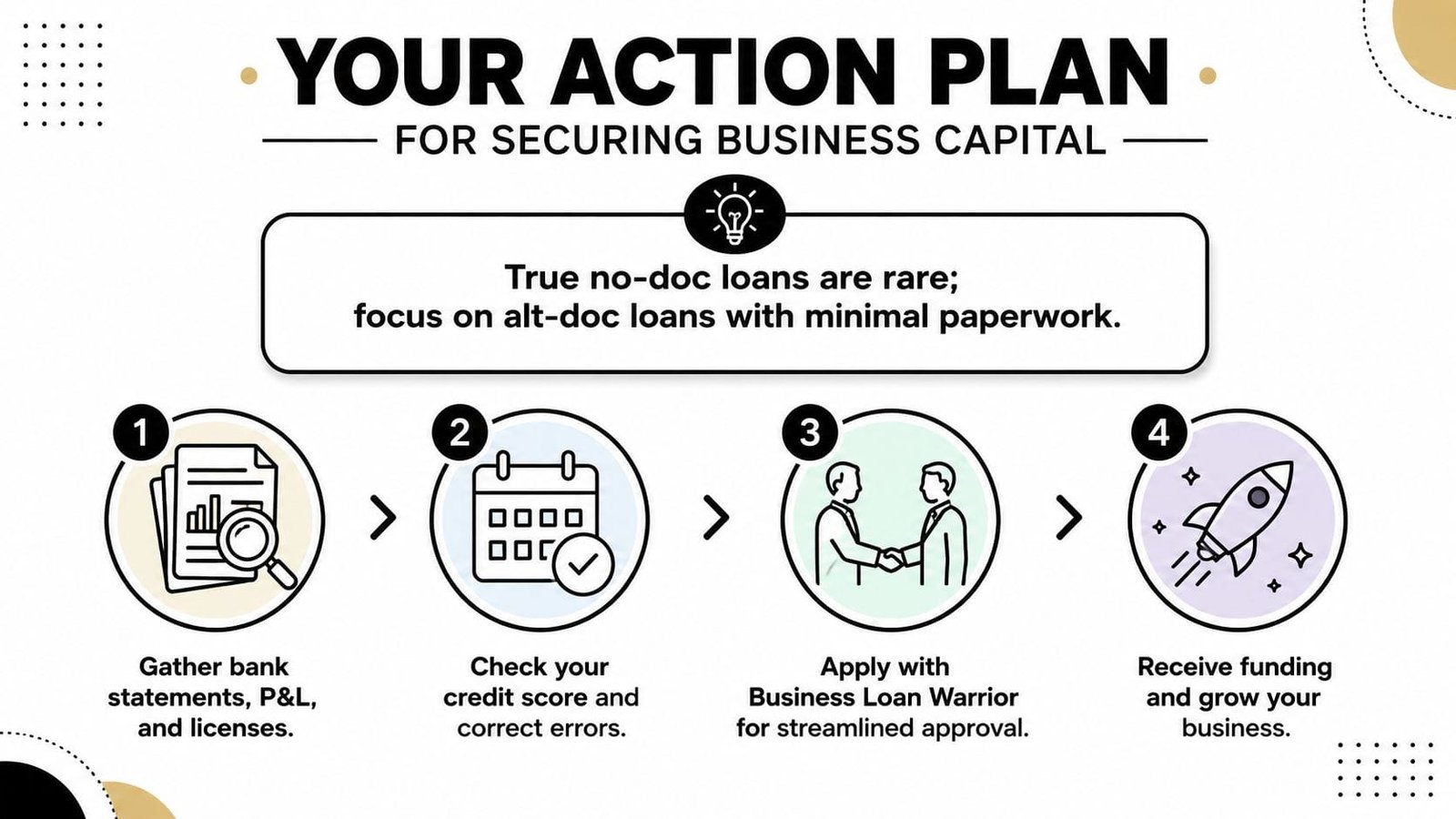
Minimal paperwork can shorten the process, but it doesn't remove the need for disciplined borrowing. Choose the product that fits your revenue cycle, reject terms you can't explain, and protect the cash your business needs to operate.
Business Loan Warrior helps small business owners compare funding paths that use practical records such as recent bank statements and revenue data instead of demanding a traditional paperwork stack from the start. Visit Business Loan Warrior to request a funding assessment and identify an option that fits your cash flow and documentation profile.