
You've found the location, signed the lease, and promised your contractor that the renovation money is coming. The problem is timing. A conventional business loan may move too slowly, while a high-cost online product could strain cash flow before the doors open. SBA Express is designed for situations like this, but approval depends on more than checking a short eligibility list.
The question isn't simply, “Do I meet the SBA Express loan requirements?” It's, “Do I meet the SBA's baseline rules, and does the lender I'm approaching accept my credit, cash flow, ownership, collateral, and documentation?” Those are separate tests. This guide explains both, including the ownership and fee changes that can affect applications in 2026.
Table of Contents
- Why SBA Express Exists and When It Makes Sense
- Baseline Eligibility Rules Every Borrower Must Meet
- Credit, Revenue, and Collateral Expectations in Practice
- Documents You Need Before You Apply
- Loan Terms, Limits, and Fees in 2026
- Application Steps and a Realistic Timeline
- Common Reasons SBA Express Applications Get Declined
- How SBA Express Compares to Other Funding Paths
Why SBA Express Exists and When It Makes Sense
A restaurant owner has secured a prime location and needs $150,000 for renovations before the scheduled opening. The contractor needs a commitment, the landlord wants progress, and waiting through a lengthy government review could put the entire launch at risk. The owner has revenue history, a workable business plan, and a reasonable repayment source, but needs a lender to make a decision quickly.
That's the gap SBA Express was built to address. Express is a faster processing option within the SBA 7(a) program, not a completely separate form of government lending. Participating lenders can use their own documentation, analyses, policies, and procedures, while the SBA has a response target of 36 hours for an application decision. The structure is described in the SBA's lender and program guidance.
The tradeoff is important. The SBA provides a 50% guarantee on SBA Express loans, and the program is capped at up to $500,000 in many SBA summaries and lender guides. Because the federal backstop is lower than on ordinary 7(a) lending, the lender keeps more risk. Faster processing doesn't mean relaxed underwriting. It often means the lender must be comfortable with the file without waiting for a detailed SBA credit review.
Practical rule: SBA Express makes the most sense when speed matters, the requested amount fits the program, and the business can present a clean, credible repayment story.
A working-capital need, equipment purchase, expansion expense, or time-sensitive bridge can fit that profile. A complicated acquisition, a large real estate project, or a request exceeding the Express cap may point toward standard 7(a) or another program instead. Owners comparing those choices can also benefit from broader business financing insights from Kons Law, especially when the legal and repayment implications matter as much as the approval speed.
Baseline Eligibility Rules Every Borrower Must Meet
Before a lender reviews your score or collateral, your business must clear the SBA's foundational eligibility rules. These requirements come from the program itself. A lender can add stricter standards, but it generally can't ignore a core SBA restriction and still treat the facility as an SBA Express loan.
Start with the business
The business generally needs to satisfy these baseline conditions:
- For-profit operation: The company must operate for profit in the United States or its territories.
- Small-business status: The company must fit the SBA's size standard for its industry. The SBA measures size through factors such as average receipts or employee counts, and the applicable threshold varies by NAICS code. An SBA-linked summary notes that many businesses generally fall below 500 employees or roughly $7 million in annual receipts, but those figures aren't universal. Review the applicable SBA lender and size-standard resources for the relevant industry.
- Eligible industry: Most ordinary operating businesses can qualify, but certain activities involving speculation, lending, or pyramid schemes may be excluded.
- Ability to repay: You'll need to show that the business can support the proposed debt from a reasonable repayment source.
- Reasonable private-credit test: SBA assistance is intended for businesses that can't obtain comparable financing on reasonable terms without the guaranty.
That last point confuses owners. It doesn't mean you must be turned down by every bank before applying. It means the lender must document why SBA support is appropriate rather than treating the program as a substitute for readily available conventional credit.
Then review ownership
Ownership and control matter. The SBA's baseline framework includes owner eligibility, personal responsibility, management ability, and investment in the business. Owners with 20% or more generally must provide personal guarantees, as noted in SBA-linked lender guidance.
Recent materials also report a significant ownership change for loans approved on or after March 27, 2025. Those materials state that 100% of business ownership must be held by U.S. citizens, U.S. nationals, or lawful permanent residents, excluding foreign or temporary visa ownership from eligibility. Review the ownership structure before submitting an application, especially if the company has multiple members, trusts, holding companies, or recent equity changes.
For a plain-language walkthrough of the broader qualification process, use this guide to qualifying for an SBA loan. It can help you separate SBA eligibility from the lender's separate credit decision.
Credit, Revenue, and Collateral Expectations in Practice
The SBA's rules are only the first filter. The participating lender still decides whether the business is creditworthy, and the 50% guarantee leaves the lender exposed to substantial risk. That's why two businesses that appear eligible under the same SBA checklist can receive different answers from different lenders.
A lender may review personal credit, payment history, existing debt, cash flow, time in business, collateral, ownership experience, and the intended use of funds. Many lender overlays look for around 650+ personal credit, $100,000+ revenue, and two years in business, according to the neutral lender-expectation summary from NerdWallet's SBA Express overview. Those are common market expectations, not universal SBA rules.
The baseline and the overlay are different tests
| Criterion | SBA baseline minimum | Typical lender overlay |
|---|---|---|
| Personal credit | The SBA evaluates creditworthiness and repayment ability | A lender may set its own credit floor and examine the depth and recency of the credit history |
| Revenue | The business must demonstrate repayment ability | The lender may require established revenue and sufficient cash flow after existing obligations |
| Time in business | The SBA baseline is broader than many bank policies | Many lenders prefer at least two years of operating history |
| Collateral | Current SBA materials state lenders aren't required to take collateral for loans up to $50,000 | Above that amount, the lender may seek available business assets or apply its own collateral policy |
| Personal guarantee | Owners with 20% or more generally personally guarantee the debt | The lender may require additional guarantees or stronger liquidity from owners |
Collateral rules have also changed over time. Older SBA Express guidance referred to no collateral requirement for loans of $25,000 or less, while current SBA materials use $50,000. That historical difference matters, but it shouldn't lead you to assume that a larger request is unsecured. Above the current threshold, the lender determines its collateral approach, subject to SBA rules.
A score that sits near a lender's lower boundary deserves careful preparation. Owners who want background on how a score in that range is commonly interpreted can review this explanation of a 618 credit score from EzVCard, but the lender will consider the entire file, not one number.
A borrower can be SBA-eligible and still fail a lender's underwriting policy.
Focus on the practical profile: stable deposits, accurate financial statements, manageable existing debt, no unexplained late payments, and a clear use of proceeds. If the business can't show enough cash flow to cover the new payment and normal operating needs, the guarantee won't solve the lender's concern.
Documents You Need Before You Apply
An Express application can move quickly only when the file is complete. The SBA's response target doesn't eliminate lender verification, credit analysis, ownership review, or closing documentation. Missing records can turn a simple process into repeated email requests.
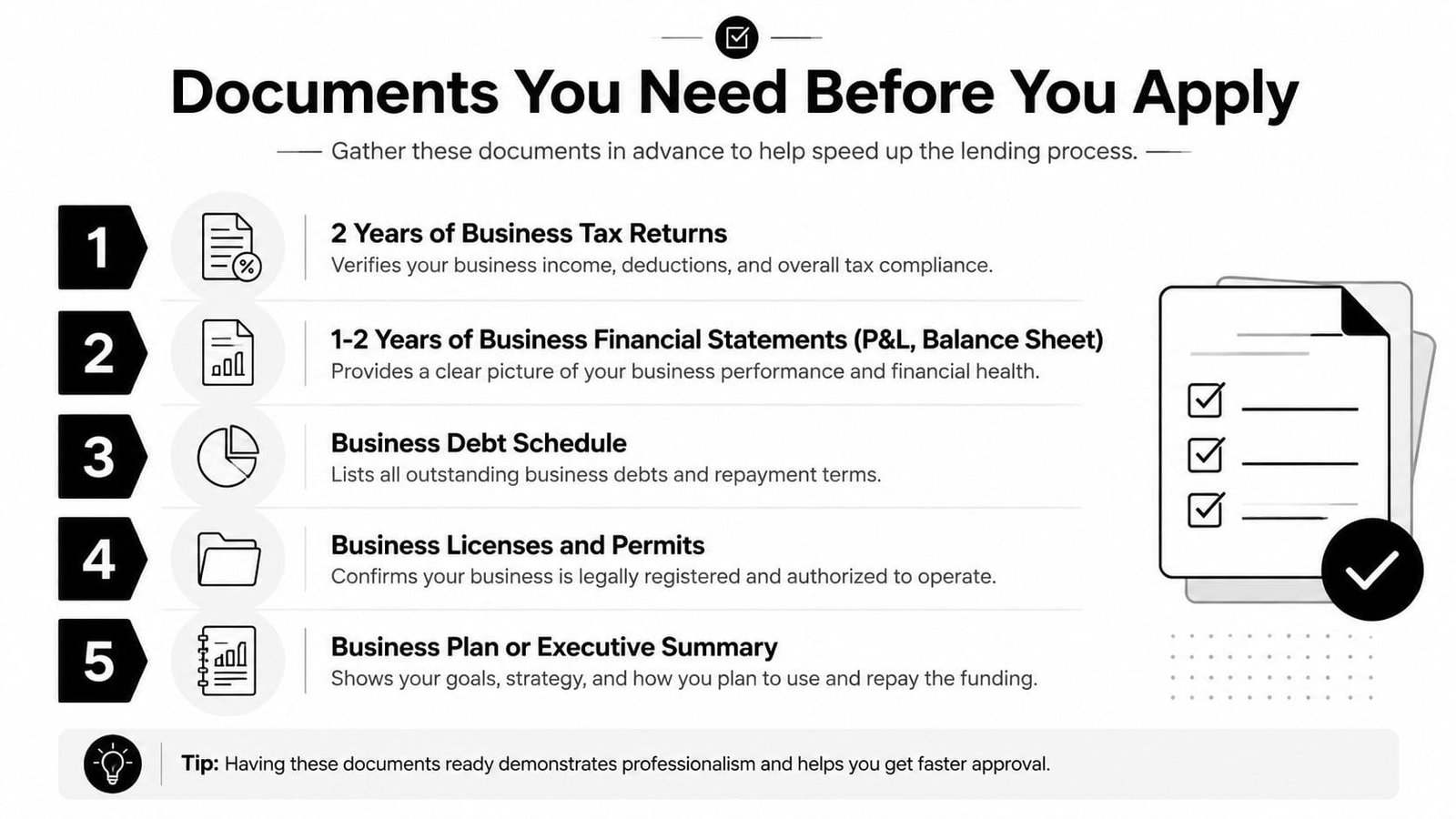
Start with the financial documents that show how the company earns and uses cash:
- Business tax returns: Prepare the business's recent tax filings, commonly covering two years when the lender requests them.
- Current financial statements: Assemble a year-to-date profit-and-loss statement and a balance sheet dated within the lender's required period.
- Debt schedule: List every business obligation, including lender, balance, payment, maturity, and collateral.
- Use-of-funds explanation: Match the requested amount to invoices, equipment details, renovation costs, working-capital needs, or another specific business purpose.
- Owner information: Gather personal tax returns, a resume or business history, and a personal financial statement such as SBA Form 413.
The lender may also request formation records, articles of incorporation, an operating agreement, ownership certificates, franchise agreements, licenses, permits, leases, and proof of insurance. If the loan involves property, equipment, construction, or a specialized industry, expect additional verification. For risk-management questions tied to SBA borrowing, expert advice from Duncan & Associates may help you identify insurance issues before closing.
SBA forms and closing records
Lenders commonly use SBA Form 1919 for borrower information and SBA Form 1920 for the lender's application. The exact package can vary because Express lenders may rely on their own forms and procedures.
Closing requires more than an approval email. The authorization documents require a valid SBA Loan Guarantee Agreement and a valid SBA Express Supplemental Loan Guaranty Agreement, as described in the SBA Express loan authorization document. For help preparing the owner's financial disclosure, review this explanation of the SBA personal financial statement.
Loan Terms, Limits, and Fees in 2026
SBA Express economics start with three defining features: a maximum loan amount of $500,000, a 50% SBA guarantee, and a lender-led process supported by the SBA's 36-hour response target. The guarantee protects only part of the lender's exposure. It doesn't guarantee approval, eliminate repayment obligations, or set aside the lender's own credit policy.
The program can support a term loan or, where offered and approved, a revolving line of credit. The useful maturity depends on the purpose and the lender's structure. Real estate financing may receive longer treatment than working capital or equipment, but the lender must match the repayment period to the asset and the business's repayment capacity.
What changed for borrowers
Recent 2025 materials report that upfront guaranty fees and lender service fees were reinstated for loans approved on or after March 27, 2025. The same materials describe the Express maximum as $500,000 and the guarantee as 50%. That means older articles describing Express as a low-fee shortcut may no longer reflect the economics of a current application.
| Feature | SBA Express in 2026 |
|---|---|
| Maximum loan amount | Up to $500,000, subject to lender approval and program rules |
| SBA guarantee | 50% of the loan amount |
| SBA decision target | 36 hours for an application decision |
| Loan structure | Term financing or a revolving line of credit, if the lender offers and approves it |
| Repayment period | Depends on purpose, asset type, and lender underwriting |
| Upfront fees | Guaranty and lender service fees may apply under the post-2025 rules |
| Collateral | Current SBA materials state no lender-required collateral for loans up to $50,000, with lender policy governing larger requests |
| Closing documents | SBA Loan Guarantee Agreement and SBA Express Supplemental Loan Guaranty Agreement |
The guarantee can make a lender more willing to consider a qualified small business than it might be under a conventional structure. But because Express provides a smaller federal backstop than ordinary 7(a) lending, the lender may compensate through stronger credit standards, collateral requirements, pricing, or tighter debt-service analysis. Ask for a written fee and repayment breakdown before accepting the offer.
Application Steps and a Realistic Timeline
SBA Express has a fast SBA response target, but the entire borrowing process still has several stages. The lender must collect documents, verify information, underwrite the request, prepare closing records, and confirm that the guaranty package is correct.
Five practical phases
- Pre-application self-check: Confirm the business is for-profit, U.S.-based, within the applicable size standard, in an eligible industry, and able to explain repayment.
- Lender selection: Compare SBA-participating lenders and ask whether they handle Express loans, what overlays they use, and whether they have delegated authority.
- Full submission: Provide the lender's application, SBA forms, tax filings, financial statements, debt schedule, ownership records, and use-of-funds documentation.
- Underwriting: The lender reviews credit, cash flow, collateral, existing obligations, management experience, and discrepancies. The SBA's response target applies to its application decision process, not every lender task.
- Closing and funding: The lender completes the guarantee agreement package, signs final documents, verifies conditions, and disburses funds.
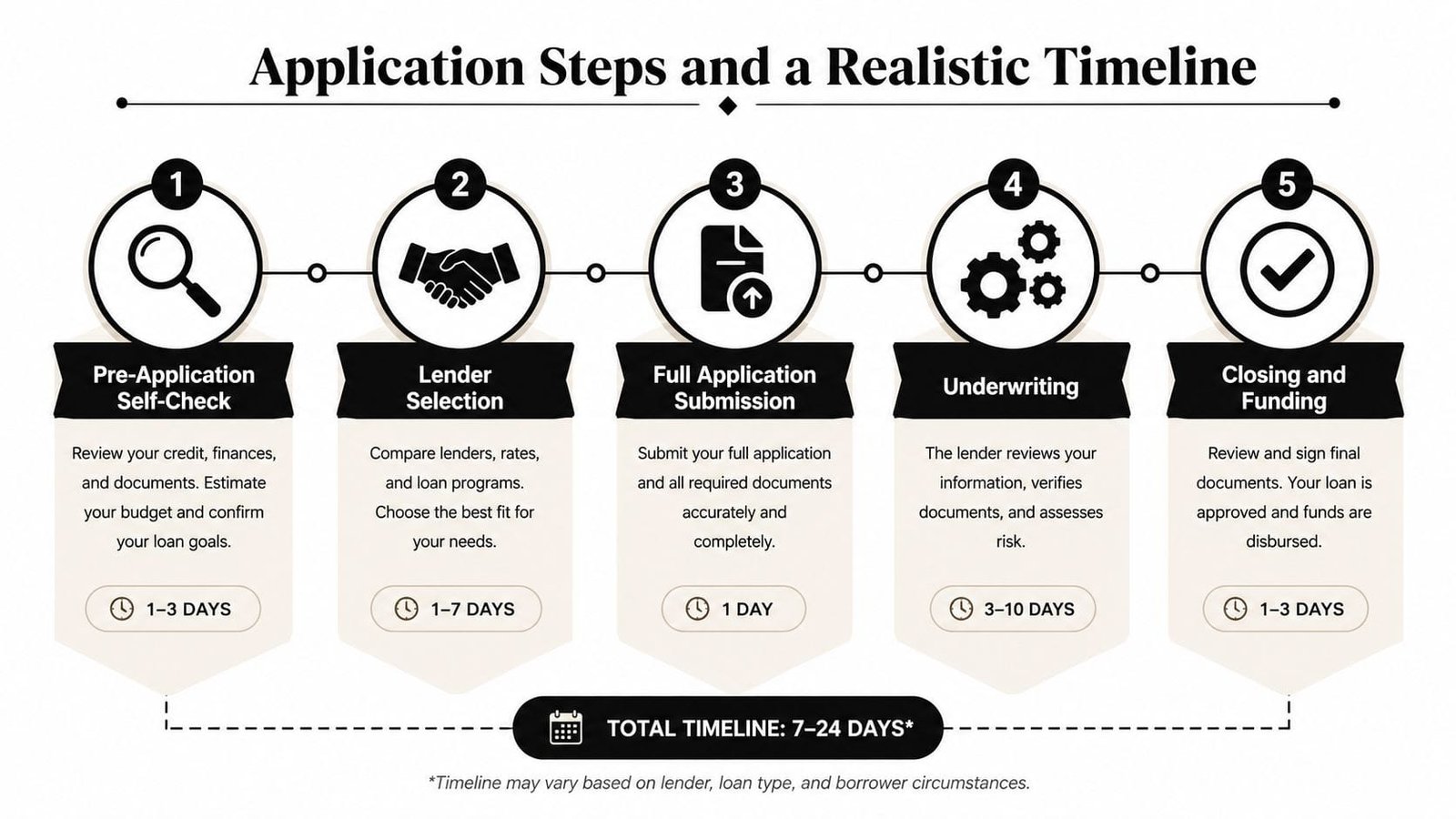
Preferred or delegated lenders may complete more decisions internally, but their internal process still varies. You can shorten delays by answering requests promptly, sending reconciled financials, and explaining unusual deposits or credit events before the underwriter asks. Owners planning around a lease, purchase contract, or construction schedule should use a realistic small-business funding timeline rather than treating the SBA response target as a funding promise.
Here's a concise video overview to supplement the written process:
Common Reasons SBA Express Applications Get Declined
Meeting the SBA Express loan requirements on paper doesn't guarantee approval. The lender still has to decide whether the business presents an acceptable risk under its own policy, and the lower Express guarantee can make that decision more conservative.
Where files commonly break down
- Cash flow doesn't support the payment: The business may be profitable on paper but lack enough available cash after existing debt, owner draws, taxes, and operating expenses. Rework the request around a payment the business can realistically support.
- Credit falls below the lender's overlay: A borrower may fit the broad SBA standard but miss the lender's internal floor. Review recent late payments, revolving balances, utilization, collections, and unexplained inquiries before applying.
- Liens, judgments, or federal debt problems appear late: Search for unresolved obligations and disclose them early. An omission can damage credibility even when the underlying issue might have been explainable.
- The ownership structure is ineligible: A recent ownership transfer, temporary visa status, or foreign ownership can conflict with current eligibility rules. Confirm every owner's status and percentage before submission.
- The business or use of funds falls outside policy: Speculative activity, lending, pyramid schemes, and other restricted areas can create a program or lender problem. A lender may also decline a use it doesn't support even if another Express lender would consider it.
Run a self-audit before submission
Check that the ownership chart matches the operating agreement, tax returns, and application. Reconcile bank deposits to reported revenue, list every debt, confirm licenses are current, and prepare a written explanation for bankruptcy, tax issues, liens, or credit interruptions. Don't try to hide an unfavorable fact. A clear explanation gives the lender something to evaluate; a surprise often causes the file to stall or fail.
If one lender says no, that result doesn't automatically mean the SBA program is closed to you. Another participating lender may use a different overlay, while a specialized community-focused option may evaluate the file differently. The right next move is to identify the exact decline reason, correct what you can, and avoid sending the same incomplete package to another lender.
How SBA Express Compares to Other Funding Paths
Express is strongest when speed and government-backed structure matter more than maximizing the loan size or obtaining the lender's most favorable economics. Standard 7(a) is usually better suited to larger or more complex financing. SBA 504 focuses on major fixed assets, while non-SBA products can be faster but may provide less structured repayment or carry different pricing.
| Program | Max loan amount | Typical timeline | Best use case |
|---|---|---|---|
| SBA Express | Up to $500,000 | SBA response target of 36 hours, with lender processing afterward | Time-sensitive working capital, expansion, equipment, or bridge financing |
| Standard SBA 7(a) | Not specified here | Generally slower than Express because of broader review | Larger or more complex business financing |
| SBA 504 | Not specified here | Varies by lender and project | Owner-occupied commercial real estate and major fixed assets |
| Community Advantage | Not specified here | Varies by mission lender and file | Borrowers served through community-focused lending channels |
| Online term loan | Varies by provider | Often lender-dependent | Businesses prioritizing convenience and speed outside SBA programs |
| Revenue-based financing | Varies by provider | Provider-dependent | Businesses with recurring revenue that prefer repayment tied to receipts |
| Business line of credit | Varies by provider | Provider-dependent | Reusable working capital rather than one-time project funding |
The comparison has a practical implication. Express may be a sensible fit for a moderate request with a firm deadline, a credible operating history, and documentation ready to review. A standard 7(a) route may deserve consideration when the project is larger, the use of funds is complex, or the higher guarantee could improve lender comfort. A 504 structure may fit a fixed-asset purchase better than a general-purpose Express request.
For owners weighing rates, fees, collateral, and timing together, the best program isn't automatically the fastest one. Match the product to the use of funds, then compare lender overlays and total repayment cost.
Business Loan Warrior can help you compare funding paths, prepare for SBA loan processing, and connect your request with options suited to your business profile. Visit Business Loan Warrior to explore a no-fee application and take the next step toward financing with a clearer view of your SBA Express eligibility.