

You might be looking at the SBA Microloan program after a frustrating week. Maybe a bank said your business is too young. Maybe your revenue is real, but uneven. Maybe you only need enough money to buy equipment, restock inventory, or cover a cash gap, and every other loan option feels oversized or too expensive.
That's where many owners first hear about SBA microloans. But the part that confuses people is this: the SBA usually isn't the lender you deal with. A local nonprofit or mission-based intermediary is. That changes how approval works, what documents matter most, and who can qualify.
It also matters more now because one of the least-discussed parts of the program is no longer just credit or time in business. A March 2026 SBA policy notice created a citizenship and residency issue that many older guides still miss, according to the SBA microloan citizenship policy update.
Table of Contents
- What the SBA Microloan Program Is Designed to Do
- Core Eligibility Requirements Every Applicant Must Meet
- How the Intermediary Lender Model Actually Works
- Documentation Checklist Intermediaries Expect
- Allowable Uses and the $50,000 Lending Cap
- Application Timeline From Inquiry to Funding
- Common Reasons SBA Microloan Applications Get Denied
- Practical Steps to Strengthen Your Approval Odds
What the SBA Microloan Program Is Designed to Do
A first-time borrower often reaches this program after hearing some version of the same answer from a bank: the loan request is too small, the business is too new, or the file is too thin.
Maria, who runs a bilingual daycare in Phoenix, fits that pattern. She has some operating history, modest revenue, and a clear use for funds: classroom furniture, supplies, and a small working-capital cushion before enrollment rises again. A conventional lender may see a small request that is hard to underwrite efficiently. The SBA Microloan program was built for that kind of gap.
The key point is easy to miss. This program is not just about small dollar amounts. It is about small businesses that may be workable borrowers, yet still fall outside a bank's standard box.
According to the official SBA microloan program page, the program serves small firms that cannot obtain credit on reasonable terms from nonfederal, nonstate, or nonlocal sources. In plain language, that usually means the owner has a legitimate business need, but the request does not fit a typical bank loan.
Why this program exists
A microloan is often a tool for the next practical step, not a large expansion plan. The program has a $50,000 cap, and average loan sizes are much smaller, which tells you how these funds are usually used. Inventory. Equipment. Supplies. Working capital tied to day-to-day operations.
That size matters because it shapes the lender's mindset. A bank may focus first on whether the file looks like a standard commercial loan. An intermediary lender often starts with a more ground-level question: does this business need a modest amount of capital for a clear purpose, and is there a believable path to repayment?
That intermediary-lender model is the part many guides skip. It changes the program's purpose in practice. The SBA supports the framework, but local nonprofit or mission-based lenders do the screening, underwriting, and borrower support. So the program is designed not only to provide money, but also to route very small businesses through lenders set up to evaluate smaller, less polished loan requests.
Why borrowers misunderstand the program
Many applicants hear “SBA loan” and expect a direct federal process or a bank process with an SBA label on it. The microloan program works more like a hub-and-spoke system. The SBA provides the program structure. Intermediaries make the loan decisions and often offer training or technical assistance alongside the financing.
That is why two businesses with similar revenue can have very different experiences depending on which intermediary they approach.
It also explains why this program deserves a closer look now. Older guides often frame qualification around credit score, collateral, or time in business alone. Those still matter, but they are not the whole picture. The March 2026 citizenship policy update also changed who may qualify through the microloan program, which means the program's purpose is no longer just helping underserved borrowers get small loans. It is also filtering applicants through intermediary rules that now sit alongside updated federal eligibility standards.
For a first-time borrower, the simplest way to view the program is this: SBA microloans exist to fund a smaller business need through an intermediary lender that is built to assess businesses banks often pass over.
Core Eligibility Requirements Every Applicant Must Meet
A first-time borrower often reaches this point assuming eligibility is one yes-or-no checklist. In the SBA Microloan program, it works more like a front door and then a second lock. First, your business has to fit the SBA's basic rules. Then the intermediary lender decides whether your file is strong enough to approve.
The baseline rules
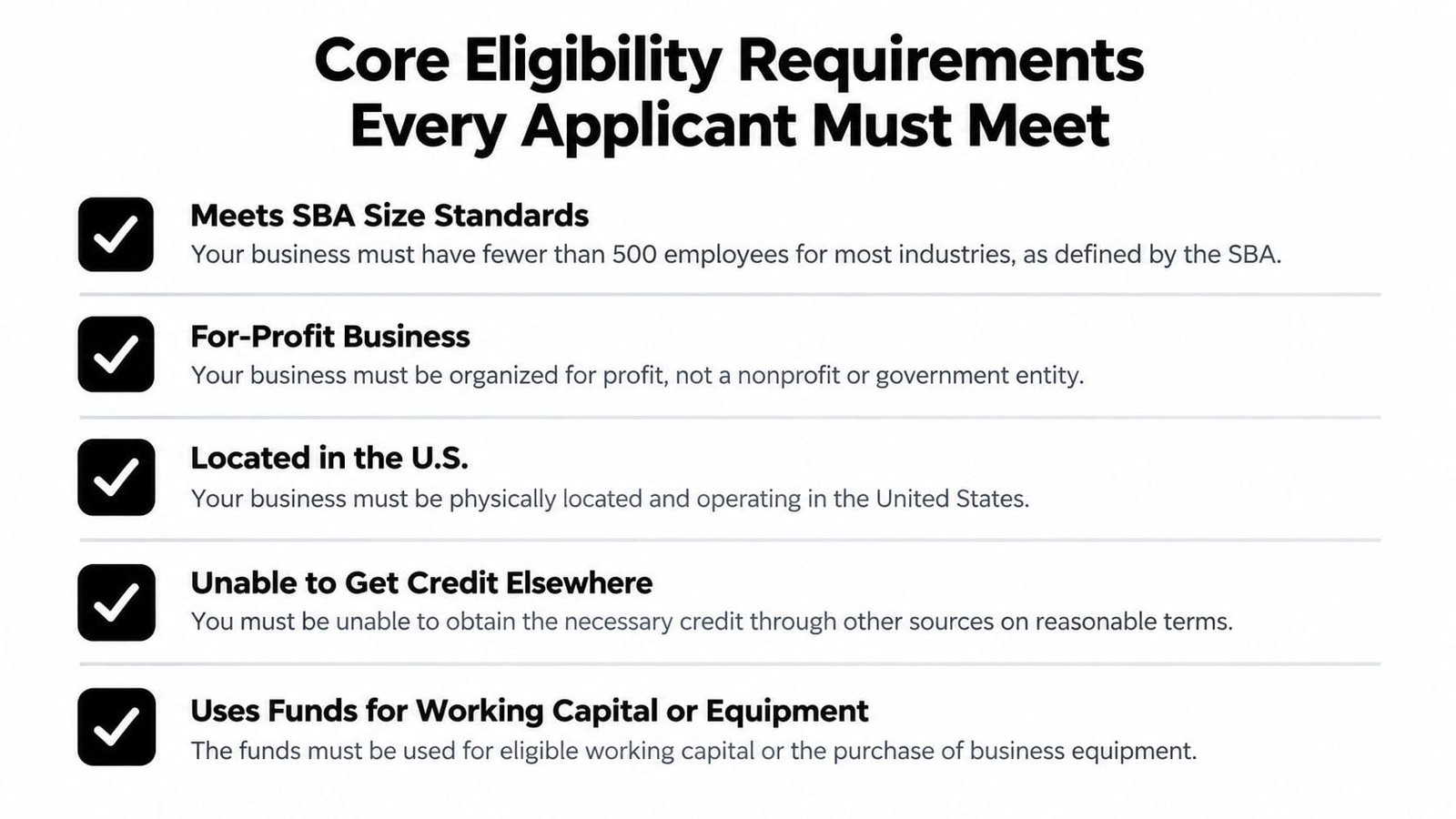
At the SBA level, the starting point is fairly straightforward. Your business generally needs to be operating, for-profit, based in the United States, small under SBA size standards, and able to repay the loan. It also cannot fall into an ineligible business category, as noted earlier in the SBA's microloan eligibility summary.
Here is what those rules mean in plain English:
- You need an actual business, not just an idea. If you already have customers, signed leases, inventory, licenses, or a clear launch plan in motion, you are easier for a microlender to assess.
- The business must be for-profit. Standard structures such as sole proprietorships, LLCs, corporations, and S corporations usually fit this rule.
- The business must operate in the U.S. The business activity itself needs to be based here.
- The business must be small enough to fit SBA size standards. Many microloan applicants, such as solo service businesses or neighborhood retail shops, fall within that range without much trouble.
- You need a believable repayment plan. An intermediary wants to see how the loan gets paid back, whether that comes from current revenue, near-term projected revenue, or both.
If you want a broader overview before zeroing in on microloans, this guide on how to qualify for an SBA loan can help fill in the bigger picture.
The March 2026 citizenship update changes the picture
This is the rule many older guides miss.
A business can satisfy the usual tests on profit status, location, and size and still hit a wall on ownership. Under a March 2026 SBA policy update, effective April 1, 2026, lender guidance now reflects a narrower citizenship standard for microloans. In practical terms, many intermediaries now read the rule to mean the business must be owned entirely by U.S. citizens or U.S. nationals whose principal residence is in the United States, its territories, or possessions, according to the SBA policy notice on microloan citizenship requirements.
For borrowers, this changes the screening order. A lender may review ownership eligibility before spending much time on revenue, collateral, or business plans.
One sentence matters here: a U.S.-based business is no longer the full test by itself.
Where borrowers get tripped up
The confusion usually comes from mixing program eligibility with lender approval. Those are related, but they are not the same thing.
Program eligibility answers, "Can this business be considered at all?"
Intermediary underwriting answers, "Will this specific lender approve this specific request?"
That distinction matters because the SBA sets the floor, while the intermediary often sets the practical bar. A borrower may clear the federal rules and still get declined because the lender does not see enough cash flow, preparation, or management readiness. That is why two applicants who both appear "eligible" on paper can have very different outcomes.
How the Intermediary Lender Model Actually Works
You apply for an SBA microloan, then learn the SBA is not the lender reviewing your file. A local nonprofit or mission-focused lending organization is. That surprises many first-time borrowers, and it changes how the program works in practice.
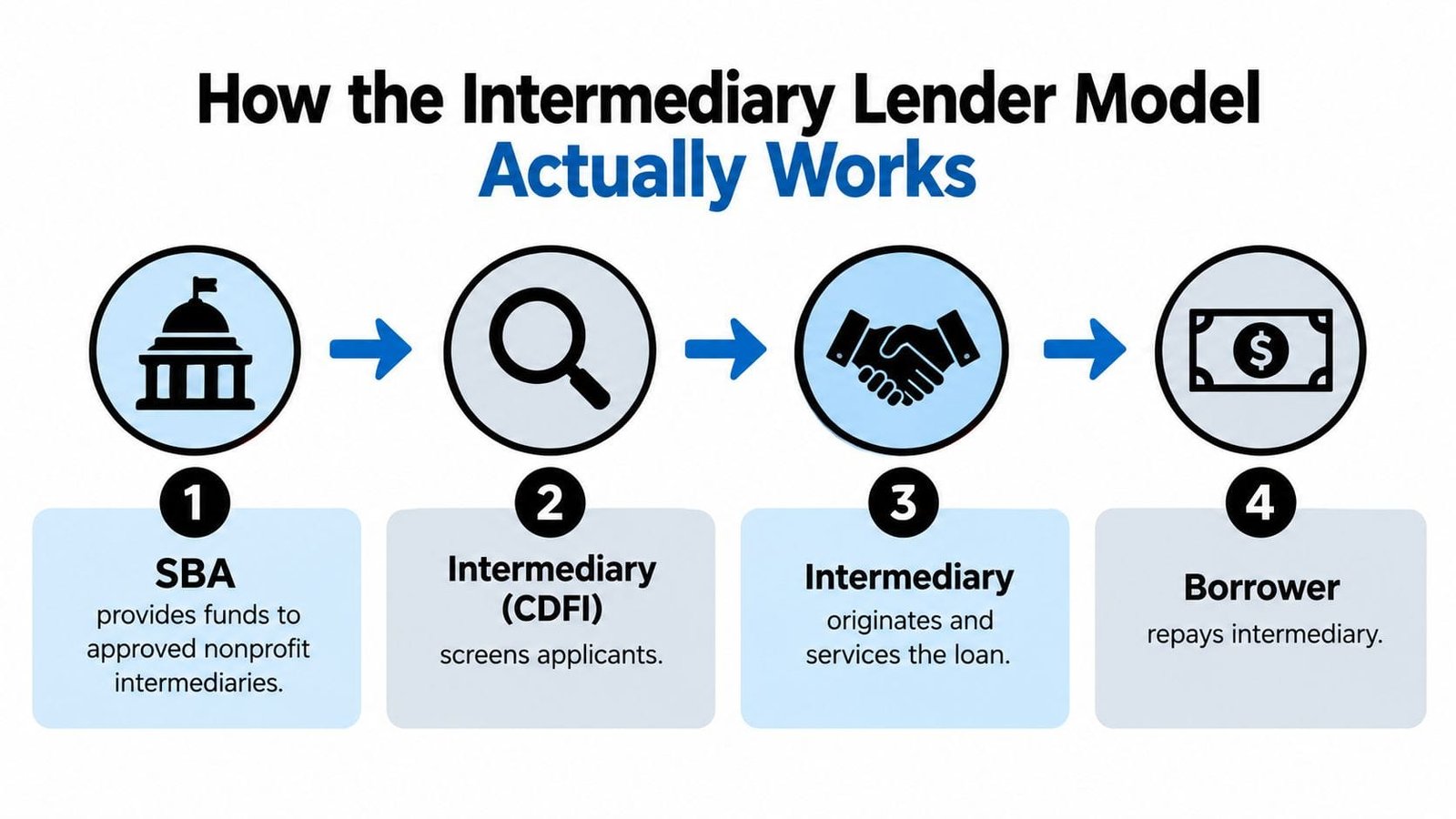
The easiest way to understand the structure is to picture a wholesaler and a neighborhood shop. The SBA supplies capital to approved intermediaries. The intermediary then decides which local businesses to lend to, closes the loan, collects payments, and handles the ongoing relationship with the borrower.
That middle layer is the whole program, not a side detail.
How the money and decision flow
A borrower does not send a microloan application to the SBA for direct approval. The path usually looks like this:
- The SBA provides funds to an approved intermediary.
- The intermediary screens applicants in its service area.
- The intermediary underwrites, closes, and services the loan.
- The borrower repays the intermediary, not the SBA.
That setup explains why two microloan applicants can have very different experiences. One intermediary may focus on startups, food businesses, or contractors. Another may prefer existing businesses with stronger bookkeeping. The federal program creates the framework, but the intermediary does the lending work day to day.
Why borrowers feel this difference right away
A bank often starts with a standard credit policy and a narrower product menu. An intermediary often starts with a conversation.
You may be asked questions that feel more practical than corporate. Why does revenue dip in one season? How fast will new inventory turn into cash? If you buy a second food truck, who will run it on weekdays? Those questions are not small talk. They help the lender decide whether the loan fits your business and whether repayment makes sense.
That is also why the March 2026 citizenship update matters so much in the intermediary model. The rule changed at the program level, but the intermediary is the one applying that rule at intake, often before doing a full credit review. In plain terms, the intermediary is both gatekeeper and lender.
Why technical assistance is part of the model
Many guides treat coaching as a bonus. In the microloan program, it is much closer to the design of the program.
Intermediaries are often expected to do more than issue funds. They may ask you to clean up bookkeeping, revise projections, or complete borrower education before closing. For a first-time owner, that can feel slow. It can also improve the file. A rough application that gets clarified early is easier to approve than a confusing one with unanswered questions.
As noted earlier in the congressional research on the SBA Microloan Program, the model was built around nonprofit or quasi-public intermediaries with lending and technical-assistance experience.
Why availability changes from one area to another
Microloans are not distributed evenly like a national credit card offer. They depend on which intermediary serves your area, how much capital it has available, what industries it knows well, and how quickly its team can process files.
So if one borrower says the process felt supportive and another says it felt strict, both can be right. They may have spoken to different intermediaries with different lending capacity, different risk standards, and different levels of hands-on assistance.
For you, the practical takeaway is simple. In this program, the intermediary is not just a pass-through. It is the lender you need to qualify with, the organization interpreting the rules at the front door, and the team that will decide whether your request is ready for funding.
Documentation Checklist Intermediaries Expect
A lot of first-time borrowers lose time here. They think SBA paperwork means a short federal form. In reality, the intermediary usually builds the application file, and a complete file moves faster than a half-finished one.
Start with the core categories below.
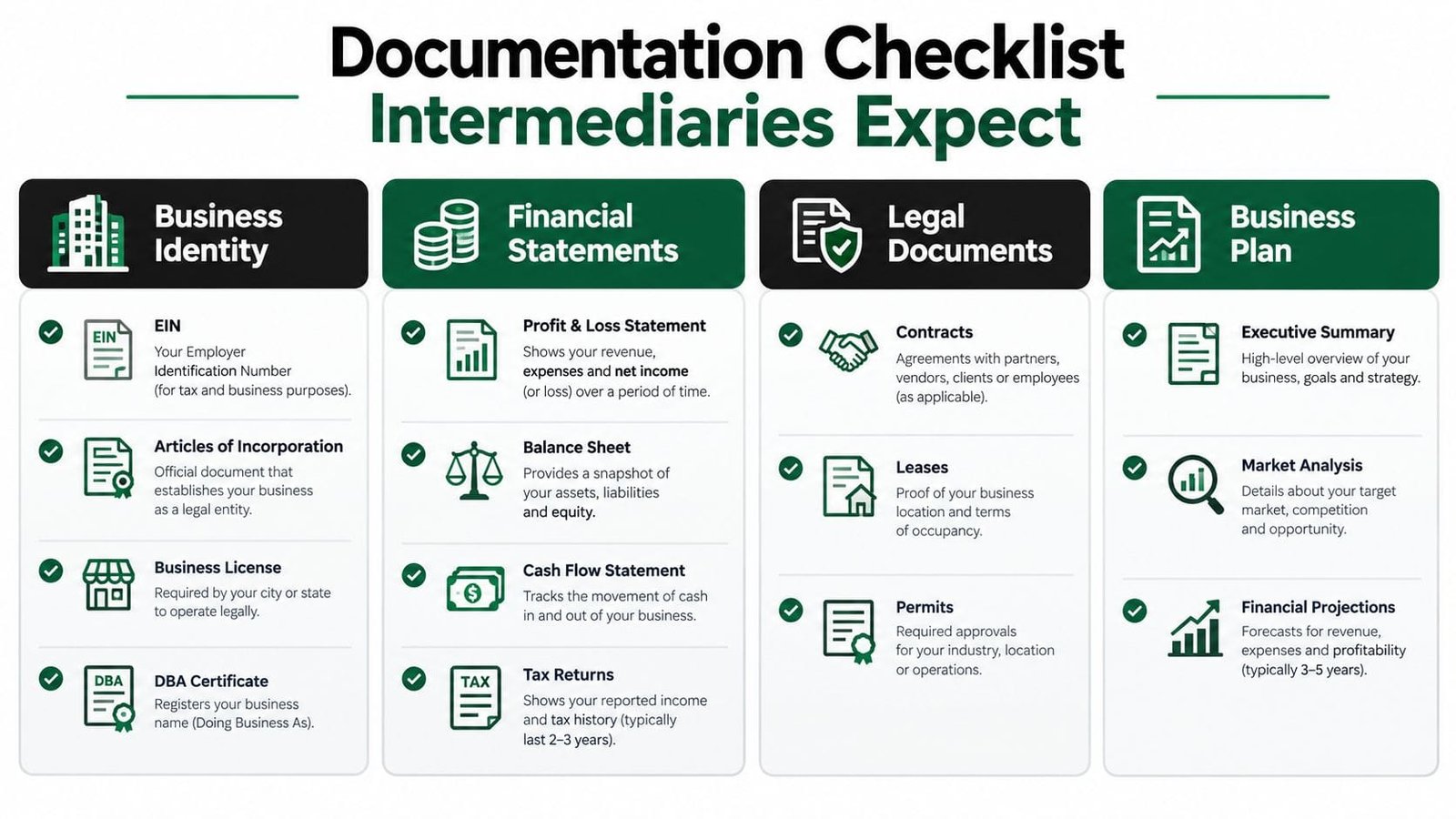
Business identity documents
These prove the business exists and is organized the way you say it is.
- EIN confirmation if your business has one
- Articles of organization or incorporation
- Business license if your city, county, or state requires it
- DBA filing if you operate under a trade name
If your entity name, tax ID, and bank account name don't line up, expect questions. Small mismatches create avoidable delays.
Financial records lenders usually want
Intermediaries test repayment ability.
- Business bank statements
- Recent business tax returns
- Profit and loss statement
- Balance sheet, if your business keeps one
- Projected cash flow
Projected cash flow is the piece many owners underestimate. The lender wants to see your logic. If you borrow for inventory, what happens next? When does the inventory turn into sales? When do those sales become cash in the bank?
For a deeper prep list, this breakdown of what documents you need for business funding can help you organize the file before you apply.
Here's a quick explainer that walks through common loan paperwork from a borrower's point of view:
Owner-level items
Even for a business-purpose loan, the intermediary usually underwrites the owner too.
Borrower mindset: Your lender is evaluating both the business story and the owner's ability to manage the loan responsibly.
Expect requests for:
- Government-issued ID
- Resume or owner background summary
- Personal financial statement
- Authorization to review credit
Loan-use support
This part often separates a ready file from a vague one.
Bring documents that show exactly how the money will be used, such as:
- Equipment quotes
- Inventory invoices or estimates
- Lease agreement
- A short written use-of-funds breakdown
If you ask for working capital, define it clearly. “Operating cushion” is vague. “Rent, payroll, and supply purchases during a seasonal slowdown” is much stronger.
Allowable Uses and the $50,000 Lending Cap
A lot of first-time borrowers hit a confusing moment here. They hear "SBA loan" and assume the money can cover almost any business need. In the microloan program, the intermediary is usually asking a narrower question: does this request help the business operate, stock up, or buy a modest piece of equipment that supports revenue?
That lens matters because this program is built for smaller, practical needs. The maximum loan amount is $50,000, and many microloans are much smaller than that, so the request has to fit the size and purpose of the program. As noted earlier, permitted uses generally include working capital, inventory, supplies, furniture, fixtures, machinery, and equipment.
What usually fits
A bakery might use a microloan for a used commercial oven, ingredient purchases, or a short-term working capital gap before busy season. A retail shop might use it for a bulk inventory order ahead of the holidays. A cleaning company might use it for equipment, supplies, and payroll support while waiting for receivables to come in.
The pattern is simple. The money should go into the business and come back out as sales, completed jobs, or smoother operations.
| Permitted Uses | Prohibited Uses |
|---|---|
| Working capital for normal operations | Buying real estate |
| Inventory purchases | Refinancing existing debt |
| Supplies needed to operate | Paying owner personal expenses or draws |
| Furniture, fixtures, machinery, or equipment | Uses that don't clearly serve the business |
Where borrowers get tripped up
The biggest problem is not the amount. It is the purpose.
An intermediary may decline a request that sounds reasonable in everyday business life but falls outside the microloan program. Buying a building is a common example. Consolidating old debt into one new payment is another. Those uses may fit other financing options, but they usually do not fit here.
Another mistake is treating $50,000 like a default ask. It is a ceiling. Intermediaries want to see that you asked for the amount your plan requires, not the largest number the program allows.
How to size the request
A microloan works a lot like packing a carry-on bag. You only bring what fits the trip. If you ask for too little, the business problem may stay half-solved. If you ask for too much, the file can start to look padded, and the repayment plan gets harder to defend.
A stronger request ties dollars to line items. For example: $8,000 for equipment, $6,000 for opening inventory, and $4,000 for working capital during the first two months. That kind of breakdown helps the intermediary see that the loan has a job to do, and that the job matches what the microloan program is designed to fund.
Application Timeline From Inquiry to Funding
Many borrowers make one bad assumption at the start: they think “micro” means “fast cash.” It usually doesn't. It often means smaller dollars with a more hands-on review.
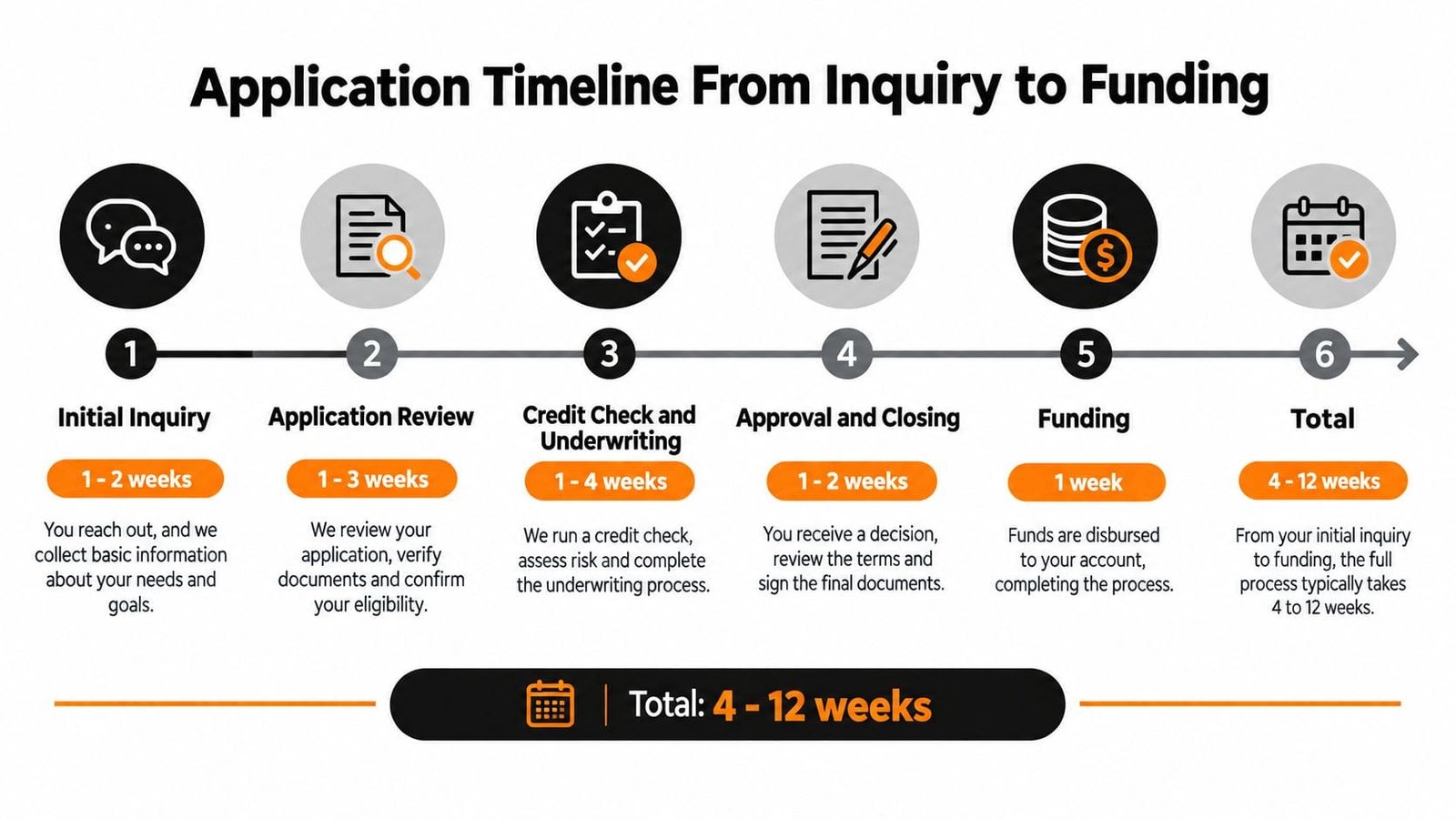
This timeline infographic gives the broad shape of the process:
What the process usually feels like
The first phase is the initial inquiry. You contact a local intermediary, explain what your business does, how much you need, and what the funds are for. If your request looks directionally right, the lender tells you what to submit next.
After that comes pre-application review. Many delays start here. Missing tax returns, unclear bank statements, and inconsistent entity documents can keep a file from moving.
Then comes underwriting. The intermediary looks at repayment ability, business history, owner background, and whether the use of funds fits the program. Some lenders also ask the borrower to complete training or technical assistance before closing.
If you want a broader comparison of funding speed across products, this article on realistic timelines for small business funding from application to cash in your account is useful context.
What speeds things up
Borrowers usually move faster when they do three things well:
- Respond quickly to follow-up document requests
- Explain the use of funds clearly in writing
- Submit organized financials instead of screenshots and partial files
The slow part is often not the program itself. It's the back-and-forth caused by incomplete paperwork or a fuzzy loan purpose.
What to expect emotionally
There may be quiet periods. That doesn't always mean trouble. It can mean the lender is reviewing your file, waiting on an internal committee, or asking you to complete one more document before approval.
The best approach is to treat the process like a real underwriting cycle, not a same-week advance. If your business needs immediate emergency cash, this program may feel slower than you want.
Common Reasons SBA Microloan Applications Get Denied
Denials usually aren't random. They tend to fall into a few predictable buckets, and each one points to a fixable weakness.
What intermediaries tend to flag
Some businesses don't show enough repayment support. Others have a workable business, but no clean explanation of how the loan turns into revenue or stability. Another group gets tripped up by missing documents or an ineligible use of funds.
The denial itself may sound broad. “Insufficient cash flow.” “Incomplete file.” “Does not meet program guidelines.” But behind each phrase is usually a practical concern the lender couldn't get comfortable with.
| Common Denial Reason | Preventive Action |
|---|---|
| Weak current cash flow or unrealistic projections | Build a simple cash-flow forecast tied to the exact loan use |
| Incomplete documentation | Assemble identity, financial, and loan-use documents before applying |
| Vague or weak business plan | Write a short plan that explains the problem, request, and repayment path |
| Credit issues with no explanation | Review your credit early and prepare a written explanation for blemishes |
| Request amount doesn't match need | Ask for a focused amount tied to quotes, invoices, or operating needs |
| Ineligible use of funds | Confirm the use with the intermediary before submitting |
| Ineligible business type or ownership issue | Screen eligibility early, especially on ownership and citizenship rules |
The hidden reason behind many denials
Sometimes the issue isn't that the business is bad. It's that the story is incomplete.
A lender can work with a borrower who has a rough patch if the explanation is clear, the documents support it, and the repayment path makes sense. What lenders struggle with is ambiguity. Unclear numbers, vague plans, and unsupported requests force them to say no because they can't defend the file.
What to do if you get denied
Start by asking what specific gap blocked approval. Then fix that gap before reapplying.
That may mean rewriting projections, reducing the request amount, changing the loan purpose, or applying with a different intermediary whose service area and underwriting style better match your business. A denial can be a dead end, but often it's a sign that the file wasn't ready yet.
Practical Steps to Strengthen Your Approval Odds
The strongest microloan applications are rarely the fanciest. They're the clearest. The owner knows how much they need, why they need it, and how repayment works.
A workable prep plan
Use this as a short pre-application checklist:
- Tighten your records first. Put business statements, tax returns, and core legal documents into one folder before you talk to lenders.
- Match the request to a real use. Ask for an amount tied to equipment bids, inventory needs, or a defined working-capital gap.
- Write a short business narrative. One page is often enough if it explains what the business does, why the money is needed, and how the loan supports repayment.
- Talk to more than one intermediary. Different lenders have different service areas, pacing, and comfort levels with startups or thinner files.
- Address credit issues upfront. If there's a late payment, old collection, or disruption from a past hard season, explain it before the underwriter has to guess.
If you want a practical framework for getting your file in shape before you apply anywhere, these practical credit application steps from Fintrack are a useful complement to microloan prep.
Use technical assistance before the lender asks
One of the smartest moves is to seek help early. Many intermediary lenders value borrowers who are willing to sharpen bookkeeping, revise projections, or attend training before submission.
That matters because microloans are often approved on a combination of documentation and borrower readiness. A lender may say yes to a modest risk if the borrower is organized, coachable, and realistic.
Bring a lender a file they can underwrite, not a pile of documents they have to decode.
One practical tool choice
If you're comparing funding paths alongside microloans, some borrowers also use platforms such as Business Loan Warrior to organize documents and review other funding options through a single application flow. That can be useful when a business needs to see whether a microloan is the right fit or whether another working-capital product is more realistic.
Keep your expectations grounded. This program is best for a defined small-business need, not every funding problem. Clean books, a focused request, and an honest explanation still do more for approval odds than any pitch.
If you're trying to decide whether an SBA microloan fits your situation, Business Loan Warrior can help you compare that path against other realistic funding options and prepare the paperwork lenders usually expect. Visit Business Loan Warrior to explore guidance, timelines, and small-business funding resources that can help you move forward with a clearer plan.