
A loan guarantee is a promise by a third party, often a government agency such as the SBA, to reimburse a lender for part of a loan if the borrower defaults. In the SBA's 7(a) program, the guarantee typically covers 50% to 90%, and eligible borrowing can reach $5 million, but the borrower still owes the full debt.
That distinction matters when you're sitting across from a lender with steady sales, a sensible expansion plan, and a frustrating rejection letter. Maybe your restaurant is profitable but doesn't own enough property for traditional collateral. Maybe your contracting company has strong jobs lined up but a short operating history. A bank can believe your business is viable and still decide that the potential loss is too large.
A guarantee changes that risk calculation. It doesn't turn a weak business into a safe investment, and it doesn't insure you against failure. It gives the lender partial protection, which may make approval or more workable pricing possible when conventional credit support falls short.
Table of Contents
- Why Lenders Say No to Good Businesses
- How a Loan Guarantee Actually Works
- Types of Loan Guarantees and Real Programs
- Eligibility and the Application Process
- The Risks and Costs Nobody Advertises
- When a Guaranteed Loan Makes Sense for Your Business
- Your Loan Guarantee Questions Answered
Why Lenders Say No to Good Businesses
A profitable restaurant can still receive a rejection. Its equipment may have little resale value, leasehold improvements may not provide practical collateral, or its operating history may be shorter than the bank accepts. A contractor can show dependable revenue and signed projects while lacking property or the long financial record a conventional lender prefers.
The gap is not always business quality. It is the lender's potential loss if repayment fails. A loan guarantee is a contractual promise by a third party, often a government agency or development institution, to reimburse a lender for a specified portion of a borrower's unpaid debt after default. The lender supplies the capital, originates and services the loan, and pursues collection. The guarantor shares part of the lender's eligible loss only after the program's conditions are satisfied.
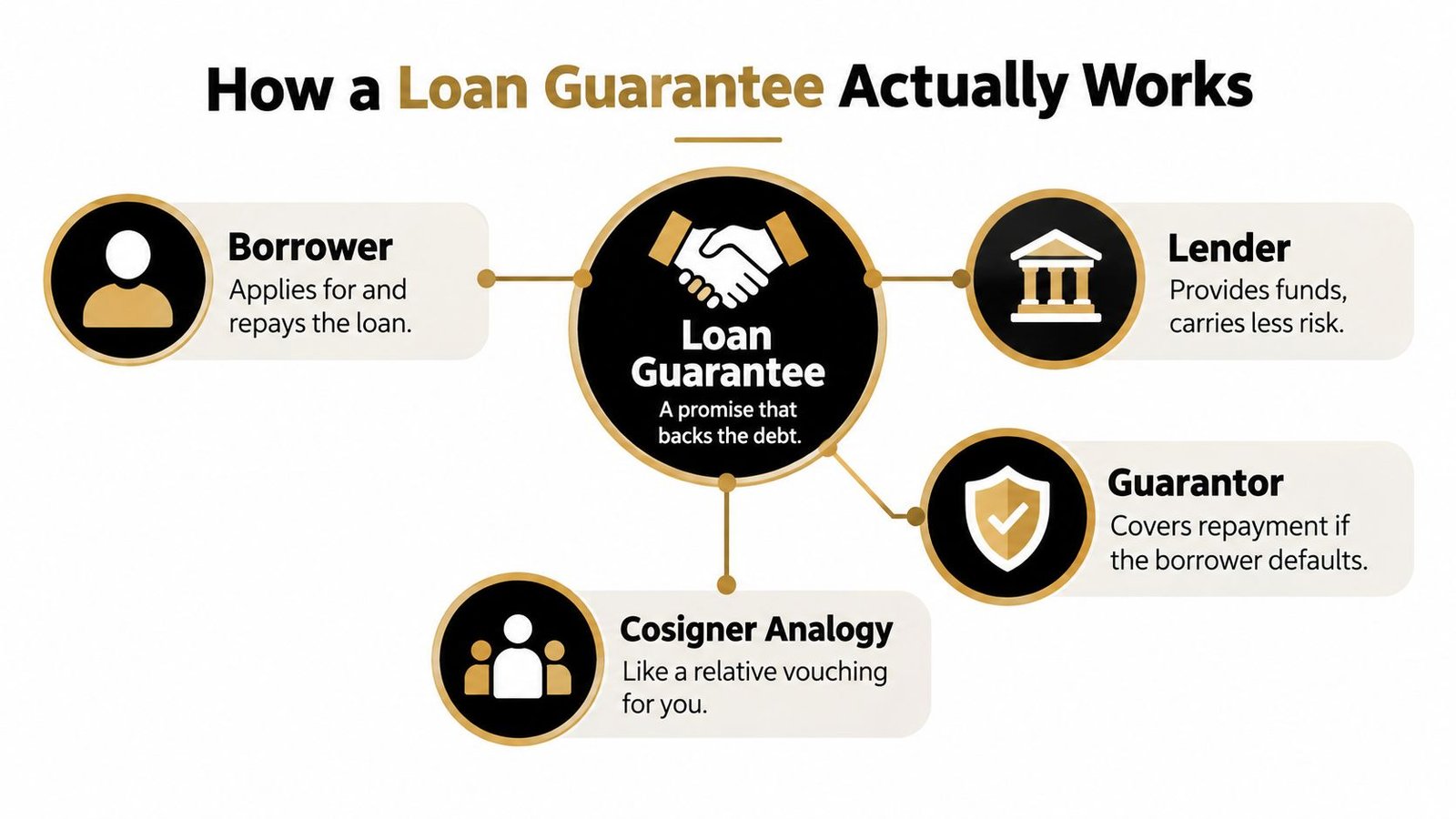
A guarantee works like a cosigner for the bank. The cosigner gives the lender another source of recovery, while the borrower still owes the full obligation. That comparison helps separate access to credit from protection from debt.
The guarantee protects the lender, not the borrower. It can reduce the lender's exposure and improve the chance of approval or workable pricing, yet it does not erase missed payments, remove every collateral requirement, or eliminate personal liability. The business owner remains responsible for the loan even when a government-backed program is involved.
Why the structure helps
Suppose a bank likes your cash flow but sees a collateral shortfall. A partial guarantee may make the bank more willing to lend because it will not bear the entire eligible loss if the loan fails. The lender still has capital at risk, so it continues testing whether the business can repay.
The arrangement also explains why a guaranteed loan is not the same as a direct government loan. In an SBA 7(a) arrangement, a private bank or credit union originates the loan. The SBA guarantees part of it when the lender considers the business viable but finds that collateral or other conventional support is insufficient. The Congressional Research Service describes this structure in its overview of SBA loan guarantees.
Technology can affect the review process as well. AI underwriting automation helps explain how lenders organize documents and assess financial and operational information, though automation does not replace the borrower's repayment responsibility.
A guarantee can improve access to financing. It cannot turn a weak application into a safe loan, and it does not insure the owner against failure.
How a Loan Guarantee Actually Works
Think of a loan guarantee as a cosigner arrangement, but with an important business-finance distinction. If a family member cosigns an apartment lease, you still owe the rent. The cosigner agrees to step in under defined conditions if you fail to pay, but that promise doesn't make the lease free or transfer your responsibility.
A guaranteed loan has three parties:
- The borrower applies for the money, signs the loan documents, and remains responsible for repayment.
- The lender supplies the capital, sets the loan terms within program rules, services the account, and pursues collection if payments stop.
- The guarantor agrees to absorb an eligible portion of the lender's loss after the program's claim requirements are satisfied.
The guarantee usually exists behind the loan rather than in place of the lender's underwriting. At origination, the lender evaluates your business and decides whether the loan qualifies for a guarantee. After closing, the lender continues to collect payments as it would on another loan.
What happens after default
A guarantor typically doesn't send money the moment a payment is missed. The lender must follow defined default, liquidation, documentation, and servicing procedures. That can include pursuing available collateral, documenting the borrower's payment history, and calculating recoveries before submitting a claim.
Consider a simplified example. If an eligible loan has a $1 million outstanding balance at default and carries an 80% guarantee, the contractual guaranteed balance is generally $800,000, while the lender retains exposure to the remaining portion. That doesn't mean the guarantor automatically pays $800,000. Collateral proceeds, recoveries, eligible interest, liquidation expenses, and program-specific rules can change the final claim payment. The Government Accountability Office's explanation of guarantee mechanics describes why the stated coverage percentage isn't the same as a guaranteed payment against every dollar of loss.
Guaranteed is not forgiven. The lender receives risk protection, while the borrower remains responsible for the debt.
Before signing, review how personal liability interacts with the guarantee. A practical guide to business loan personal guarantees can help you identify the separate promises an owner may be asked to make.
Types of Loan Guarantees and Real Programs
Loan guarantees use the same basic structure, but the guarantor, eligibility rules, coverage, and intended borrower vary. A government agency, development institution, export agency, or private guarantor agrees to cover part of the lender's eligible loss. The borrower still owes the full debt.
A useful comparison is a cosigner. The cosigner may make a lender more comfortable approving the loan, but the borrower remains responsible for repayment. A guarantee works similarly for the lender, although its legal terms and claim process depend on the program.
Government-backed guarantees
The SBA's 7(a) program is the best-known U.S. example for small businesses. A private bank or credit union provides the loan, while the SBA guarantees part of the balance when the business appears viable but may fall short of conventional collateral or credit-support requirements. Typical coverage ranges from 50% to 90%, and eligible 7(a) borrowing can reach $5 million per borrower, according to the Congressional Research Service's SBA guarantee report.
The program shows why a guarantee is a lending tool, not a grant. In fiscal year 2022, the average guaranteed 7(a) loan was approximately $538,900, based on the same CRS reference. The private lender supplies the capital and remains exposed to the uncovered portion. The guarantor's support may improve access or pricing, but it does not erase the borrower's debt, collateral exposure, or personal liability.
Other public programs serve narrower needs. USDA business guarantees support eligible rural businesses, while export credit guarantees can assist companies selling eligible goods or services abroad. Each program has its own rules and permitted uses. Approval under one program does not establish eligibility under another.
Private and development guarantees
A development institution, export agency, or private guarantor may also support a loan. These arrangements often reflect a policy or commercial purpose, such as encouraging investment, trade, or economic development.
The protection may apply to a particular project, borrower category, or lender portfolio. The agreement determines which losses qualify, how much the guarantor covers, and what the lender must do before submitting a claim.
Partial-credit guarantees
Most guarantees cover only part of a loan or eligible loss. A World Bank review found a median coverage ratio of 80% among surveyed guarantee schemes, while about 40% offered coverage of up to 100%, as reported in the Congressional Research Service review of small-business credit programs. Partial coverage leaves the lender with a reason to assess repayment capacity and manage the loan carefully.
| Guarantee Type | Who Guarantees | Typical Coverage | Best Fit |
|---|---|---|---|
| SBA 7(a) | U.S. Small Business Administration | 50% to 90% | Viable small businesses with limited conventional credit support |
| Rural business guarantee | USDA or a related public program | Program-specific | Eligible businesses operating in rural areas |
| Export credit guarantee | Public export-credit institution | Program-specific | Companies selling eligible goods or services abroad |
| Private guarantee | Private guarantor or development institution | Contract-specific | Projects or borrowers supported by a commercial or development mandate |
| Partial-credit guarantee | Government, development institution, or private guarantor | Often below 100% | Markets where shared risk can make otherwise unavailable credit accessible |
Coverage is only one term to review. Fees, collateral, covenants, personal guarantees, and claim procedures can affect the loan just as much.
Eligibility and the Application Process
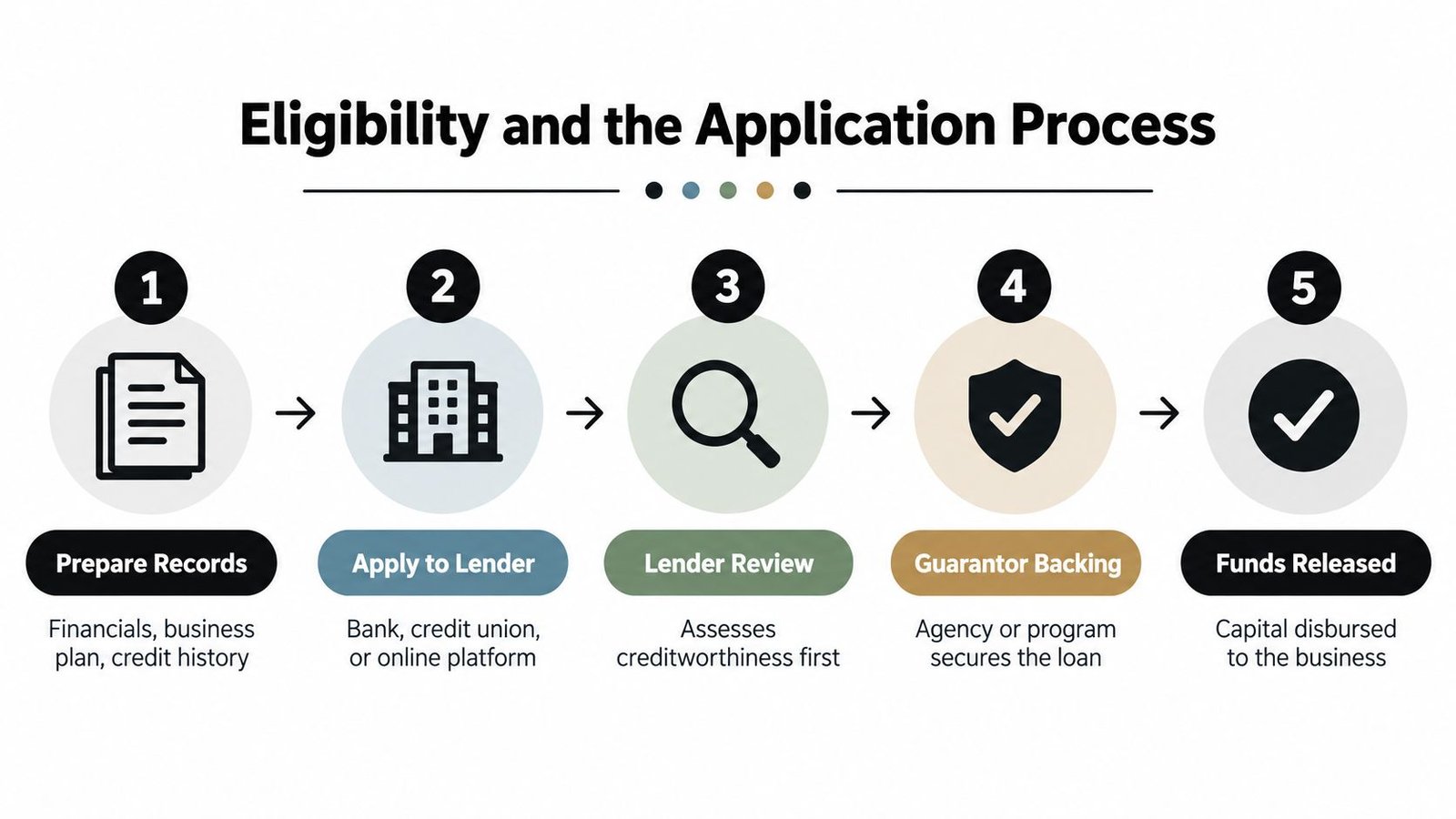
A guaranteed loan application usually starts with the lender, not the guarantor. You apply to a bank, credit union, or participating lending platform, and that lender determines whether it wants to pursue the guarantee under the relevant program.
That means preparation still matters. The guarantee may reduce the lender's potential loss, but it doesn't replace the lender's assessment of whether your business can repay.
Prepare a lender-ready file
Start with the records that let an underwriter understand the business quickly:
- Financial statements: Provide the business's historical income, expenses, assets, liabilities, and cash position.
- Cash-flow projections: Explain how the requested loan payment fits alongside payroll, inventory, taxes, rent, and other obligations.
- Business plan: Connect the requested capital to a specific use, such as equipment, construction, working capital, acquisition, or expansion.
- Credit history: Review business and personal credit records for errors, unresolved delinquencies, or unexplained inquiries.
- Ownership information: Gather identification, ownership details, tax materials, and any personal financial information the program requires.
- Collateral details: List available assets and existing liens, even if the guarantee is intended to address a collateral gap.
A lender will still ask whether the business has reliable repayment capacity. It may examine revenue quality, margins, customer concentration, industry conditions, management experience, existing debt, and the owner's financial history. A guarantee supports a viable request. It doesn't rescue a project whose expected cash flow can't support its obligations.
Expect review before backing
After you submit the application, the lender underwrites the request and may ask for clarification or additional documentation. If the lender approves the credit structure, it handles the guarantee request and confirms that the loan meets program requirements before closing.
The process can be document-heavy because the guarantor needs evidence that the lender followed the rules. A practical SBA loan application process guide can help you organize the sequence without assuming that approval is automatic.
Practical rule: Treat the guarantee as support for a strong application, not as a substitute for one.
The Risks and Costs Nobody Advertises
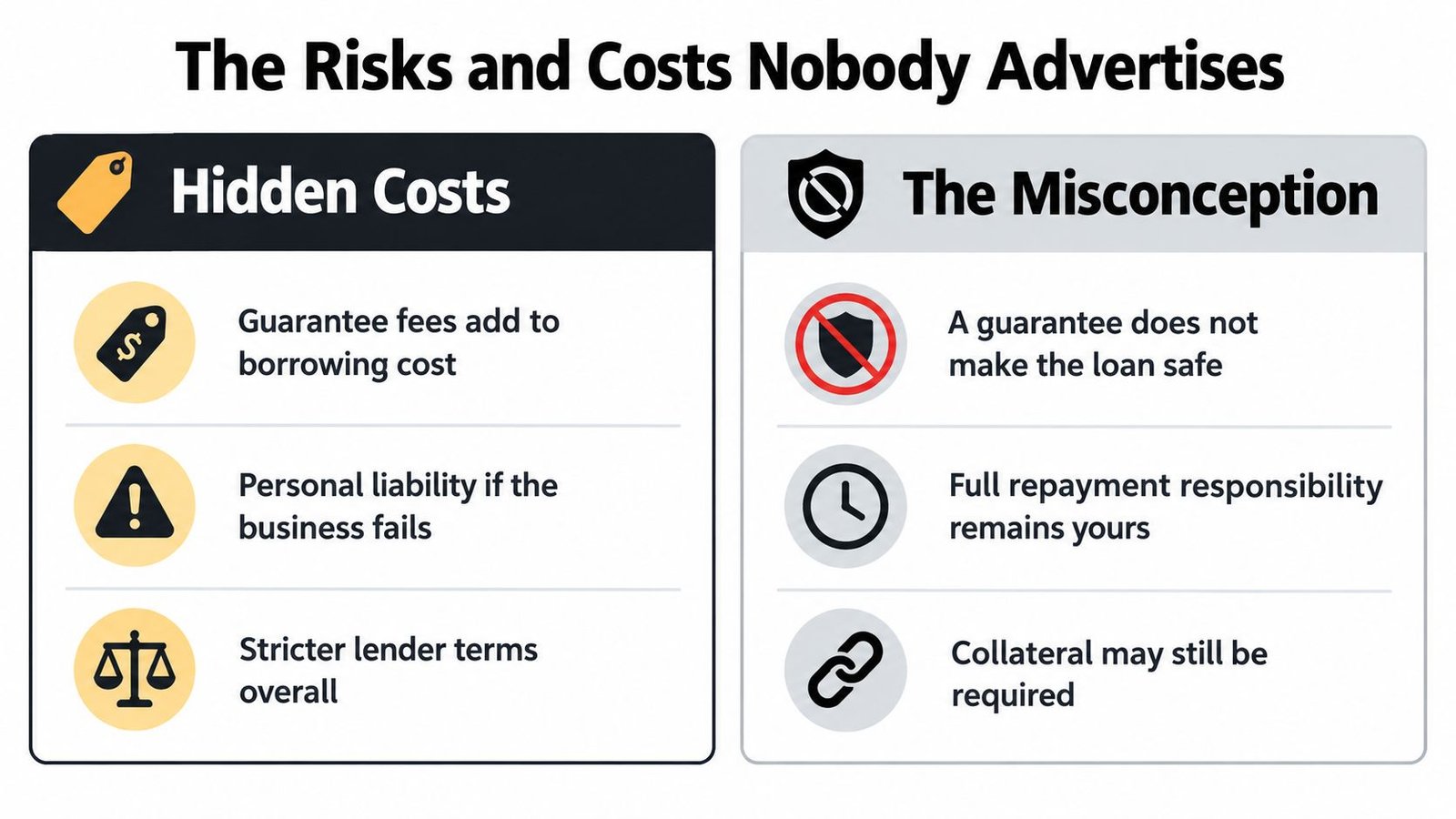
A guaranteed loan can improve access to credit, but it isn't borrower insurance. The borrower remains responsible for the contractual balance, including interest and fees, even when a public agency guarantees part of the lender's exposure.
Many programs also require a personal guarantee. That promise can put the owner's personal finances at risk if the business defaults, depending on the documents, applicable law, exemptions, and collection process.
What default can look like
Default usually triggers more than a conversation about missed payments. The lender may pursue collateral, liquidate available assets, apply recoveries, and document its servicing activity before presenting a claim to the guarantor.
The borrower may still owe the remaining contractual balance after collateral is sold. Collection can involve salary, administrative, or tax-refund offsets in applicable public-program settings, as described in the Congressional Research Service discussion of SBA borrower obligations.
That's why owners should read the personal guarantee, collateral documents, and default provisions before closing. A lender's protection doesn't cap your personal exposure at the guarantee percentage.
Costs and retained lender risk
The financing cost can include a guarantee fee, program fees, interest, and other closing or servicing charges. The exact amount depends on the program and loan terms, so ask the lender for a complete cost schedule rather than focusing only on the interest rate. You should also compare prepayment terms, collateral requirements, reporting obligations, and financial covenants.
Partial coverage is deliberate. Treasury's State Small Business Credit Initiative profile describes state loan guarantees that may cover up to 80% of losses, while lenders must keep at least 20% of their own capital at risk, according to the Congressional Research Service program analysis. That retained exposure helps preserve lender discipline.
| Potential advantage | Borrower-side limitation |
|---|---|
| Improved access: A lender may consider a viable business with a collateral shortfall. | Debt remains: You still owe principal, interest, and applicable fees. |
| Potentially better structure: Public backing may support terms unavailable through some alternatives. | Personal exposure: A personal guarantee may apply. |
| Shared lender risk: The lender doesn't bear the entire eligible loss. | Project risk remains: A guarantee can't make weak economics work. |
| More financing choices: The business may qualify for a larger or longer-term facility. | More paperwork: Program compliance can add documentation and review. |
A guarantee reduces financing friction. It can't make an economically weak project viable, and it shouldn't persuade you to borrow more than the business can repay.
For a closer look at one common SBA cost, review this explanation of the SBA guarantee fee.
When a Guaranteed Loan Makes Sense for Your Business
A guaranteed loan tends to make sense when the business is solid but conventional underwriting leaves a gap. The strongest candidates usually have understandable cash flow, a specific use for the funds, and enough operating discipline to manage a longer repayment obligation.
Consider a restaurant with dependable cash flow that needs a substantial equipment upgrade, or a contractor financing a larger expansion project. The owner may have a credible repayment plan but not enough conventional collateral. A guarantee can make the lender more comfortable evaluating the business on its cash generation and purpose, rather than rejecting it solely because the collateral package is thin.
Match the structure to the need
A guaranteed term loan may be worth investigating when:
- The project is substantial: Equipment, construction, expansion, or acquisition financing can require a structure that fits the asset or project timeline.
- The business can wait for review: A more involved application may be acceptable when the priority is a sustainable structure rather than immediate cash.
- The alternative is expensive: Compare the total cost of a guaranteed facility with short-term products, not just the advertised rate.
- Cash flow is predictable: Regular repayment requires reliable operating cash after essential expenses.
- Collateral is incomplete: The guarantee may help address a lender's loss concern, though it won't necessarily eliminate collateral requirements.
The alternatives can be better when speed, flexibility, or a smaller draw matters more than a formal guarantee. A line of credit can suit recurring working-capital needs. Invoice financing may fit a company waiting on payment from creditworthy customers. Equipment financing can align repayment with a specific purchase, while an unsecured term loan may be simpler when the amount is modest and the business can absorb the pricing.
Merchant cash advances can provide rapid access based on card or receivables volume, but owners should examine the total repayment obligation and cash-flow effect carefully. Faster funding isn't automatically cheaper, and a lower documentation burden doesn't remove repayment risk.
Compare before you commit
| Decision factor | Guaranteed loan | Line of credit | Invoice financing | Short-term or merchant financing |
|---|---|---|---|---|
| Primary strength | Structured funding for viable businesses with credit gaps | Flexible access for working capital | Converts eligible invoices into liquidity | Speed and simpler processing |
| Best question | Can the business support the required documentation and payment? | Will borrowing needs recur and fluctuate? | Are unpaid invoices creating the cash gap? | Is the cost justified by the urgency? |
| Main caution | Personal liability, fees, collateral, and slower review | Variable availability and possible renewal terms | Customer concentration and advance costs | Higher total cost or frequent repayment pressure |

The right choice depends on the use of funds, repayment source, required speed, total cost, and the consequences if revenue arrives later than expected. A guarantee deserves consideration when it solves a specific underwriting problem, not just because the word sounds safer.
Your Loan Guarantee Questions Answered
Does a guaranteed loan mean automatic approval?
No. A guarantee is closer to a cosigner for the lender than an approval stamp for you. The lender still reviews the business, its owners, the planned use of funds, and its ability to repay. Public backing may improve the lender's risk position, but eligibility rules and underwriting still apply.
What happens to me personally if a guaranteed loan defaults?
The debt remains yours. If you signed a personal guarantee, you may be responsible for the unpaid balance even after the guarantor pays the lender's eligible claim. The lender may also liquidate pledged collateral and continue applicable collection procedures. A guarantee protects the lender against part of its loss, not the borrower from repayment.
Can a guarantee reach 100%?
Some programs have provided full coverage in specific circumstances. During the COVID-19 emergency, the Paycheck Protection Program offered a 100% SBA guarantee for eligible covered loans originated between February 15 and June 30, 2020. Those loans could have terms of up to 10 years, with interest rates capped at 4%, according to the Congressional Research Service program history. That exceptional arrangement did not make every loan forgivable and should not be treated as the usual guarantee structure.
Is a guarantee the same as a grant or loan forgiveness?
No. A guarantee supports the lender if you default. A grant generally does not require repayment, while forgiveness removes eligible debt under specific rules. Unless your loan documents state otherwise, plan to repay the full guaranteed loan.
Before signing, review the total obligation, personal exposure, collateral, fees, and payment schedule. The guarantee may help you qualify or receive better terms, but it never removes the debt.