
An SBA loan is a business loan issued by a participating lender, with the U.S. Small Business Administration guaranteeing part of the lender's potential loss if the borrower defaults. The flagship 7(a) program approved 51,856 loans worth $36.5 billion in fiscal year 2021, showing how widely this form of financing is used. Congressional Research Service
You may be looking at a new oven for your restaurant, equipment for a contracting business, or the lease on a second location. The project makes sense, but your bank may hesitate because your collateral is limited, your cash flow moves with the seasons, or your business history doesn't fit a conventional credit box. That's the access problem SBA lending was built to address.
The guarantee can make a lender more comfortable extending credit, but it doesn't turn borrowing into free money. You still owe the debt, still face underwriting, and may still need to provide personal guarantees and collateral. Understanding that distinction is the key to answering what is an SBA loan without falling for the usual government-loan myths.
Table of Contents
- What an SBA Loan Really Means for Small Businesses
- How the SBA Guarantee Actually Works
- Comparing SBA 7(a), 504, and Microloan Programs
- Who Qualifies for an SBA Loan
- Applying for an SBA Loan Step by Step
- Costs, Terms, and Use Cases for SBA Financing
- SBA Loan Myths That Trip Up Real Borrowers
- Your Next Step Toward SBA Funding
What an SBA Loan Really Means for Small Businesses
A bakery owner named Maya wants to buy production equipment and add a second sales counter. Her bank likes the business, but the equipment won't cover the full amount of the requested loan if the business fails. Maya isn't necessarily unqualified. The lender sees more potential loss than it wants to carry alone.
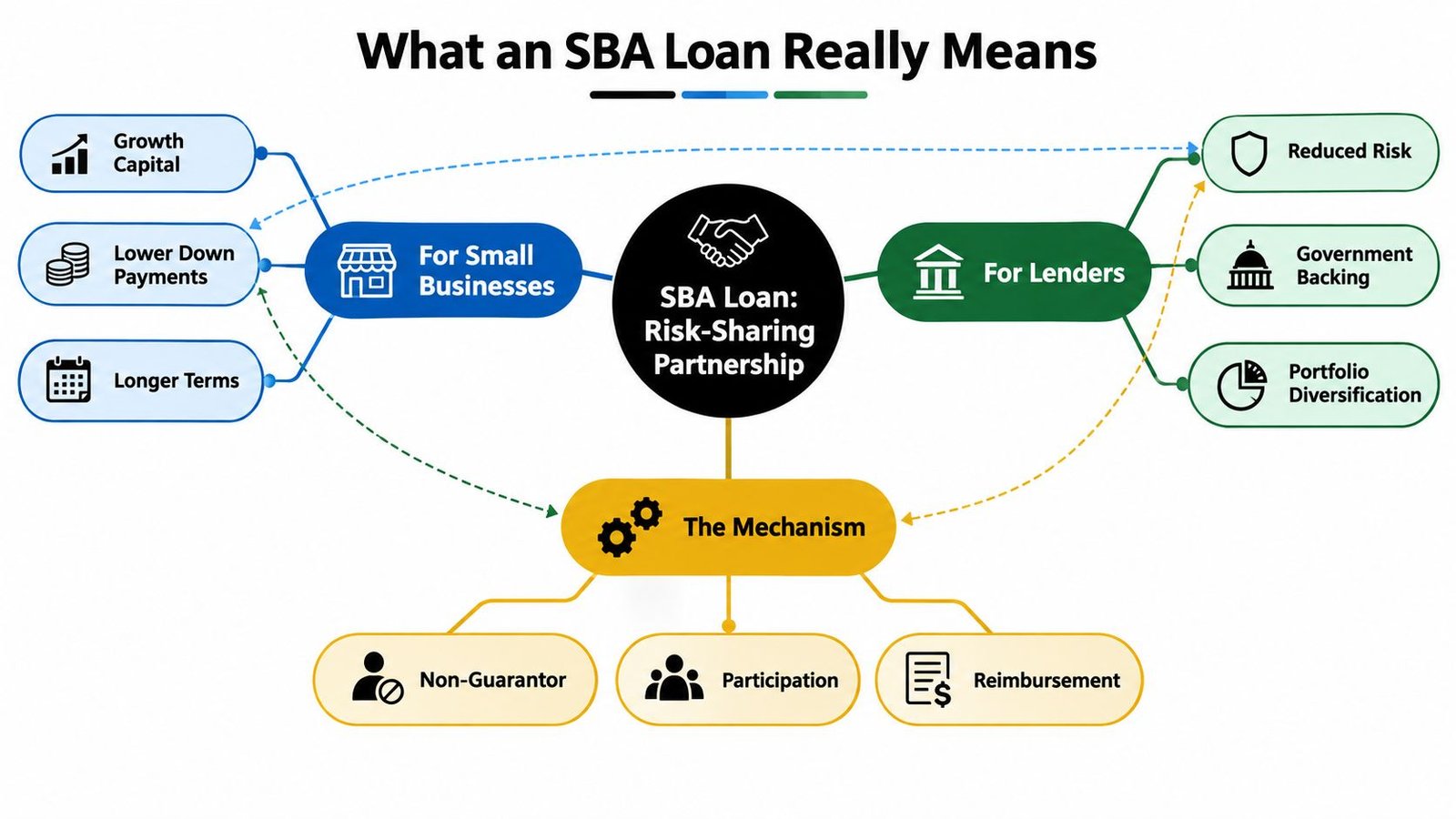
An SBA loan is a private-sector business loan with a federal credit enhancement. A bank, credit union, or other participating lender provides the money. The SBA generally doesn't hand the borrower a check. Instead, it agrees to cover a defined portion of the lender's loss if an eligible borrower defaults and the lender has followed the program's rules. The Congressional Research Service explains the guarantee structure and the SBA's role.
What the loan is and isn't
Think of the SBA as a limited backstop, not a replacement lender. A conventional business loan leaves the bank responsible for the entire credit risk. An SBA-backed loan shares part of that risk with the federal program, which may help a business obtain credit on reasonable terms when the bank's normal requirements are difficult to meet.
That makes an SBA loan different from several products people often confuse with it:
- It isn't a personal loan: The financing serves a business purpose and is underwritten around the company's finances, although owners may have personal obligations.
- It isn't a grant: The borrower must repay the full debt. No part of the balance disappears just because the SBA guarantees the lender.
- It isn't direct government cash: The lender approves and funds the loan, while the SBA supports the lender's risk position.
- It isn't automatic approval: The lender still reviews cash flow, credit history, collateral, management experience, business purpose, and repayment capacity.
The arrangement benefits both sides. The owner gets another route to capital, while the lender gets protection against part of a qualifying loss. In fiscal year 2021, the SBA approved 51,856 7(a) loans totaling $36.5 billion, a scale documented by the Congressional Research Service's overview of SBA lending. The practical takeaway is simple: an SBA loan is still debt, but the guarantee can widen the doorway to debt.
How the SBA Guarantee Actually Works
A useful analogy is a co-signer who promises to absorb part of a lender's loss, but with important limits. The co-signer doesn't make the loan, doesn't take over the borrower's payments, and doesn't remove the borrower's responsibility. The SBA guarantee operates in a similar risk-sharing role for the participating lender.
The process generally works like this:
- The borrower applies to a participating lender. The bank or other lender reviews the business, owners, requested amount, purpose, and repayment plan.
- The lender evaluates repayment capacity. The lender must decide whether the business can make scheduled principal and interest payments.
- The lender requests SBA authorization when required. The SBA reviews whether the proposed structure fits program rules.
- The lender funds the loan. The borrower signs the loan documents and receives the money from the lender.
- The SBA supports the lender only after a qualifying loss. If the borrower defaults, the lender must follow required procedures before seeking reimbursement for the guaranteed share.
For a deeper explanation of this risk-sharing mechanism, see this guide to how a loan guarantee works.
The percentages protect the lender
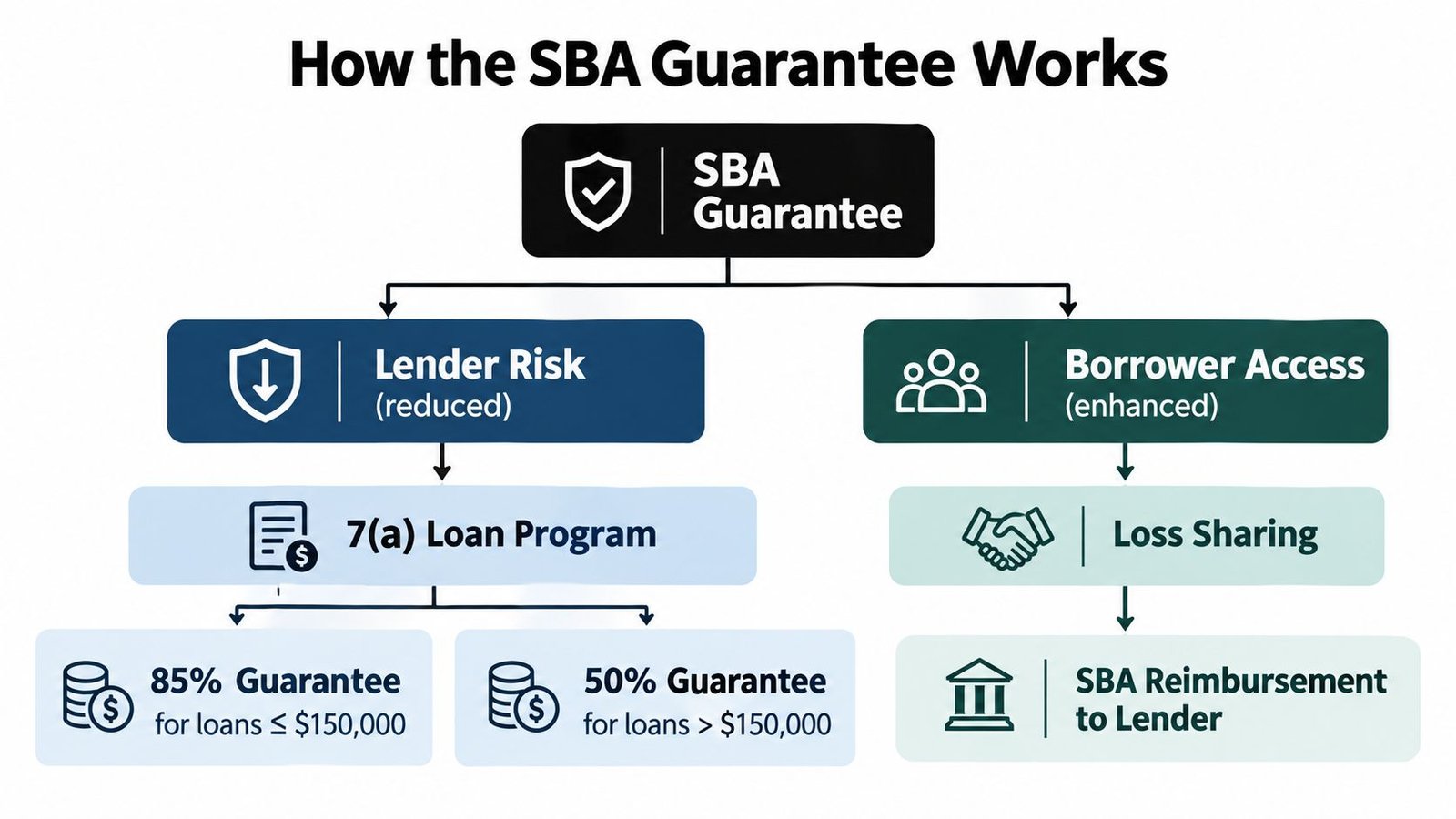
For most 7(a) loans, the SBA can guarantee up to 85% of amounts of $150,000 or less and up to 75% of amounts above $150,000. SBA Express loans have a 50% guarantee and a maximum loan amount of $500,000. These figures describe the portion of the lender's exposure that may be protected, not the portion of your balance that you can stop paying. The SBA provides these guarantee details for lenders.
Suppose a borrower stops paying. The lender doesn't send the remaining bill to the SBA. It must manage the default, pursue available recovery, and comply with program requirements. The guarantee can reduce the lender's ultimate loss, but it doesn't eliminate that loss or excuse weak underwriting.
Practical rule: Treat the guaranteed portion as the lender's protection, not the borrower's forgiveness.
The borrower remains responsible for the entire obligation. SBA-guaranteed programs generally require personal guarantees, so owners shouldn't assume the company's legal structure shields them from every consequence of default. The SBA's role changes the lender's risk exposure. It doesn't change the payment schedule you signed.
Comparing SBA 7(a), 504, and Microloan Programs
The SBA doesn't offer one universal loan. Its three major business-loan programs are 7(a), CDC/504, and Microloan, and each routes capital toward a different business need. Choosing the right program starts with the asset or problem you want to finance, not with the program name you saw first.
SBA Loan Programs at a Glance
| Program | Max Loan Amount | Best For | Typical Borrower |
|---|---|---|---|
| 7(a) | Up to $5 million | Working capital, equipment, real estate, expansion, refinancing, and business acquisition | An established or eligible for-profit business needing flexible financing |
| CDC/504 | Varies by project and program rules | Major fixed assets, especially owner-occupied commercial real estate and long-lived equipment | A business investing in property or substantial equipment |
| Microloan | Up to $50,000 | Smaller startup, inventory, equipment, or working-capital needs | A smaller business working with an intermediary lender |
The SBA's lender guidance identifies these as the agency's major business-loan programs and describes their distinct structures.
When 7(a) usually fits
The 7(a) program is the broadest option. It can support working capital, equipment, real estate, expansion, refinancing, or acquiring a business, subject to lender and program requirements. That flexibility makes it a common starting point for an owner whose funding request combines several needs, such as buying equipment while retaining cash for operations.
Its maximum loan amount is $5 million, while the SBA's maximum guaranteed exposure is generally $3.75 million. Those are program limits, not promises of approval. The lender still sizes the request around the company's cash flow and ability to repay.
When 504 or Microloan makes more sense
CDC/504 financing is designed primarily for major fixed assets. If the main purpose is buying owner-occupied commercial real estate or long-lived equipment, its narrower design may fit better than a flexible working-capital loan.
Microloans move through intermediary lenders and are intended for smaller funding needs. The SBA lists a maximum Microloan amount of $50,000. A small retailer purchasing initial inventory or a service provider buying modest equipment might find this structure more practical than pursuing a much larger facility.
A simple routing rule helps:
- Flexible business need: Start by examining 7(a).
- Major property or equipment purchase: Examine CDC/504.
- Smaller community-based funding request: Ask about Microloan intermediaries.
The right program still depends on eligibility, documentation, repayment capacity, and the lender's own credit standards.
Who Qualifies for an SBA Loan
SBA eligibility is a gate, not a finish line. A business can meet the program's basic rules and still fail a lender's underwriting review because the cash flow is too weak, existing debt is too high, or the owner can't explain how the money will be repaid.
The core eligibility questions
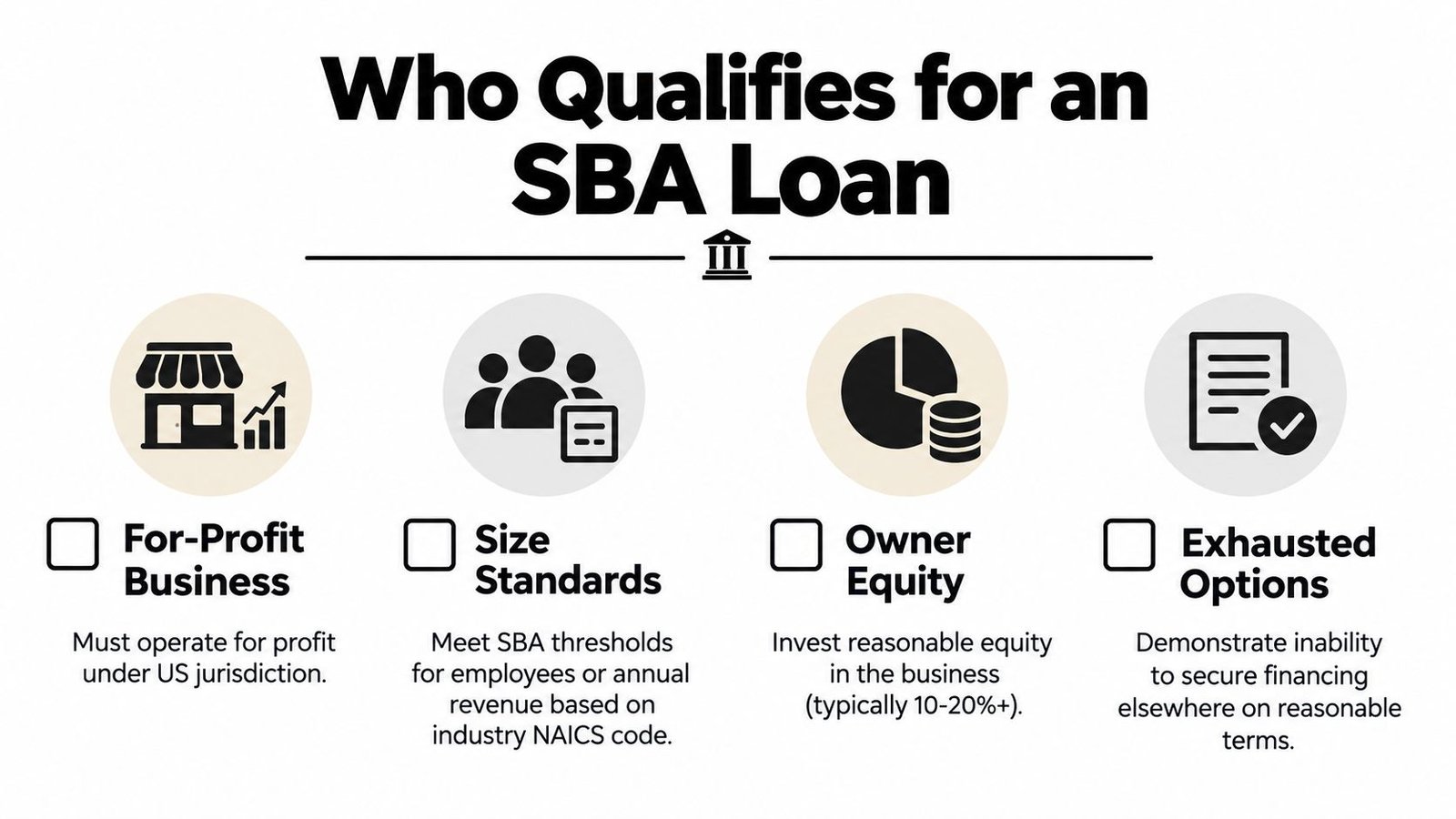
The SBA and lender generally look for several foundational characteristics:
- For-profit operation: The applicant generally needs to be a for-profit business operating in the United States.
- SBA size compliance: The business must fit the SBA's size standard for its industry. The relevant threshold can depend on the company's industry classification, revenue, or employee count.
- Creditworthiness: Owners and lenders need evidence that the company can repay the requested debt. Personal and business credit history can both matter.
- Reasonable business purpose: The request must support an allowable purpose, such as working capital, equipment, real estate, expansion, refinancing, or acquisition, depending on the program.
- Limited access to comparable credit: The business generally must show that it can't obtain comparable financing on reasonable conventional terms.
The SBA's eligibility and lender terms describe the importance of for-profit status, U.S. operations, size standards, creditworthiness, and the credit-elsewhere test.
Eligibility versus bankability
The credit-elsewhere test can confuse owners. It doesn't mean you must be rejected by every bank before applying. It means the lender needs to understand why a comparable conventional loan isn't reasonably available. If a business already qualifies for ordinary credit on acceptable terms, the SBA structure may not be the appropriate route.
A banker also wants to see the story behind the application. A profitable service company with uneven monthly revenue may need to show how it handles slow periods. A newer business may need a stronger owner contribution, clear projections, or additional support. A company carrying substantial existing debt may need to request less than its first estimate.
A qualifying business has permission to be considered. A bankable business shows how the requested debt will be repaid.
Before applying, review the steps for qualifying for an SBA loan and compare them with your own records. Look for inconsistencies between tax returns, accounting reports, bank deposits, and the debt schedule. Those gaps don't automatically end an application, but unexplained gaps make underwriting harder.
Applying for an SBA Loan Step by Step
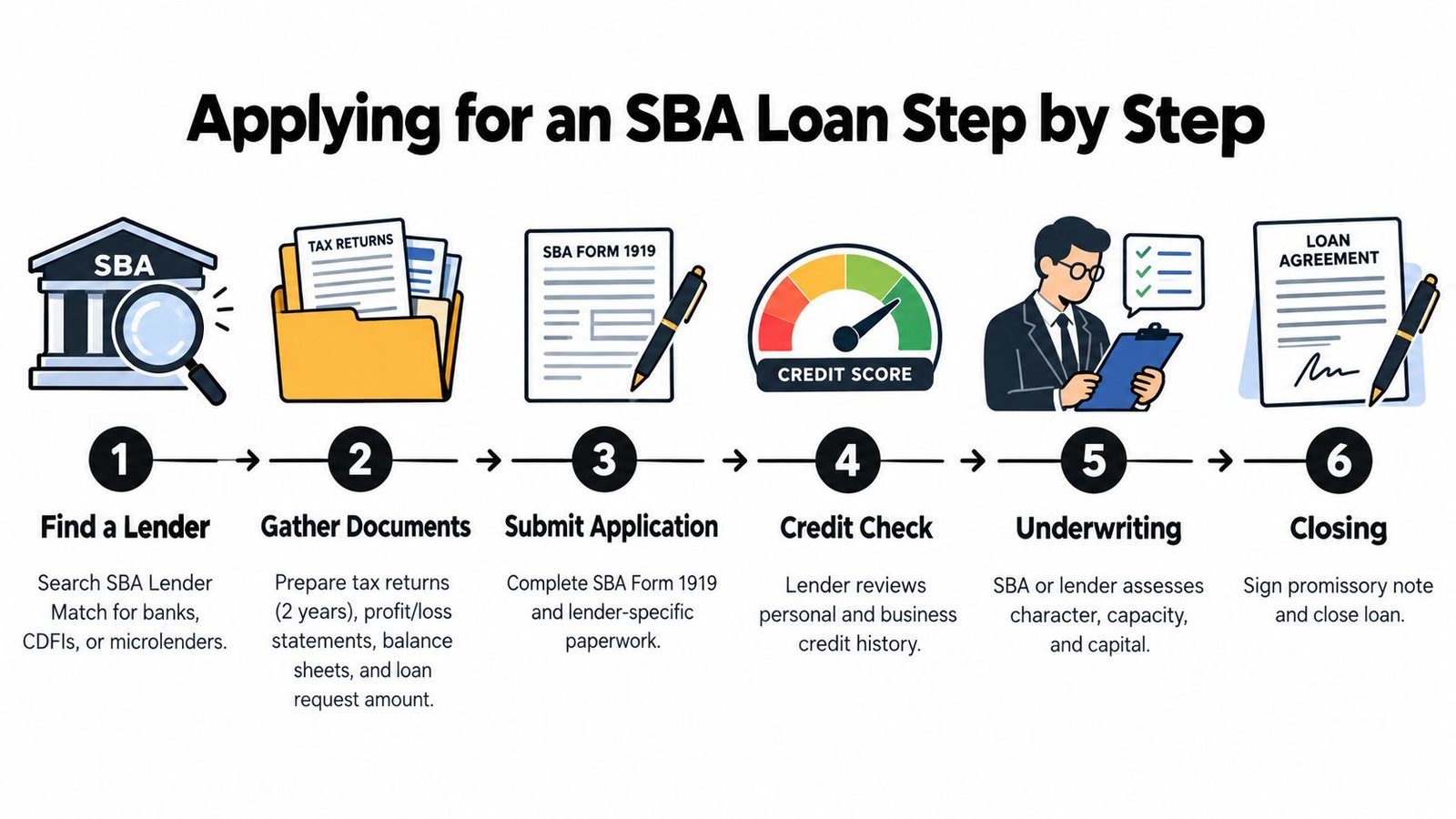
The SBA loan process starts with the lender, not with a government counter. You'll usually work with a bank, credit union, Community Development Financial Institution, or microlender that participates in the relevant program.
Build a banker-ready file
Start with the purpose. Write down how much you want, exactly how you'll use it, what the spending will accomplish, and which business cash flow will make the payments. “Working capital” is a category, not a repayment plan. Explain whether the funds will support inventory, payroll during an expansion, a specific acquisition, or another documented need.
Your file should typically include:
- Business and personal financial statements
- Business and personal tax returns
- A current debt schedule
- Ownership information
- A documented use-of-proceeds plan
- Evidence that projected cash flow can service principal and interest
These preparation items are identified in the SBA's lender eligibility guidance. Your lender may request additional business records, legal documents, bank statements, projections, or collateral information.
Follow the lender's sequence
After receiving the file, the lender checks the owners, business, credit history, cash flow, collateral, and proposed use. If the request fits SBA rules, the lender seeks the relevant guarantee authorization. Once approved, the lender completes closing documents and funds the transaction.
Don't expect every application to move at the same speed. A straightforward request with organized records may move more smoothly than a complicated acquisition, property transaction, or refinance. Missing documents, unclear ownership, changing loan amounts, and unexplained financial differences can create repeated follow-up.
For a practical document checklist and process overview, use this SBA loan application process guide.
Plan for questions, not just forms
Underwriting is a conversation about risk. Be prepared to explain revenue changes, owner withdrawals, tax differences, existing debt, seasonal patterns, and the reason conventional credit isn't a reasonable fit. A clear answer supported by records is stronger than an optimistic forecast without evidence.
You should also ask the lender who handles each decision, what information remains outstanding, and how the proposed payment fits your projected cash flow. The SBA guarantee may support access, but the lender remains your primary point of contact from application through closing.
Costs, Terms, and Use Cases for SBA Financing
An SBA loan earns its place in a financing plan when the asset or business benefit lasts long enough to justify the paperwork and scheduled payments. The question isn't just whether the SBA can support the request. It's whether the project will generate enough dependable cash flow to carry the debt without starving day-to-day operations.
Match the repayment period to the benefit
SBA financing can support working capital, equipment, real estate, expansion, refinancing, and business acquisition, subject to program and lender rules. A long-lived piece of equipment may justify longer repayment than a short inventory cycle. Owner-occupied commercial property may support a different structure from a temporary cash-flow gap.
The loan may also involve interest, lender charges, SBA-related fees, collateral requirements, and personal-guarantee obligations. Exact pricing depends on the program, lender, loan structure, credit profile, and market conditions. Ask for the complete payment schedule and all closing costs before accepting an offer.
Use this readiness test before you apply:
- Purpose: Can you identify exactly where the proceeds will go?
- Repayment: Can the business make principal and interest payments during a weak sales period?
- Documentation: Do your tax returns, statements, bank activity, and debt schedule tell the same story?
- Risk: What happens if customers pay late, costs rise, or the project takes longer than expected?
- Alternative: Is a conventional loan, line of credit, equipment loan, or another structure better suited to the need?
Borrow for an asset or plan you can explain. Don't borrow merely because a lender says you can.
SBA financing is often a reasonable candidate for a durable expansion, an equipment purchase, an eligible acquisition, qualifying real estate, or refinancing that improves the business's debt structure. It may be a poor fit when the business is using new debt to cover a recurring operating loss with no credible recovery plan.
Homeowners evaluating separate personal obligations may also encounter resources such as property tax relief for Texas homeowners. That type of resource addresses a household property-tax issue, not an SBA business-financing request, so keep the two decisions separate when reviewing your cash position.
SBA Loan Myths That Trip Up Real Borrowers
The most expensive misunderstanding is thinking the SBA is the lender. In most cases, a participating bank or other lender provides the money, reviews the application, sets the loan structure within program rules, and manages the relationship. The SBA's guarantee supports the lender's risk. It doesn't replace the lender's judgment.
A second myth says the guarantee protects the borrower from repayment. It doesn't. If the business defaults, the owner remains responsible for the debt, and personal guarantees can create personal exposure. The guarantee helps the lender recover part of an eligible loss after required procedures. It doesn't erase the balance or convert a loan into a grant.
The gap between eligibility and approval
Owners often hear that SBA programs are more accessible and assume that means easy approval. The process is more demanding. A business may meet basic program criteria but still lack the cash flow, credit history, collateral, management evidence, or financial consistency a lender needs.
The Federal Reserve reported in 2025 that more than a quarter of small businesses identified credit availability as a challenge, while other businesses were concerned about confusing terms or felt discouraged from applying. The Federal Reserve speech discusses these access barriers and the tightening environment facing small businesses.
That access problem is especially important for owners with uneven cash flow, limited collateral, prior debt, or weaker personal credit. SBA backing may improve a lender's risk position, but it can't create repayment capacity that the business doesn't have.
Stress-test before you sign
Write down the payment and test it against uncomfortable conditions. What happens if sales soften, suppliers charge more, or customers delay payment? Could payroll, rent, taxes, and existing debt still be paid on time?
If the answer is uncertain, a larger loan may worsen the problem. Consider a smaller request, a different repayment structure, a staged project, or a non-debt solution before submitting the application. The best SBA candidate isn't the owner who wants the largest approval. It's the owner who can connect a specific use of funds to durable repayment capacity.
Your Next Step Toward SBA Funding
An SBA loan is a lender-issued business loan supported by a partial SBA guarantee. 7(a) offers the broadest use of proceeds, CDC/504 focuses on major fixed assets, and Microloans serve smaller funding needs. Eligibility generally depends on for-profit U.S. operations, SBA size standards, creditworthiness, an acceptable business purpose, and limited access to comparable conventional credit.
This week, gather your business and personal financial statements, tax returns, debt schedule, ownership records, and use-of-proceeds plan. Then stress-test the proposed payment and shortlist two or three participating lenders that handle your type of request. A complete, candid file gives the lender something useful to underwrite.
Business Loan Warrior offers SBA loan processing and other business financing options through a single application, with tools for connecting financial accounts, tracking approvals and repayments, and communicating with underwriters. Visit Business Loan Warrior to compare your funding path and start organizing the information a lender will need.