

Business succession planning is a structured 12-to-36-month ownership and leadership transition process that covers valuation, successor readiness, legal documents, and financing. The clock is already running for 73% of privately held U.S. companies that plan to transfer ownership within the next decade, so this isn't a theoretical issue, it's a deadline problem.
You're probably closer to an exit than you want to admit. Maybe the business is profitable, the team is solid, and nobody's panicking, but the question is whether the company can survive a transfer without the founder holding everything together by force of habit.
Table of Contents
- What Is Business Succession Planning
- Why Most Plans Fail Before They Start
- The Main Ownership Transition Structures
- Valuation, Tax, and Legal Mechanics
- Funding the Transition Without Starving the Business
- A Practical 12 to 36 Month Timeline
- Planning for the Owner Who Cannot Be There Tomorrow
- Next Steps for Owners Ready to Act
What Is Business Succession Planning
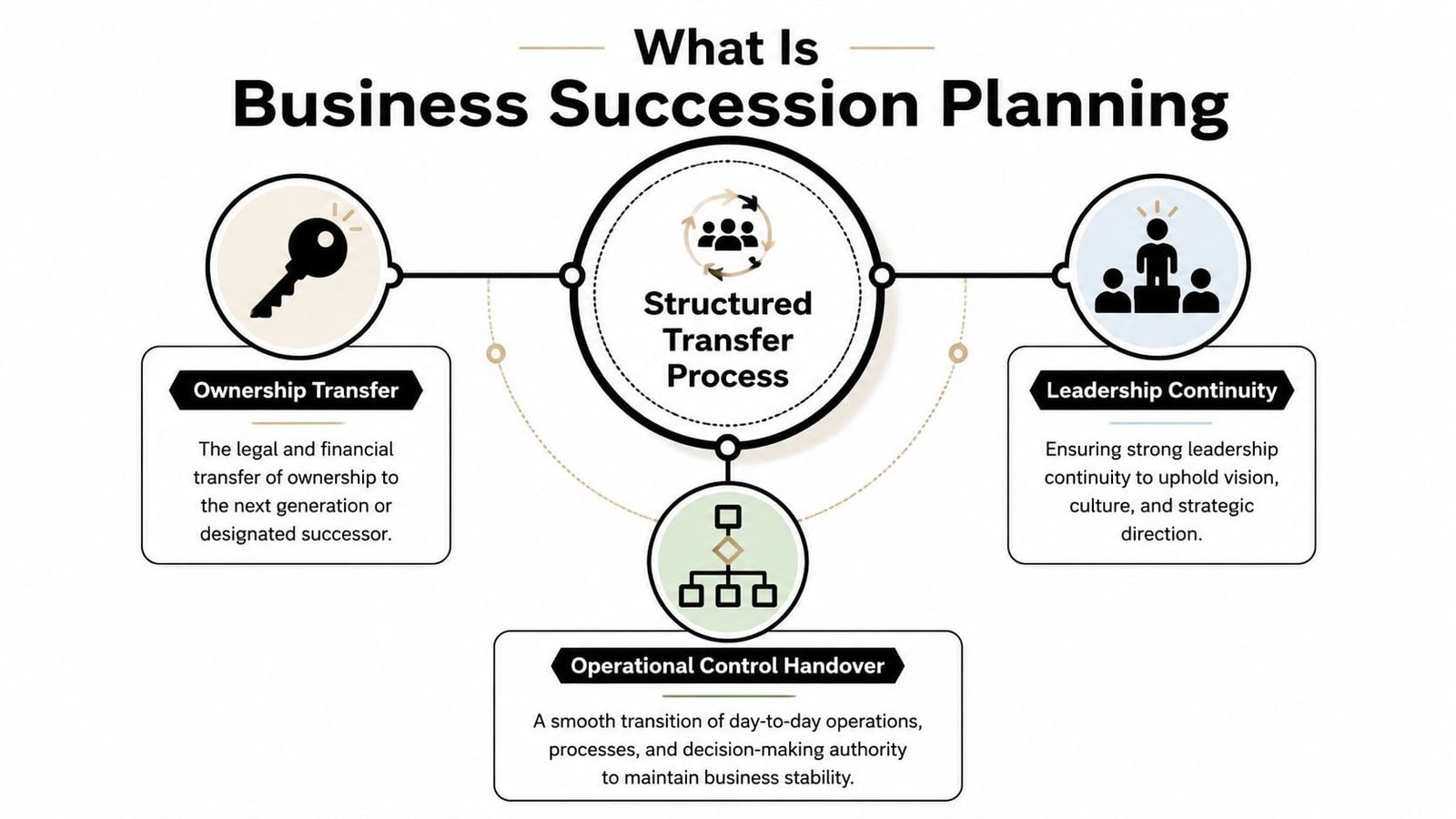
Business succession planning is the structured process of transferring ownership, leadership, and operational control to the next party, whether that's a family member, a management buyout team, an outside buyer, or employees. It is not a single document sitting in a drawer. It's a working program that ties together valuation, successor readiness, legal paperwork, tax positioning, and financing over time.
A founder who built a profitable service firm can still create a mess by avoiding this work. If that owner never names a successor, never documents decision authority, and never thinks through the money needed for a buyout, the business becomes fragile the moment the founder steps away. Revenue may still look strong on paper, but customers, lenders, and employees all notice when one person is carrying too much institutional knowledge.
Why the timeline starts before you think it does
The planning window usually opens 3 to 5 years before a transition, because successor development, financing, and legal cleanup take time. That timing is not arbitrary. A structured plan is meant to reduce key-person risk by identifying critical roles, capturing knowledge, and developing the next decision-maker before a vacancy forces the issue, as SHRM explains in its guidance on modern succession planning (SHRM on modern succession planning).
That matters now because ownership transition is broad and urgent. Project Equity cites a survey showing 73% of privately held U.S. companies expect to transition ownership within a decade, about a $14 trillion transfer opportunity, and 49% expect to exit within five years (Project Equity business owner statistics). In Germany, the KfW SME report projected about 125,000 SME owners per year through 2027, totaling roughly 626,000 succession cases over five years among 3.81 million SMEs, which shows this is a mature-market continuity issue, not a niche planning exercise (Project Equity business owner statistics).
Practical rule: if the plan doesn't tell you who owns what, who leads what, and who gets paid when, it isn't a succession plan. It's a wish.
For owners trying to think through protection tools, a good starting point is a resource on life insurance for business succession, because funding and continuity are tied together from day one.
Why Most Plans Fail Before They Start
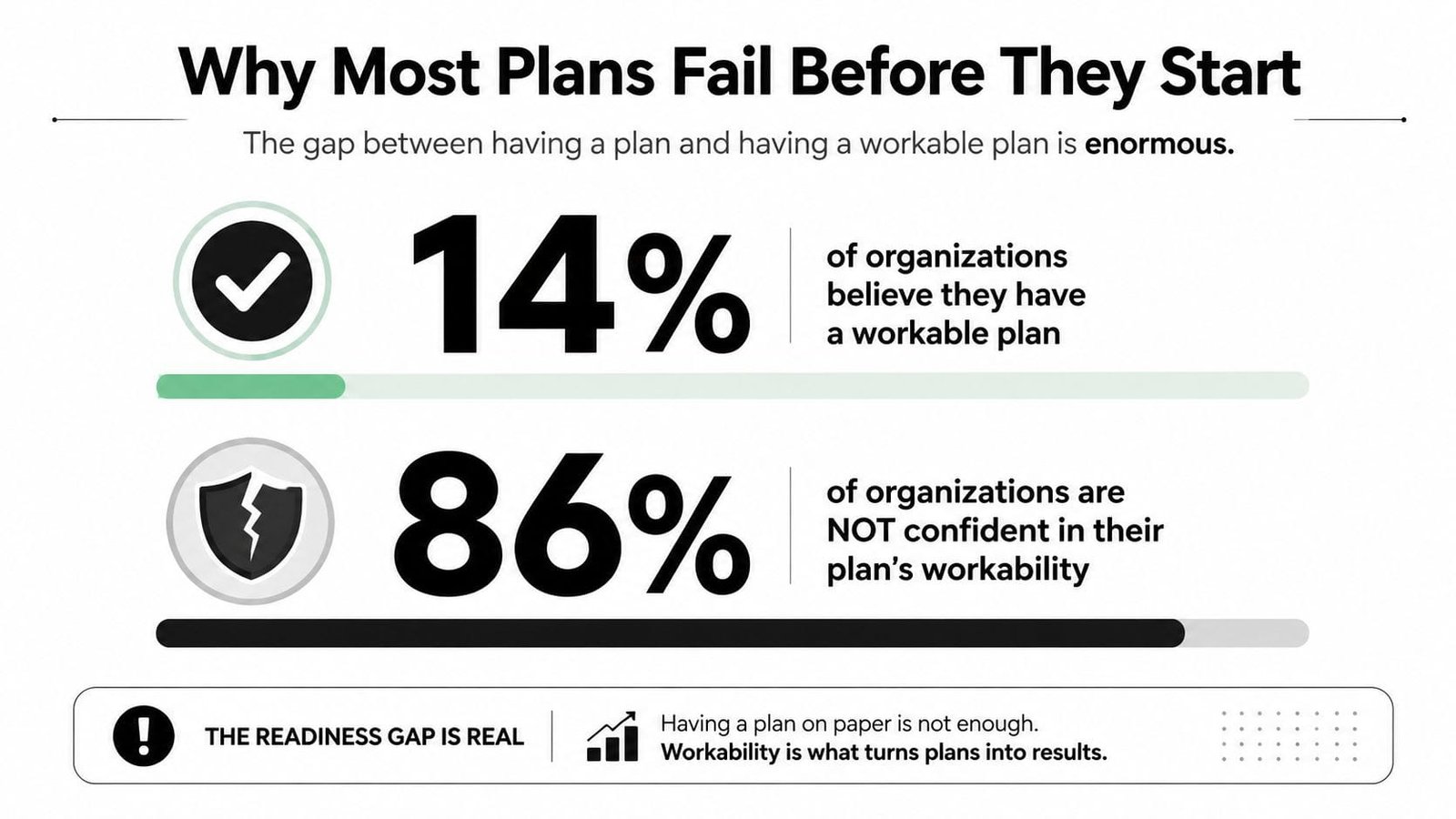
A succession plan can look tidy on paper and still collapse the moment money, authority, and timing collide. Zipdo succession planning statistics show a wide gap between organizations that say they have a plan and those that believe it works, and that gap is where owners get burned. The problem is usually not intent. It is execution under pressure.
Paper plans don't keep the lights on
A company does not need a spreadsheet. It needs a successor who can step in, keep customers calm, keep lenders comfortable, and keep cash moving. Many firms still do not have that. Benchmark research shows a thin bench of ready successors for critical roles, and in practice that means the owner becomes the default answer for every decision, every approval, and every exception. That is concentration risk, plain and simple.
The financing side is where weak planning gets expensive fast. If a transition depends on a buyer, the bank will ask who is backing the deal, what collateral exists, and whether the business can service new debt without choking operations. If the transfer depends on a buy-sell agreement, the key question is whether the funding matches the value and timing of the exit. If the cash is not there, the plan is fiction.
Bad succession also hits revenue and the lender relationship. Analyst research tied weak succession to meaningful annual revenue losses, and the mechanism is predictable, delayed decisions, customer churn, talent flight, and a bank that no longer sees a clean path after the owner leaves. The owner who ignores this usually discovers the truth too late. A transition that is underfunded becomes a liquidity problem before it becomes a leadership problem.
Readiness beats optimism
A business is ready when someone else can run it without the founder sitting in every meeting.
That sounds blunt because it is. Too many owners call a business transferable when the numbers, the team, and the financing say otherwise. AIIR Consulting noted that CEO turnover in 2019 was the highest in nearly 20 years, while only 54% of public companies were actively developing CEO successors and 40% had no internal candidate ready to replace the CEO (Zipdo succession planning statistics). Public-company data and private-company reality are different, but the lesson carries over. Owners routinely overrate how much the business can function without them.
The financing mechanics separate the actual plans from the decorative ones. A family transfer may need seller financing to bridge the gap between what the next generation can pay and what the owner expects. A management buyout can stall if the company cannot support acquisition debt. A third-party sale can look attractive until the buyer needs an SBA-backed loan and the business cannot satisfy the lender's standards without a cleaner financial history. If the transition structure and the capital structure do not fit together, the exit gets trapped in the middle.
A plan is only workable when it names the successor, shows how that person gets control, and shows how the money changes hands. Without those pieces, the owner does not have succession planning. The owner has delay.
The Main Ownership Transition Structures
Owners usually face four real choices, and the right one depends on family, money, timing, and who can operate the company after the transfer. Get the structure wrong and everything downstream gets harder. Get it right and the legal and financing pieces become manageable.
The four structures that matter
A family transfer fits when there's a willing and capable next generation. It can preserve legacy, but it often carries emotional baggage, uneven readiness, and tax planning complexity. A management buyout works when current leaders know the business and want ownership, and it can move faster than a family transfer when no heir wants the job.
A third-party sale usually delivers the cleanest exit for a retiring owner who wants market pricing and doesn't need insiders to take over. The trade-off is due diligence, buyer financing, and the possibility that the buyer changes culture quickly. An ESOP, or employee stock ownership plan, suits owners who care about legacy and retention, and it's no longer a niche structure reserved for giant corporations.
| Structure | Best Fit | Typical Timeline | Key Trade-Off |
|---|---|---|---|
| Family transfer | Willing, prepared heirs and owners who want continuity | Slower, because readiness and family alignment take time | Legacy is strong, but emotional conflict and uneven capability can derail it |
| Management buyout | Strong internal operators with a desire to own | Usually faster than a family handoff | The team knows the business, but financing can be tight |
| Third-party sale | Owner wants market-based exit and maximum buyer pool | Varies with buyer search and diligence | Highest exit flexibility, but less control over culture |
| ESOP | Owners want employee continuity and retention | More structured and document-heavy | Alignment can be excellent, but the legal and financing setup is more complex |
Don't pick a structure blind
Choose based on who can fund it, who can run it, and what the owner wants to preserve. A structure that sounds elegant on paper can be a disaster if the company can't finance the transfer without draining working capital. That's why valuation and tax come first, not last.
Valuation, Tax, and Legal Mechanics
An objective business valuation comes first because every structure rests on what the company is worth. You can't price a family transfer, a buyout, or a sale by instinct and expect the rest of the plan to hold. Once the value is clear, the tax and legal pieces stop being abstract and become a sequencing problem.
Tax follows structure, not hope
Family transfers often force owners to think through estate and gift tax exposure. Management buyouts usually create capital gains considerations. Third-party sales can change depending on whether the deal is structured as an asset sale or a stock sale, which affects how gain is treated. ESOPs come with their own special rules, so nobody should guess their way through that part.
The wrong sequence is common. Owners sign on a price, then discover the tax bill changes the economics, then realize the financing no longer works. That's how transition plans break.
Documents make the transfer real
The legal backbone usually includes operating agreements, buy-sell agreements, shareholder agreements, trusts, and powers of attorney. Those documents decide who has authority, who can sell, who can buy, and what happens if someone dies, becomes disabled, or walks away. Associated Bank's business succession guidance puts the emphasis exactly where it belongs, on valuation, legal and financial structuring, and periodic review (Associated Bank business succession planning).
If you want one practical benchmark, use the valuation process to force hard conversations early. Then use the legal documents to lock the decision path before money is committed. That sequencing is cleaner, cheaper, and far less likely to blow up at closing.
For owners who need a deeper reference point on value-setting, business valuation services are worth reviewing before any deal structure gets finalized.
Funding the Transition Without Starving the Business
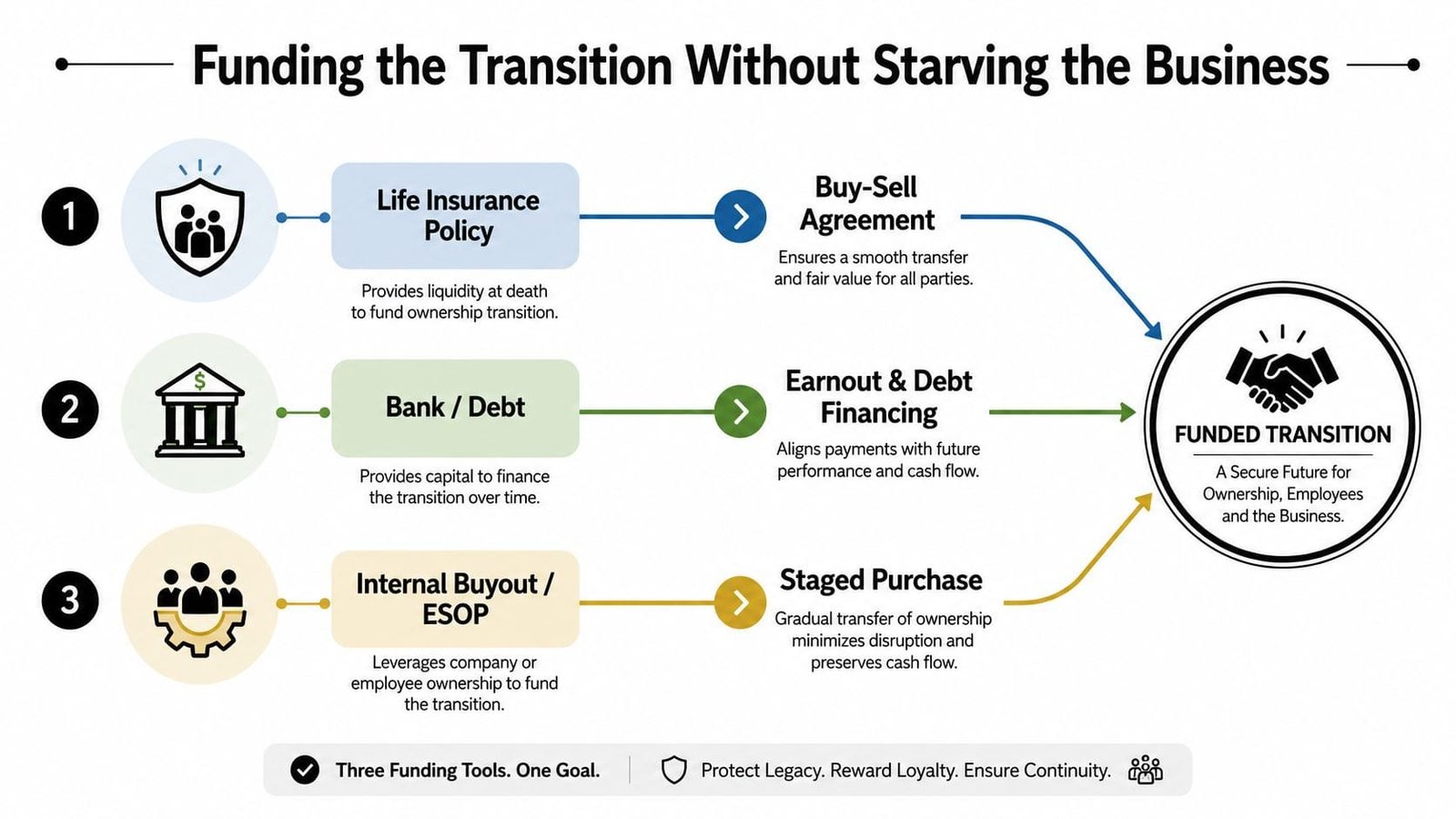
Succession turns into a financing problem the moment someone has to pay the owner. That's where most transitions get squeezed, because the buyer needs cash, the seller needs liquidity, and the operating company still needs working capital. If you ignore that tension, the business can look sold and still be underfunded.
Match the funding tool to the moment
A buy-sell agreement funded by life insurance solves the sudden-death scenario. It gives the business or the remaining owners cash to buy out an interest without waiting for a lender to move. A seller-financed note helps in orderly exits because it spreads the purchase price over time and keeps the deal from collapsing under upfront cash pressure. SBA-backed acquisition loans and conventional business acquisition loans cover the orderly-sale scenario when a buyer needs outside capital to close.
There's also the working-capital problem. A transition often pulls cash out of the business right when the new owner needs room to breathe, so a line of credit can be the difference between continuity and a liquidity trap. If the deal structure leaves no cushion for payroll, inventory, or receivables timing, the transfer becomes a stress test for the business itself.
Funding rule: if the business can't survive the transition while servicing the deal, the deal is too aggressive.
A practical way to think about the capital stack is simple. Down payment. Seller note. Bank debt. Equity. Then working capital on top, not afterthought. That sequence matters because the business still has to operate while ownership changes hands.
Compare the stack before you sign anything
For owners studying financing mechanics, the business acquisition loan options are a useful benchmark, especially when a management team or outside buyer needs to compare seller carry and lender expectations. For cash-flow discipline during the run-up to closing, a small business budgeting guide 2026 can help owners stress-test the company before they commit to a transaction structure.
The point is not to find the fanciest funding source. The point is to keep the business alive while ownership changes.
A Practical 12 to 36 Month Timeline
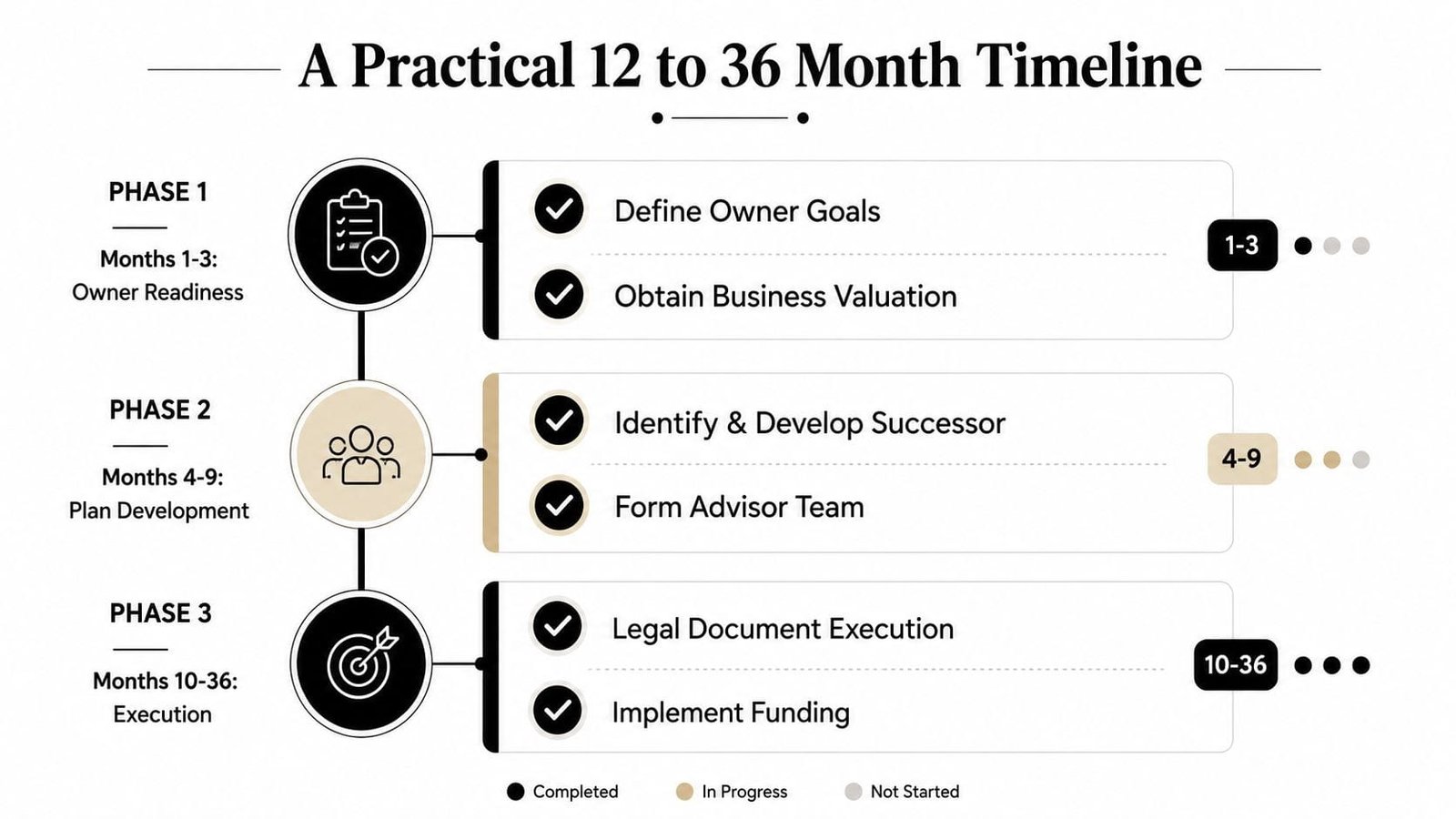
A serious transition runs on milestones, not vague intentions. Owners need a timeline that ties readiness to financing, because the money and the handoff have to move together. Anything less is fantasy planning.
Months 1 to 9
Start with the owner's goals, the current valuation, and the advisor team. Get the accountant, attorney, valuation specialist, and funding partner aligned early, because each of them will affect different pieces of the deal. Then identify the likely successor, whether that's family, management, an outside buyer, or employees, and assess the skill gaps.
By month 9, the tax structure should be taking shape. If financing assumptions don't match the likely deal type, that mismatch needs to surface now, not at closing. This is the stage where optimism gets replaced by math.
Months 10 to 36
Draft the legal documents, design the buy-sell funding, and begin successor development in earnest. Then move into buyer search, internal buyer financing, letters of intent, and due diligence. The final stretch is closing, execution, and the first 90 days of post-close governance, where authority has to be real, not symbolic.
A workable 30-day quick-start checklist looks like this:
- Define the exit goal: Decide whether you want family continuity, insider ownership, a third-party sale, or an employee structure.
- Order a valuation: Get an objective baseline before talking price.
- Name the likely successor: Even a provisional choice is better than silence.
- Review the legal documents: Check operating agreements, buy-sell terms, and powers of attorney.
- Map the funding path: Decide what part of the deal could be seller-financed, lender-financed, or insured.
For comparison, a guide like the Synopsix people intelligence approach is useful when you're evaluating internal bench strength, but the owner still has to turn that insight into action. The plan doesn't matter if nobody funds it.
Planning for the Owner Who Cannot Be There Tomorrow
Succession is not just a retirement project. It's continuity planning for the day the owner isn't available, whether that's because of illness, an accident, disability, death, or a key-person departure. The business doesn't care what the reason is. It only cares whether someone can make decisions in the next 24 to 72 hours.
The emergency layer comes first
The emergency plan should answer five questions fast. Who can sign? Who can access the bank? Who controls digital accounts? Who talks to customers? Who has authority to make the next operating decision?
That layer belongs beside, not behind, the long-term transition plan. Buy-sell agreements, key-person life insurance, and durable powers of attorney all sit in this continuity layer because they protect the company before any orderly sale or planned handoff can happen. A business lawyer can help wire those documents together so the company doesn't stall at the worst possible moment, which is why owners should understand the role covered in what a business law attorney does.
Don't confuse continuity with ownership transfer
The emergency decision-maker is not always the final buyer. Sometimes it's an interim operator, a spouse, a partner, or a trusted executive with limited authority. The goal is stability first, economics second.
Most failures happen before the formal handoff begins. That's the part owners underestimate, and it's the part that can damage enterprise value fastest.
Next Steps for Owners Ready to Act
Start with three moves this month. Assemble the advisor team, name a likely successor, and pull the financing options into the same conversation instead of treating them as separate projects. If the successor can't be funded, the choice isn't real.
Then run pre-qualification checks on acquisition financing and working-capital support before you commit to a structure. That lets you compare terms without locking yourself into a bad fit, and it keeps the process grounded in what the business can carry. Owners who want a cleaner way to coordinate that work can use a single no-fee application, check pre-approval without affecting credit, connect bank accounts, and speak with underwriters before they decide.
For internal readiness and leadership depth, the Synopsix people intelligence approach is a useful lens, but the owner still has to act on the findings. The best succession plan is the one that gets started this quarter, not the one that sounds smartest in a meeting.
Business Loan Warrior helps owners compare funding options for acquisition, buyout, and working-capital needs without wasting time on dead-end applications. If you're getting serious about succession, visit Business Loan Warrior to explore financing paths that can support the transition, not choke it.