
You’re staring at a purchase that keeps getting delayed, the supplier’s quote changed twice, and your accountant still can’t tell whether the order fits the budget. That’s exactly where a lot of small businesses get stuck. The problem usually isn’t the product itself, it’s that the procurement process isn’t written down, managed, or tied to cash flow.
Table of Contents
- Procurement Process Overview
- Understanding Procurement Fundamentals
- Exploring Procurement Process Stages
- Small Business Procurement Examples
- Tracking KPIs and Avoiding Pitfalls
- Procurement Tools and Templates
- Financing and Loan Readiness Impact
- Conclusion and Next Steps
Procurement Process Overview
A small retailer runs out of best-selling inventory on a Friday, rush-orders replacement stock on Monday, and then finds out the invoice is higher than expected. That’s not just a buying problem. It’s what happens when there’s no clear procurement process guiding who asks, who approves, who buys, and who checks the order.
Procurement is the controlled business process that starts when a need is identified and ends only after internal approval, budget checks, and supplier review are complete. In business terms, it’s the difference between buying something and managing a purchase responsibly. According to JPMorgan’s procurement statistics, businesses allocate an average of 15% of their total budget to procurement, which helps explain why so many companies treat it as a formal workflow rather than an informal shopping task.
For a small business owner, that matters because every surprise order can create a ripple effect. Cash gets tied up, suppliers get rushed, and the team starts working around the process instead of through it. A mature procurement setup reduces those surprises by making decisions visible before money leaves the business.
Practical rule: if a purchase affects budget, timing, or quality, it should move through a documented approval path, not a quick text message and a card swipe.
Procurement also protects supplier reliability. When the process is clear, vendors know what to expect, and your team knows what counts as an acceptable delivery. That predictability is one reason procurement sits at the center of cost control, supply planning, and financing readiness.
Understanding Procurement Fundamentals
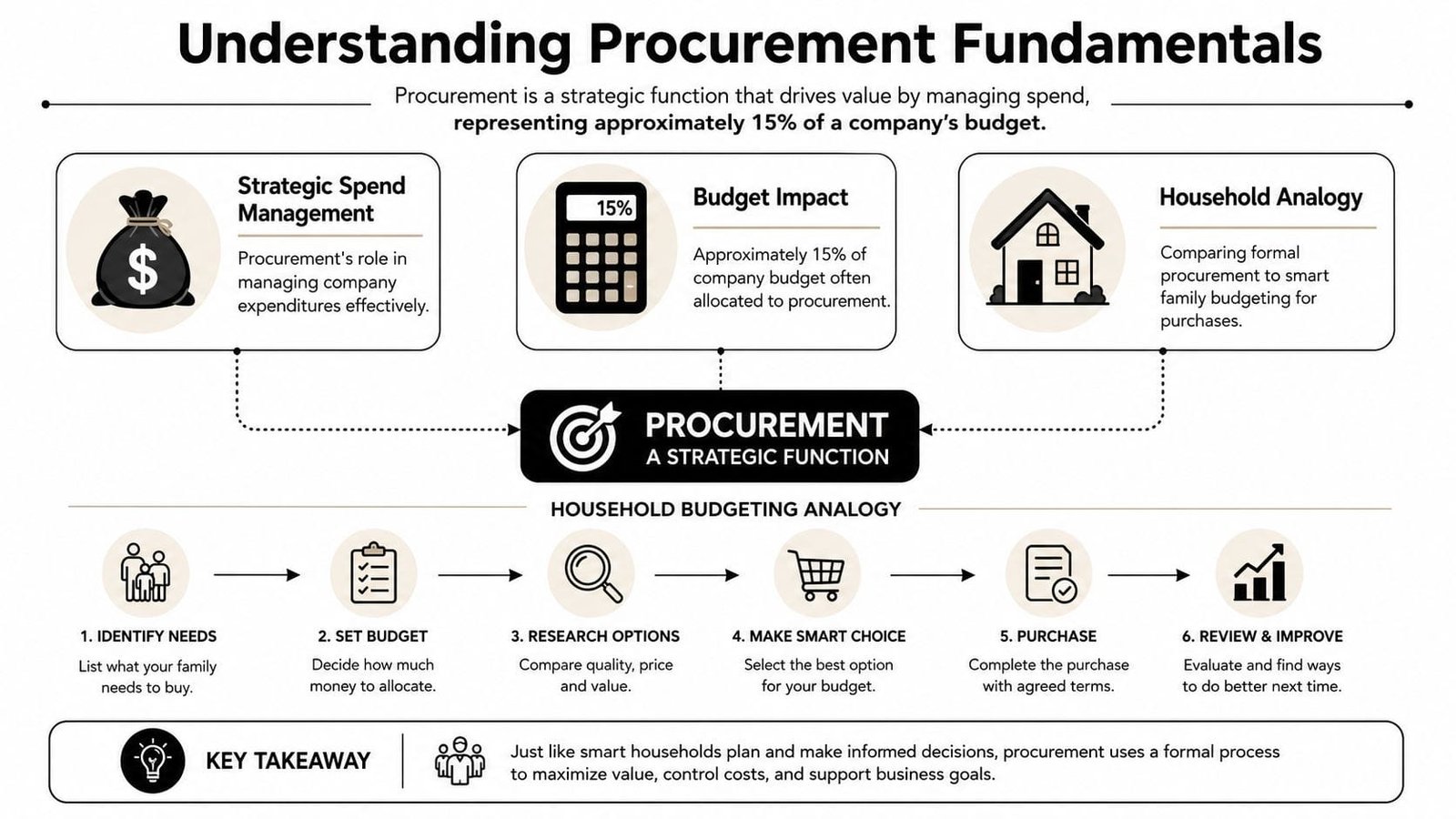
A small business owner usually feels the need for procurement before they ever call it that. A printer runs out of toner, a caterer needs packaging that holds up in transport, or a service contract is about to expire. The question is not just what to buy, but who should approve it, what it should cost, and how the purchase affects cash.
That is the heart of a formal procurement process. It turns buying into controlled spending, so decisions are visible before money leaves the business. In JPMorgan’s procurement statistic summary, procurement is described as taking up an average of 15% of total budget, which helps explain why it belongs in the same discussion as payroll, rent, and financing. The same summary also points to broad movement toward digital workflows, with industry statistics showing that over 80% of companies are expected to digitize procurement workflows by 2026 to reduce errors and lower costs.
That shift changes the day-to-day work. A paper-based process depends on memory, email threads, and signatures that can get buried. A digital process creates a record, which makes approvals easier to track, keeps compliance checks visible, and gives lenders or investors a clearer picture of how the business handles spending. If you are sourcing something like sustainable disposable food packaging, that record helps you compare suppliers, confirm material and size requirements, and avoid paying for the wrong product.
What procurement does for a small business
Procurement keeps spending tied to business intent. It helps you decide whether the purchase is needed, whether the supplier is dependable, and whether the timing fits your cash cycle. It also reduces impulse buying, which can happen when a purchase feels useful in the moment but does not fit the budget or the plan.
Good procurement habits also support loan readiness. A lender looking at your business wants to see that purchases are reviewed, contracts are documented, and cash outflows are controlled. A company that can show clear approval steps and supplier records looks more organized than one that relies on scattered receipts and verbal agreements. That kind of discipline matters because financing decisions are easier when spending patterns are predictable and supported by records.
When procurement is managed well, it becomes part of your financial story, not just your purchasing routine.
Exploring Procurement Process Stages
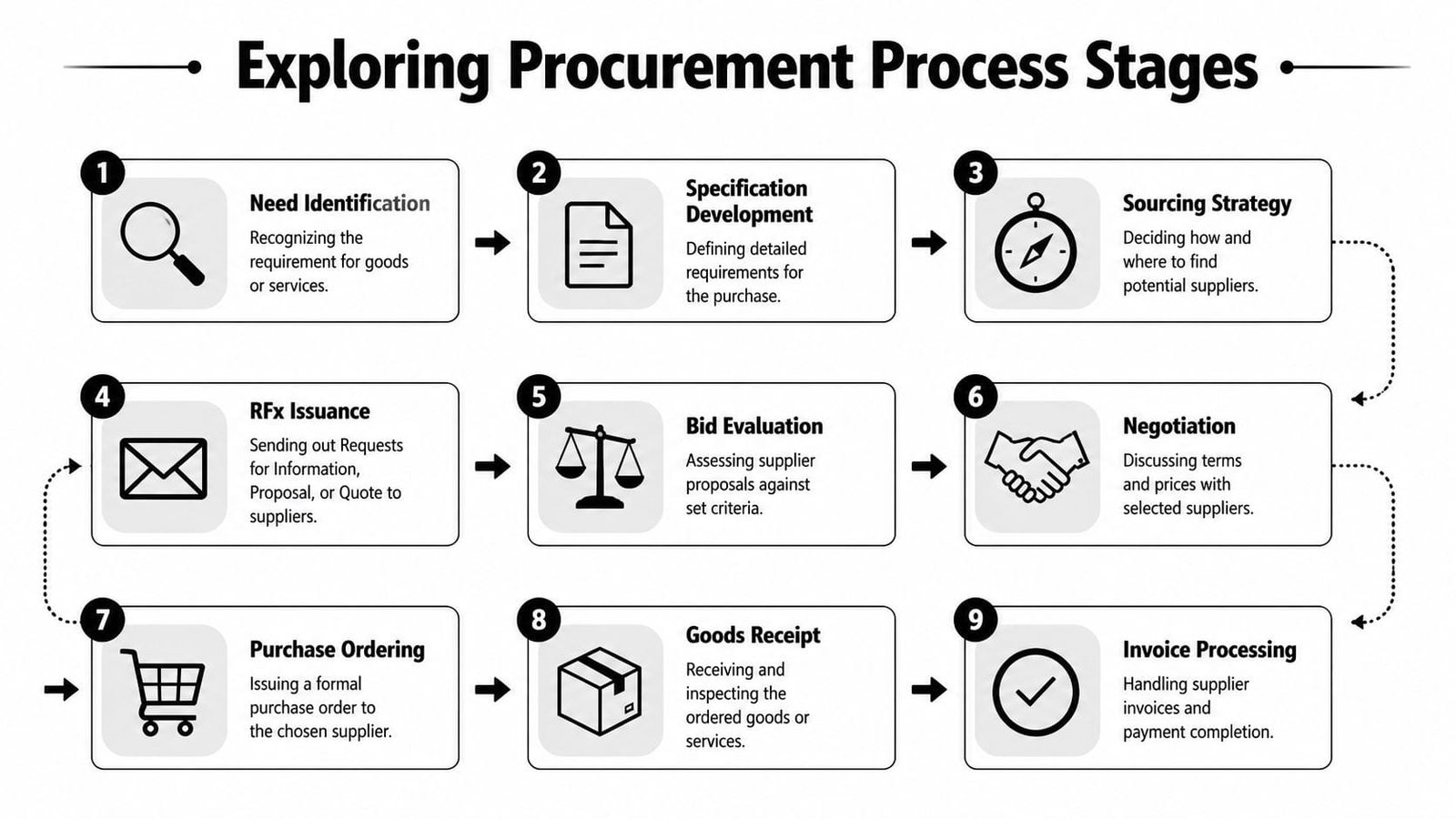
A procurement workflow works best when it’s treated like a relay race. Each stage passes clean information to the next, and if the handoff is sloppy, the whole race slows down. In technically rigorous settings, procurement can run through planning, requirement analysis, specification writing, review and approvals, issuance, amendment management, and final storage, which is why the early steps matter so much for later evaluation and contract performance, as described in this specification development guide.
Need identification and specification development
The process starts when someone notices a real need. Maybe the espresso machine is failing, maybe stock is low, or maybe a service contract is expiring. The next step is turning that need into a clear specification, because vague requests cause confusion later.
Good specifications describe the scope, what’s out of scope, compliance standards, and test methods, which aligns with expert guidance on technical specifications. If the team says “we need a commercial fridge,” that’s weak. If they say “we need a fridge that fits these dimensions, supports these temperature requirements, and can be verified on delivery,” that’s usable.
Clear specs don’t just help buyers. They help suppliers quote accurately, compare fairly, and deliver what was actually requested.
Sourcing, RFx, and evaluation
Once the need is defined, the team decides how to find suppliers. Some purchases call for a simple quote request, while others need a broader request for information, proposal, or quote. The point is to get comparable responses, not just the fastest reply.
This stage is where supplier evaluation starts to matter. Price is only one factor. Delivery reliability, quality, responsiveness, and fit all shape the decision. If the specification is tight, bid comparison gets easier. If the spec is loose, every supplier answers a different question, and the review turns into a debate instead of a decision.
Negotiation, ordering, and receipt
After shortlisting, the buyer negotiates terms, then issues the purchase order. The PO is the formal commitment, and it should reflect the agreed price, quantity, timing, and conditions. After delivery, goods or services should be checked against the order and the spec. If something doesn’t match, the team needs to document it immediately.
Invoicing, payment, and supplier management
The invoice stage closes the loop. The finance team matches the invoice to the PO and receipt, then pays according to the agreed terms. After that, supplier management keeps the relationship alive through review, performance tracking, and issue resolution. That’s where procurement stops being a one-time transaction and becomes an operating discipline.
For teams mapping this out visually, step-by-step process map creation is a practical way to document each decision point and approval.
A well-built sequence makes the next decision easier. If the spec is clear, negotiation is cleaner. If the receipt is documented, payment is smoother. If supplier management is consistent, the next purchase starts from a better position than the last one did.
Small Business Procurement Examples

A café owner needs a new grinder and a replacement brewer. Instead of buying the first model that looks familiar, she writes down the power requirements, daily volume, and cleaning needs. Then she asks two suppliers for quotes, compares service terms, and checks whether installation is included. That one page of notes keeps the order aligned with the café’s actual workflow, not just the sales pitch.
A boutique retailer faces a different problem. Seasonal inventory has a short selling window, so timing matters as much as price. The owner creates a simple spreadsheet with item codes, quantities, supplier names, promised delivery dates, and received dates. When one supplier asks for a larger minimum order than expected, the owner compares that requirement against expected sell-through before committing. The result is a more controlled purchase and less excess stock sitting on the floor.
A small accounting template can do a lot here. It can track requisitions, quotes, approvals, receipts, and invoice status in one place, which makes follow-up easier when the order arrives in pieces or the invoice needs clarification. That matters because procurement is not just about the vendor winning the sale, it’s also about making sure the business can receive, confirm, and pay for what it ordered.
The public-sector side of procurement shows why this discipline matters for smaller suppliers too. A 2024 Urban Institute report found that small and minority-owned suppliers often face opaque procedures and slow payments in procurement systems, and it recommends prompt-payment reforms to improve participation.
That finding is useful even for private businesses. If a supplier is hard to pay, hard to reach, or unclear about next steps, the buying process becomes slower and riskier. Good procurement practices reduce those frictions on both sides of the deal.
Tracking KPIs and Avoiding Pitfalls
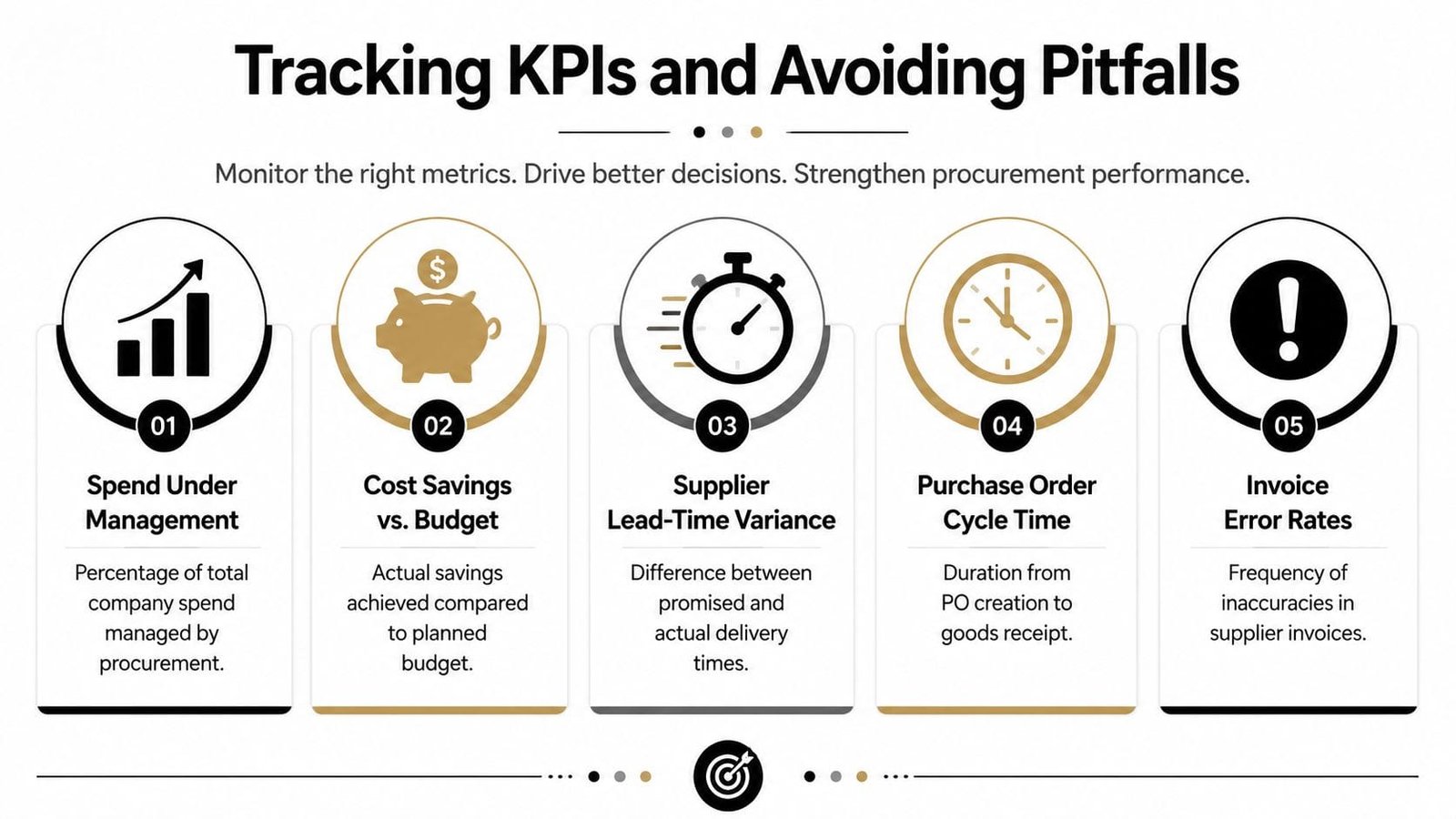
Procurement gets easier to manage when you measure it the same way every month. The best small-business dashboards don’t try to track everything. They focus on a few signals that show whether orders are controlled, suppliers are reliable, and invoices are clean.
The metrics worth watching
- Spend under management: This tells you how much purchasing is moving through the formal process instead of happening ad hoc.
- Cost savings versus budget: This shows whether negotiated pricing and planning are helping.
- Supplier lead-time variance: This highlights the gap between promised and actual delivery dates.
- Purchase order cycle time: This shows how long it takes to move from PO creation to receipt.
- Invoice error rates: This catches mismatches, missing details, and pricing errors before payment goes out.
A simple spreadsheet can track these items without fancy software, especially if the team keeps entries consistent. Dashboards help too, but only if someone updates the source data regularly. Under-resourced teams often struggle here, because poor spend visibility and manual workflows can put supply continuity and control at risk, as noted in 2024 industry guidance on procurement resourcing.
Common pitfalls that slow procurement down
The first pitfall is unclear specs. When the request is fuzzy, the supplier quotes the wrong thing, the team reworks the order, and delivery gets delayed. The second is weak spend visibility, which makes budget overruns harder to catch until they’ve already happened.
Manual approvals are another bottleneck. If every request waits in one inbox, the process depends on someone’s availability instead of a defined workflow. Weak supplier performance tracking creates a different problem, because the business keeps ordering from vendors who miss deadlines or send inconsistent quality.
If an invoice looks wrong, treat it as a process signal, not just a paperwork problem.
For accounts payable control, a practical reference is this accounts payable management guide, since AP is where procurement records either stay clean or turn messy. A better process makes the next review easier, especially when cash flow is tight.
Procurement Tools and Templates
A small business does not need a large procurement platform to get better control. It needs a short set of tools that make each step repeatable, like a kitchen prep station where each tool has a clear job. A shared spreadsheet, a purchase order template, a specification worksheet, and a single place to keep approvals and invoices can cover most day-to-day needs.
A strong specification worksheet forces clarity before anyone buys. It should spell out the scope, performance criteria, compliance requirements, and the testing method, because expert guidelines on technical specifications stress turning stakeholder needs into measurable criteria. That matters most when the business is buying equipment, packaging, or services, where “good enough” is hard to judge unless the team has a defined test.
A specification sheet also helps owners avoid vague purchases that look cheap at first but create rework later. If a printer, machine, or service does not match the written standard, the team has to explain the gap, send the item back, or absorb the loss. A worksheet makes that problem visible before the order goes out.
For budgeting decisions, procurement tools should sit alongside financial planning. Smart capital budgeting for business owners is a useful lens when a purchase affects not only what the business can buy, but how long it takes to recover the cash tied up in that buy. If you are comparing software, equipment, or fixtures, the financing logic matters as much as the purchase price.
A practical starter toolkit looks like this:
- Shared approval sheet: Use it to route requests and record who approved what.
- PO generator: Keep it simple, but include item description, quantity, price, and delivery terms.
- Invoice tracker: Match invoices to POs and receipts before payment.
- Specification worksheet: Use it to define performance, standards, and acceptance checks.
A good setup does not need much technology, but the right tools can make it easier to keep records clean. A few small business teams use a basic workflow with documents stored in one place and clear ownership for each approval step, then build from there with small business essential tech tools. The point is not to buy software for its own sake. It is to make each purchase easier to approve, trace, and explain later, which also gives the business cleaner records when a lender asks how spending decisions were managed.
Financing and Loan Readiness Impact
Lenders like businesses that can show control, not just sales. A documented procurement process helps because it proves the owner knows what gets bought, who approves it, and how the business tracks delivery and payment. That lowers the appearance of operational risk, especially when cash flow is tight.
Procurement maturity also strengthens the story behind a funding request. Approved purchase orders show planning. Supplier contracts show terms are defined. Invoice logs show the business can track obligations and pay on time. Those documents help a lender see that inventory or equipment spending isn’t random, it’s managed.
A lender is more comfortable financing a business that can explain how purchases move from request to payment without chaos.
That matters for equipment loans, SBA-style reviews, and working-capital requests. If the business can show recurring supplier relationships, documented approvals, and clean invoice handling, it signals that new debt is more likely to support growth than cover avoidable mistakes. If financing is tied to inventory or supplier payments, supply chain financing can also become part of the discussion.
Conclusion and Next Steps
Procurement is the control system behind everyday buying. When it’s mature, it improves supplier reliability, keeps spending visible, and gives lenders more confidence in the business. Start with one step, like a spec sheet or a purchase order template, then build the rest into a simple, repeatable workflow. Review supplier scorecards, keep invoice records organized, and prepare a lending folder that shows approvals, contracts, and payment history.