
You're probably dealing with a familiar problem right now. Payroll is due, vendors want payment on their terms, and one or two large customers still haven't paid invoices that are already spoken for in your internal forecast. On paper, the business looks healthy. In the bank account, it feels tighter than it should.
That gap is where many otherwise solid companies get stuck. A business doing $20 million to $50 million in annual sales can still run short on working capital because growth absorbs cash faster than collections return it. Longer customer payment terms can turn a profitable quarter into a stressful month.
That's where supply chain financing starts to matter. Not as a buzzword, and not as a niche treasury product for giant enterprises. For the right supplier, it's a practical way to turn approved receivables into usable cash sooner, without relying on the same underwriting logic as a conventional loan.
Table of Contents
- The Cash Flow Squeeze Every Business Knows
- How Supply Chain Financing Actually Works
- The Four Main Types of Supply Chain Finance
- Weighing the Benefits and Risks of SCF
- SCF vs Invoice Financing and Traditional Loans
- Is Supply Chain Finance Right for Your Business
- How to Secure Supply Chain Financing A Practical Guide
The Cash Flow Squeeze Every Business Knows
If you sell to larger customers, you already know the pattern. You buy materials, schedule labor, ship product, submit the invoice, and then wait. Meanwhile, your own obligations keep moving. Rent doesn't wait. Insurance doesn't wait. Freight bills definitely don't wait.
That mismatch between when cash goes out and when cash comes in is what turns normal operations into a working capital problem. Many owners first notice it when growth stops feeling exciting and starts feeling expensive. More sales create more invoices, but they also create more payroll, more purchasing, and more strain on the line between delivery and collection.
Supply chain financing is built for that gap. It helps suppliers get paid earlier on invoices a buyer has already approved, while the buyer still pays on the original due date. It's less about “borrowing for survival” and more about making the order-to-cash cycle less punishing.
One reason this topic matters now is scale. The global supply chain finance market reached about USD 2.646 trillion in annual payables volume in 2025, yet only about 6-7% of the potential market is currently utilized, which means roughly 90-94% remains untapped according to BCR Publishing's market update. That tells me two things. First, the tool is already mainstream enough to matter. Second, a lot of eligible businesses still aren't using it.
What this looks like in practice
For a mid-market company, the cash squeeze usually shows up in one of these ways:
- Fast sales growth: Revenue rises, but cash gets trapped in receivables.
- Long customer terms: Large buyers push payment further out than your vendors will tolerate.
- Seasonal purchasing: You need to build inventory or staff ahead of collections.
- Thin timing margins: One delayed payment forces you to rearrange everything else.
Practical rule: If your profit and your cash position tell two different stories, you don't have only a margin issue. You may have a timing issue.
This is also why disciplined visibility matters. Before pursuing any financing structure, it helps to map expected inflows and outflows in detail. A tool like Hinawi ERP cash flow forecasting can help management see whether the problem is slow collections, poor payment sequencing, or a genuine capital gap.
Why many businesses miss the opportunity
Some owners assume supply chain finance is only for massive public companies and their direct top-tier vendors. Others hear the term and lump it in with expensive receivables products they've already ruled out. Both assumptions leave money on the table.
If your business has good customers but awkward timing, this isn't an abstract finance concept. It's a working capital lever.
How Supply Chain Financing Actually Works
The simplest way to understand what is supply chain financing is as follows. Your business benefits from the credit strength of the customer that owes you money, not just from your own balance sheet.
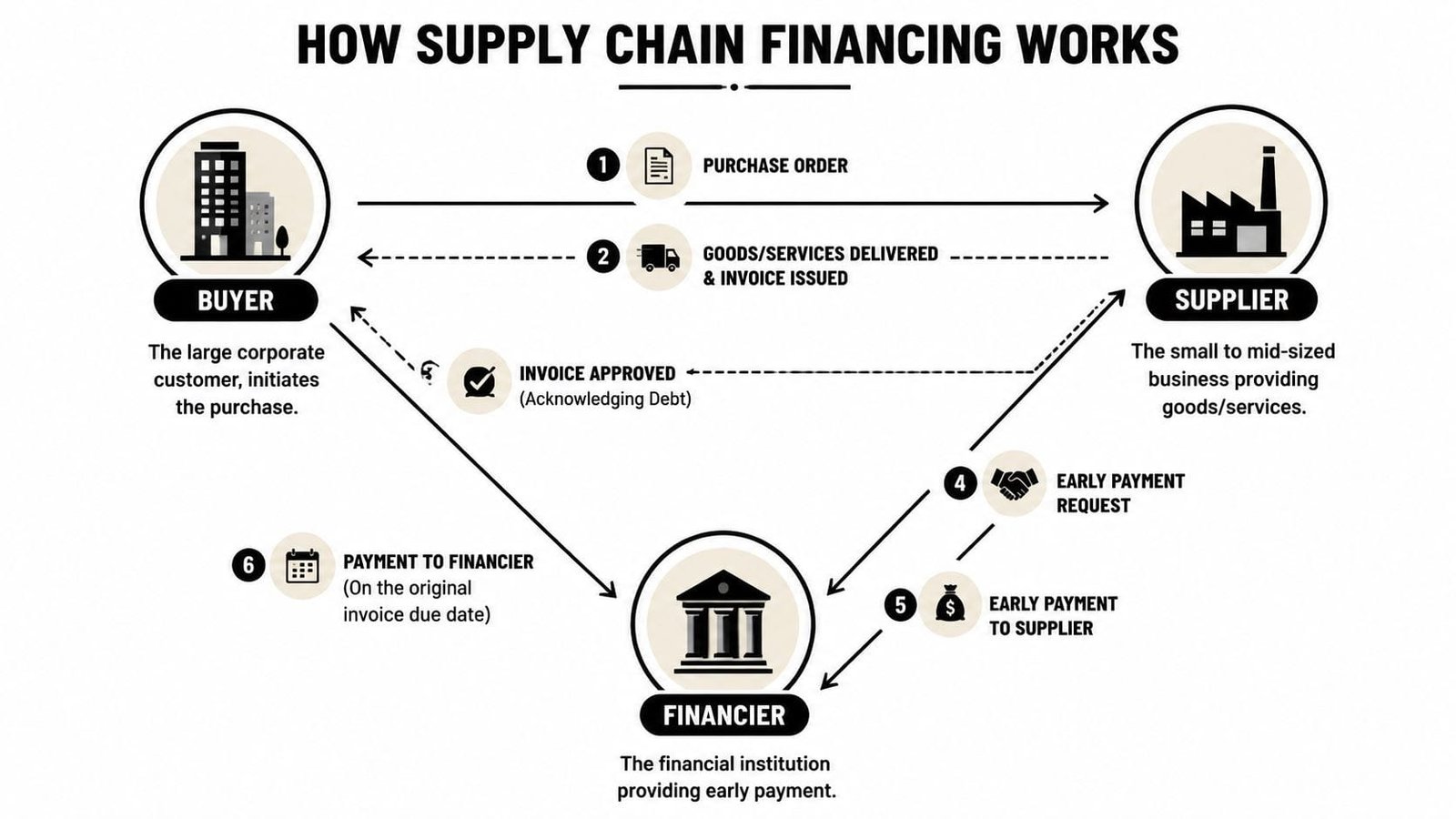
A common analogy is a creditworthy friend co-signing for you. In supply chain finance, the “friend” is the buyer. The lender cares that the buyer has approved the invoice and is expected to pay on the agreed date. Because the buyer's credit profile is stronger, the supplier may get funding on better terms than it could secure alone.
The three parties that make it work
Three participants sit at the center of the arrangement:
- Buyer: The customer, often called the anchor buyer, that purchases goods or services.
- Supplier: Your business, which delivers the goods or services and issues the invoice.
- Financier: Usually a bank or specialized platform that advances the payment early.
Here's the normal flow:
- The buyer places the order.
- You deliver the goods or complete the service.
- You issue the invoice.
- The buyer approves that invoice for payment.
- The financier pays you early, minus its discount or fee.
- The buyer pays the financier on the original due date.
This structure is why supply chain finance is described as buyer-driven. The buyer's approval is what turns a normal receivable into something financeable under the program.
What an approved invoice really means
An approved invoice isn't just “sent.” It means the buyer has acknowledged the obligation to pay according to the agreed terms, subject to the program rules. That distinction matters. Financing usually doesn't happen at the purchase order stage in classic SCF. It happens after delivery and invoice approval.
According to the European Banking and Financial Services industry definition, SCF is a buyer-driven arrangement in which a buyer approves a supplier's invoice for financing, allowing the supplier to receive early payment. The financing cost is based on the buyer's stronger credit rating, which can reduce the supplier's funding cost by 2–5 percentage points compared with traditional financing.
That last point is the commercial heart of the product. You're not just getting cash faster. You may be getting it on pricing linked to the buyer's credit strength rather than your own.
A short walkthrough helps make that concrete:
You ship to a national customer on extended terms. The invoice is approved, but the due date still sits well into the future. Instead of waiting, you elect early payment through the program. The financier advances the funds. Your customer pays later, on schedule. You improve liquidity without having to renegotiate the customer's terms.
Here's a useful explainer if you want a visual overview:
The part many owners miss is that this isn't mainly about adding debt in the usual sense. It's about accelerating cash that is already tied to a valid commercial transaction.
The Four Main Types of Supply Chain Finance
Not every working capital solution that touches receivables belongs in the same bucket. That's where confusion starts. A supplier hears “supply chain finance,” but the provider is really discussing factoring, inventory lending, or an early-payment discount structure.
The better approach is to separate them by who initiates the transaction, what asset or event triggers funding, and how pricing is generally determined.
Supply Chain Finance Types at a Glance
| Financing Type | Who Initiates It? | Cost Basis | Best For… |
|---|---|---|---|
| Payables Financing | Buyer-led | Often linked to the buyer's credit profile and approved invoices | Suppliers selling to larger, creditworthy customers |
| Traditional Factoring | Supplier-led | Often tied to the supplier, the receivable, and the buyer's payment behavior | Businesses that need flexibility without a buyer-sponsored program |
| Inventory Financing | Supplier or borrower-led | Based on inventory value, control, and lender structure | Companies with cash tied up in stock before sale |
| Dynamic Discounting | Buyer-led | Buyer offers early payment in exchange for a discount | Buyers with excess cash and suppliers willing to trade margin for speed |
Payables finance or reverse factoring
This is the version commonly referenced when discussing supply chain financing. The buyer sets up the arrangement. Once the buyer approves the invoice, the supplier can request early payment.
This works best when you sell to a large, stable customer and can't easily force shorter payment terms. In that setting, reverse factoring can be cleaner than trying to stretch your own vendors or rely on a general working capital loan.
What doesn't work is assuming every customer is willing to sponsor a program. Some buyers have one. Some don't. Some have one only for selected suppliers.
Traditional factoring
Factoring is often confused with SCF because both involve getting cash against invoices. But the supplier initiates factoring directly. You choose invoices or a portfolio, and the factor advances funds based on its own underwriting approach.
This can be useful when the buyer has no SCF program, or when you need more control over which receivables you finance and when. It can also be a practical option if you have a broad customer base instead of one dominant anchor buyer.
If you're evaluating pre-delivery funding against confirmed customer demand, purchase order financing can also come into the conversation. That's a different trigger point from classic SCF, but it solves a related working capital problem earlier in the cycle.
Inventory financing
Inventory financing addresses a different bottleneck. Your cash is tied up in product sitting in a warehouse, in transit, or allocated to future sales. Instead of financing an approved invoice, the lender finances against the inventory itself under its own collateral and monitoring rules.
This can be useful for importers, distributors, and seasonal businesses that must stock up before revenue arrives. It is not a substitute for payables finance, but in some businesses it complements it.
Dynamic discounting
Dynamic discounting is the least lender-dependent option in this group. The buyer uses its own cash to pay suppliers early in exchange for a discount. If the buyer has surplus liquidity and wants stronger supplier relationships, this can work well.
For the supplier, the question is straightforward. Is the discount worth faster cash and lower collection uncertainty? Sometimes yes. Sometimes no. It depends on your margins, urgency, and alternatives.
The best financing structure isn't the one with the most impressive name. It's the one that matches where cash gets stuck in your operating cycle.
Weighing the Benefits and Risks of SCF
Supply chain finance can be a strong tool. It can also create blind spots if you treat it like free money or assume every buyer-sponsored program is automatically in your interest.
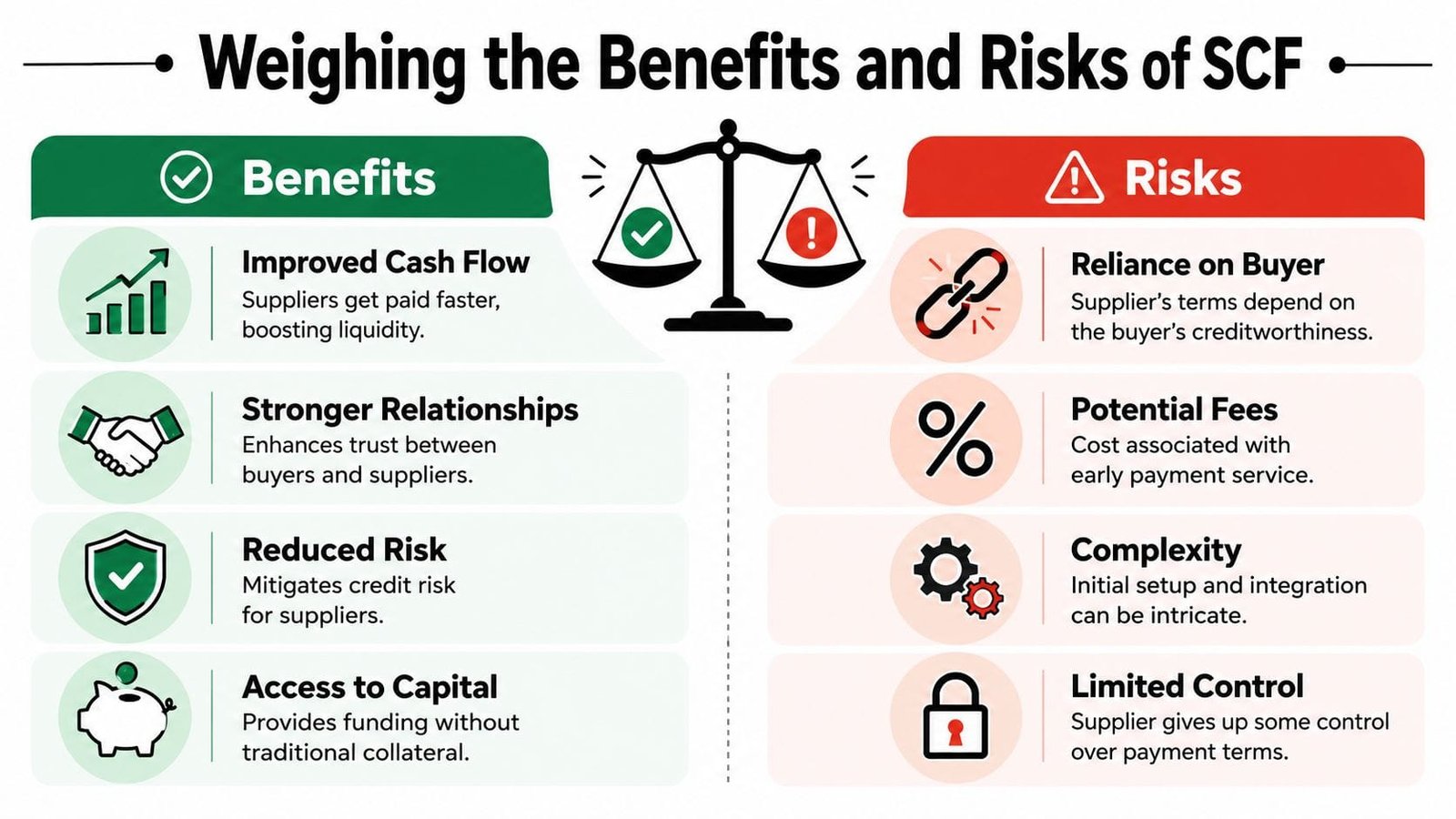
The upside is real. So are the trade-offs.
Where suppliers usually win
For suppliers, the biggest gain is speed of cash. You stop waiting through the full customer payment cycle and can convert approved invoices into liquidity much earlier. That helps with payroll timing, purchasing power, and capacity planning.
There's also a relationship benefit. Buyers that support supplier finance programs often want continuity in their supply base. Faster supplier access to cash can reduce friction and support more stable operations on both sides.
Common advantages include:
- Improved predictability: Approved invoices become easier to plan around than uncertain collection dates.
- Less pressure on other facilities: You may avoid overusing your line of credit for routine timing gaps.
- Potentially lower cost than some alternatives: Especially when pricing reflects the buyer's credit strength rather than yours.
- Better operating flexibility: You can take on orders without every growth move creating a fresh cash crunch.
Where companies get into trouble
The first risk is buyer concentration. If too much of your liquidity plan depends on one anchor buyer, you're exposed. If that relationship weakens, if terms change, or if invoices get disputed more often, your financing plan can wobble with it.
The second risk is program dependency. Some suppliers gradually build the business around receiving early payment every cycle. That can work, but only if you price jobs and manage margins with the financing cost in mind.
A few practical warning signs:
- You're using SCF to cover structural losses: Financing can fix timing. It can't fix bad margins.
- Invoice approval is inconsistent: If buyers approve late or dispute frequently, the program won't feel reliable.
- You haven't modeled the cost: Fast cash helps, but the discount still affects profitability.
- Operations and finance aren't aligned: If shipping, billing, and collections teams don't close paperwork cleanly, delays creep in fast.
Watch for this: If a financing tool becomes the only reason your cash flow works, the real issue may be operational or pricing discipline, not just timing.
There's also a governance angle. Since disclosure standards tightened in recent years, buyers have less room to keep supplier finance programs opaque. That's healthy. Suppliers should prefer structures that are clearly documented, consistently administered, and easy to reconcile.
Used well, SCF stabilizes working capital. Used carelessly, it can hide deeper fragility.
SCF vs Invoice Financing and Traditional Loans
Most business owners often misunderstand this point. They hear early payment against invoices and assume every product is basically the same. It isn't.

The core difference is in how the capital gets underwritten.
The underwriting difference that matters
Supply chain finance differs significantly from asset-based lending because it underwrites capital based on the buyer's promise and verified trade data, not the SME's credit file or collateral, as explained by the International Chamber of Commerce Academy. That distinction matters for the 141 million microenterprises globally that are underserved by traditional lenders due to a lack of credit data in that same source.
For a U.S. business in the $20 million to $50 million range, the lesson is simple. If your customer base is stronger than your own credit profile, your receivables may support financing in a way your balance sheet alone does not.
Traditional loans work differently. A bank or lender may look at:
- historical financial statements
- collateral coverage
- debt levels and debt service
- owner guarantees
- borrowing base formulas
Invoice-based products sit somewhere in the middle. If you want a grounded comparison of supplier-led receivables funding, this overview of what invoice factoring is is helpful because it shows where the supplier remains the active party rather than the buyer.
When each option makes sense
Use SCF when the strength of the customer relationship is the main asset and the buyer supports the process.
Use invoice financing or factoring when you need more independence from buyer-sponsored programs, or when you want to choose which receivables to accelerate.
Use a traditional loan when the need is broader than receivables timing. Equipment purchases, facility buildouts, acquisitions, and long-horizon expansion usually fit better in a term structure than in an invoice product.
If your lender keeps asking about collateral, but your real strength is a solid roster of paying customers, you may be asking the wrong lender for the wrong product.
That's the main reason this distinction matters. SCF doesn't ask your business to look like a conventional borrower before it can access working capital.
Is Supply Chain Finance Right for Your Business
The right question isn't whether SCF is “good.” The right question is whether your business sits in the kind of commercial position where it works cleanly.
For many U.S. suppliers, the answer depends less on company size than on customer quality, invoice discipline, and where they sit in the supply chain.
Signs you may be a strong fit
A strong fit often looks like this:
- You sell to larger, dependable customers: Their credit profile may carry more weight than your own.
- Your invoices are clean: Delivery disputes, missing paperwork, and inconsistent billing slow everything down.
- Payment terms are stretching your cash cycle: The business is profitable, but timing is tight.
- You want flexibility without pledging more hard collateral: Especially if your best asset is contractual demand from credible buyers.
This matters even if you don't think of yourself as a classic enterprise supplier. Many mid-market firms assume they're too small for structured trade finance when the crucial point is whether there is a reliable buyer and a verifiable trade flow.
The deep-tier option most smaller suppliers miss
This is the overlooked angle. Deep-Tier Supply Chain Finance, or DTSCF, extends SCF beyond tier-1 suppliers by leveraging the anchor buyer's credit risk, and it can generate up to 30% more working capital for SMEs in lower tiers compared with traditional programs, according to the Asian Development Bank's analysis of deep-tier supply chain finance.
That matters if you supply a company that supplies a major buyer, even when you don't hold the direct top-level contract yourself.
A lot of mainstream content skips this. It talks as if only the supplier billing the household-name corporation can benefit. In practice, deeper-tier businesses may qualify when transaction data, invoice flows, and anchor-buyer visibility are strong enough.
Here's the concept:
- Tier 1 supplier: Sells directly to the major buyer.
- Tier 2 or Tier 3 supplier: Sells into that chain indirectly.
- Deep-tier opportunity: Financing can still flow downstream if the program and data structure support it.
For a business owner, the key takeaway is practical. Don't disqualify yourself just because your customer isn't the Fortune 500 company at the top of the chain. Ask where the anchor sits and whether financing visibility extends beyond first-tier vendors.
How to Secure Supply Chain Financing A Practical Guide
Once you understand what is supply chain financing, the next step is operational. This isn't a product you shop for casually. You need to prepare your receivables, your buyer conversations, and your documentation before you start comparing options.
Start inside your own receivables data
Begin with your sales ledger. Identify which customers consistently pay, which ones generate the largest approved invoices, and where long terms are creating the biggest strain. You're looking for concentration, consistency, and financeable patterns.
Then gather the paperwork that proves trade flow:
- Customer agreements: Payment terms, delivery terms, and billing rules
- Invoice history: Especially invoices that moved cleanly from issue to approval
- Proof of delivery or service completion: Missing support often causes avoidable delays
- Aging reports: To show how receivables behave by customer
Ask better questions before you apply
Talk to your customers directly. Ask whether they already have a supplier finance program, whether non-tier-1 suppliers can participate, and what invoice approval process the financier relies on.
When you evaluate providers, ask how they handle integration, disputes, approvals, and reporting. New disclosure standards have made this part more transparent. As of January 1, 2024, new international accounting standards require companies to disclose key details of SCF programs, including payment terms and liabilities, which increases transparency according to Deutsche Bank's overview of SCF growth drivers and disclosure rules.
A practical operating checklist helps:
- Map your biggest payment gaps
- Prioritize buyers with the strongest approval discipline
- Confirm whether a buyer-led program already exists
- Compare provider processes, not just pricing
- Test the workflow on a narrow set of invoices first
If your business includes transportation or fleet-heavy operations, it also helps to think in terms of asset control versus cash flow timing. That's why guides like how lease to own trucking works can be useful context. They show a different financing logic, one based on acquiring equipment access rather than accelerating receivables.
Once you've narrowed your options, tighten your internal AP and AR workflow too. Better invoice timing and cleaner payment coordination improve the odds that any financing structure will work as intended. This guide on streamlining vendor payments using financing tools is a useful companion if your payables process is part of the bottleneck.
If your company is growing but cash keeps getting trapped between delivery and payment, Business Loan Warrior is a practical place to explore funding options. The platform helps business owners compare customized solutions, check pre-approval through a single application, and find the right fit for working capital, invoice financing, equipment, expansion, and more.