
You're probably staring at a stack of spending decisions right now, not a neat balance sheet. One card is carrying a work trip, another is covering supplies, the line of credit is there for payroll timing, and the equipment loan keeps humming in the background. That's not a morality problem. It's a working capital problem, and the owners who handle it best treat credit like a set of dials, not a test of discipline.
If you want a practical way to compare options and avoid getting spun up by lender jargon, a solid starting point is the credit education and comparison material at Peaceful Mindful Pocket LLC credit tools. Use that kind of resource to get oriented, but keep your decisions grounded in cash flow, payback, and term matching.
Table of Contents
- The Mindset Shift Behind Smart Credit Use
- Deciding When Borrowing Actually Makes Sense
- Choosing the Right Type of Credit for the Job
- Managing Utilization, Payments, and Inquiries Like Controls
- Building a Real Business Credit Profile
- Mistakes That Quietly Cost Small Businesses the Most
- A 30-Day Credit Routine and a Pre-Borrowing Checklist
The Mindset Shift Behind Smart Credit Use
A lot of owners come to me talking about credit like it's a stain to scrub off the books. They've got three cards, a line of credit, and maybe an equipment loan, and the instinct is to ask, “How do I get rid of all of this?” That's the wrong first question. The better question is, “Which of these balances is buying me time, inventory, capacity, or revenue, and which one is just sitting there costing me money?”
That shift matters because credit is not a moral scorecard. It's a tool, and tools work best when you know what they're for. A wise operator looks at every dollar borrowed and asks whether it's funding something that will return more value than it costs, whether that's smoother payroll timing, a needed machine, or inventory that turns fast enough to justify the carry.
Practical rule: if you can't explain what the borrowed money is supposed to produce, don't borrow it.
That's the filter I'd put in front of every decision. What does this fund? What does it cost? What happens if revenue drops next month? If the answer to the last question creates panic, the deal is too fragile or the repayment structure is wrong. If the answer to the first question is “gap filling with no plan,” you're not financing growth, you're hiding stress.
Use the right lens and credit becomes manageable. Treat it like an enemy and you'll either avoid useful borrowing or misuse the borrowing you already have. That's why operators win. They don't borrow the least, they borrow with the clearest purpose.
Deciding When Borrowing Actually Makes Sense
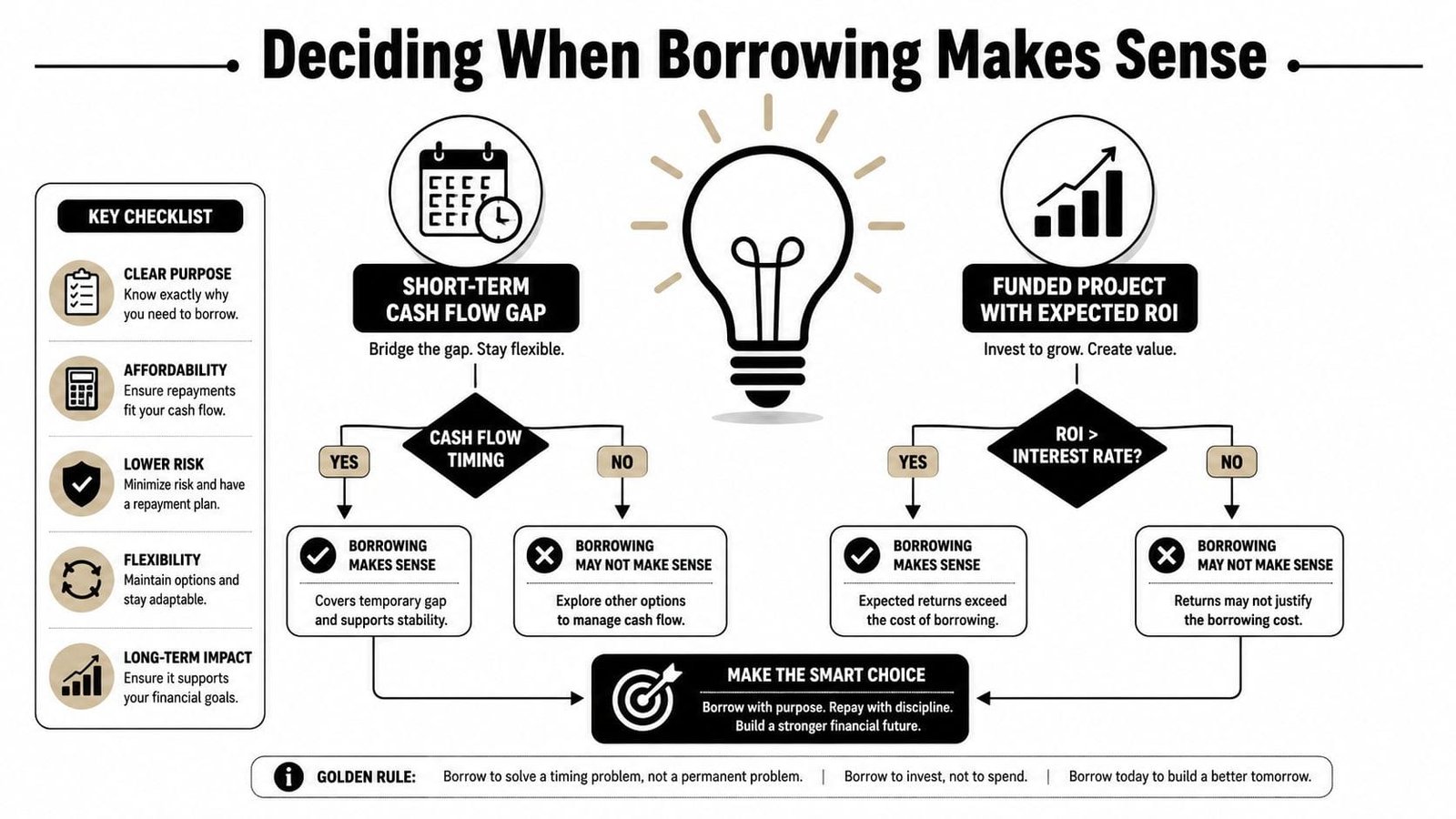
Borrowing makes sense when cash arrives later than the expense, or when the asset you're buying produces enough margin to justify the financing cost. That sounds simple because it is. The hard part is being honest about whether the purchase is productive, or just urgent.
Start with cash flow timing
If the money is going out now and the revenue tied to it arrives later, credit can bridge the gap. That's normal in a business. The mistake is using expensive credit to solve a problem that never improves. A payroll crunch that keeps repeating is not a financing opportunity, it's a warning sign.
Then test the payoff
A purchase should earn its keep. If equipment, inventory, or a location upgrade improves throughput, protects service levels, or raises margin, borrowing can be rational. If the only benefit is keeping the lights on this week, I'd want a very clear repayment path before I signed anything. Term should match the life of the asset too. Don't finance a long-lived item with a tiny window that forces a refinance before the asset has paid itself down.
A working rule is blunt, but useful. If the capital funds something durable, use durable financing. If it covers a short-lived gap, use short-term credit with a plan to extinguish it quickly.
Know the real cost before you say yes
The true cost is more than the headline rate. Fees matter. Timing matters. If you need a simple way to think about interest on card balances, remember that Bankrate's payment example converts APR to a daily periodic rate by dividing by 365 and then multiplying by the balance. That's the kind of math that keeps you from pretending carry is cheap when it isn't. For a deeper comparison of borrowing structures, I'd also point owners to business loan vs line of credit, because the wrong structure is where a lot of good intentions go sideways.
Choosing the Right Type of Credit for the Job
Most costly borrowing mistakes start with product mismatch. Owners see a lender offer one thing, accept it under pressure, and only later realize they needed a different tool. A line of credit, a term loan, and invoice financing can all be useful. They are not interchangeable.
Match the product to the problem
A business line of credit fits uneven cash flow, seasonal swings, and short-term gaps. You draw what you need, pay it back, and use it again if the business keeps behaving the same way. A term loan fits a larger, defined purchase that benefits the company over time, like expansion or a major upgrade. Equipment financing fits a machine or asset that can be tied directly to the purchase itself.
SBA-backed products are worth serious attention when the business needs a larger, more structured funding solution and can tolerate a slower process. Invoice financing fits businesses waiting on receivables, because it turns unpaid invoices into working capital sooner. Business credit cards are best for controlled, short-cycle expenses you can pay off quickly, not for floating chaos month after month.
If the expense has a clean end date, use a product with a clean payoff path.
Merchant cash advances deserve caution because the repayment is tied to sales flow and the effective cost can be punishing if you're already tight. I'd treat them as a last resort, not a default bridge.
| Credit Type | Best For | Typical Term |
|---|---|---|
| Business line of credit | Short-term cash flow gaps and uneven revenue | Revolving, reusable |
| Term loan | Defined purchases and planned expansion | Fixed repayment period |
| Business credit card | Small recurring expenses and short-cycle spending | Revolving, monthly billing |
| SBA loan | Larger strategic projects and longer payback needs | Longer structured repayment |
| Merchant cash advance | Emergency access when other options aren't available | Short, sales-linked repayment |
| Equipment financing | Machinery and other asset purchases | Tied to equipment life |
| Invoice financing | Unlocking cash tied up in receivables | Short, invoice-based |
If you're evaluating a larger move, such as opening a franchise, the financing structure matters even more. The research and planning at how to open a franchise can help you see why the capital stack has to fit the business model, not the other way around.
Managing Utilization, Payments, and Inquiries Like Controls
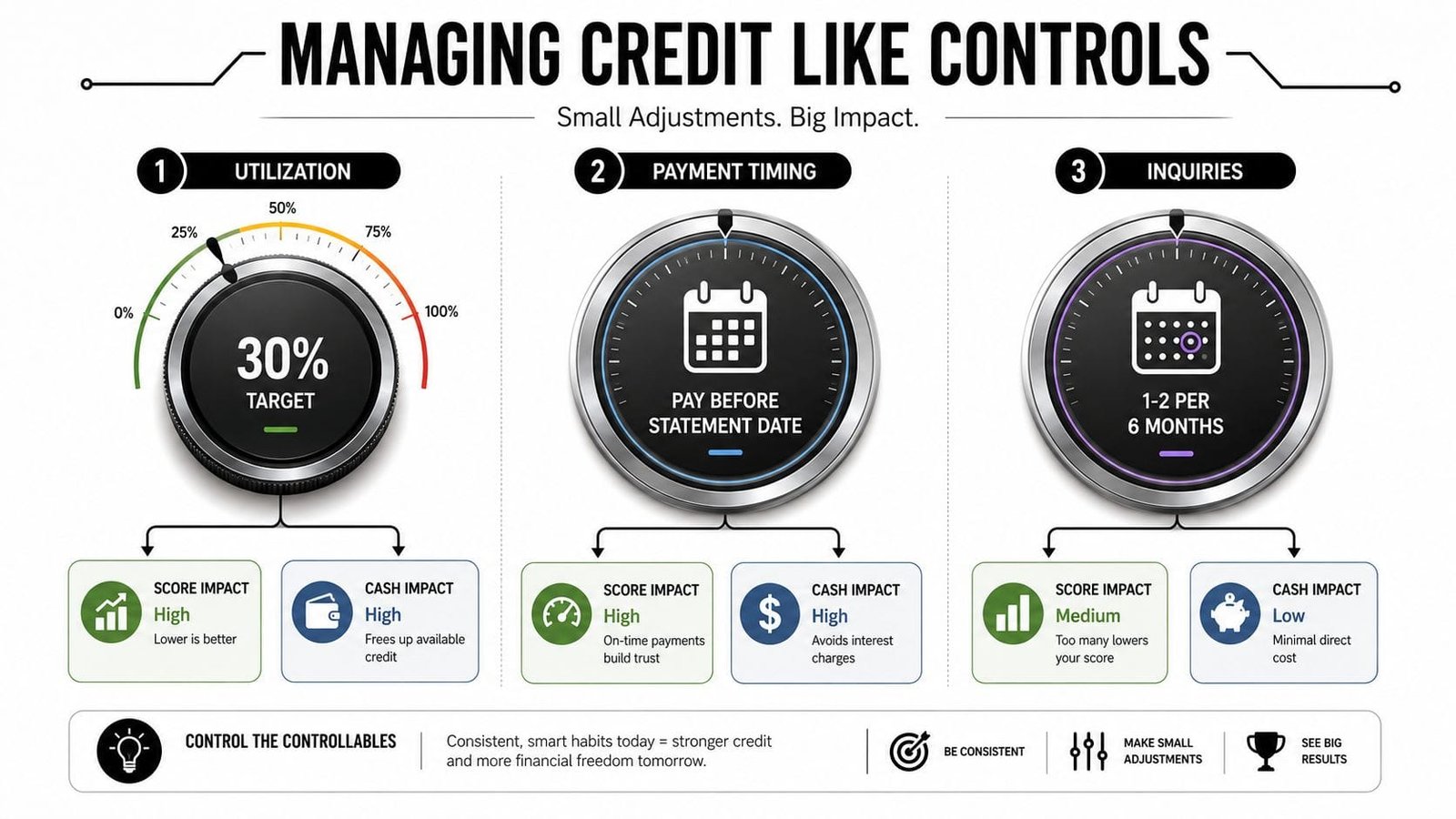
Once you borrow, lenders start watching three controls, utilization, payment timing, and inquiry spacing. Treat them like operating dials, not moral tests. Owners who manage those three levers well usually keep credit available and cash flow under control without making dramatic moves.
Utilization is the first dial
The CFPB reported the average cardholder's total credit utilization was 20.6% in 2022. Consumer-education sources also recommend staying below 30% to avoid serious score damage, because utilization is one of the clearest signals lenders use to judge whether debt is being managed responsibly. Keep that in mind if your personal and business credit overlap, because a heavy balance on either side can hurt the file lenders see.
A card that sits near its limit can drag you down even if you pay it off later. Lenders often look at the reported balance, not your good intentions. That means a temporary max-out can leave a mark longer than owners expect.
Payment timing changes what the bureau sees
Pay the statement balance by the due date every month. That is the baseline. Pay before the statement closes when you want the reported balance to look cleaner, because that lowers utilization at the exact moment it gets measured. On the cost side, minimum payments on cards are often only about 1–3% of the balance, so carrying debt that way stretches payoff time and pushes interest expense higher. Use the daily rate method described by Bankrate, dividing APR by 365, if you want to see how fast carry really adds up.
Inquiries need spacing
A stack of applications in a panic window can do avoidable damage. If you are shopping for auto or mortgage credit, Canada's financial regulator notes that quotes collected within a 2-week period are typically treated as one inquiry, which lets borrowers rate-shop without multiplying score damage. Outside those rate-shopping windows, slow down and apply only after you have narrowed the choice. If you want a plain explanation of how a hard credit pull works, that is the line lenders care about most.
A simple comparison makes the point. A $10,000 balance on a $20,000 limit is a very different utilization profile than the same balance on a $50,000 limit. Same debt, different signal. That is why smart owners manage limits and balances together instead of staring only at the monthly payment.
Building a Real Business Credit Profile
Too many small businesses stay trapped on the owner's personal credit because it feels easier. It is easier, at first. It also caps flexibility, keeps the owner personally exposed, and blurs the line between business risk and household risk. I don't like that structure unless there's no other practical choice.
Start with separation, not sophistication
The first move is boring and necessary. Get an EIN, open a dedicated business bank account, and make sure the business name is used consistently across accounts. Then build vendor relationships that report to commercial bureaus, because that reporting is what starts giving the business its own footprint. Net-30 supplier accounts can help when they're reported properly and paid on time.
Business credit cards can help too, but only if they're used lightly and paid in full. The point is to show controlled use, not dependence. Over time, commercial bureaus such as Dun & Bradstreet, Experian Business, and Equifax Business become more relevant as the file thickens.
Know where personal credit still matters
For smaller companies, lenders often still look at both personal and business credit. That means one clean profile doesn't cancel out a messy one. Improve both by keeping utilization modest, paying on time, and avoiding application sprees. That's the direct path.
If you want a plain-English comparison of the two profiles, the breakdown at business credit vs personal credit is useful because it shows why they interact but don't mean the same thing.
A stronger business file doesn't always erase the personal guarantee.
That last point matters. Some products still require a personal guarantee even when the business looks healthy on paper. I'd read that language carefully every time, because it tells you exactly who is holding the risk if things go wrong. Build the business profile, yes, but don't assume it automatically removes personal exposure.
Mistakes That Quietly Cost Small Businesses the Most
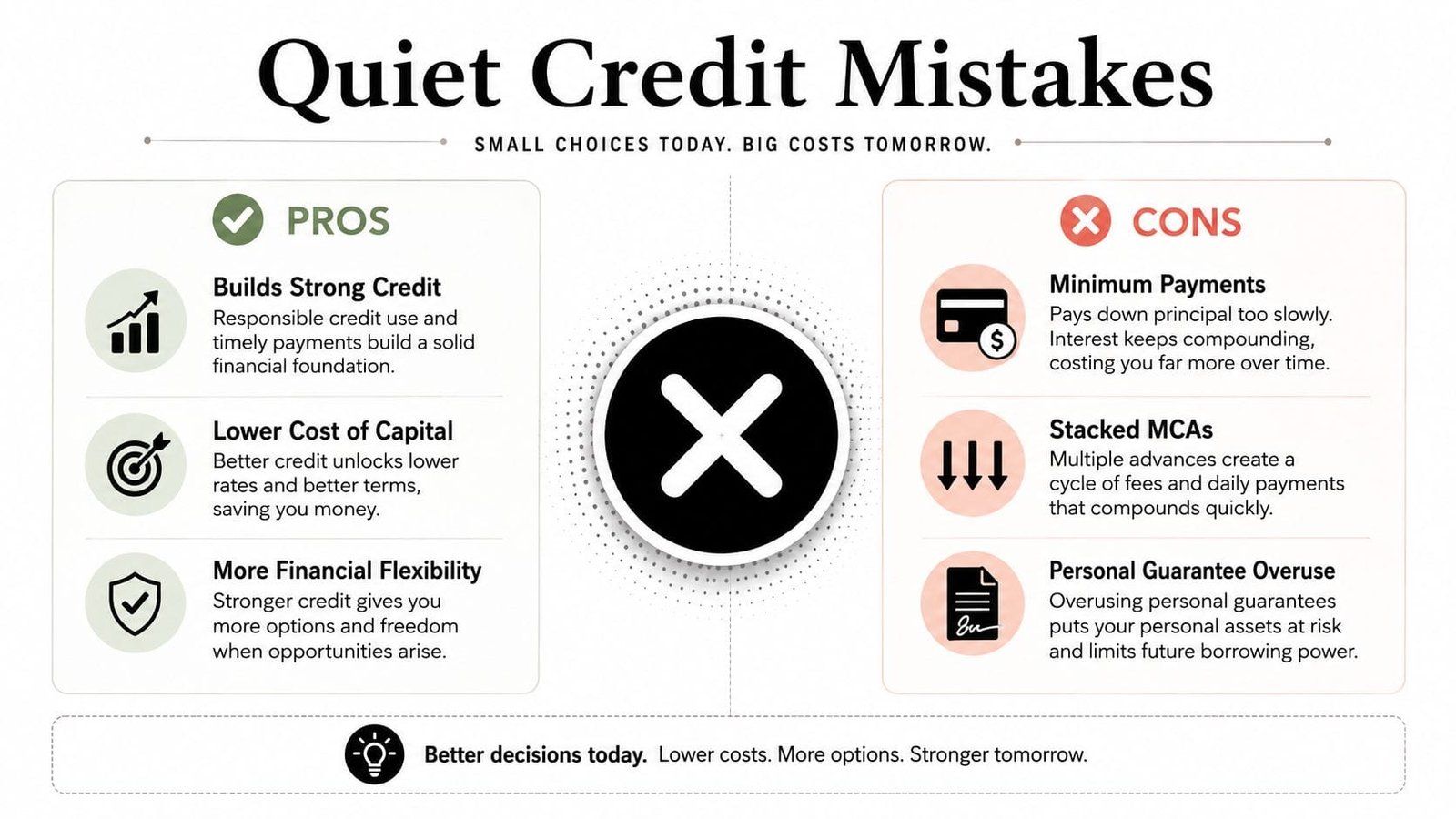
The most expensive credit mistakes usually don't look dramatic on day one. They look convenient. A minimum payment here, a cash advance there, a promo offer that seems harmless, and then the business starts paying for yesterday's decisions long after the original problem is gone.
The traps I see most often
Minimum payments keep an account technically current, but they're a slow bleed. You feel safe because no one is calling, yet the balance keeps hanging around and interest keeps eating margin. That's not control, that's drift.
Stacking merchant cash advances is even uglier. Owners take one, then another, then another when sales soften. The business starts losing future cash before it has a chance to recover, and the repayment pressure gets worse exactly when flexibility matters most.
Using personal cards for payroll emergencies can also backfire fast if there's no repayment plan. The owner's own utilization spikes, household cash gets stressed, and the business problem gets mixed with personal risk.
Ignoring personal guarantee language is just sloppy. If you sign it, understand it. Don't assume the business name is the only thing on the hook.
0% offers are not free money
Promotional offers only work if you map the payoff before the rate changes. Treating a promo as a grace period without a deadline is how balances become expensive later. The card company isn't doing you a favor. It's giving you time to move debt, and you need an exit plan before you accept.
If a promo only works when everything goes perfectly, it isn't a plan.
That's the core issue with sloppy credit use. The owner doesn't notice the cost until the business is already boxed in. Smart operators name the trap early and avoid paying for convenience with future flexibility.
A 30-Day Credit Routine and a Pre-Borrowing Checklist
The best credit habits are dull, repeatable, and tied to the calendar. Don't wait until you're anxious to look at the numbers. Give yourself a monthly routine, then use a checklist before every new credit decision.
A 30-day routine that actually sticks
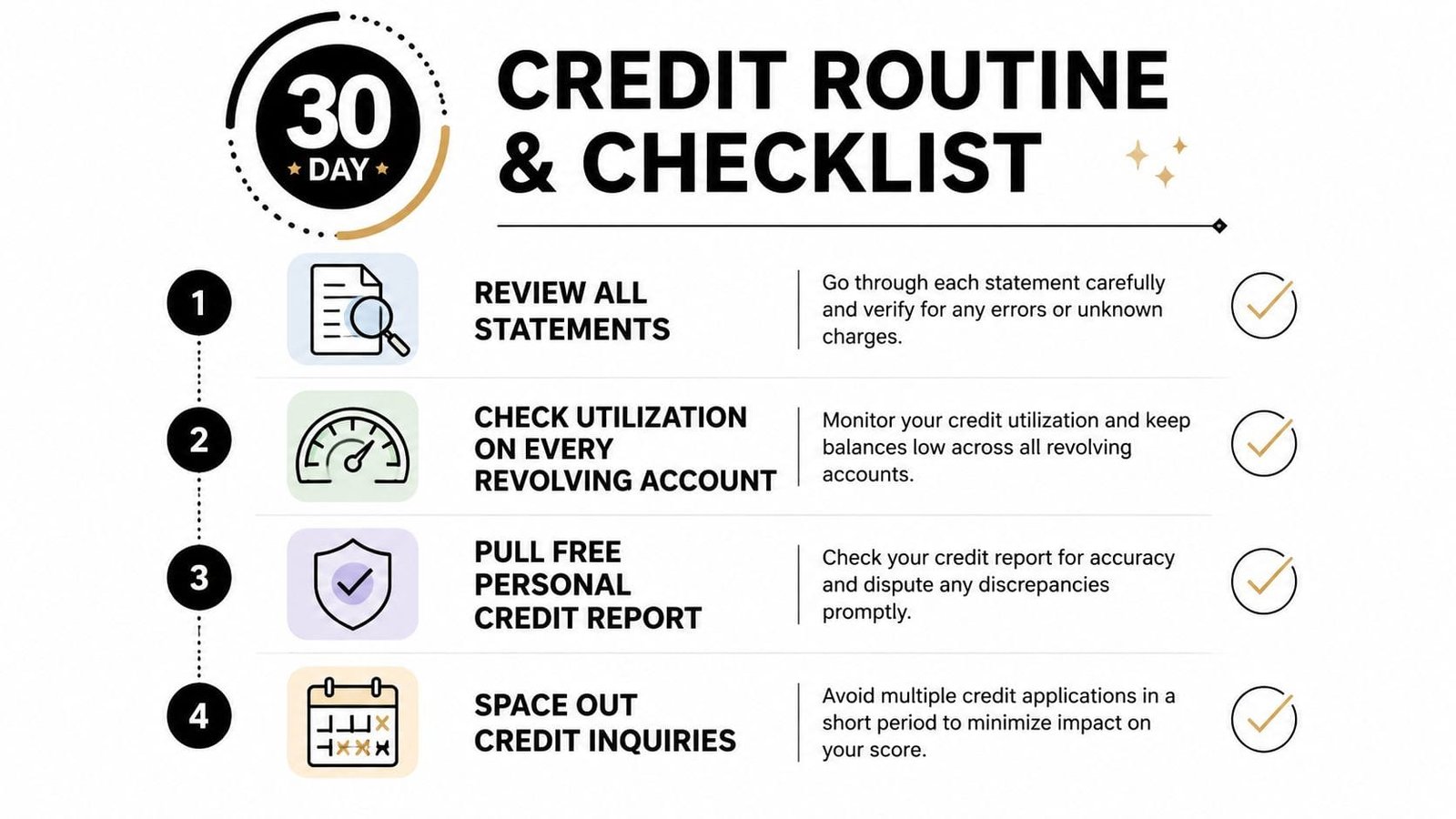
Once a month, review every statement and confirm the charges are right. Then check utilization on every revolving account, not just the one that feels busy. Pull a free personal credit report and review a business credit summary from at least one bureau so you know what lenders are likely to see. Finally, look ahead 60 days and make sure expected repayments are covered by scheduled revenue, not by hoping another loan shows up.
The checklist I'd use before signing anything
- What exactly is this funding? If the answer is vague, stop.
- How will this get repaid? If repayment depends on wishful thinking, stop.
- What's the total cost of capital, fees included? If you only know the rate, you don't know the cost.
- Does the term match the asset or need? Short-lived gap, short-lived product. Durable asset, durable financing.
- What happens if revenue drops? If the answer is panic, the structure is too tight.
- Is there a personal guarantee? If yes, treat it as real personal risk, because it is.
If you're also timing other major purchases, keep the application window narrow and avoid piling on unnecessary hard pulls. A quick hard-pull explanation at what is a hard credit pull helps you separate normal shopping from avoidable score drag. And if a refinance lowers stress without extending a bad habit, that can be smarter than taking on new debt just to feel productive.
A good credit routine makes borrowing calmer because you already know what the numbers say. A bad one turns every lender conversation into a scramble. Run the routine, use the checklist, and don't sign a deal until the repayment story makes sense on paper.
If you want a lender-side view of how small business funding gets approved, structured, and compared, visit Business Loan Warrior. It's built for owners who want to match the right capital to the right need, not just chase the first offer that lands in their inbox.