
You can have a strong sales month and still get a hard no from a lender. That's the part many owners learn too late. The income statement can look healthy while the balance sheet shows thin liquidity, heavy debt, or too little collateral for a bank to feel comfortable.
That's why income statement vs balance sheet isn't an academic comparison, it's a funding question. One tells a lender how the business performed over time. The other tells them what the business owns, what it owes, and how much cushion is left if things get tight.
If you're trying to prepare for a loan, the main job is to make both documents tell a consistent story. If you want a practical way to think about the cash side of that story, it helps to understand small business liquidity before a lender asks follow-up questions. The cash flow view sits between profit and balance-sheet strength, and it often explains why a business that looks profitable still feels strapped.
Table of Contents
- Introduction Why Profit Does Not Always Equal Cash
- The Two Pillars of Financial Reporting
- A Line-by-Line Comparison of Each Statement
- What Each Statement Reveals About Your Business Health
- How Lenders Read Your Financials for Loan Approval
- Common Pitfalls and Accounting Blind Spots to Avoid
- Your Loan-Ready Checklist and Final Questions
Introduction Why Profit Does Not Always Equal Cash
A café owner can look at a month-end report, see strong sales, and still worry about payroll on Friday. That's not a contradiction, it's a timing problem. The income statement can show profit from orders already earned, while the bank account reflects cash that may still be tied up in receivables, inventory, or upcoming bills.
A lender sees that tension immediately. The income statement answers whether the business is generating earnings over a period, while the balance sheet answers what the business owns and owes right now, which is why the two reports work as a pair rather than substitutes for each other, as summarized in this business accounting guide on balance sheets and income statements. If you're preparing for financing, the question isn't just “Did I make money?” It's “Can I survive a slow week, a delayed payment, or a larger debt payment without breaking?”
That's the practical reason underwriters care. A business can show decent sales and still be fragile if short-term liabilities are piling up faster than cash is coming in. The reverse happens too. A business can look thin on paper for a single period and still have a sturdy capital base that supports lending.
Practical rule: if profit and cash disagree, lenders usually trust the balance sheet to explain why.
For owners who are trying to speak the same language as a bank, the useful habit is to read the statements together and then reconcile them with the cash flow statement. A clean way to start is to review the indirect method in this cash flow statement walkthrough, because that's where net income gets tied back to actual cash movement.
The Two Pillars of Financial Reporting
A lender looks at these two reports for different reasons. The income statement shows how the business performed over a period, while the balance sheet shows what the business owns and owes on a specific date. One is a film reel of operating results. The other is a still frame of financial position.
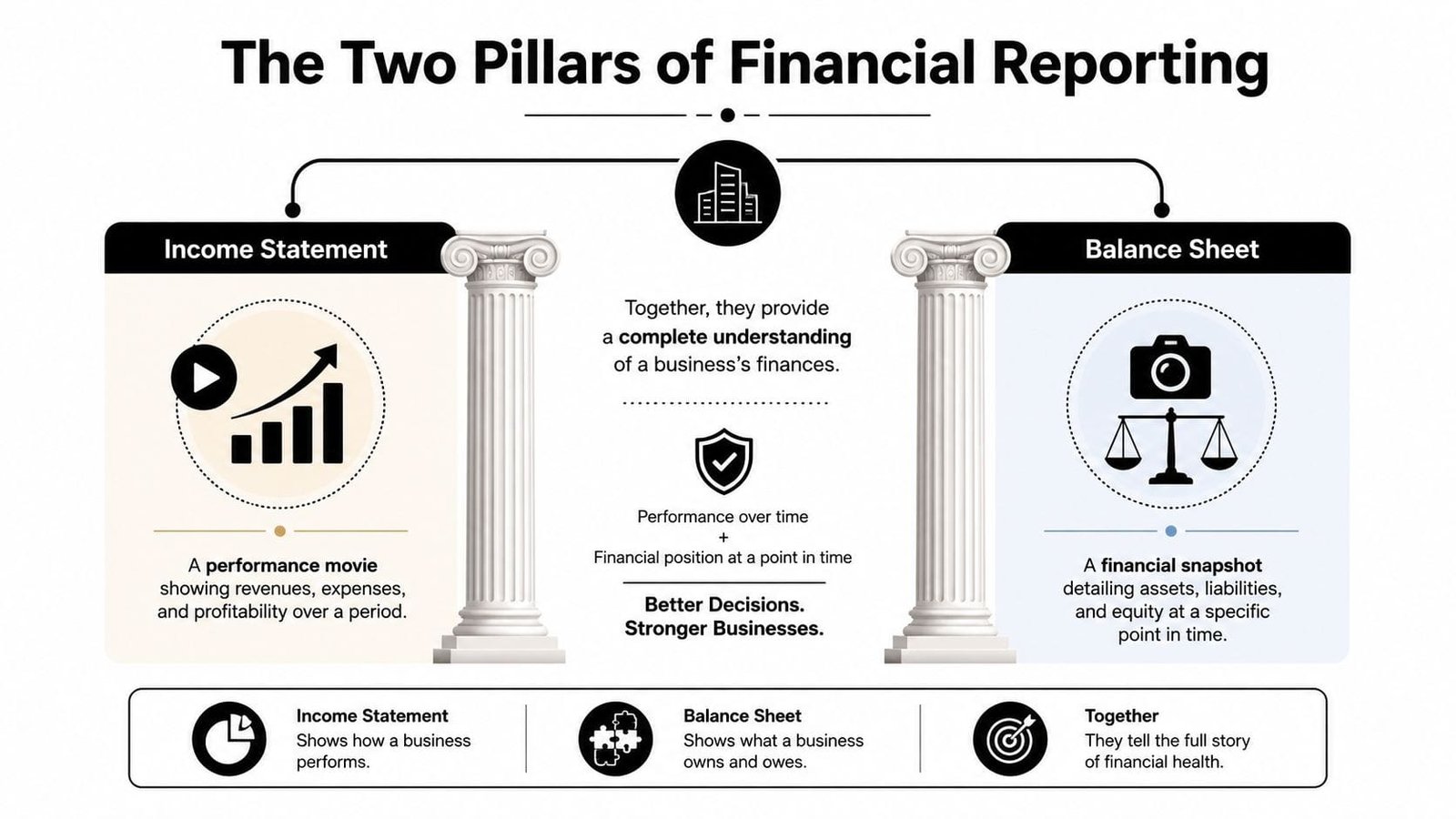
That difference matters in a loan file. A bank wants to know whether the company can produce earnings and whether it has enough cushion to handle repayment stress, supplier pressure, or a slow collections cycle. Period results answer one question. Snapshot position answers another.
Income Statement as the performance movie
The income statement reads like a running scorecard. Revenue comes in, expenses go out, and net income is what remains after the period's costs are accounted for. For an underwriter, that tells you whether the business model is producing earnings in a way that can support debt service.
A strong income statement helps, but it does not settle the lending question by itself. A company can post healthy sales and still have a tight cash position, weak reserves, or heavy obligations sitting outside the current profit period.
Balance Sheet as the financial snapshot
The balance sheet shows assets, liabilities, and equity on one date, and the accounting equation keeps the statement in balance because assets equal liabilities plus equity. That structure matters to lenders because it shows net worth, debt load, and how much protection exists if the business runs into trouble.
A balance sheet can look acceptable while earnings are under pressure, and the reverse can happen too. That is why underwriters read for the gap between performance and position, then ask which one is masking the underlying risk.
Owners who want cleaner lender-facing reports often use software that presents both statements side by side and reduces manual cleanup before a review. If you are comparing options, Landscapey's financial reporting tool recommendations is a practical place to see how teams turn bookkeeping output into statements that are easier to present to a lender.
A Line-by-Line Comparison of Each Statement
A lender does not need polish. They need a clean comparison that shows how the business performs and what shape it is in today. The table below breaks down how the two reports differ in purpose, timing, and structure, and why each one answers a different question in a loan file.
| Attribute | Income Statement | Balance Sheet |
|---|---|---|
| Purpose | Measures performance and profitability over a period | Measures financial position at a point in time |
| Timing | Covers a quarter, month, or year | Captures the last day of the accounting period |
| Core question | How did the business perform? | What does the business own and owe right now? |
| Main sections | Revenue, expenses, net income | Assets, liabilities, equity |
| Governing logic | Revenue minus expenses equals net income | Assets equal liabilities plus equity |
| Lender use | Shows earnings power | Shows liquidity, debt levels, and collateral capacity |
The connection between them emerges after the table. Net income from the income statement does not disappear. It flows into the balance sheet through retained earnings, which is one reason underwriters read both reports together. That link between profitability and owner equity is part of the basic structure of financial reporting, and it is the reason a profit figure can affect the balance sheet long after the month ends.
How the line items talk to each other
Revenue and expenses live on the income statement because they describe activity over time. Assets and liabilities live on the balance sheet because they describe position at a date. A sale booked today may improve revenue, but if the customer has not paid yet, cash may not move.
That gap matters in lending. A café can show a healthy monthly profit and still have weak working capital. Inventory may sit on the shelf, suppliers still need payment, and the cash account may look tighter than the P&L suggests. The lender is not asking for both reports to make life harder. They are checking whether earnings are turning into usable cash and whether obligations are piling up faster than the business can absorb them.
Modern reporting tools can make that relationship easier to read by putting the P&L and cash flow signals in one place. For a practical example of how operators use those views, see HiveHQ's P&L dashboard insights.
A simple end-of-month example
A small café might close the month with decent revenue on the income statement. At the same time, the balance sheet could show more payables, more inventory, or a heavier debt load than last month. If those items are growing faster than cash, the business is not as steady as the profit number suggests.
Underwriter's lens: income shows earning power, balance sheet shows staying power.
That is the practical reading order. First check whether the business makes money. Then check whether the business can hold its ground when collections slow, costs rise, or a lender wants proof of repayment capacity. For owners who want to test whether their books are presenting that story clearly, this financial health assessment resource gives a useful framework for reviewing the numbers before a bank does.
What Each Statement Reveals About Your Business Health
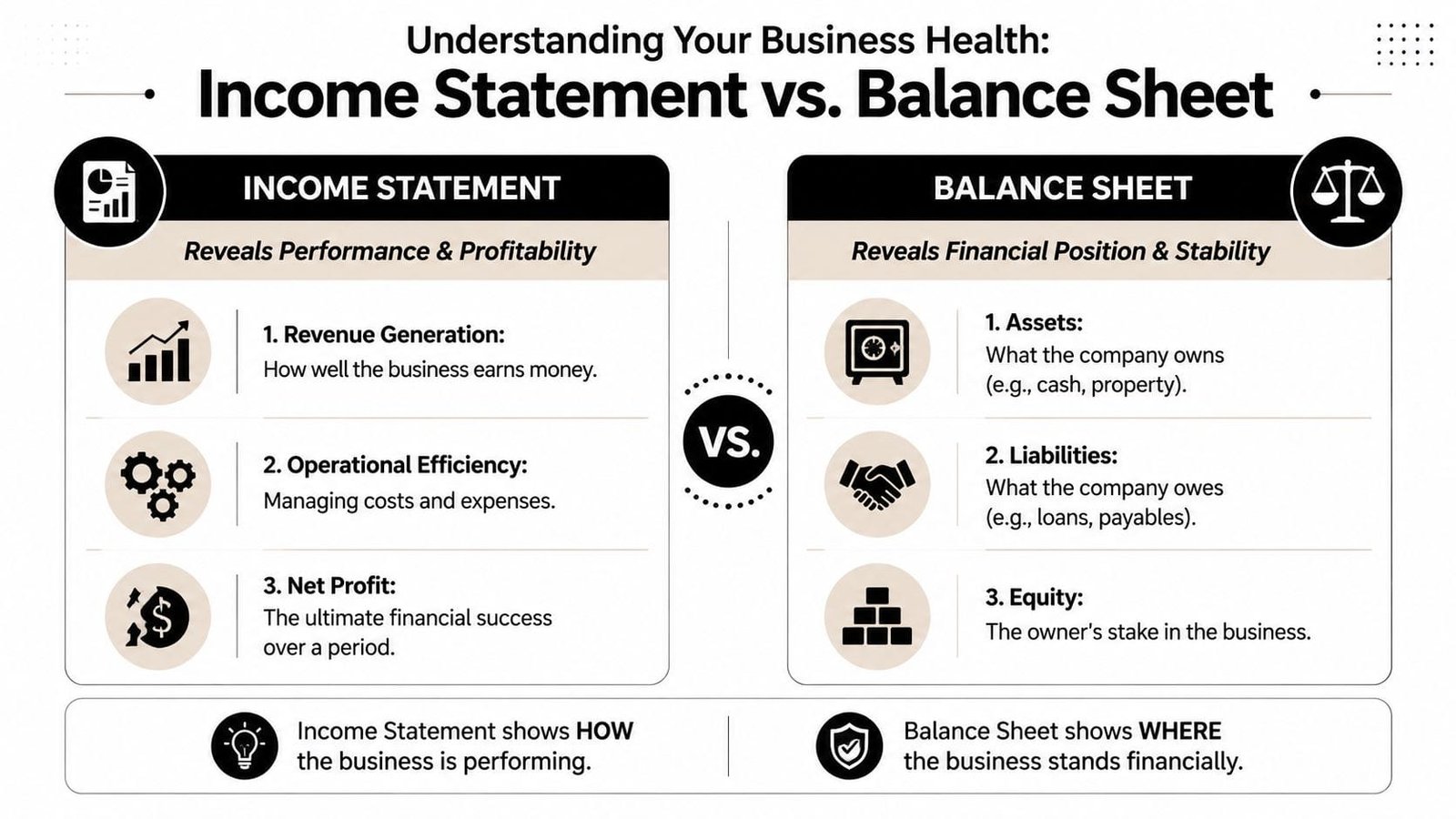
The income statement tells you whether the business model is producing profit efficiently. The balance sheet tells you whether the business is standing on solid ground. A lender cares about both, but for different reasons.
What the income statement says about performance
On the income statement, the key question is efficiency. Are revenues turning into profit, or are costs eating up too much of each sale? A lender won't just glance at the bottom line. They'll look for whether the business is earning consistently, whether expenses are controlled, and whether the operation has room to absorb loan payments.
Margins matter because they reveal how much cushion exists after direct costs and overhead. Strong revenue with sloppy spending can look exciting for a moment, but it doesn't impress an underwriter for long. The report has to show that the business can create earnings without relying on a lucky month or a one-time spike.
What the balance sheet says about stability
The balance sheet speaks to resilience. Liquidity tells a lender whether the business can handle short-term bills. Solvency tells them whether the company can sustain its obligations over time. Assets, liabilities, and equity together show how much room there is before the business gets squeezed.
That's why a strong balance sheet often carries more weight in credit conversations. A company with adequate assets and manageable debt can handle a rough patch better than a business with thin reserves and excessive debt. The lender wants to know whether the business can keep paying even if sales slow or collections lag.
Why the two views have to be read together
A business can look efficient on the income statement and still be brittle on the balance sheet. It can also look asset-rich and still be unprofitable. Neither view is complete on its own.
The most useful habit is to ask two questions at once. Is the operation profitable, and is the capital structure stable? If either answer is shaky, a lender will dig deeper before extending credit.
How Lenders Read Your Financials for Loan Approval
A loan file can look strong to an owner and still raise concerns for an underwriter. Owners usually ask whether the business feels healthy. Underwriters start with risk, then test whether the numbers support repayment.

Why the balance sheet usually gets the harder look
For credit risk, lenders often care more about the balance sheet than the income statement because it shows liquidity, debt structure, and collateral capacity. Profit alone can hide a cash squeeze. That matters most for asset-heavy businesses or companies short on working capital, where the lender needs to know what supports the loan if operating results weaken, as noted in this SEC guidance on financial statement use.
The income statement still matters. A business may show solid earnings and still fail underwriting if debt is already stretched, cash is too thin, or the assets do not support the request. If you want a clear way to verify that figure, this guide on how to find net income explains the line item lenders expect to see.
What a lender is really testing
A lender is asking whether the business can repay without drama. Earnings matter, but the balance sheet has to show enough room to absorb surprises and keep the company from getting squeezed by short-term obligations. If the numbers do not line up, the underwriter usually shifts from approval mode to question mode.
The workflow has also changed. Many fintech lenders now pair traditional statements with bank-transaction data and automated cash-flow review, so a monthly packet by itself does not tell the whole story. The lender is trying to see actual money movement, not just accounting output.
What helps a file move forward
Clean statements help. So does a balance sheet that is not loaded with short-term debt or stale receivables. If the business is asset-light, the lender may lean more on recurring cash movement and the consistency of the income statement. If the business is asset-heavy, the collateral story carries more weight.
Practical rule: strong profit helps you qualify, strong balance sheet helps you survive underwriting.
The best loan files make those two views agree. The income statement shows the engine. The balance sheet shows the fuel tank, the wear on the chassis, and the room left to keep driving.
Common Pitfalls and Accounting Blind Spots to Avoid
The biggest mistake owners make is assuming the income statement tells the whole truth. It doesn't. Accounting rules can make the same business look stronger on one report and weaker on the other, especially when revenue recognition, inventory timing, leases, or accrual-based expenses are involved, as explained in this balance sheet versus income statement guide.
Where the books start to mislead
Delayed receivables can make profit look real while cash stays trapped. Inventory can rise before sales catch up, which weakens the balance sheet even if margins still look acceptable. Lease liabilities and debt maturities can also create hidden pressure that owners miss when they only scan the bottom line.
Many small businesses often get burned before a loan review. They compare month-over-month profit and think the story is improving, but they haven't reconciled working capital, debt timing, or unpaid obligations. A lender will notice that gap quickly.
What to clean up before a lender sees it
Don't leave long-term debt misclassified. Don't let inventory values drift without review. Don't assume an accounting profit means the bank account is healthy. And don't send statements that don't match the ledger or the bank feed.
The safest approach is simple. Reconcile the books, explain unusual jumps, and make sure the balance sheet reflects actual obligations. If a category looks confusing to you, it'll look worse to an underwriter.
Your Loan-Ready Checklist and Final Questions
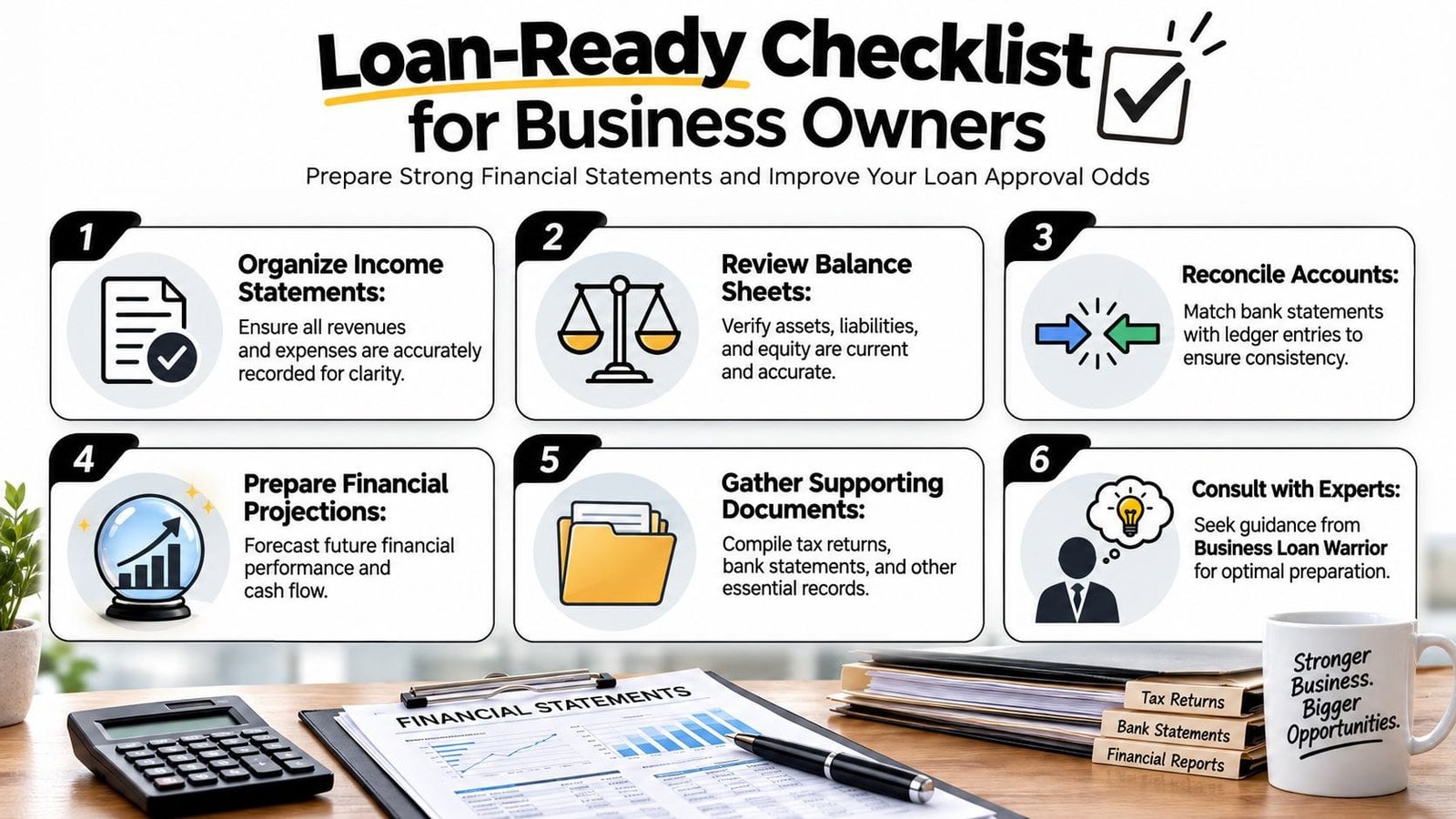
Before a loan application goes out, make sure the income statement and balance sheet are current, consistent, and easy to explain. Reconcile them to bank activity, check for stale liabilities, and be ready to clarify any swings in receivables, inventory, or debt. If the numbers tell a clean story, the lender spends less time doubting the file and more time evaluating the deal.
A few questions come up constantly:
What's the third statement lenders care about? The cash flow statement. It helps bridge profit and cash, which is why it often explains what the other two reports can't.
How much history do lenders want? It depends on the loan and the lender, but they usually want enough history to see a pattern, not a one-month snapshot.
Are self-prepared statements enough? Sometimes, yes, especially for simpler files. But if the numbers are messy, a CPA review can make the file easier to underwrite.
Business Loan Warrior helps small businesses present a cleaner funding story, from statement review to loan matching. If you're getting ready to borrow and want a lender-friendly view of your numbers, visit Business Loan Warrior and start the application with a clearer financial picture.