

A commercial subcontractor can finish the work, submit a clean pay application, and still face a serious cash shortage. Payroll arrives every week, material suppliers expect payment, and equipment costs continue while the general contractor's payment cycle may run 50 to 75 days, with construction days-sales-outstanding often reaching 60 to 90 or more days. Some public projects use net-120 terms. Construction factoring guidance exists for that exact timing mismatch.
Factoring can turn an approved receivable into usable cash in roughly 24 to 48 hours, but construction factoring isn't generic invoice factoring. Retainage, progress billing, lien waivers, change orders, pay-when-paid clauses, and reserve releases determine how much cash reaches your bank account. The headline advance rate matters less than the amount you can use after retainage and fees.
Table of Contents
- What Factoring Means for a Construction Company
- How Pay Applications and Retainage Change the Math
- Who Qualifies and What Underwriters Look For
- Typical Fees, Contract Length, and the Real Cost
- Factoring vs Lines of Credit, SBA, and Other Options
- A Worked Cash-Flow Example for a Subcontractor
- Risks, Trade-Offs, and When Factoring Is the Wrong Call
What Factoring Means for a Construction Company
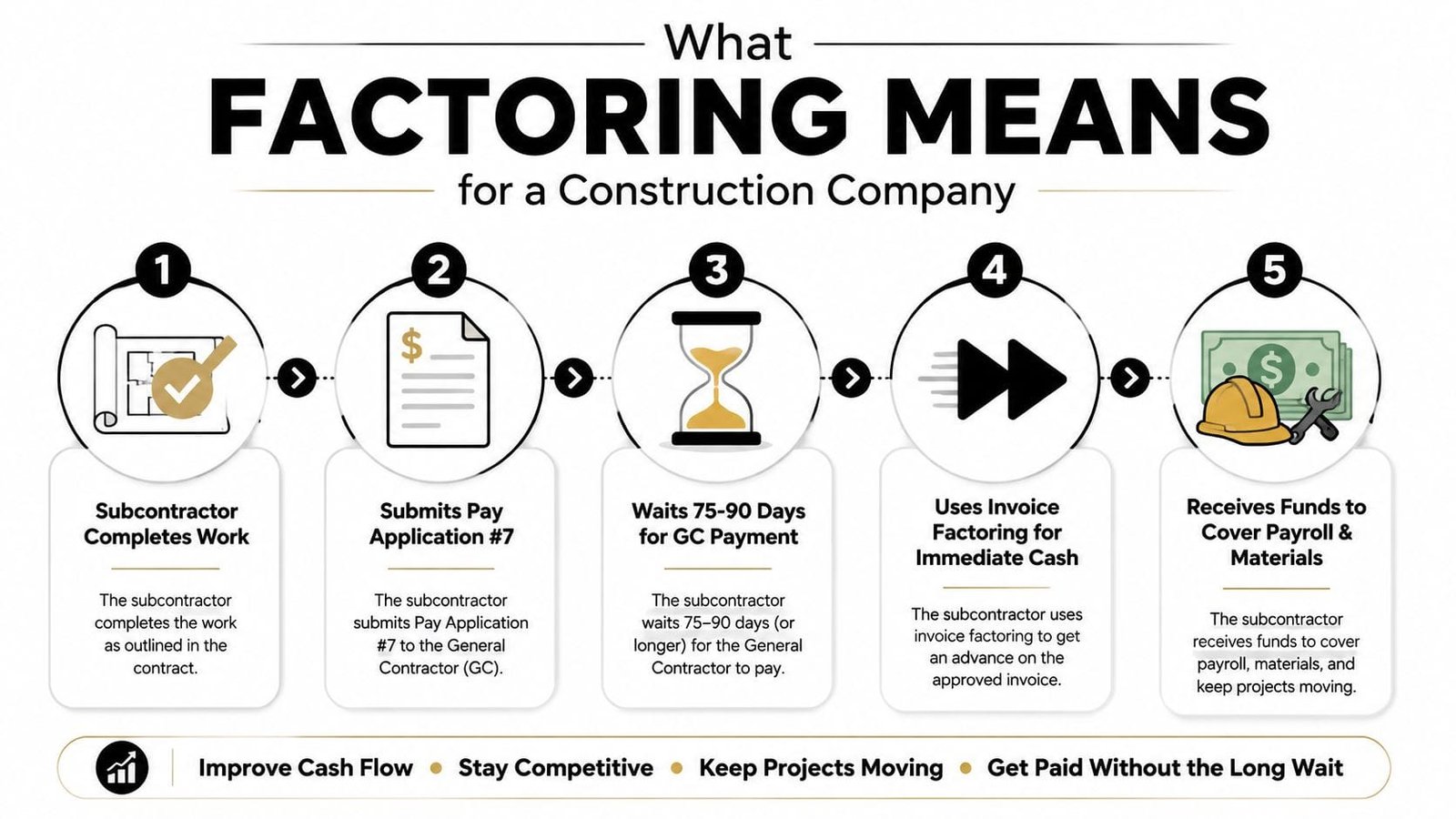
A drywall subcontractor finishes a $180,000 commercial scope and submits pay application number seven. The general contractor says payment runs on a 75 to 90 day cycle, while payroll, lumber draws, fuel, and supplier invoices keep arriving every two weeks. The subcontractor may have earned the revenue, but earned revenue doesn't pay the crew until the receivable converts to cash.
Construction factoring changes who funds that waiting period. The contractor sells an eligible account receivable to a factoring company, called the factor. The factor advances a portion of the invoice, commonly 70% to 90%, and collects payment from the general contractor. After the customer pays, the factor releases the remaining reserve after deducting its fee.
You aren't taking a conventional loan against a building, truck, or piece of equipment. You're selling an invoice at a discount, which means the transaction transfers ownership and collection responsibility under the agreement. That distinction matters for accounting, borrowing capacity, and the remedies available if the invoice isn't paid.
The basic transaction
- Complete and document the work. The pay application or invoice must relate to completed, verifiable work. Supporting schedules, approvals, lien waivers, and change-order records help the factor confirm that the receivable is collectible.
- Submit the receivable. The factor reviews the contract, billing documents, customer, payment terms, and any existing liens or assignments.
- Receive the advance. The factor deposits the agreed advance, usually after excluding amounts that aren't currently payable, especially retainage.
- Customer pays. In a notification structure, the general contractor pays the factor directly. In a non-notification structure, the contractor may receive payment and forward it according to the agreement.
- Reserve gets released. The factor deducts the fee and sends the remaining eligible balance to the contractor.
The plain-language explanation of invoice factoring is useful if you want the general mechanics before reviewing construction-specific terms.
Terms that change your risk
Recourse factoring leaves you responsible if the customer fails to pay for reasons covered by the agreement, such as a dispute, invalid documentation, or prolonged nonpayment. It usually costs less because you retain more collection risk. Non-recourse factoring shifts certain customer-credit risks to the factor, but it generally costs more and rarely protects you from disputed or fraudulent invoices.
Spot factoring lets you sell selected invoices when a project creates a temporary cash gap. A whole-turnover agreement may require you to route all eligible receivables through the factor, which can produce more consistent funding but less flexibility. Notification factoring is usually easier for a factor to control, while non-notification factoring may preserve the customer-facing experience but can carry tighter controls.
Advisor's rule: Don't compare factors by advance rate alone. Ask how they calculate the eligible invoice base, what happens to retainage, when the reserve is released, and who carries the risk of a disputed pay application.
How Pay Applications and Retainage Change the Math
The invoice face value is often not the amount a contractor can factor. Construction contracts commonly withhold 5% to 10% retainage, and that withheld portion may not be payable until project completion or closeout. Construction factoring cost guidance explains why factors typically calculate the advance against the net invoice rather than the full billing.
Consider a $100,000 monthly pay application with 10% retainage. The immediately payable base is $90,000, not $100,000. At an 85% advance against that net amount, the initial gross advance is $76,500. If the fee is 3% of the eligible $90,000, or $2,700, usable cash after that fee is $73,800. The reserve remains until the general contractor pays the eligible invoice.
That example shows why retainage is a bottleneck. A contractor may see an advertised 85% advance, but the practical advance against the original billing is lower because the factor excludes the withheld portion before applying its percentage.
Retainage and Advance Math on a $100,000 Pay Application
| Line Item | Amount | Running Total |
|---|---|---|
| Gross pay application | $100,000 | $100,000 |
| Retainage withheld at 10% | ($10,000) | $90,000 eligible |
| Net eligible invoice | $90,000 | $90,000 |
| Gross advance at 85% | $76,500 | $76,500 funded |
| Factoring fee at 3% of eligible invoice | ($2,700) | $73,800 usable |
| Reserve before customer payment | $13,500 | $13,500 held |
| Retainage excluded from advance | $10,000 | $23,500 not immediately funded |
The table assumes the factor charges the fee against the eligible invoice and doesn't include any separate wire, audit, minimum-volume, or termination charges. Your contract may calculate fees differently, so request a settlement statement before signing.
Pay-application timing still matters
Progress billing creates a sequence of smaller receivables rather than one final invoice. A factor may fund each approved draw, but it can hold back disputed change orders, unapproved work, backcharges, missing lien waivers, and retainage. If a contract releases part of retainage at a project milestone and the remainder after punch-list completion, the factor may release money in stages rather than all at once.
Review the subcontract for language that permits retainage to be bonded, reduced, or purchased out. Those provisions can materially improve the usable advance. If retainage remains trapped until closeout, plan payroll and material purchases around the payable portion, not the total contract value. A construction loan draw schedule guide can also help you map funding needs against project milestones.
Who Qualifies and What Underwriters Look For
Factoring is often easier to obtain than a bank loan because the factor is primarily buying a receivable. The customer's ability and willingness to pay can matter more than the contractor's balance sheet, but that doesn't mean underwriting is casual.
A factor will want evidence that the business operates legitimately, the work was completed, the invoice is enforceable, and the customer isn't likely to dispute payment. Construction documentation carries unusual weight because a clean invoice can still be affected by a missing waiver, unresolved change order, or contract clause that shifts collection risk.
The contractor profile
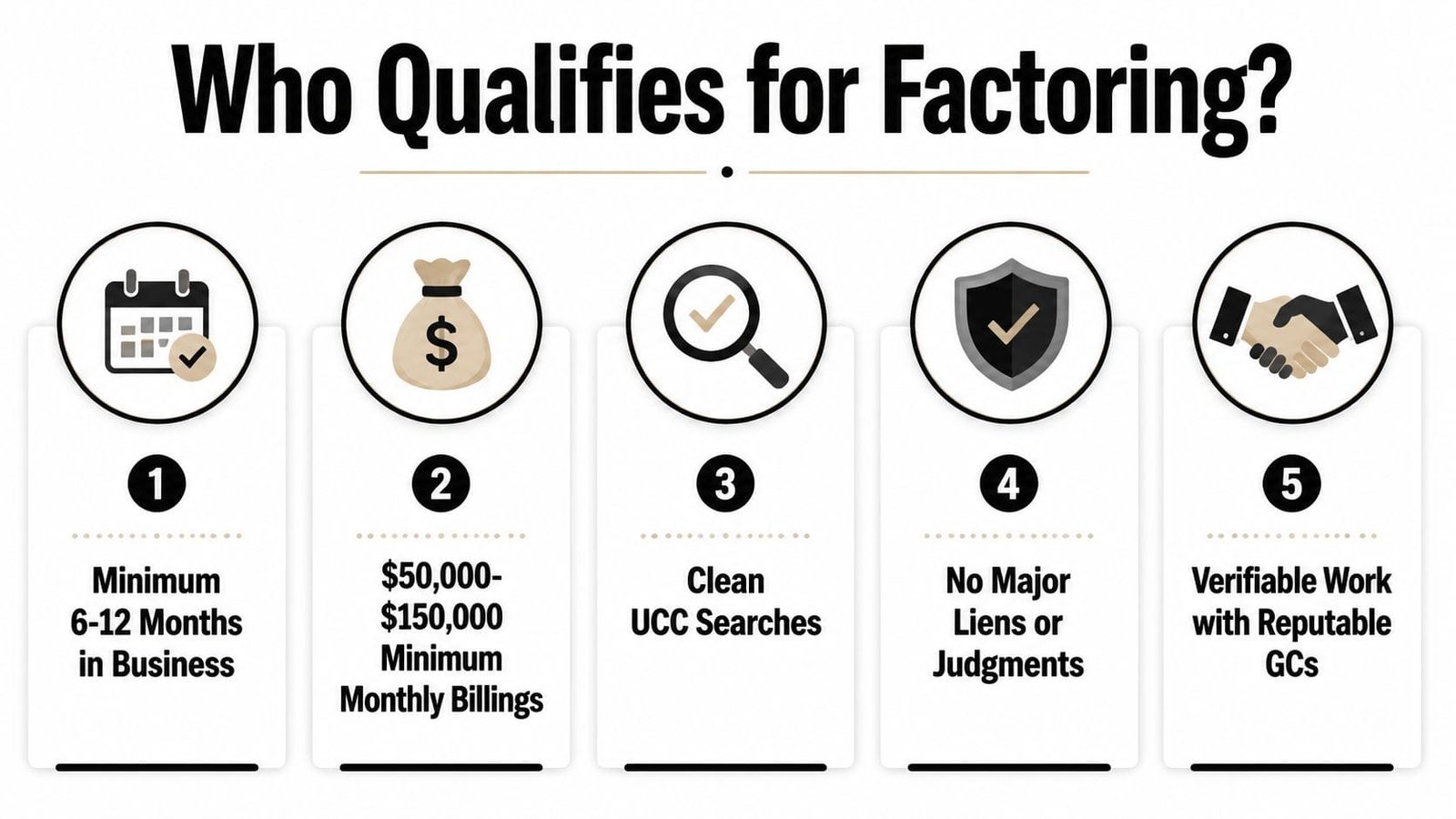
Many construction factoring programs look for a business with roughly 6 to 12 months in operation, monthly billings around $50,000 to $150,000, clean UCC searches, no recent bankruptcy, no serious tax liens, and business credit often above 600. These are common screening points rather than universal rules, so a contractor outside one range may still qualify with strong account debtors and well-documented receivables. Construction factoring qualification guidance describes the range of advance structures and contract considerations factors commonly review.
Expect to provide:
- Executed contracts and subcontracts: The factor needs to see payment terms, assignment restrictions, retainage language, and pay-when-paid provisions.
- Pay applications and invoices: Approved progress billings are stronger than unsupported billing drafts.
- Lien waivers: Conditional and unconditional waivers for prior draws help demonstrate clean payment administration.
- WIP schedules: Work-in-progress reports show how billed work relates to remaining obligations.
- A/R aging and bank statements: These reveal customer concentration, overdue balances, and operating cash pressure.
The customer matters more than the score
The factor studies the general contractor, project owner, or government payer because that party ultimately funds the receivable. A newer subcontractor with a strong commercial GC can be more financeable than an established contractor billing a weak or uncooperative customer.
That underwriting logic also creates clear red flags. Concentration with one GC, private residential work, prevailing-wage payroll disputes, open mechanic's liens, and contracts that push collection risk downstream can reduce approval odds. A pay-when-paid clause deserves careful review because it may make the receivable's collection timing dependent on another party's payment.
The strongest application isn't the one with the best-looking revenue number. It's the one that lets an underwriter trace work completed, payment approved, lien rights addressed, and customer payment behavior from contract to bank deposit.
Typical Fees, Contract Length, and the Real Cost
Factoring fees are commonly quoted at 1% to 5% for the first 30 days outstanding. Construction factoring fee guidance provides that range, but the advertised rate isn't the full cost of using capital. Construction agreements may also include reserve rules, minimum billing requirements, wire charges, audit fees, termination charges, and different pricing for recourse and non-recourse transactions.
A factor may quote a discount rate that increases for each additional period the invoice remains unpaid. That means a receivable paid in one month and a receivable paid in three months don't carry the same cost, even if the initial percentage looks identical. Retainage can add another complication because the factor may exclude it from the advance or price any retainage program separately.
Fee components to inspect
| Cost Component | Typical Range | Who Pays |
|---|---|---|
| First 30-day factoring fee | 1% to 5% of the eligible invoice, according to construction factoring fee guidance | Contractor |
| Advance reserve | 10% to 30% of the eligible invoice, depending on the agreed advance | Contractor receives after customer payment |
| Retainage exclusion | 5% to 10% of the invoice is commonly withheld in construction contracts, according to retainage factoring guidance | Contractor waits or arranges separate funding |
| Additional time outstanding | Contract-specific | Contractor |
| Wire, audit, minimum-volume, and termination charges | Contract-specific | Contractor |
The table separates the reserve from the fee. The reserve isn't automatically a cost. It's money held until the customer pays. The fee is the factor's charge for purchasing and servicing the receivable.
How to evaluate a quote
Ask for a written example based on one of your actual pay applications. Have the factor show the gross invoice, excluded retainage, advance, reserve, fee calculation, expected release date, and every extra charge. Then test the same invoice under a longer payment delay.
Construction factoring contracts may run 12 to 24 months, and some require 60 to 90 days' written notice to exit, according to construction factoring contract guidance. Review auto-renewal, minimum monthly volume, personal guarantees, UCC filings, customer notification, and recourse triggers before you accept the facility.
Don't annualize the fee as if the money is outstanding for only the first billing period. Use the actual days from advance to customer payment, then account for the reserve haircut and retainage exclusion. A low first-period rate can become expensive if your GC consistently pays late.
Factoring vs Lines of Credit, SBA, and Other Options
Construction businesses usually evaluate factoring alongside a revolving line of credit, an SBA loan, invoice-backed financing, and a merchant cash advance. The right choice depends on whether your problem is a specific unpaid receivable, a recurring operating gap, a long-term expansion, or an immediate need for unrestricted cash.
Factoring wins when a contractor has eligible invoices and needs funding quickly. A line of credit usually wins on recurring cost once the company qualifies and maintains access. SBA financing fits expansion and durable assets, not a payroll gap that must be solved before the next draw. Merchant cash advances are usually the weakest fit because repayment comes from future sales rather than from a defined construction receivable.
A practical comparison
| Option | Speed | Typical APR | Best For | Main Drawback |
|---|---|---|---|---|
| Construction factoring | Fast after invoice verification | Quoted as a fee on eligible receivables, commonly 1% to 5% for the first 30 days, according to factoring fee guidance | Immediate payroll and material liquidity tied to approved billings | Fees, reserves, customer notification, and retainage limits |
| Business line of credit | Usually slower to establish than factoring | Contract-specific | Repeated cash gaps for an established contractor | Underwriting, borrowing limits, and possible collateral or UCC restrictions |
| SBA financing | Slowest of these choices | Contract-specific | Expansion, equipment, acquisitions, or durable working capital | Documentation, approval time, and repayment obligations |
| Invoice-backed financing | Varies by lender | Contract-specific | Keeping more control over customer collections while borrowing against receivables | It creates debt and may require stronger financials |
| Merchant cash advance | Fast, but repayment can pressure operating cash | Quoted as a factor rate rather than a conventional APR | Businesses with predictable card or account revenue | Fixed repayment pressure, high cost, and poor alignment with progress billing |
If you want a broader explanation of receivables-backed borrowing, review this guide to accounts receivable financing. For operational improvements before borrowing, HomeProBadge contractor payment tips offers practical ways to tighten billing, documentation, and collection routines.
The five-minute decision rule
Choose factoring when approved receivables are sitting unpaid, payroll is recurring, the project pipeline is strong, and waiting for the GC would force you to delay work. Choose a line of credit when you need repeat access and can qualify for a lower ongoing cost. Choose SBA financing when the need is strategic and long-lived. Reject an MCA unless you have carefully modeled repayment against your actual collection cycle and have no better structure available.
A Worked Cash-Flow Example for a Subcontractor
Consider a mechanical subcontractor with roughly $250,000 in monthly billings, 10% retainage, net-60 payment terms, and a 2% per-30-day factoring rate. This is a planning scenario, not a promised outcome. It shows why factoring can keep the operating account alive while also revealing the weeks when reserves and retainage still create pressure.
At an 80% advance against the post-retainage billing base, each $250,000 monthly application produces an eligible base of $225,000. The gross advance is $180,000. If the factor charges 2% for the first 30-day period, the first-period fee on that eligible base is $4,500. The contractor therefore has approximately $175,500 of initial usable cash before any other contract charges.
The 13-week operating picture
| Period | Operating event | Cash-flow effect |
|---|---|---|
| Weeks 1 to 2 | First pay application submitted and verified | Advance supports payroll and material purchases |
| Weeks 3 to 4 | Crews continue work while the next application develops | Cash remains dependent on disciplined spending |
| Weeks 5 to 6 | Second billing cycle is submitted | A new advance can replenish operating liquidity |
| Weeks 7 to 8 | First receivable approaches its contractual payment window | Reserve remains unavailable until customer payment |
| Weeks 9 to 10 | Customer payment may release the first reserve, less fees | Cash improves, but retainage stays outside the advance |
| Weeks 11 to 13 | Third billing cycle and project milestones continue | Funding remains tied to approved, eligible billings |
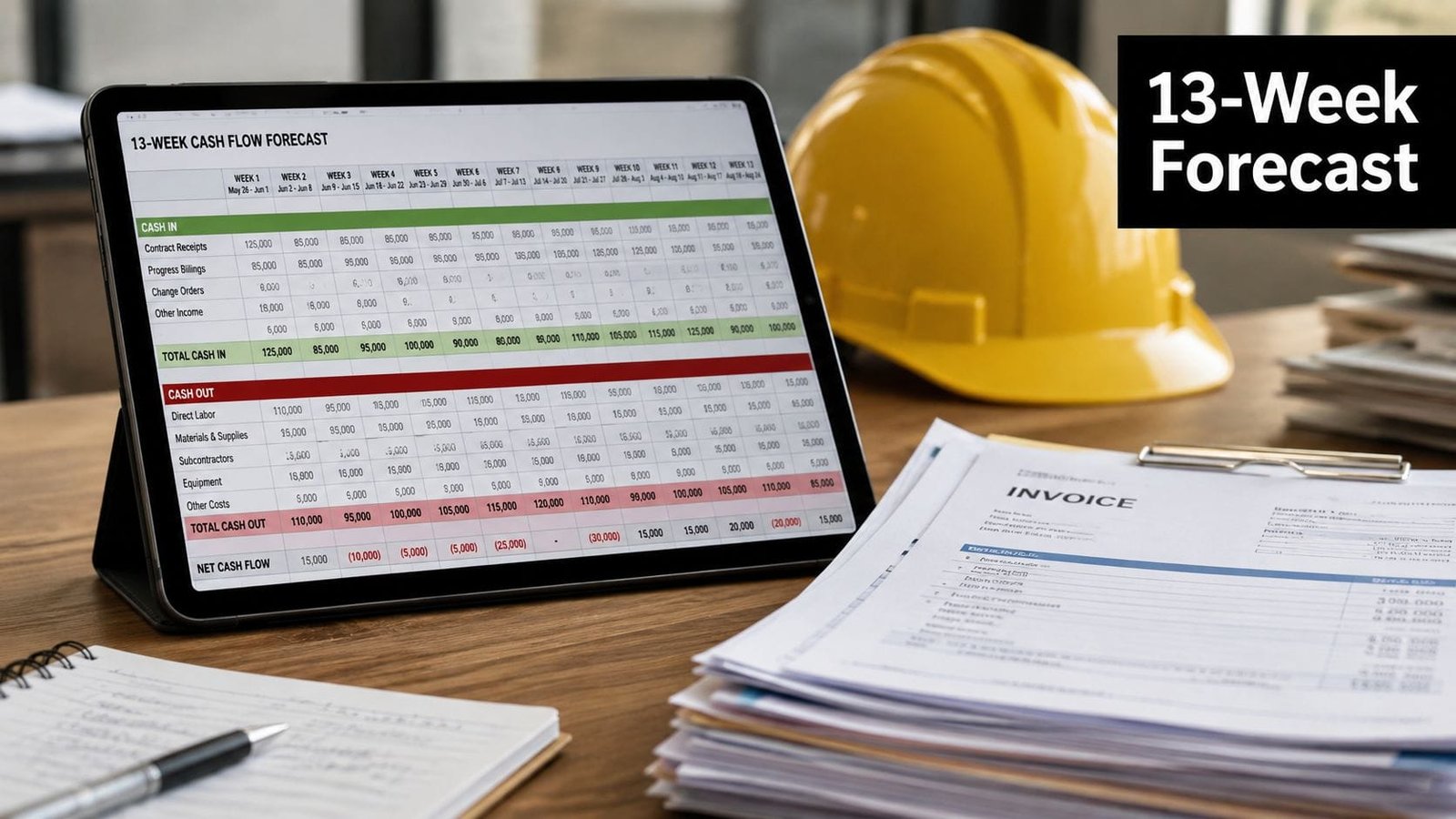
Without factoring, the contractor must fund labor and materials from existing cash until the net-60 customer payment arrives. If the opening cash reserve is thin, the account can move negative before the first receivable clears. Factoring changes the timing by bringing forward the eligible portion, but it doesn't eliminate the need for a cash forecast.
The temporary squeeze usually appears when the contractor submits a billing that is not yet approved, when a change order is disputed, or when the factor holds a reserve while the GC reviews the application. Retainage remains a separate planning issue because the factor generally doesn't advance against money that the contract says isn't currently payable.
The reserve should be treated as unavailable cash, not as a future payroll source. Build the forecast with three balances: operating cash, factor reserve, and unfinanced retainage. That separation prevents a common mistake, spending against money that won't be released until the customer pays or the project reaches closeout.
A separate cash-flow video can help owners visualize how weekly expenses interact with delayed collections.
Risks, Trade-Offs, and When Factoring Is the Wrong Call
Factoring isn't automatically too expensive. The better question is what a payment delay costs your project. A missed payroll can disrupt crews, slow production, damage supplier relationships, and create a dispute that costs more than the factoring fee. At the same time, a contractor who signs an unsuitable agreement can create a different problem, especially if the facility carries long notice requirements or blocks other financing.
Late-payment pressure remains severe. One independent 2025 report found that the average subcontractor waited 96 days to get paid, while another 2025 survey found 70% of contractors said payment delays threaten the industry and 82% waited at least 30 days beyond the expected payment date. The construction factoring and retainage analysis links those figures to the continuing working-capital problem. The operational point is simple: a contractor can have profitable work and still lack the cash to perform it.
Where the structure can hurt
A general contractor may refuse to verify an invoice, dispute a backcharge, or delay payment over documentation. Under recourse terms, that can leave the subcontractor responsible for buying back the receivable or replacing it with another eligible invoice.
A master factoring agreement can also become expensive when monthly billing drops. Minimum-volume obligations, automatic renewal, termination provisions, and personal guarantees deserve the same scrutiny as the headline fee. A UCC filing may further complicate a later SBA or bank facility if it covers receivables or other business assets.
Factoring is usually the wrong call when:
- Margins are comfortably high: You may be able to absorb the wait without selling receivables.
- The backlog is short: Paying ongoing factoring charges makes little sense if eligible invoices will soon disappear.
- Customers pay promptly: A reliable collection cycle reduces the value of immediate funding.
- Cheaper committed capital exists: An established line can be a better recurring tool when its terms fit your cash cycle.
- Receivables are disputed: Factoring won't repair weak documentation or unresolved project claims.
| Contractor Situation | Best Move | Why |
|---|---|---|
| Approved commercial receivables are delayed and payroll is weekly | Factoring | It matches funding to collectible invoices |
| Recurring gaps exist across a stable customer base | Line of credit | Revolving access may cost less over repeated use |
| Expansion requires durable capital | SBA loan or term financing | Long-term funding better matches long-lived investments |
| Retainage is the main shortage | Retainage planning or specialized financing | Standard factoring may leave the trapped portion untouched |
| Repayment depends on unpredictable project collections | Avoid an MCA | Fixed withdrawals can worsen the timing mismatch |
Choose factoring when receivables are 60 or more days out, weekly payroll is essential, and the pipeline supports continued billing, as outlined in the construction factoring and retainage analysis. Before signing, obtain a settlement example, confirm the UCC scope, ask how disputed invoices are handled, and model retainage separately from ordinary reserves.
Business Loan Warrior helps contractors compare invoice financing, construction loans, lines of credit, SBA funding, and other working-capital options against the actual timing of their receivables. Visit Business Loan Warrior to review funding paths and connect your project cash-flow needs with a financing structure that fits.