
Getting a short term construction loan approved isn't the hard part. The difficult work starts after closing, when every draw, inspection, lien waiver, contractor invoice, and completion date has to align with the lender's conditions. A project can have sound economics and still run into trouble if cash arrives late or the refinance exit isn't ready when the construction facility matures.
Short term construction loans fund the active creation or rehabilitation of real estate, not a finished asset. They're useful for ground-up development, major renovations, retail build-outs, and other projects where permanent financing can't be placed until work is complete. Treat the facility as an operating system for the build, not as a lump of cash, and you'll make better decisions about borrowing, reserves, inspections, and rollover risk.
Table of Contents
- The Reality of Short Term Construction Loans
- How Phased Draws and Interest Reserves Work
- Qualifying for Construction Financing
- Comparing Short-Term, Long-Term, and SBA Options
- Real-World Use Cases and Hidden Rollover Risks
- Budgeting the True Cost of Your Build
- Next Steps and Frequently Asked Questions
The Reality of Short Term Construction Loans
Approval is only the starting line
A conventional mortgage is generally secured by a completed property with an established value and operating history. Construction debt supports a plan for producing that collateral. Until the work is finished, the lender is exposed to incomplete improvements, changing costs, contractor performance, permitting problems, and market conditions that may shift before the exit loan is available.
That explains why construction credit reacts sharply to economic stress. In FDIC research on acquisition, development, and construction loans, the noncurrent rate rose from 0.8% at year-end 2006 to 16.8% by March 31, 2010, after the financial crisis. The research also found that the ADC noncurrent rate peaked at 16.8% from 2008 through 2013, while other commercial real estate categories generally remained below 5% at their peaks. Federal Reserve data on construction and land development lending provides the historical context for why lenders scrutinize timing and completion so closely.
The underlying reason is straightforward. Construction loans are usually repaid from a sale, a completed-property refinance, or stabilized operating cash flow. If construction slips, the borrower may reach maturity before the property can support that repayment.
Practical rule: Underwrite the exit before you celebrate the approval.
A large market with short-duration risk
Construction and land development lending remains a major U.S. credit category. The Federal Reserve's weekly series showed a balance of about $457.7 billion in August 2026, while the comparable domestically chartered bank series reached about $458.5 billion in early September 2026. Those figures come from the Federal Reserve construction and land development loan series, and they reinforce an important point: this isn't a niche product used only by small builders.
Size doesn't make the product forgiving. A multi-hundred-billion-dollar market can still be highly selective at the individual deal level. Lenders want a credible budget, a capable sponsor, a contractor who can deliver, and enough liquidity to absorb a delay without asking the lender to rescue the project.
The borrower's real job is coordination. The construction budget, draw schedule, inspection calendar, contractor payment process, and permanent financing plan must function together. If one component falls behind, the borrower may need to fund payroll or materials from equity while waiting for the next draw, then pay an extension fee if the work can't finish before maturity.
How Phased Draws and Interest Reserves Work
A construction facility generally doesn't release the entire commitment at closing. The lender advances money as work is completed and verified, which protects both sides. The borrower avoids paying interest on funds that aren't yet needed, while the lender can compare actual progress with the approved budget before increasing exposure.
How money moves through the project
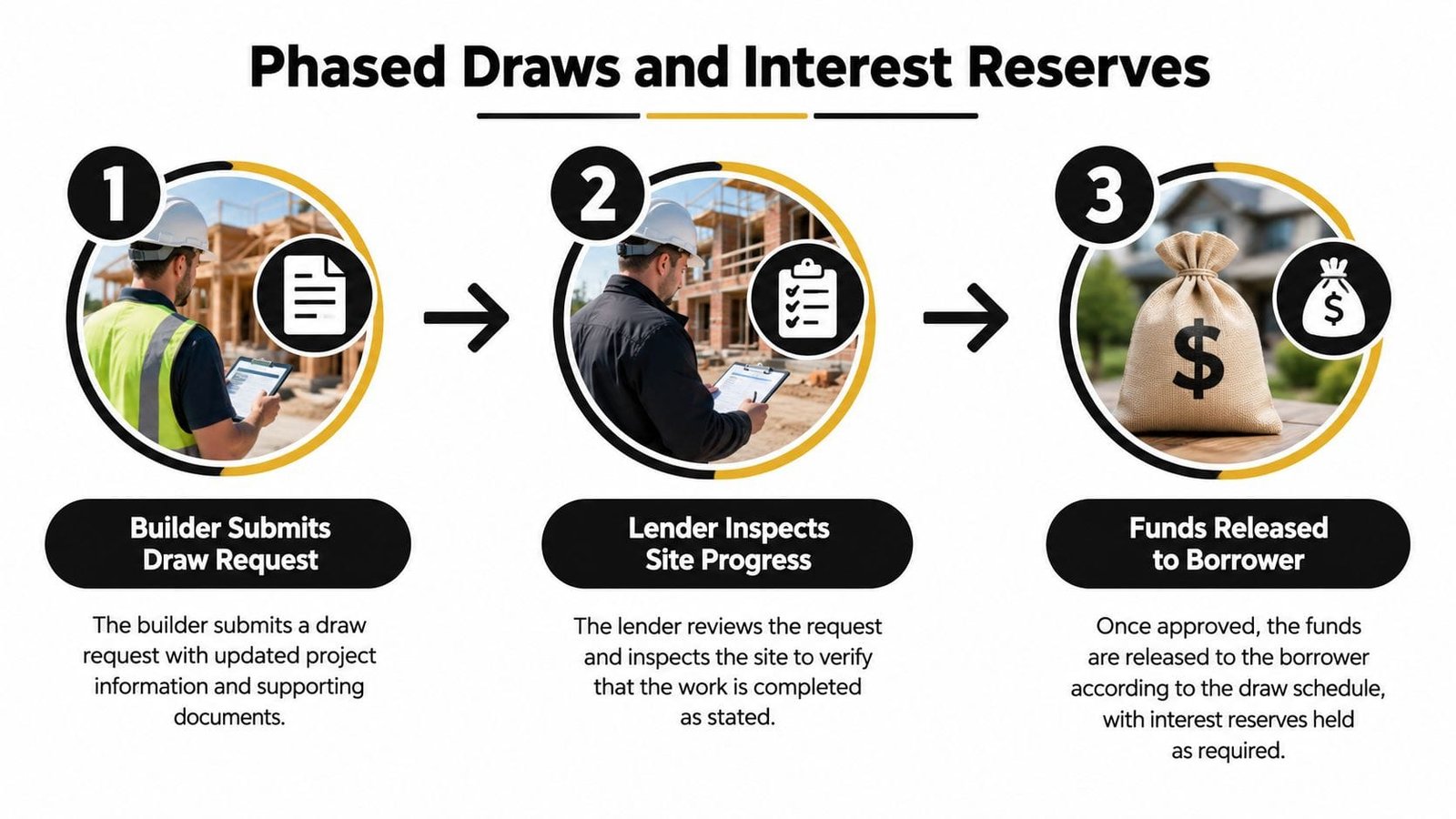
A typical draw process follows these steps:
- The borrower submits a request. The package may include invoices, a current budget, contractor payment applications, updated cost-to-complete information, and lien waivers covering prior work.
- The lender verifies progress. A lender or third-party inspector checks whether the claimed work exists and whether the project remains consistent with the plans and schedule.
- The lender releases approved funds. The advance is applied to eligible costs, subject to the loan agreement, retainage rules, and any unresolved exceptions.
Common milestones include land or site work, foundations, framing, mechanical rough-ins, finishes, and final inspection. The exact sequence varies by project, but the principle stays the same: the draw schedule is a cash-flow timetable, not merely an administrative attachment to the loan.
For a more detailed operational reference, review this guide to construction loan draw schedules. It can help you map lender inspections to contractor billing and identify where documentation may create a bottleneck.
Interest reserves are useful, but not free
Many facilities include an interest reserve at closing. Interest accrues on the amount drawn, and the reserve covers scheduled interest payments during construction. Because the outstanding balance rises as the lender funds more work, the carrying cost typically changes over the build rather than remaining fixed from day one.
An interest reserve protects construction cash flow, but it also consumes project proceeds. If the build takes longer than expected, the reserve may be depleted before completion, leaving the borrower responsible for payments or requiring a budget revision. A reserve should therefore be tested against the actual draw curve, not treated as a generic allowance.
The borrower should also confirm how quickly inspections are scheduled, which documents are mandatory, who pays inspection costs, and what happens when a subcontractor's lien waiver is missing. A technically complete building can still face a funding delay if the draw package doesn't satisfy the lender's process.
LTC determines how much equity is exposed
Lenders commonly size construction facilities to the lower of loan-to-cost and loan-to-stabilized-value constraints. Senior institutional lenders in major markets often cap LTC around 50% to 60% of total project cost, while bank construction lending is often cited in the 60% to 70% range. These ranges are discussed in institutional construction loan data-room requirements.
A tighter LTC cap means the borrower must fund more of the land, hard costs, soft costs, and contingency from equity. It also means a cost overrun can have a larger effect on the capital stack. If the approved loan amount can't increase, the sponsor must contribute additional capital or reduce scope.
Qualifying for Construction Financing
Construction underwriting evaluates two things at once: the sponsor's ability to repay and the project's ability to become a financeable asset. A strong balance sheet won't cure an unrealistic budget, and an attractive project won't compensate for a sponsor who can't fund required equity or manage the work.
What the lender wants to understand
The sponsor's experience matters because construction requires decisions under pressure. Lenders look for evidence that the borrower understands budgets, change orders, draw procedures, contracts, and the intended exit. A first-time developer may still qualify, but the lender may expect a stronger general contractor, additional liquidity, or a more conservative structure.
The contractor receives similar scrutiny. The lender may review licensing, insurance, financial capacity, references, contract terms, staffing, and the contractor's history with comparable work. A low bid isn't necessarily a good bid if it leaves no room for realistic labor, materials, permits, or coordination.
The project file should answer practical questions before the first underwriting call:
- Scope: Are architectural plans, specifications, permits, zoning materials, and a construction narrative complete?
- Budget: Does the budget separate land, hard costs, soft costs, financing costs, and contingency?
- Schedule: Does the timeline identify dependencies, inspections, delivery assumptions, and the expected certificate of occupancy?
- Team: Are the sponsor, architect, general contractor, engineers, and major subcontractors identified?
- Exit: Will repayment come from a sale, refinance, stabilized cash flow, or another documented source?
- Liquidity: Can the borrower fund required equity and handle costs that fall outside the approved loan?
The construction loan requirements checklist is useful for organizing this material before approaching lenders.
Leverage and the data room
The LTC constraint is more than a ratio. It determines how much of the project the lender will fund and how much capital the sponsor must keep available. For investors focused on rehabilitation, this explanation of what LTC means for rehab investors offers helpful context on how total cost and borrowing interact.
A lender may also compare the completed property's expected value with the requested debt. If the stabilized value doesn't support the proposed loan, a borrower may need to contribute more equity even when the construction budget itself appears reasonable.
The strongest data room is internally consistent. The plans should match the budget, the budget should match the draw schedule, and the schedule should support the projected exit date. Contradictions create friction and invite conservative assumptions.
Lender's perspective: A contingency line isn't a substitute for a credible estimate. It protects against uncertainty, but it doesn't justify an incomplete plan.
Comparing Short-Term, Long-Term, and SBA Options
The right financing structure depends on what the property will be worth and how it will be used after completion. Short-term debt may be appropriate during active construction, while permanent debt is designed for a finished asset. SBA-backed financing can fit an owner-occupied business, but it brings program rules and an eligibility analysis that commercial lenders may not require.
| Feature | Short-Term Construction | Long-Term Permanent | SBA Construction 504 |
|---|---|---|---|
| Primary purpose | Fund active construction or substantial renovation | Finance a completed, income-producing or owner-used property | Finance eligible owner-occupied real estate and qualifying improvements |
| Funding pattern | Staged draws tied to verified progress | Usually funded after underwriting a completed or stabilized asset | Structured around program eligibility, project costs, and approved use |
| Term profile | Short maturity aligned with the build and exit | Longer maturity with scheduled amortization | Longer-term structure intended for eligible business use |
| Rate considerations | Often reflects construction risk and may be variable | May offer more predictable long-term debt service | Program structure can improve term fit, but fees and requirements apply |
| Main risk | Completion delay, draw friction, and refinance rollover | Valuation, operating performance, and long-term debt service | Eligibility, documentation, owner-occupancy, and timing |
| Best fit | Ground-up projects, heavy renovations, and transitional assets | Completed assets with stable cash flow or a clear permanent use | Businesses occupying qualifying commercial property |
| Key question | Can the project finish and refinance or sell on time? | Can the property support the debt over the long run? | Does the business and property meet program requirements? |
Short-term debt can close more flexibly for a construction project because it focuses on the build and the anticipated exit. That flexibility has a price. The borrower must manage a maturity date, interest carry, inspections, and a repayment event before the project has a long operating history.
Permanent financing can be cheaper to carry over the life of the property, but it usually requires a completed asset and more stable information. Applying for it too early can produce an appraisal or underwriting result that no longer matches the finished project.
SBA 504 financing may suit an established business building or acquiring owner-occupied commercial space. It isn't a universal construction substitute, and borrowers should distinguish it from other SBA products. This comparison of SBA 7(a) versus 504 financing helps clarify the different use cases.
Decision test: Choose the facility that matches the project's next financing event, not the facility with the most attractive headline term.
Prepayment provisions also deserve attention. A short-term loan may allow repayment when the property sells or refinances, but fees, minimum interest, extension charges, or lender-consent requirements can alter the economics. Review those terms before assuming a quick exit is costless.
Real-World Use Cases and Hidden Rollover Risks
A speculative residential development may use a construction facility to fund land improvements, vertical construction, and sales preparation. A retailer may use one for a major build-out where the business needs the space completed before it can generate revenue. An industrial developer may rely on construction debt while building a warehouse that will be sold, leased, or refinanced after delivery.
The common feature is an unfinished asset. The borrower needs the lender's capital to move the project from one milestone to the next, but the lender expects evidence that each advance produced the intended progress.

The rollover problem
Suppose a project is nearly complete, but a permit issue delays the certificate of occupancy. The permanent lender won't close until the certificate is issued, the construction lender's maturity date is approaching, and the borrower still has contractors waiting for final payment. The project may be economically sound, yet the borrower has a timing crisis.
The lender may offer an extension, but an extension isn't automatic. It may require updated financial statements, a revised budget, evidence of remaining equity, a new appraisal, and a credible completion plan. The agreement may also impose extension fees, additional interest, legal costs, or tighter reserves.
Recent market conditions make an assumed refinance particularly dangerous. A 2026 Federal Reserve survey summary described construction-loan demand as moving higher while lending standards had shifted back toward neutral rather than loose. A separate 2026 market report said 37% of construction lenders required zero presales, compared with 29% in 2025 and 18% in 2023. The market report and survey summary are referenced in the Consumer Financial Protection Bureau's construction loan overview. The practical implication is mixed: demand may improve, but lenders can remain cautious about risk.
Small delays can become financing events
Draw delays often begin with ordinary operational issues:
- Inspection timing: The inspector can't visit when the contractor expects.
- Documentation gaps: An invoice, sworn statement, or lien waiver is incomplete.
- Budget variance: Actual costs no longer match the approved line item.
- Change orders: The lender needs approval before funding revised scope.
- Final conditions: The lender requires evidence of completion before releasing retainage or closing the loan.
A borrower should establish a weekly draw meeting with the contractor, lender contact, inspector, and project manager. Track work completed, funds requested, documents outstanding, contingency remaining, and days to maturity. Start extension discussions well before the contractual deadline, not after the project has already missed it.
Budgeting the True Cost of Your Build
The interest rate is only one input in the cost of construction debt. A usable budget includes origination charges, inspections, engineering reviews, legal work, insurance, lender-controlled reserves, and the internal cost of managing repeated draw submissions.
Build the financing model around the draw curve. Interest accrues on the drawn balance, not necessarily the full commitment, so a project that spends slowly may carry less interest early than one that accelerates spending. That benefit disappears if the schedule extends long enough to consume reserves or trigger an extension.
A practical cost framework
Separate the model into four layers:
- Project costs: Land, labor, materials, permits, consultants, and other approved uses.
- Financing costs: Interest, origination fees, inspection charges, legal expenses, and third-party reviews.
- Liquidity protection: Interest reserve, contingency, and cash available for unreimbursed costs.
- Exit costs: Refinance fees, sale costs, repayment charges, and any extension expense.
Do not hide contingency inside an inflated line item. Keep it visible, define who can authorize its use, and identify the point at which the lender must approve a budget transfer. A borrower who uses all contingency early may have no practical answer when a later structural or site issue appears.
The same discipline applies to site and foundation assumptions. A resource such as this garage foundation cost breakdown can help owners identify how seemingly narrow construction components may involve multiple cost categories. It shouldn't replace a project-specific estimate, but it can prompt better questions about excavation, materials, labor, and site conditions.
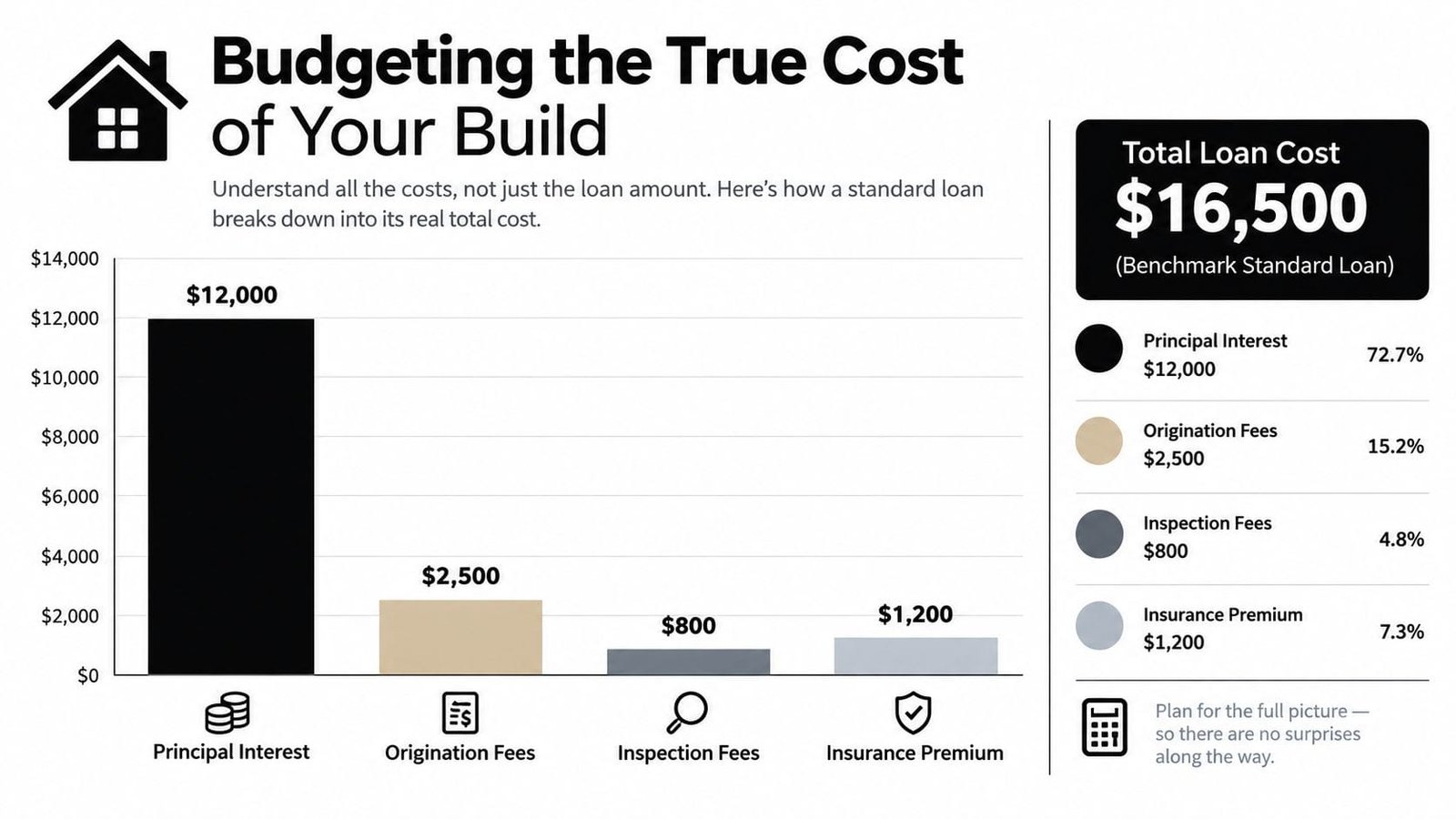
The supplied illustration presents a $16,500 example with $12,000 of principal interest, $2,500 of origination fees, $800 of inspection fees, and $1,200 of insurance premium. Treat those figures as the graphic's example, not as a universal pricing schedule. Your lender's term sheet and project documents control the actual cost.
Next Steps and Frequently Asked Questions
Start with the exit, then work backward. Confirm whether the project will be sold, refinanced, or held for operating income, and identify the conditions that must be satisfied before that repayment event can occur.
A disciplined application sequence
- Assemble the data room. Include plans, specifications, permits, budget, schedule, contractor contract, insurance, environmental materials, title information, borrower financials, and the proposed exit.
- Stress the timeline. Add realistic time for inspections, change orders, final approvals, lease-up or sales activity, and refinance underwriting.
- Match debt to liquidity. Calculate the equity required under the lender's LTC constraint and preserve cash for costs that can't be reimbursed immediately.
- Compare term sheets beyond rate. Review draw mechanics, inspection standards, reserves, maturity, extension provisions, defaults, prepayment terms, and lender approval rights.
- Create a draw calendar. Assign responsibility for each request, supporting document, inspection, approval, and payment date.
A single, organized submission is more persuasive than a stream of partial documents. It also gives the lender a clearer view of whether the project team can manage the facility after closing.
Frequently asked questions
Can the loan fund land acquisition?
It can, depending on the lender, collateral structure, LTC calculation, and whether the land purchase forms part of the approved construction budget. Some lenders may require the borrower to own the land first or contribute land equity, while others may include acquisition and development costs in the facility. Ask how land value is treated before relying on it as required equity.
What happens if the contractor changes during construction?
Notify the lender before signing with a replacement contractor. The lender may require new licensing and insurance records, a revised contract, updated financial information, a budget reconciliation, and confirmation that the new contractor can complete the remaining scope. Changing contractors without lender approval can interrupt draws and create a covenant problem.
What credit profile is required?
There is no universal threshold for institutional construction debt. Lenders assess credit alongside liquidity, repayment capacity, experience, guarantor strength, project economics, and the contractor's qualifications. A strong score won't overcome an underfunded project, while a well-capitalized sponsor with a credible plan may receive a more constructive review than a borrower relying solely on a credit metric.
Before signing, ask the lender to explain exactly what happens if the exit is delayed. The answer should include the notice period, extension process, fees, reserve requirements, and documentation needed to keep the facility in good standing.
Business Loan Warrior offers a single, no-fee application for businesses seeking customized construction and growth financing, with pre-approval checks designed not to affect credit. Visit Business Loan Warrior to organize your financing request and compare funding options before draw timing or rollover risk puts pressure on the project.