
A customer's payment is due later this month, but payroll and an inventory order need cash now. You've already delivered the work and sent the invoice; the gap is timing, not a lack of sales. An invoice finance quote may offer a way to turn eligible unpaid invoices into earlier cash, but the headline rate alone won't tell you what that cash will cost.
To judge the offer, you'll need to understand how much is advanced, what's held in reserve, which fees apply, and what happens if a customer pays late or disputes the bill. The key comparison is cash received against total cost over the time your invoices take to clear.
Table of Contents
- Why an Invoice Finance Quote Is More Than a Rate
- What Drives the Price on an Invoice Finance Quote
- Gather the Documents That Shape Your Quote
- Compare Invoice Finance Quotes by Total Dollars
- Test the Quote When Customers Pay Late
- Choose a Quote and Move Toward Funding
Why an Invoice Finance Quote Is More Than a Rate
A manufacturer has completed an order, sent the invoice, and now has to pay staff and suppliers while waiting for the customer to settle. The owner asks for an invoice finance quote, hoping to bridge that gap without taking on a conventional loan that doesn't cover the full need.
Invoice finance generally advances money against eligible unpaid business invoices. The provider is repaid when customers pay those invoices, and the quote is shaped by the receivables as well as the business. A provider may consider who owes the money, how reliably those customers pay, whether invoices are disputed, and how concentrated the ledger is among a few buyers.

What the quote is actually offering
The offer should spell out the advance rate, the percentage of eligible invoice value made available upfront, and the reserve, the portion held back until the customer pays and the provider deducts fees. It should also identify any service or administration charge, the discount charge or margin on drawn funds, the facility limit, and whether the arrangement is recourse.
That last point matters. With recourse, the business may have to repay the advance if the customer doesn't pay. Non-recourse protection may shift some customer-credit risk to the provider, but it doesn't necessarily cover every dispute, credit note, or other reduction in what the customer owes.
Owners often look at invoice finance when a bank loan or line of credit doesn't meet the immediate cash need. The Federal Reserve reported that 37% of U.S. small employer firms applied for a loan, line of credit, or merchant cash advance during the prior 12 months in 2023. It also reported that the share of applicant firms receiving all the financing they sought fell from 47% in 2017 and 51% in 2019 to 31% in 2021. Those figures describe broader credit conditions, not invoice finance specifically, but they help explain why a business might compare more than one source of working capital (Federal Reserve analysis of small-firm financing).
For a company planning a product launch, working-capital costs can compete with other investments. Teams weighing invoice funding against their software budget may also find it useful to review validation plans for growing SaaS teams as they plan operating expenses. For a broader overview of receivables-based funding, see this guide to accounts receivable financing.
The useful number isn't just the amount offered or a single rate. It's the cash you receive compared with the total cost over the collection period.
What Drives the Price on an Invoice Finance Quote
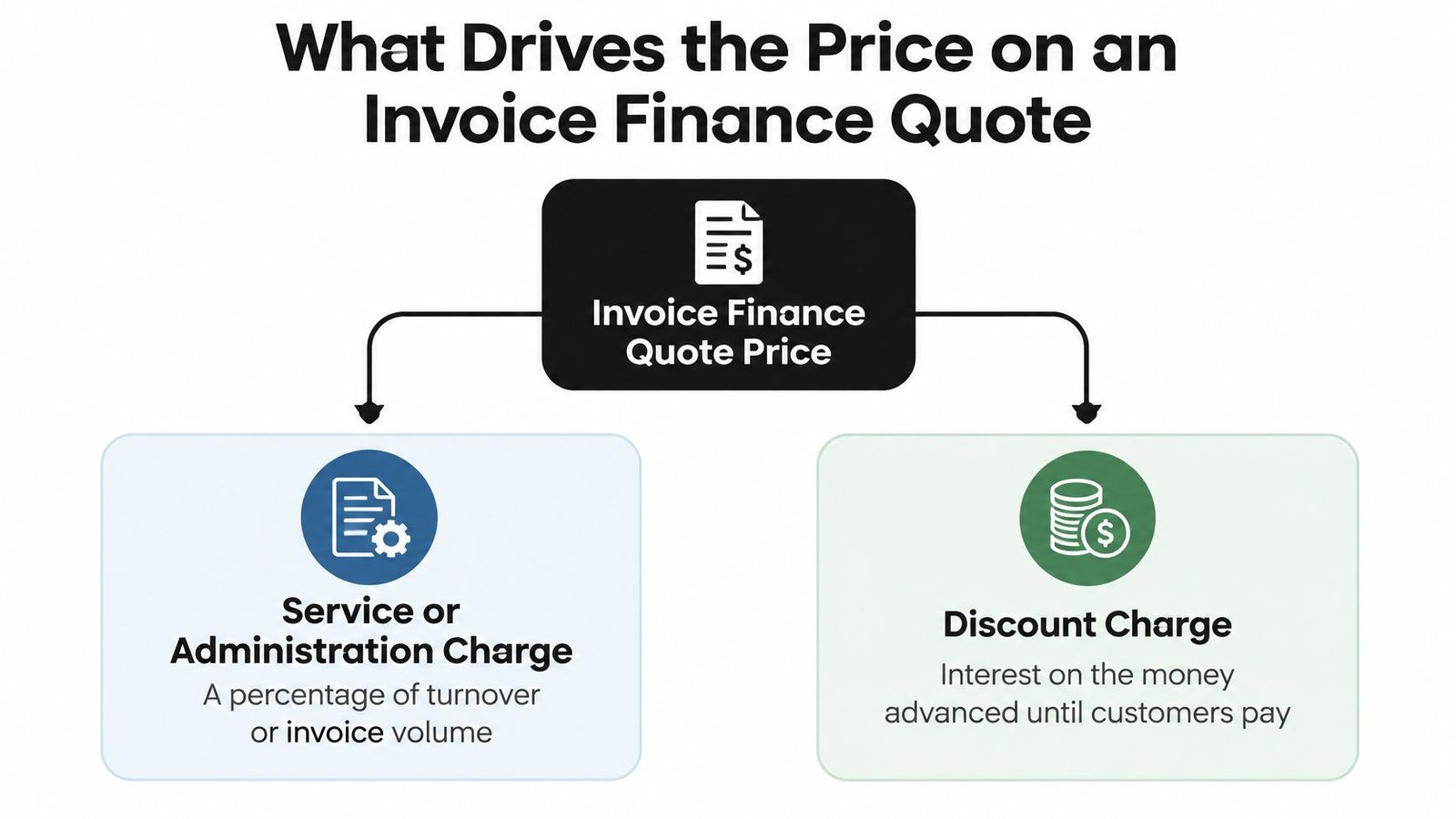
An invoice finance quote often combines charges that apply to different bases. Adding the percentages together can make the offer look simpler than it is, and can mislead you about the effective cost.
A service or administration charge may be calculated against a defined level of turnover or invoice volume. A discount charge, by contrast, is generally a margin over a base rate applied to the funds you draw, for the time you use them. If a quote shows a service fee of 2% of annual turnover and a 3% margin, those figures don't automatically add up to a 5% cost on every invoice. The service fee uses its stated turnover definition; the margin applies to the outstanding advance.
Separate the fee bases
The advance rate and reserve determine how much cash arrives upfront. If an eligible invoice is for $10,000 and the provider advances 80%, the initial advance is $8,000, before applicable fees. The remaining amount is not automatically free cash: the provider may hold it as a reserve, then release what remains after the customer pays and fees are settled.
Service fees may cover facility administration or, in factoring arrangements, additional credit-control work. Discount charges increase with the balance drawn and can continue while an invoice remains unpaid. A customer who pays in 60 or 90 days can therefore make the discount cost higher than the same customer paying in 30 days.
A UK benchmark offers a useful illustration of the two-part pricing structure, though U.S. businesses should use their own quote and terms. It reports average total costs, excluding the bank base rate, of 0.90% of annual turnover for invoice discounting and 1.27% for factoring, with observed ranges of 0.43%–2.70% and 0.99%–3.50%, respectively. The benchmark describes a service charge on turnover plus a discount fee calculated as a margin over the base rate on funds drawn (invoice finance benchmark report).
Check charges beyond the headline
A low stated rate can be offset by minimum monthly fees, arrangement or renewal fees, wire-transfer charges, and termination costs. Ask for the basis of every fee, the balance it applies to, and whether the discount charge accrues daily or on another schedule. Then estimate the effective cost using expected funded volume, average utilization, and the time invoices usually remain unpaid.
The deal type also affects what you're buying. Factoring may include collection services and customer notification, while confidential invoice discounting can leave your business responsible for collections. These aren't identical services, so their prices shouldn't be compared as though they were.
Gather the Documents That Shape Your Quote
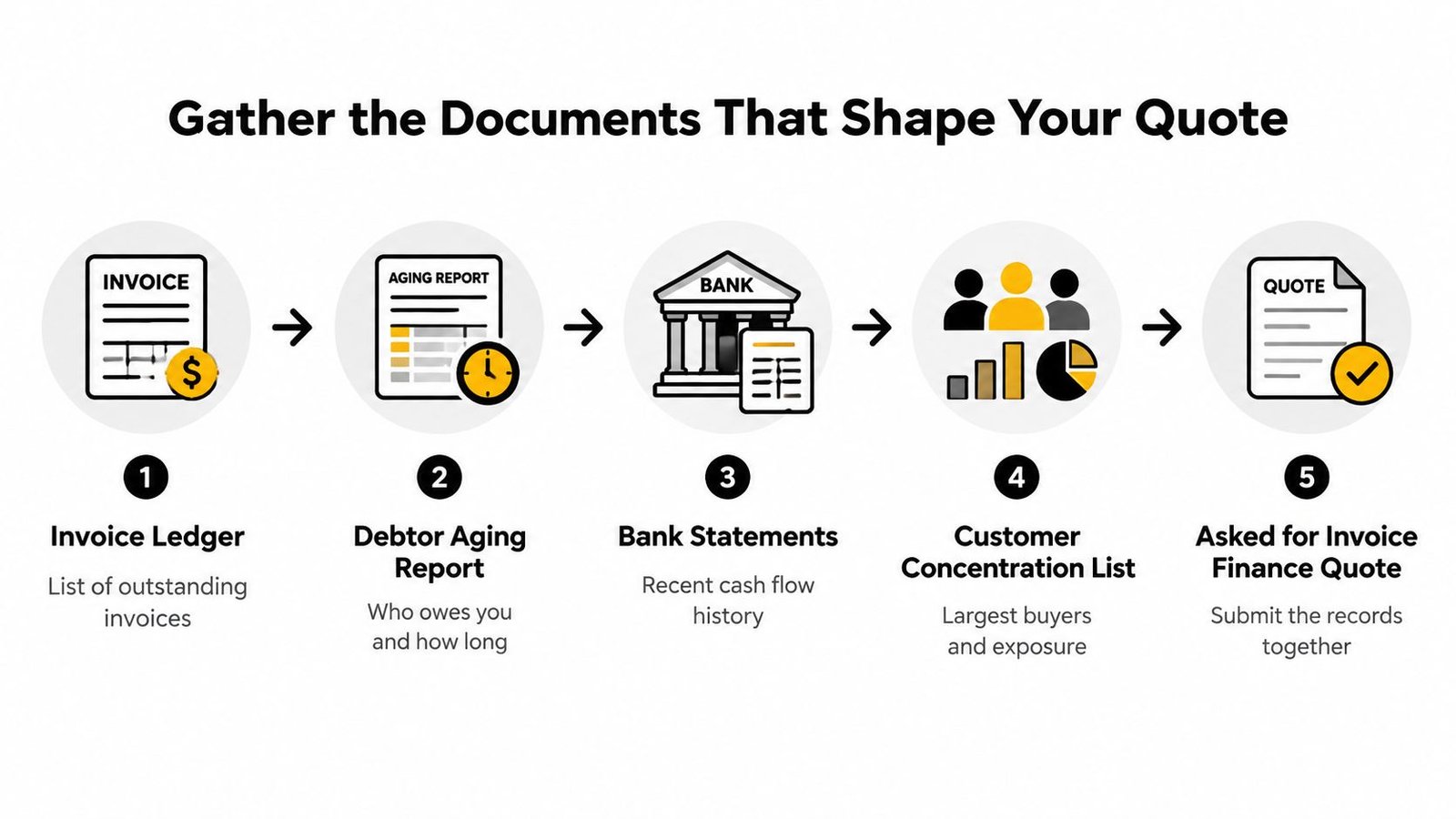
A quote is only as useful as the receivables information behind it. Before contacting providers, assemble records that let them calculate eligibility and let you verify their assumptions.
Start with the invoice ledger: a list of unpaid invoices showing the customer, amount, issue date, due date, and any payments or adjustments. Reconcile it against your billing records so an invoice isn't included twice or shown as outstanding after a credit or payment has already been applied.
Make the receivables easy to test
Prepare a debtor list that shows how much each customer owes. That makes concentration visible: a business may have many invoices but still rely heavily on a small number of buyers. Add an aging schedule that separates invoices into current, 31–60, 61–90, and 90+ day buckets. Aging helps a provider assess collection risk and helps you see which balances may be ineligible.
Mark disputed invoices, credit notes, returns, contra accounts, tax-related balances, and invoices that are materially overdue. A provider may exclude those items from the borrowing base. It may also apply cross-aging, which means that if too much of one customer's balance is late, the provider can make that customer's wider receivable balance ineligible, including invoices that aren't yet overdue.
The borrowing-base calculation is straightforward in principle: eligible receivables multiplied by the advance rate. If the provider excludes a large customer or disputed invoices, the amount available can shrink even if your gross invoice ledger looks substantial. Ask the provider to show the eligible balance, the reserve, and the proposed rate so you can check the calculation rather than relying on a headline limit.
Stress-test the availability
Run the same calculation after a major debtor becomes 60 or 90 days past due. Then test a dilution haircut for returns, allowances, disputes, bad debts, and similar credits. A receivables-management reference notes that dilution is usually 5% or less of receivables, though the relevant benchmark varies by industry (receivables management guidance).
Price both the committed facility and your expected usage. A quote should show the facility limit, advance rate, reserve, service or administration fee, discount rate or margin, minimum fees, termination charges, and the collection period assumed in the pricing. Send the provider a complete packet so you can see whether the proposed terms fit your real ledger, not an idealized one.
Compare Invoice Finance Quotes by Total Dollars
Don't rank offers by the monthly percentage alone. Reported market pricing spans roughly 1%–5% of invoice value per month, and providers may add administration, wire-transfer, minimum-volume, termination, or facility fees. The lowest headline rate can turn out to be the more expensive offer if the customer pays slowly or a minimum fee continues to apply (overview of invoice financing pricing and terms).
Ask each provider to price the same eligible invoices against the same payment scenarios. For illustration, use one $10,000 invoice and compare two structures: a confidential discounting quote with a low monthly discount charge but a facility minimum, and a factoring quote with a higher discount charge but a service charge that includes collection work. Don't assume either is cheaper from the headline alone. Request the total dollar cost if the customer pays in 30, 60, or 90 days, including the reserve, every fee, and any ongoing charge.
Make each offer disclose the same things
| Quote field | What to confirm | Why it changes the cost |
|---|---|---|
| Advance amount and reserve | How much arrives upfront, and what stays held back | Determines usable cash and the balance released after settlement |
| Fee basis | Whether each charge applies to turnover, invoice volume, or drawn funds | Shows which balance or activity bears the cost |
| Accrual method | Whether discount charges accrue daily, monthly, or compound | Slow customer payment can increase the total |
| Ancillary charges | Administration, wire, facility, minimum-volume, renewal, and termination fees | Fixed or recurring costs can outweigh a low headline rate |
| Collection period | Total repayment if payment arrives in 30, 60, or 90 days | Makes offers comparable under your actual payment pattern |
| Recourse terms | Who bears the loss if the customer doesn't pay | Changes your exposure as well as the price |
Use eligible, collectible receivables, not raw invoice volume, when comparing facilities. If your accounting or inventory systems are changing alongside your financing process, a practical overview of ERP infrastructure decisions for business owners can help you think through how operational records support financial decisions.
A fee for invoice finance isn't automatically an APR. The arrangement may be structured as factoring, a receivables purchase, or credit, and the cash-flow and legal structure can differ. An APR-equivalent calculation may help with context, but comparisons across different structures can be imperfect, so label that estimate clearly and keep the total dollar cost beside it. For a plain-language comparison of invoice financing versus factoring, focus on what services and risks each structure includes.
The best offer is the one that fits your invoices and collection cycle after every charge is counted. If a provider won't give you totals for the payment scenarios, you don't yet have enough information to compare the quote.
Test the Quote When Customers Pay Late
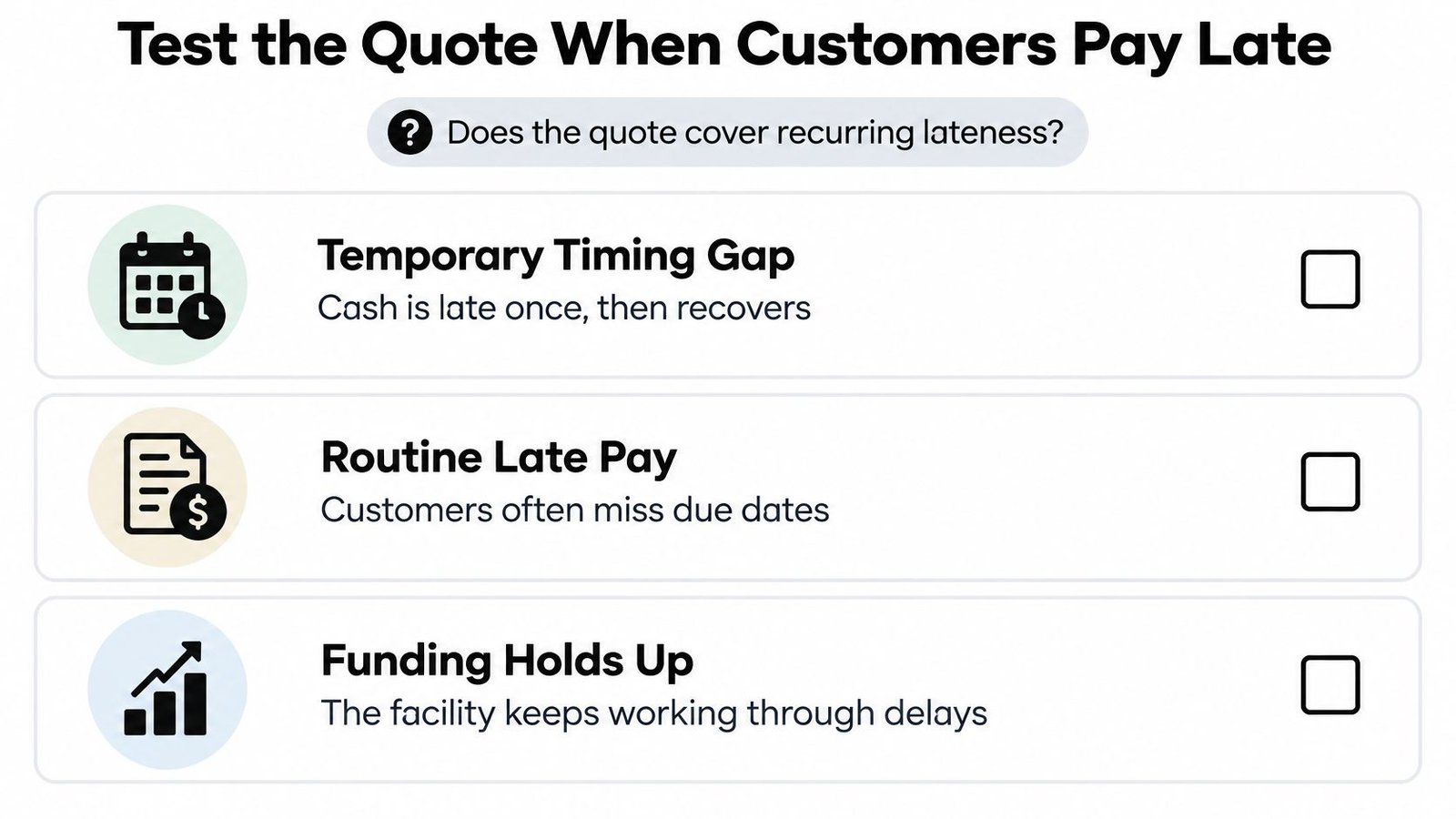
Ask whether the facility solves a temporary cash-timing problem or keeps funding customers who routinely pay late. A quote can look affordable under an assumed payment date but behave differently when a customer misses that date, disputes part of the bill, or never pays.
Follow the invoice through three outcomes
If a customer pays at the expected time, the provider applies the payment, deducts fees, and releases any remaining reserve according to the agreement. If payment takes longer, ask whether discount charges continue to accrue and whether the invoice or the customer's other balances become ineligible under cross-aging rules. A concentrated ledger is especially exposed: if one major buyer slips, the borrowing base may shrink at the same time cash is still tied up.
A partial dispute or credit note reduces what the customer owes. Ask how the provider handles the disputed amount, whether it's excluded from eligibility, and whether the reserve is enough to cover the adjustment. If the customer never pays, the agreement's recourse terms determine whether your business must repay the advance. With non-recourse protection, some customer-credit losses may be covered, but protection can cost more and may exclude commercial disputes, dilution, or fraud.
Late payment can affect businesses that extend trade credit. In 2025, 63% of small and medium-sized employers that offered customer credit considered late payment a problem, up six percentage points from the prior year, while only 44% of SMEs extended trade credit (UK SME late-payment survey reporting). These UK figures don't predict what a U.S. customer will do, but they reinforce why a quote should be tested against the payment behavior of your own buyers.
Read the operational terms, too
Before signing, get clear answers about who contacts customers, whether the facility is confidential, which invoices are ineligible on day one, and what notice period and termination fees apply. Confirm how the provider treats a late invoice, a partial dispute, and a customer default in writing. Good accounts receivable management can help you spot payment patterns before you decide to finance them.
If the same customer repeatedly pays late, financing may keep the cash moving without fixing the underlying collection issue. Compare the cost of the facility with practical steps such as tighter credit terms, earlier follow-up, or addressing recurring billing disputes.
Choose a Quote and Move Toward Funding
Choose an offer only after checking that the advance will cover the cash gap once ineligible invoices and reserves are accounted for. Then compare the total dollars at the collection period you expect, not a best-case assumption. Finally, make sure recourse, customer concentration, and dispute exclusions fit the risk your business can carry.
Invoice finance can be useful when you have credible commercial receivables and need liquidity before customers pay. It's less suited to a business that needs a permanent fix for routinely overdue accounts or can't absorb a repayment if a customer defaults. If the quote doesn't show how availability and liability change as an invoice ages, ask for a revised explanation before agreeing.
For a U.S. owner comparing funding paths, Business Loan Warrior is a fintech-enabled lending platform with a no-fee application, a pre-approval check that doesn't affect credit, bank-account connection, and a secure dashboard to track approvals, repayments, and credit insights, and to chat with underwriters. Its options include invoice financing alongside business loans, SBA loan processing, lines of credit, short-term financing, equipment and construction loans, merchant cash advances, and acquisition loans. The platform reports serving 2,000+ businesses and delivering $100M+ in funding; that's background about the company, not a promise of approval or a particular offer.
Bring your invoice ledger, aging schedule, and debtor concentration list together. Request each provider's full fee and scenario disclosures, then submit one application to compare which structure fits your cash-flow need.
Business Loan Warrior offers a no-fee application and a way to view invoice financing alongside other business funding options. If you're ready to compare a quote with your cash-flow needs, visit Business Loan Warrior.