

You've owned a profitable service company for years, and now three people have given you three different answers about what it's worth. Your broker points to comparable sales. Your lender focuses on the cash flow that can support acquisition debt. A strategic buyer talks about expansion value, customer overlap, or operational savings that may not apply to an individual purchaser. None of those opinions is automatically wrong, but they answer different questions.
The smart way to value a small business for sale is to reconcile those views rather than choose the most flattering one. Start with normalized earnings, apply a defensible market multiple, cross-check the result with an asset or income method, and then test whether a real buyer can finance the price. Asking price should be the output of that process, not a number copied from an online calculator.
Table of Contents
- The Real Question Behind Your Asking Price
- Normalizing Earnings the Way Buyers Actually Do It
- SDE and EBITDA Multiples by Deal Size and Industry
- Choosing Between Market, DCF, and Asset-Based Methods
- Financial Documents and Adjustments That Hold Up Under Scrutiny
- Why the 2026 Market Is Rewriting Old Rules of Thumb
- Reconciling the Numbers and Closing on a Fair Price
The Real Question Behind Your Asking Price
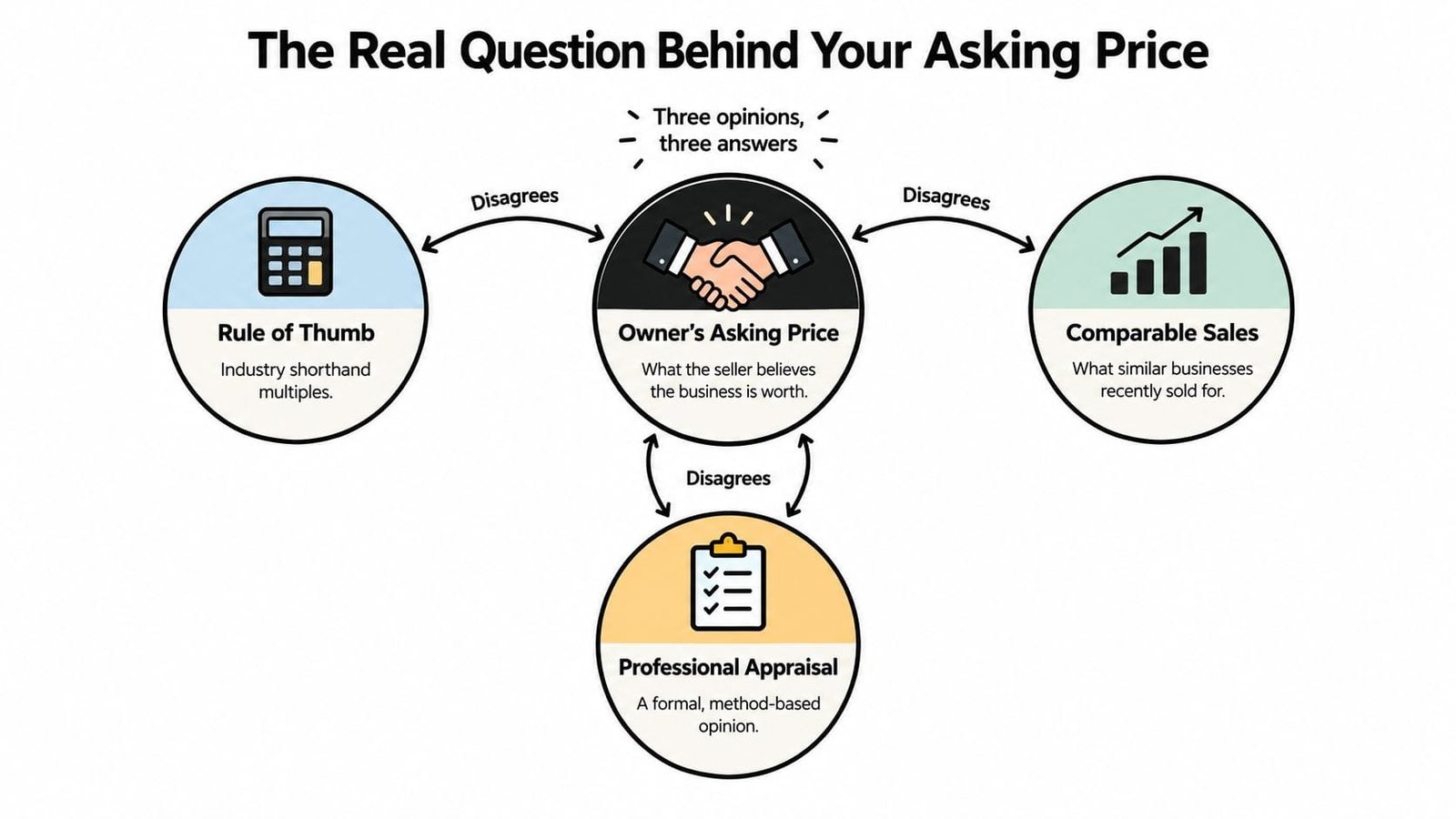
A service company owner might hear three realistic price anchors in today's market. The first is the broker's opinion of value, usually based on recent transactions, reported earnings, business size, and the risk profile of comparable companies. The second is the SBA lender's financing ceiling, which asks whether the buyer's cash flow can support the proposed debt after accounting for a replacement operator, working capital, and other obligations. The third is the strategic buyer's ceiling, which may reflect geographic expansion, customer overlap, or cost savings that an individual buyer can't achieve.
Those anchors often disagree because each party values a different outcome. A broker may identify what similar companies have sold for. A lender cares about repayment capacity. A strategic acquirer may see value that doesn't appear in the seller's standalone financial statements, but that buyer may also negotiate aggressively because it understands the seller's dependence on a limited buyer pool.
Why simple pricing shortcuts fail
The most common mistake is applying a familiar revenue percentage or a generic industry multiple before cleaning up the profit and loss statement. Revenue describes activity, not the cash a buyer can take home or reinvest. A business with impressive sales but weak margins may be worth less than a smaller company with recurring customers, disciplined expenses, and reliable owner benefit.
Another mistake is treating the seller's preferred buyer as the only possible buyer. A strategic acquirer may justify a higher price, while an SBA-financed individual buyer may establish a lower practical ceiling. That difference can change the marketing strategy, deal structure, and amount of seller financing required.
Deal-side rule: A multiple is only defensible after you can explain what earnings it applies to, why the business deserves that multiple, and how the buyer will pay for it.
For owner-operated companies, Seller's Discretionary Earnings, or SDE, is often the central measure. BizBuySell's 2025 Insight Report transaction summary covered 9,586 closed transactions and reported an average sale multiple of 2.61x SDE and 0.69x revenue, with a $350,000 median sale price. The same market data reported median SDE of $158,950 and median revenue of $703,000. Those figures are reference points, not automatic answers for your company.
The reconciliation process is straightforward in principle:
- Normalize the trailing-twelve-month earnings.
- Select SDE or adjusted EBITDA based on how the business operates.
- Compare the result with closed transactions and relevant market evidence.
- Review assets, liabilities, customer concentration, and transferability.
- Test the price against buyer financing and transition risk.
That process may produce a lower number than the owner hoped. It may also reveal value that a revenue rule of thumb missed. Either outcome is more useful than signing a listing agreement around an unsupported price.
Normalizing Earnings the Way Buyers Actually Do It
Buyers underwrite the earnings they believe will remain after closing, not the profit figure printed on a tax return. The starting point is usually reported net income, followed by a careful review of expenses that benefit the owner, relate to a one-time event, or differ from the cost a new operator will incur.
For an owner-operated company, the calculation generally moves toward SDE. For a business that already has management depth and can operate without the owner, adjusted EBITDA may be more appropriate. The distinction matters because SDE includes the owner's financial benefit, while EBITDA is designed to show operating performance before financing, taxes, depreciation, and amortization. This explanation of EBITDA and its use in business analysis is useful when deciding which earnings measure fits the buyer profile.
Add-backs buyers can verify
The strongest adjustments have a clear business reason and supporting documentation. An owner's W-2 compensation above a defensible market replacement salary may be partly added back, but the replacement cost still belongs in the buyer's model. Family payroll can be adjusted when the family member doesn't perform a necessary role, although payroll records and evidence of actual work will determine whether the adjustment survives review.
Other commonly reviewed items include:
- Personal vehicles and insurance: A buyer may accept an adjustment for personal use, but business vehicles, commercial coverage, and necessary travel remain operating costs.
- One-time legal or repair expenses: A settlement, unusual lawsuit, or isolated repair can be supportable when invoices and explanations show it won't recur.
- Forgiven loans or grants: PPP or EIDL forgiveness may require careful treatment so the buyer understands whether the benefit was exceptional or part of ongoing operations.
- Travel, meals, and entertainment: Discretionary spending can be adjusted only to the extent it represents genuine owner benefit rather than sales activity or employee requirements.
- Bonuses and retirement contributions: A buyer's accountant may reclassify these based on whether they were discretionary, recurring, or necessary to retain staff.
A market-rate owner salary replacement is not a guess designed to maximize SDE. Review the duties the owner performs, estimate what the business would pay an employee or manager to perform them, and deduct that cost before presenting the earnings to a buyer who won't fill the same role.
An illustrative normalization worksheet
The following worksheet is a hypothetical illustration of the mechanics, not a market statistic or a claim about a particular company.
| Line Item | Reported Amount | Adjustment | Adjusted Amount | Buyer Pushback Risk |
|---|---|---|---|---|
| Reported net income | $420,000 | Starting point | $420,000 | Low |
| Owner compensation above replacement cost | Included in expenses | Add back excess portion | Higher SDE | Medium |
| One-time legal expense | Included in expenses | Add back documented nonrecurring amount | Higher SDE | Low to medium |
| Personal travel and meals | Included in expenses | Add back substantiated discretionary portion | Higher SDE | Medium to high |
| Market-rate replacement salary | Not separately shown | Deduct required replacement cost | Lower SDE | Low |
| Illustrative normalized SDE | $420,000 starting figure | Net supported adjustments | $385,000 illustrative result | Depends on documentation |
The example intentionally shows that normalization doesn't always increase earnings. A seller may identify legitimate add-backs while also recognizing that a buyer must pay someone to replace the owner. Unsupported personal expenses, recurring perks, and costs that will continue after closing invite pushback and can damage credibility far beyond the value of the adjustment.
SDE and EBITDA Multiples by Deal Size and Industry
The right multiple depends less on a slogan such as “service businesses sell for three times earnings” and more on the quality of the earnings being multiplied. Buyers pay more for cash flow that is recurring, transferable, diversified, and supported by systems. They discount earnings that depend on the owner's relationships, one large customer, or a forecast that has not been demonstrated in the financial statements.
For smaller owner-operated businesses, SDE is usually the practical measure. The market data summarized by Patriot Growth Capital show that deals below $500,000 often price around 2.0x SDE, while businesses in the $1 million to $2 million range may price around 3.0x to 3.3x SDE. A separate overview of small-business valuation methods describes owner-operated transactions as commonly falling around 2x to 4.5x SDE, while larger lower-middle-market companies may use 4x to 8x or more EBITDA, depending on size and risk. See the small-business valuation guide for buyers and sellers for the distinction between these approaches.
What moves a business toward the top or bottom
A recurring-revenue home services company with documented renewal behavior, trained technicians, and low owner involvement may support stronger buyer interest than a project-based operator with the same SDE. A software company may attract a different valuation framework because buyers examine retention, recurring revenue quality, product concentration, and development risk. Healthcare services, staffing, food and beverage, and retail each require their own comparison set because labor, regulation, lease obligations, and customer behavior affect transferability.
Use these factors to position the multiple:
- Recurring revenue: Contracts and repeat purchasing can make future cash flow easier to underwrite.
- Owner dependency: A business that needs the seller for every sale, estimate, or customer relationship carries transition risk.
- Customer concentration: Dependence on a small number of accounts can reduce the price even when current earnings look strong.
- Growth quality: Buyers distinguish durable growth from a temporary surge that requires unusual spending.
- Management depth: Documented processes and capable staff support a multiple that doesn't rely on the seller remaining indefinitely.
- Deal size: Larger, more resilient companies may attract EBITDA buyers rather than owner-operators using SDE.
A practical multiple grid
| Deal Size Tier | SDE Multiple Range | EBITDA Multiple Range | Home Services | F&B / Retail | SaaS / Tech | Healthcare Services |
|---|---|---|---|---|---|---|
| Smaller owner-operated businesses | Around 2.0x SDE in smaller deals | Usually not primary method | Recurring contracts can support stronger positioning | Lease and labor risk require close review | Revenue quality and product risk matter | Regulatory and provider dependence matter |
| Established small businesses | Around 2.0x to 4.5x SDE | Case-specific | Systems and technician depth matter | Margin consistency matters | Retention and development costs matter | Referral sources and compliance matter |
| Larger lower-middle-market firms | SDE may give way to EBITDA | Around 4x to 8x or more | Management depth is central | Scale and site economics matter | Recurring revenue can influence buyer appetite | Payer mix and leadership depth matter |
These ranges are not a substitute for closed comparable transactions. Weight recent deals by business size, earnings quality, geography, and buyer type. If the seller must remain heavily involved during transition, the buyer may reduce the multiple, increase contingent consideration, or require seller financing. The headline multiple matters less than the final structure and the cash the seller can collect.
Choosing Between Market, DCF, and Asset-Based Methods
A credible valuation rarely depends on one method. The market approach tells you what comparable businesses have sold for. The discounted cash flow approach asks what the company's future cash generation is worth today. The asset-based approach measures what remains after valuing assets and subtracting liabilities.
Decision matrix
| Method | Best For | Required Inputs | Watch Out For |
|---|---|---|---|
| Market approach | Stable businesses with relevant closed transactions | Normalized SDE or EBITDA, comparable sales, size and risk adjustments | Asking prices are not closed prices, and poor comparables mislead |
| Discounted cash flow | Growing companies with a credible operating history | Cash-flow projections, capital needs, working capital, risk-adjusted discount rate | Forecast optimism can overwhelm the analysis |
| Asset-based approach | Asset-heavy, real-estate-heavy, holding, or distressed businesses | Tangible assets, identified intangible assets, liabilities, and current values | It can understate transferable earnings and customer relationships |
The market approach usually works best for a mainstream small business with stable operations and enough comparable evidence. For owner-operated companies, that generally means SDE. Once the company has management capable of running the operation without the owner, adjusted EBITDA may provide a cleaner basis because the buyer will evaluate the business as an investment rather than as a personal job.
DCF becomes more useful when historical earnings don't capture the company's future economics. A growing business with a real operating history, identifiable capital requirements, and defensible projections may justify an income approach. The burden of proof is higher, though. A forecast based only on management confidence won't persuade a cautious buyer or lender.
Asset-based valuation deserves more respect than it receives in generic online guides. It can be the primary method for a company whose value sits in equipment, real estate, inventory, or other identifiable assets. It also provides a useful downside reference for an earnings-based valuation.
The strongest advisor reconciles the methods rather than averaging them mechanically. A market multiple may establish the center of the range, DCF may test whether projected growth supports it, and asset value may show how much downside protection exists. Relevant inputs can include filed tax returns, reconciled financial statements, transaction databases, industry evidence, equipment appraisals, customer contracts, and debt schedules. The history of business valuation methods helps explain why modern buyers focus on future cash generation while still using asset and market evidence as important checks.
Financial Documents and Adjustments That Hold Up Under Scrutiny
A valuation becomes real during due diligence. Buyers reconcile the seller's story to the tax returns, general ledger, bank activity, contracts, payroll, and balance sheet. If the books don't explain the add-backs, the buyer won't underwrite them at full value.
Start with three years of profit and loss statements, three years of balance sheets, the trailing-twelve-month profit and loss statement, and a general ledger that reconciles to the filed tax returns. A seller should also prepare accounts receivable aging, accounts payable detail, debt schedules, payroll reports, customer concentration information, and copies of major contracts.
The income figure must be understandable before adjustments begin. This guide to finding net income can help owners distinguish the reported bottom line from the normalized earnings a buyer will analyze.
Adjustments that usually withstand review
A defensible add-back connects to a specific document and a clear explanation:
- Owner compensation: Show the actual compensation, the duties performed, and the market-rate replacement cost.
- Family payroll: Provide job descriptions, payroll records, and evidence supporting any amount that isn't needed after closing.
- Personal vehicles and travel: Separate personal benefit from genuine business use rather than adding back the entire expense.
- One-time legal costs: Include invoices and a written explanation of why the event won't recur.
- Normalized rent: Compare related-party rent with a supportable market figure and show the adjustment clearly.
- Discretionary expenses: Identify personal benefit, but don't relabel employee or customer-facing costs as discretionary.
Buyer's test: If the expense will continue under new ownership, it isn't an add-back merely because the seller dislikes paying it.
Recurring owner perks are particularly dangerous. A buyer may accept a documented personal element in a vehicle or travel expense, but not an adjustment that removes a cost required to keep the company operating. The same applies to maintenance, software, insurance, staff benefits, and marketing.
Working capital and operational disclosures
Working capital often creates a price adjustment after the headline valuation is agreed. A business that needs normal levels of inventory, receivables, or operating cash can't be handed over stripped of those resources. Deferred maintenance can create a similar problem because the buyer may reduce the offer after identifying equipment or facilities that need immediate investment.
Customer concentration also belongs in the valuation conversation before a buyer discovers it. A concentrated customer base, expiring contracts, weak receivables, or undisclosed liens can materially change the final price and structure. Sellers who disclose these items early have more credibility and more room to negotiate a solution.
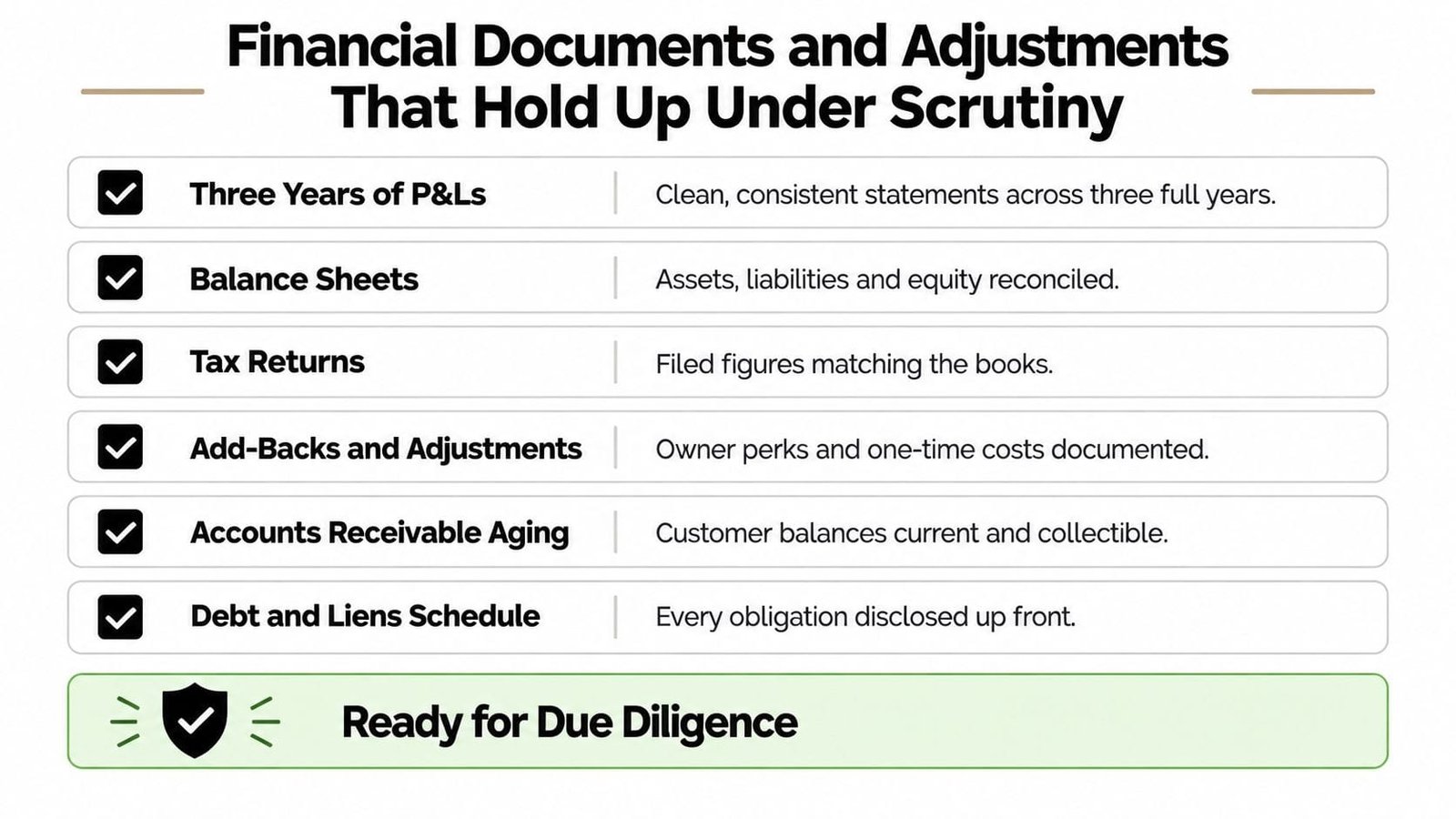
Give your CPA a one-page checklist containing the financial statements, tax returns, general ledger, bank reconciliations, payroll records, add-back schedule, contracts, receivables aging, debt and lien schedule, equipment list, and working-capital analysis. The cleaner that package is, the less time a buyer spends questioning whether reported earnings are reliable.
Why the 2026 Market Is Rewriting Old Rules of Thumb
Peak-era multiples are poor anchors when buyers have become more selective. Current market evidence shows why sellers should separate transaction reality from optimistic online commentary. BizBuySell's 2025 transaction data reported an average small-business sale at 2.61x SDE, while the valuation guidance in that dataset showed smaller deals often pricing closer to 2.0x SDE and businesses in the $1 million to $2 million range around 3.0x to 3.3x SDE. Those reference points don't eliminate variation, but they make a generic “seven times earnings” expectation difficult to defend for a typical owner-operated company.
Sector repricing creates another problem. The 2025 valuation discussion from FE International notes that SaaS valuation multiples had stabilized around 6x to 7x revenue, roughly 60% below peak levels in the example discussed. That comparison doesn't set the value of a local service business, but it illustrates the broader lesson: market conditions can reset multiples quickly, even for sectors that buyers still consider attractive.
Test the financing, not just the valuation
A buyer who can't finance the purchase won't close, regardless of how compelling the seller's growth story sounds. Individual buyers often rely on acquisition financing for smaller transactions, while strategic buyers may use different capital sources and place more emphasis on synergies. Each buyer therefore creates a different practical ceiling.
Run at least three cases:
- Base case: Use the multiple supported by comparable closed transactions and normalized earnings.
- Downside case: Reduce the multiple and test whether debt service, owner replacement, working capital, and transition costs still work.
- Strategic case: Identify which claimed synergies are real, measurable, and likely to be shared with the seller rather than kept by the acquirer.
Retire revenue-only rules, peak-era multiples, and add-backs that exist only because the seller wants a higher price. Keep rules that help organize evidence, such as comparing SDE for owner-operated companies with EBITDA for businesses that already function through management. The number that matters is the price a credible buyer can support after reviewing the books, financing terms, and transfer risk.
Reconciling the Numbers and Closing on a Fair Price
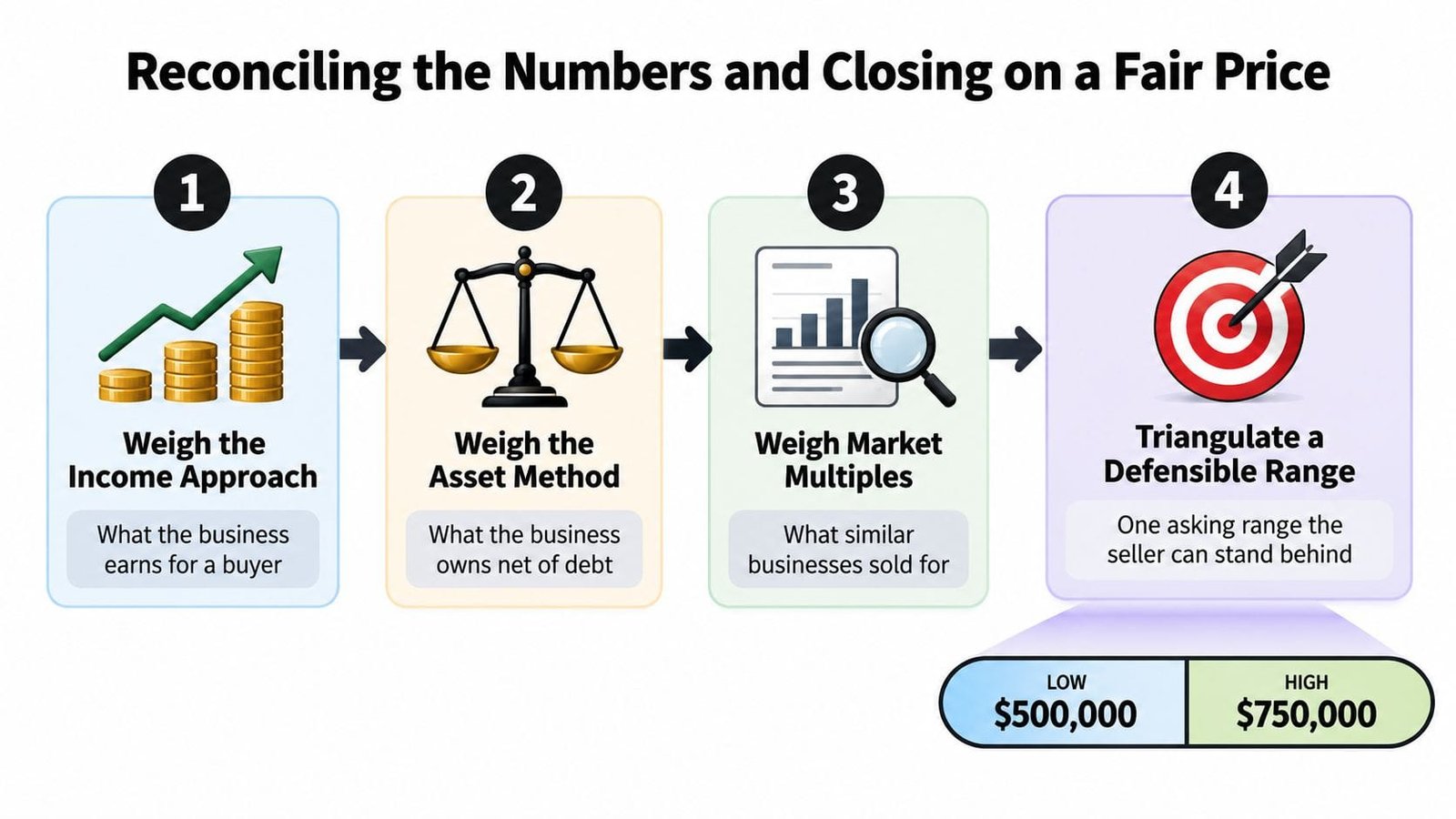
The final valuation should answer four questions. What does the business earn for a buyer? What does it own after liabilities? What have similar businesses sold for? Can a qualified buyer finance and operate the company at the proposed price?
A four-part reconciliation
First, weigh the income approach using normalized SDE or adjusted EBITDA. Remove unsupported add-backs and account for the salary required to replace the owner. Second, review the asset method, including inventory, equipment, real estate, identifiable intangible assets, debt, and deferred capital needs.
Third, compare the result with relevant market transactions. Give more weight to closed deals that resemble the company in size, industry, geography, customer concentration, and owner involvement. Fourth, triangulate an asking range that the seller can explain without relying on a single flattering comparison.
The seller mistakes that derail this process are predictable:
- One-multiple dependence: A rule of thumb cannot replace transaction-specific analysis.
- Owner dependency: Buyers discount earnings they believe will disappear when the seller leaves.
- Unsupported add-backs: Aggressive adjustments create retrading during diligence.
- Premature pricing: Applying a multiple before normalizing the profit and loss statement produces a fragile valuation.
- Financing blindness: A price that looks reasonable on paper may fail the buyer's debt model.
Watch the process in action before preparing your own buyer package.
Before signing a listing agreement, finalize the trailing-twelve-month adjusted profit and loss statement, document every add-back, reconcile the balance sheet, identify working-capital requirements, and model the buyer's financing. If you're preparing to purchase a small business, the same discipline applies from the other side of the table.
Acquisition financing can establish the practical valuation ceiling. A higher multiple may exceed what the buyer's cash flow can support, while a seller note or contingent payment can shift risk rather than eliminate it. The fairest price is the one supported by earnings, market evidence, assets, transferability, and a financing structure that can survive lender and buyer scrutiny.
Business Loan Warrior helps owners evaluate acquisition financing, SBA loan processing, business loans, and other funding options when a sale or purchase depends on workable capital terms. Use the valuation framework above to prepare your numbers, then visit Business Loan Warrior to explore funding options and connect your proposed price with a realistic financing plan.