
The operating-cost model discussed by Turns places monthly expenses for a staffed, leased store at $7,600–$13,600. Treat that range as a first screen: rent, utility rates and machine age can move the total substantially. A low quoted lease can still cost more each month than a pricier address once water, sewer, dryer fuel and equipment failures enter the model. That is why two stores with similar rent can land far apart. The better question is which machines, staffing plan and utility tariffs at that address set the monthly number.
Table of Contents
- The Monthly Budget at a Glance
- Why Utilities and Repairs Swing the Budget
- Rent and Payroll as Fixed Overhead
- Why Your Market Changes the Math
- Budget Scenarios by Store Size and Operating Model
- Build Your Own Monthly Budget Before You Sign a Lease
The Monthly Budget at a Glance
Build your budget by expense line rather than choosing a national total and working backward. The operating-cost model discussed by Turns places monthly expenses at $7,600–$13,600, but that estimate doesn't establish a price for every store configuration.
The table below separates usable benchmarks from expenses that need an actual quote. Figures attributed to sources in later sections are included as reference inputs, not additional expenses to stack indiscriminately.
Typical Monthly Operating Costs by Expense Line
| Expense line | Typical monthly range | Benchmark basis |
|---|---|---|
| Rent, leased store | $3,800–$4,000 | Quoted-rent benchmarks, including a roughly 2,200-square-foot example; the higher median includes triple-net charges |
| Utilities, water, sewer, gas and electricity | $1,500–$2,500 or more | Press Cleaners' 2025 estimate |
| Broader utility sensitivity range | $1,000 to more than $5,000 | Cents' utility-cost estimate, reflecting usage and local rates |
| Payroll, one attendant | About $2,380 | Annual wage benchmark before employer payroll taxes and benefits |
| Machine maintenance | $300–$1,500 | Maintenance allowance, not a guaranteed ceiling on breakdowns |
| Equipment repairs, documented case | About $2,500 | Historical spending at one U.S. store, not an industry average |
| Insurance | Obtain a coverage-specific quote | Price property, liability and applicable employee coverage |
| Supplies, detergent and cleaning | Build from purchase records | Separate resale inventory from service and cleaning consumption |
| Payment processing | Calculate from processor statements | Include transaction charges, subscriptions and equipment fees |
| Marketing | Set from local campaign plans | Identify recurring commitments and discretionary campaigns |
| Debt service | Enter scheduled repayments | Use the actual loan or equipment-financing agreement |
| Taxes and fees | Confirm with a local tax adviser | Identify obligations by jurisdiction and entity type |
The rent and wage inputs appear together in KioskForce's laundromat benchmark discussion: quoted rent near $3,800 for roughly 2,200 square feet, another leased-store median near $4,000, and an annual employee wage estimate of $28,557. Its revenue benchmarks put median utilities at 20% and leased-store rent at 18%, illustrating how much revenue those categories can absorb before other bills are paid.
Read the Table as a Framework
Don't add routine maintenance and the documented repair case automatically. Ask your service contractor whether a proposed maintenance agreement includes parts, emergency calls and labor. Otherwise, you could double-count covered work while overlooking excluded repairs.
For help organizing the spreadsheet, Recepta.ai's guide to calculating operating expenses offers a useful companion to a line-item budget. Keep a separate cash-flow view for loan principal, equipment purchases and owner withdrawals rather than treating every cash payment as the same accounting expense.
Practical rule: A blank quote is an unresolved cost, not a zero.
Copy the expense lines into a spreadsheet, add columns for supporting documents and payment dates, and replace each benchmark with a site-specific quote before comparing leases.
Why Utilities and Repairs Swing the Budget
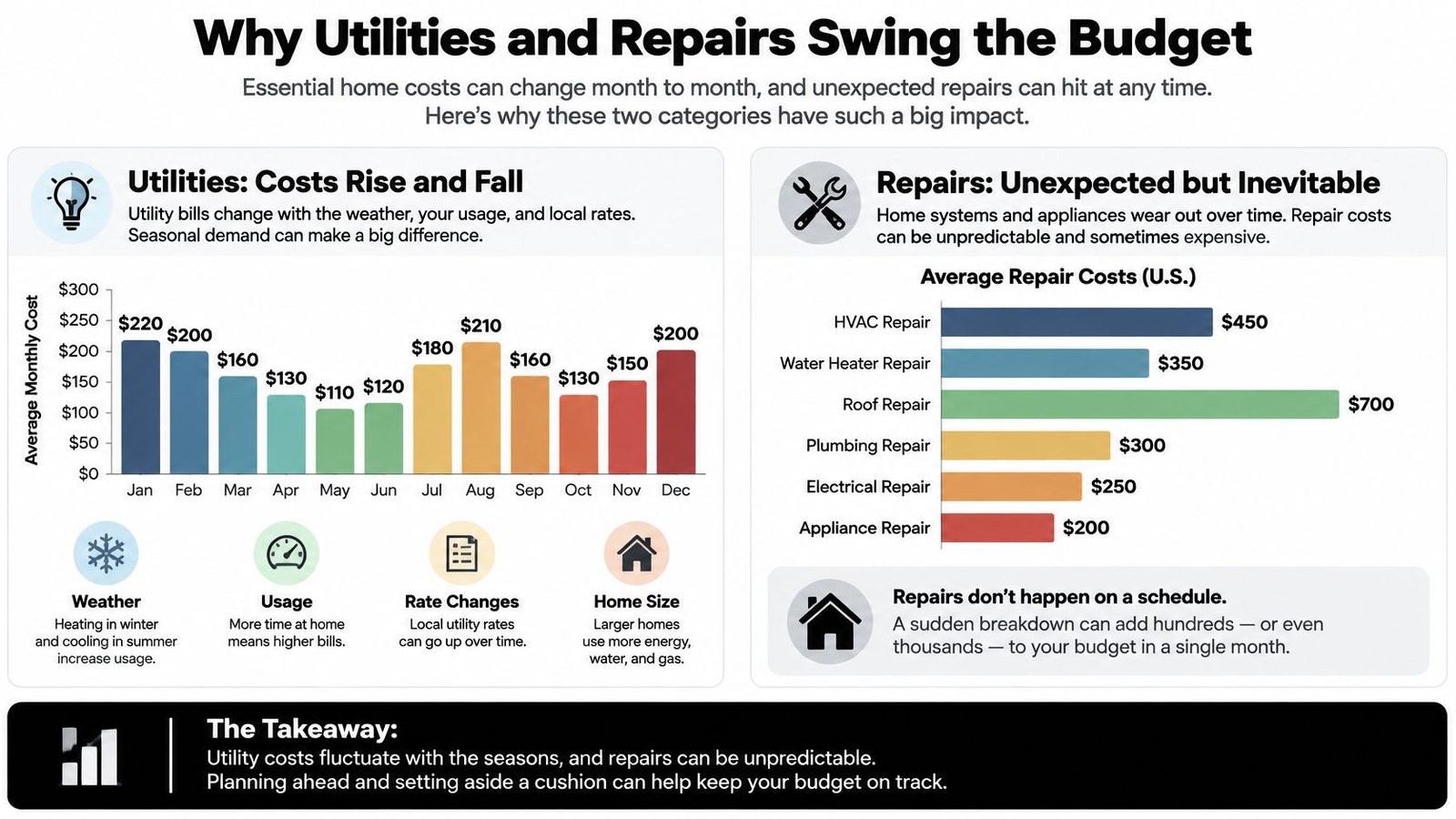
A historical U.S. laundromat profiled by The Atlantic spent more than $100,000 annually on utilities and approximately $30,000 on equipment repairs, equivalent to more than $8,333 and about $2,500 per month, respectively. Together, those categories exceeded $10,833 monthly before rent, payroll, insurance and other obligations.
The same account reported about $140,000 in annual profit. The financial lesson isn't that those costs are typical. It's that a profitable laundromat can still require substantial cash to keep operating.
Build Utilities from Physical Consumption
A single utility allowance hides several different operating decisions. Washers consume water, hot-water systems consume heating energy, dryers consume fuel or electricity, and the building requires lighting and climate control. Sewer billing can make water efficiency valuable beyond the water charge itself.
Use separate spreadsheet lines for:
- Water and sewer: Machine consumption multiplied by the applicable billing rates, plus fixed charges.
- Water heating: The heating system's fuel, efficiency and expected hot-water demand.
- Dryers: Fuel type, operating time and equipment specifications.
- Building electricity: Lighting, ventilation, payment equipment and climate control.
The following visual highlights why utility consumption and repair exposure deserve separate allowances.
Check the Units Before Estimating Water
The National Park Service's commercial laundry guidance, discussing EPA efficiency requirements, gives maximum water factors for commercial washers manufactured from 2018 onward of 4.1 gallons per cycle per cubic foot for front-loaders and 8.8 for top-loaders. It also describes older equipment using roughly 32–38 gallons per load and efficient washer-extractors operating near 2.5 gallons per pound.
These measures aren't interchangeable. Water factor must be multiplied by drum capacity and cycle count, while a gallons-per-pound measure requires pounds processed.
Water use by washer type
| Washer type | Water benchmark | Monthly water estimate |
|---|---|---|
| Front-loader, made 2018 or later | Maximum water factor of 4.1 gallons per cycle per cubic foot | Water factor × drum capacity × monthly cycles |
| Top-loader, made 2018 or later | Maximum water factor of 8.8 gallons per cycle per cubic foot | Water factor × drum capacity × monthly cycles |
| Older equipment | Roughly 32–38 gallons per load | Gallons per load × actual monthly loads |
| Efficient washer-extractor | About 2.5 gallons per pound | Gallons per pound × actual monthly pounds washed |
Use manufacturer specifications for the actual model whenever available. A maximum permitted water factor isn't a prediction of every selected wash program, and it doesn't account for leaks or restroom use.
Compare Ownership Costs, Not Purchase Prices
A used washer's lower purchase price doesn't settle the investment decision. Put its expected repairs, water consumption, heating demand and downtime beside the newer machine's financing payment and operating costs.
A cheaper machine is only cheaper if its purchase savings exceed the additional costs of operating and maintaining it.
For building-level checks beyond the machines, Lighthouse Energy Services' energy saving tips for commercial buildings can help frame an inspection of lighting, HVAC and operating controls. Keep those improvements separate from washer and dryer savings so you can test each proposal against a clear baseline.
Ask the repair contractor to identify recurring faults, parts availability and work excluded from a service agreement. Then fund routine service separately from a repair reserve. That makes the budget useful even when breakdowns don't arrive on a predictable schedule.
Rent and Payroll as Fixed Overhead
Rent and core staffing create the spending floor beneath your volume-sensitive utility bills. You can reduce discretionary advertising during a slow period, but a lease payment and scheduled employee coverage don't disappear because fewer customers arrive.
Review the lease, payroll schedule and operating plan together.
Assemble the Committed-Cost Baseline
The benchmark reproduced in a document hosted by the New York Department of Public Service lists approximately $3,800 monthly rent and $28,557 annual labor cost per employee, or about $2,380 monthly. Adding those inputs produces a baseline near $6,180 per month, before utilities, maintenance, insurance, supplies, processing, debt service and taxes.
That wage figure isn't fully loaded payroll. Add employer payroll taxes, applicable insurance, benefits, overtime and replacement coverage using your payroll provider's estimate. Build the schedule around opening, closing, cleaning, customer assistance and machine monitoring rather than assuming an employee's job title establishes sufficient coverage.
A second full-time equivalent adds another wage commitment at the same benchmark, plus those employment costs. Before hiring, map each task to a shift and identify which responsibilities the owner will perform.
Calculate Break-Even from Contribution
Use this relationship:
Monthly break-even customer visits = monthly fixed costs ÷ contribution per customer visit
Contribution means customer revenue less the costs incurred to serve that visit. Subtract the relevant utility consumption, transaction fees, supplies and directly attributable service labor before calculating what remains for fixed overhead.
A guide to calculating overhead costs can help classify committed expenses consistently. Don't mix a fully loaded labor allowance in one scenario with wages alone in another.
Use the video as supplementary context while keeping your own lease and payroll documents as the budgeting inputs.
Finish the analysis by comparing rent and payroll as shares of your projected revenue. A high ratio is a prompt to investigate the lease, staffing schedule or sales assumptions, not automatic evidence that the location cannot work.
Why Your Market Changes the Math
Searching for the lowest rent can produce the wrong shortlist. Two sites with identical lease payments can post very different monthly costs once utilities, demand charges and repairs enter the model, so the comparison that matters is occupancy plus operating cost at the same expected customer volume.
Commercial electricity shows why. Published commercial rates differ sharply by region and by utility, and the spread between a low-rate market and a high-rate market can rival the rent gap between two candidate sites. A cheap lease in an expensive utility territory can cost more per month than a pricier site where power, water and sewer run cheaper. Before comparing locations, pull the current commercial tariff from the utility that serves each address.
Commercial Electricity Rate Reference
| Market reference | Commercial electricity rate | What it means for the budget |
|---|---|---|
| Regional average, from published utility tariffs | Pull the current commercial rate from the utility's tariff sheet | First-pass reference, not a site quote |
| A second candidate market, pulled the same way | The comparable commercial rate for that region | Shows how far geography can move the utility line |
| Your site, from the actual bill | Enter energy charges and applicable tariff terms | Replace benchmarks before comparing sites |
A bill carries more than an energy rate. Obtain the tariff schedule and identify fixed service charges, demand charges, seasonal pricing and any other applicable components, since two sites paying the same energy rate can still produce different bills. For water and sewer, confirm the billing units before entering rates into your model.
Run a Like-for-Like Sensitivity Test
Hold equipment, operating hours and customer volume constant while testing candidate locations. Otherwise, you won't know whether the difference comes from geography or a different business plan.
| Scenario | Rate input | Budget calculation | Decision use |
|---|---|---|---|
| Low-rate case | Lowest documented applicable local tariff | Expected consumption × rate, plus fixed charges | Tests the strongest supported cost case |
| Base case | Actual site tariff and expected seasonal use | Expected consumption × site rates, plus demand and fixed charges | Establishes the operating forecast |
| High-rate case | Documented higher tariff or applicable seasonal charges | Same consumption under higher supported rates | Tests cash-flow exposure |
Cheaper-site test: Compare the rent savings with the additional water, sewer, electricity and fuel expense. If the utility disadvantage exceeds the rent advantage, the cheaper lease costs more to operate. Apply the same arithmetic to repairs: a site with aging machines or older plumbing can spend its rent advantage on service calls before the first year ends.
Translate each scenario into break-even utilization by dividing required paid cycles by available machine-cycle capacity. Keep realistic downtime and customer scheduling constraints in that capacity estimate.
For an equipment upgrade, compare the proposed debt payment with supported operating savings and maintenance changes. Financing efficient machines can improve cash flow, but only if the site-specific savings justify the payment. A vendor's efficiency claim isn't a substitute for your tariff and expected machine usage.
Budget Scenarios by Store Size and Operating Model
An unattended self-service store and a wash-dry-fold operation shouldn't share the same labor assumption. Their owners are purchasing different levels of service, supervision and production capacity.
Zarla's laundromat business-plan guide gives an attendant and wash-dry-fold labor range of $0–$5,000 monthly and maintenance of $300–$1,500. Those broad allowances help identify the categories to model, but they don't establish separate prices for small, medium and large stores.
Monthly Budget Scenarios by Store Model
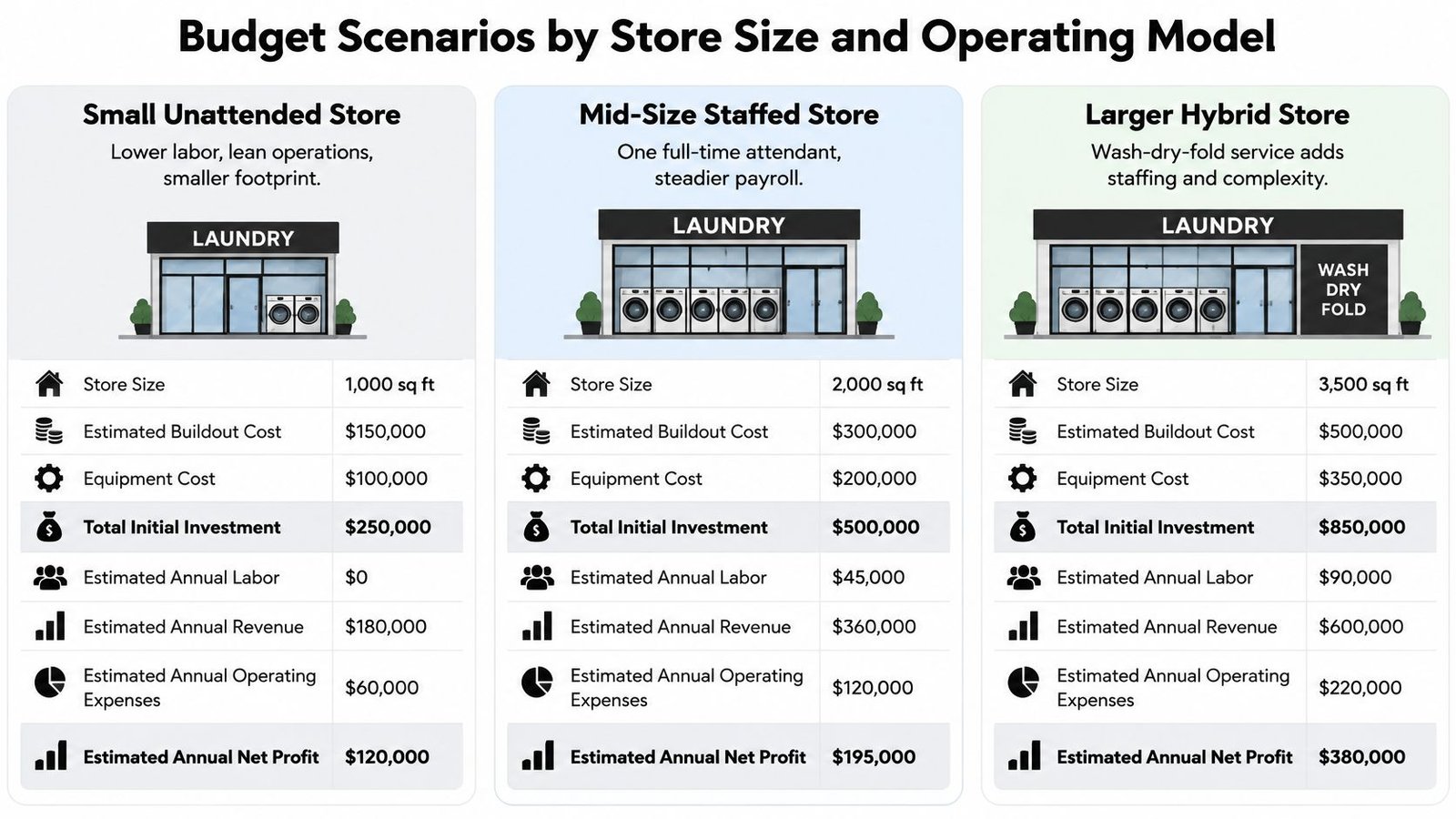
The table uses the reference inputs already established. It's a comparison worksheet, not a set of size-specific forecasts.
| Scenario | Labor | Rent | Utilities | Maintenance | Other lines |
|---|---|---|---|---|---|
| Small unattended, leased | $0 for an attendant; owner work excluded | About $3,800 reference only | $1,500–$2,500 reference | $300–$1,500 reference | Obtain security, cleaning, payment-system and insurance quotes |
| Mid-size staffed, leased, one attendant | About $2,380 before employer taxes and benefits | About $3,800 reference only | $1,500–$2,500 reference | $300–$1,500 reference | Add payroll taxes, absence coverage and insurance quotes |
| Larger hybrid with wash-dry-fold | Use a staffed production schedule; broad published allowance runs $0–$5,000 | Replace the $3,800 reference with a larger-site quote | $1,000 to more than $5,000 reference; model actual machine use | $300–$1,500 reference; obtain fleet-specific pricing | Quote delivery, folding supplies, storage and pickup systems |
The visual comparison distinguishes the operating models, rather than assigning a reliable profit forecast to each.
What Each Owner Is Actually Taking On
Small unattended store. Removing the attendant transfers responsibilities rather than eliminating them. Assign cleaning, customer refunds, vandalism response, cash handling and emergency access to the owner or a paid provider, then enter those costs.
Staffed self-service store. Test whether the schedule covers the hours customers need assistance. Payroll should reflect coverage requirements, not just an attractive monthly allowance.
Hybrid service store. Treat wash-dry-fold as a separate production activity. Price orders against washing, drying, folding labor, supplies, packaging and any delivery expense before deciding how much those orders contribute to shared overhead.
Compare operating models after service labor, not before it. Otherwise, the model requiring the most unpaid owner work can appear artificially attractive.
Separate Monthly Costs from Launch Capital
Folding tables, storage, payment hardware and delivery infrastructure require capital before they generate service revenue. Keep those purchases in a startup or expansion schedule, then bring their financing payments into monthly cash flow where applicable.
The coin laundry startup cost guide can help organize that separate capital plan. Label every footprint-based or machine-count adjustment as an estimate, and obtain local quotes before treating it as a forecast.
Any subtotal of wages, rent, utilities and maintenance is a known-lines subtotal, not the total cost to operate. Add insurance, processing, supplies, taxes and financing before judging whether a model is affordable.
Build Your Own Monthly Budget Before You Sign a Lease
Your final spreadsheet should explain not only the expected monthly cost to run a laundromat, but also when cash leaves the account and which assumptions could change the decision. A budget supported by documents is more useful than a polished total built from national averages.
Use a small-business budget worksheet as the starting structure. Add columns for the expense owner, supporting document, payment date and confidence level.
Replace Assumptions with Evidence
Replace benchmark allowances with site quotes. Enter the lease proposal, insurance quote, service agreement, processor pricing and repayment schedule so every material line has a documented basis.
Collect a complete seasonal history of utility bills. Request the previous twelve monthly bills from the seller or landlord where available, separating water, sewer, gas and electricity so seasonal use and billing changes remain visible.
Build a machine inventory. Record model, capacity, age, water specification and expected turns for each washer and dryer, allowing consumption estimates to reflect the equipment you'll operate.
Price the staffing schedule. Send the proposed shifts and job duties to a payroll provider, including absence coverage and service-production work, so the estimate represents employment cost rather than wages alone.
For an existing business, reconcile utility consumption with machine records and reported sales. A mismatch doesn't prove anything by itself, but it does identify a question to resolve before relying on the seller's forecast.
Test Whether the Plan Can Carry Its Commitments
Calculate break-even paid activity. Apply the contribution-based formula to your actual prices and service costs so you can compare required customer activity with realistic capacity.
Stress-test documented rate alternatives. Substitute applicable seasonal or higher local utility rates while holding volume constant, making the cash-flow effect visible without confusing it with sales growth.
Set a repair reserve from equipment condition. Ask a qualified technician to inspect the fleet and price likely work, because a generic maintenance allowance can't describe the immediate needs of a neglected machine.
Keep the reserve separate from the monthly maintenance expense in your cash plan. Money allocated to a reserve remains available cash until spent, whereas a repair invoice is an actual outflow. Distinguishing the two prevents a useful contingency from becoming an accounting double count.
Before signing: Resolve any assumption that could change your answer from affordable to unaffordable. Don't bury it inside a miscellaneous expense line.
Make the Financing Decision from the Cash Gap
If the completed model shows a funding gap, identify its cause before choosing a financing product. Equipment purchases may fit equipment financing; uneven short-term cash needs may call for a line of credit. A recurring operating deficit requires a change in pricing, volume, costs, or operating model, not more borrowing.
Compare payment amounts, repayment frequency, total financing cost, collateral requirements and prepayment terms. Enter the proposed payments into the high-cost case as well as the base case, and check whether the business can still cover essential operating commitments.
The decision standard is straightforward: sign the lease only when the operating plan, capital budget and financing schedule work together. A low advertised rent isn't enough if the store cannot fund its machines, utilities and staffing through a difficult month.
Business Loan Warrior offers equipment financing, business loans and lines of credit that owners can compare for machine purchases, expansion or working-capital needs. Visit Business Loan Warrior with your completed laundromat budget and funding requirement, then review any proposed repayment schedule and full terms before committing.