
The SBA 7(a) program caps an individual loan at $5 million, while the standard maximum SBA guarantee on a loan of that size is $3.75 million. That means the amount a lender may approve and the portion the SBA guarantees are related, but they aren't the same figure.
So, what do “SBA loan limits” really tell you if your company is considering an acquisition, equipment purchase, expansion, or working-capital facility? The headline number answers only one part of the question. A borrower also needs to separate the total principal available, the SBA-backed exposure, and the amount a lender will approve after reviewing cash flow, collateral, equity, eligibility, and existing obligations.
For an established business, especially one generating sales in the tens of millions of dollars, that distinction can determine whether a financing plan is realistic or overstated. A $5 million statutory ceiling doesn't mean every qualified company can borrow that amount, and a smaller delivery channel may impose a different limit before underwriting begins.
Table of Contents
- What SBA Loan Limits Mean
- Quick Reference SBA Program Caps
- SBA 7(a) Loan Limits and Guarantee Structure
- SBA 504 Program Limits and Project Financing
- Microloans and Expedited Delivery Channels
- Why Typical Approvals Fall Well Below the Cap
- How to Calculate Realistic Borrowing Capacity
- SBA Loan Limits in Practice for Growing Companies
- Next Steps for Pre-Approval and Funding
What SBA Loan Limits Mean
What does an SBA loan limit measure when a company is seeking financing? It can refer to three separate ceilings, and confusing them can materially overstate borrowing capacity. The gross loan limit is the total principal a lender may extend under a program. The SBA-guaranteed exposure limit is the portion the agency backs for the lender. The lender underwriting limit is the amount supported by repayment capacity and the bank's risk policy.
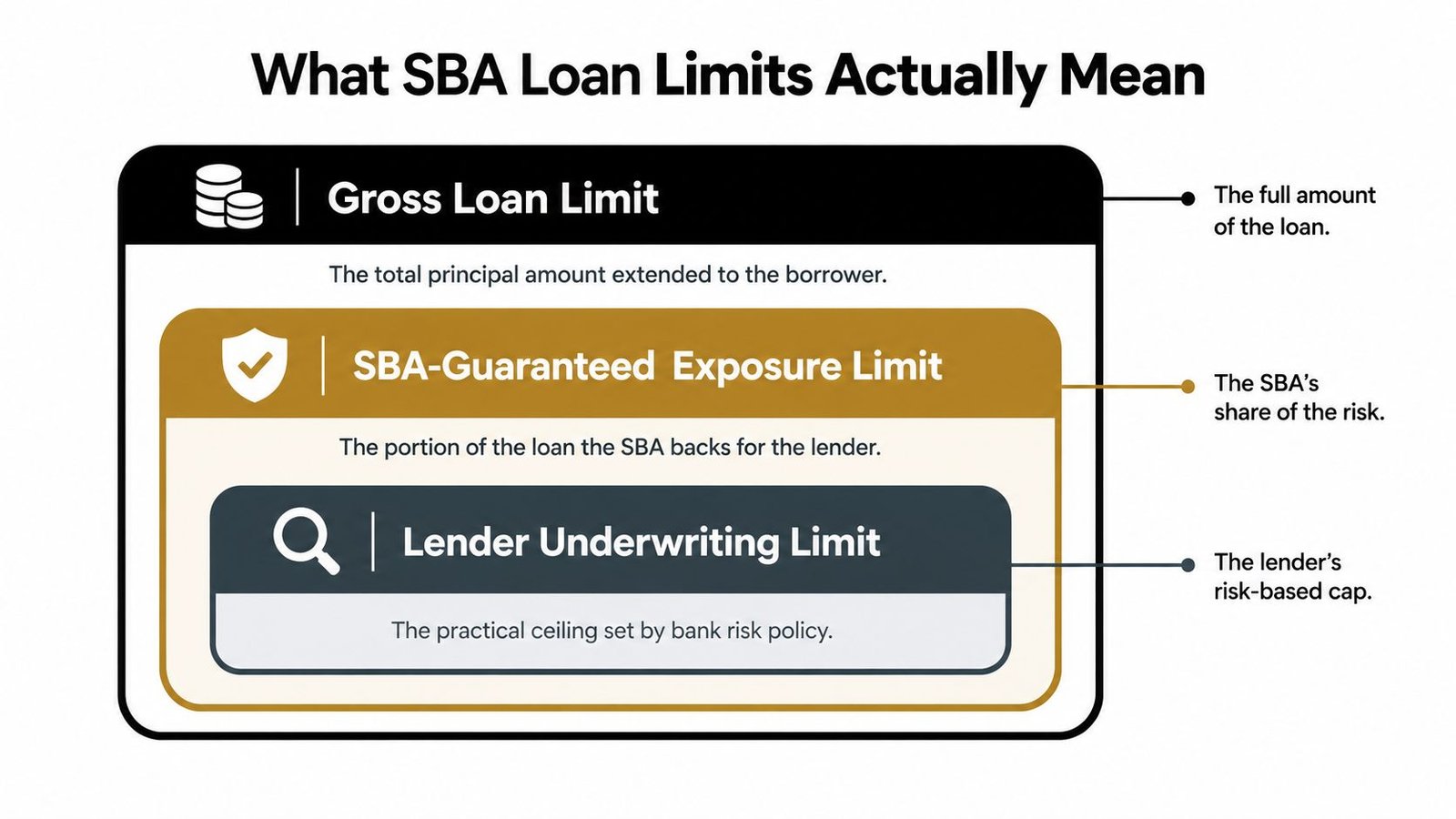
The $5 million 7(a) ceiling sets a program boundary, not an approval amount. Applicants must meet eligibility, credit, repayment, and lender-underwriting requirements, according to the SBA's capital access guidance. The ceiling also applies to the borrower's total SBA-guaranteed 7(a) financing, so a company should not assume it can multiply available capacity across locations, subsidiaries, or lenders.
Practical rule: Begin with the program ceiling. Then reduce it for guarantee exposure, repayment capacity, affiliation, and existing SBA debt.
The distinction becomes more important for a $20M-$50M business evaluating a major transaction. Revenue may support a substantial facility, while cash flow, collateral, equity, or eligibility produces a smaller approval. A smaller financing need may fit an expedited delivery channel, whereas a larger request may require the documentation and underwriting of a standard loan. The headline cap identifies the outer boundary. The borrower's financial profile and delivery channel determine the usable ceiling.
Quick Reference SBA Program Caps
The table below separates headline program limits from the function each option serves. Where the verified data identifies a precise limit, it should be read as a program ceiling, not a promise of approval.
SBA Program Caps at a Glance
| Program | Headline Limit | Typical SBA Guarantee Exposure | Best Use Case |
|---|---|---|---|
| Standard 7(a) | $5 million per individual loan | Generally 75% for loans above $150,000 | Working capital, acquisitions, equipment, expansion, and other eligible business purposes |
| SBA Express | $500,000 | A separate expedited delivery structure | Smaller financing needs where a faster process matters |
| Export Express | $500,000 | A separate expedited delivery structure | Export-related financing needs |
| 504 | $5 million regularly, with up to $5.5 million for certain eligible energy projects | Project-specific structure rather than a standard 7(a)-style guarantee comparison | Major fixed assets, facilities, construction, and equipment |
| Microloan | A smaller program route | Intermediary-based structure | Modest startup, inventory, equipment, or working-capital needs |
| International Trade | Subject to program-specific limits | Up to 90%, or $4.5 million where the applicable limit is met | Businesses pursuing or supporting international trade |
The standard 7(a), Express, 504, Microloan, and International Trade options aren't interchangeable. The right comparison isn't “Which one has the highest number?” It's “Which program's permitted use, delivery method, guarantee structure, and repayment profile fit the transaction?”
A company seeking a facility purchase shouldn't evaluate a 504 loan in the same way it evaluates a general-purpose 7(a) facility. A business needing a smaller, time-sensitive working-capital request may find an Express channel more proportionate than pursuing the standard ceiling.
SBA 7(a) Loan Limits and Guarantee Structure
Could a business qualify for the headline $5 million 7(a) loan limit and still have materially less practical borrowing capacity? Yes. The gross limit applies to the borrower's total SBA-guaranteed 7(a) financing, not to each location, subsidiary, or lender as a separate entitlement. The SBA 7(a) program overview also explains that the guarantee percentage varies by loan size.
For loans of $150,000 or less, the SBA generally guarantees 85%. Above $150,000, the standard guarantee is generally 75%. Applied to a $5 million 7(a) loan, that percentage creates a maximum SBA guarantee of $3.75 million. The remaining exposure stays with the lender.
Why the guarantee matters to lenders
The borrower receives the gross loan proceeds, while the lender assesses its retained risk. That distinction affects credit policy, collateral analysis, pricing, documentation, and approval appetite. A guarantee can support a larger request, but it does not convert the full loan into SBA-covered exposure.
The lender must still determine whether the business can service the debt, whether the proposed use is eligible, and whether collateral, equity, affiliation, and size requirements support the request. For a $20 million to $50 million business, the headline cap therefore says little by itself. Ownership structure, existing SBA financing, cash flow, and the lender's underwriting remain central to the practical ceiling.
The amount the SBA guarantees measures lender risk. It is not additional cash available to the borrower.
Delivery channel creates a separate constraint. SBA Express and Export Express each cap an individual loan at $500,000, one-tenth of the standard 7(a) ceiling, according to the SBA's capital access materials. Express is therefore a distinct method of delivery, with a lower maximum and a different tradeoff between processing speed and loan size.
A larger acquisition or expansion should be modeled in two layers: gross proceeds and guaranteed exposure. The borrower should also review potential SBA guarantee fees as part of total financing cost. Those fees and the lender's retained exposure can affect the transaction even when the requested amount falls within the program cap.
The short walkthrough below shows how the guarantee percentage changes the lender's retained exposure on a maximum-size 7(a) loan.
SBA 504 Program Limits and Project Financing
The 504 program uses project financing, so its headline ceiling cannot be read like a general-purpose borrowing allowance. The program provides a regular $5 million maximum and up to $5.5 million for certain eligible energy projects, as outlined in this SBA 504 loan guide. Those figures describe gross project financing, not the amount every borrower can obtain.
The structure is built for major fixed assets, including facilities, construction, and substantial equipment purchases. It is not designed primarily for flexible working capital. The requested amount must connect to an eligible asset, documented project costs, and the program's requirements. A company can therefore fall below the headline limit because the project itself does not support a larger facility.
Match the financing structure to the asset
A facility expansion should be assessed differently from a request that combines payroll, inventory, acquisition costs, and equipment. The relevant comparison is between a defined fixed-asset project and a broader financing need that requires greater flexibility. A 504 structure may fit the first case, while another SBA or conventional structure may better fit the second.
The analysis has three layers: the gross loan limit, the SBA-guaranteed exposure within the transaction, and the borrower's practical ceiling. The first is a regulatory maximum. The second affects how risk is allocated among the participating parties. The third depends on project economics, repayment capacity, eligibility, collateral, and lender underwriting.
That distinction matters for asset-intensive businesses. A manufacturer, distributor, construction company, or expanding owner should establish project scope and repayment support before treating the program cap as a target.
The practical conclusion is narrow but useful: a 504 ceiling can support a qualifying fixed-asset investment, yet it does not convert an approved project amount into unrestricted cash. The asset, structure, and repayment case determine how much of the ceiling is usable.
Microloans and Expedited Delivery Channels
Which SBA channel fits the amount and purpose of the request? Microloans address smaller financing needs through intermediary lenders, while expedited channels serve borrowers seeking a faster path for a more limited facility. The distinction matters because a business should match the delivery method to its borrowing requirement, not treat every SBA product as a route to the same capacity.
A microloan has a maximum of $50,000. It can support working capital, inventory, supplies, or equipment when the business does not need a multimillion-dollar project facility. That ceiling also defines the product's role. It is a targeted source of capital, not a substitute for a larger 7(a) transaction.
Express channels trade size for delivery speed
SBA Express and Export Express loans each have a $500,000 maximum, as described in the SBA's 7(a) loan program details. These are separate delivery channels, not informal exceptions to the standard underwriting framework. Their practical value is faster processing for a contained request, while the lower cap limits their usefulness for acquisitions, major expansions, or layered working-capital needs.
A company choosing between an expedited channel and standard 7(a) should compare the requested amount, use of funds, documentation, and repayment case. Speed may justify the Express route when the need is narrow and urgent. A larger or more complex transaction generally requires the broader analysis associated with standard delivery.
International Trade loans serve a different purpose. They can receive a guarantee of up to 90%, or $4.5 million, subject to program-specific limits and a qualifying trade-related use. The higher guarantee does not replace eligibility, repayment, and purpose tests.
The practical ceiling therefore depends on both product design and borrower capacity. A smaller channel may improve fit, but it cannot expand the underlying limit.
Why Typical Approvals Fall Well Below the Cap
The statutory maximum describes the top of the range, not the normal transaction. In FY2025, the SBA approved 78,078 7(a) loans with an average amount of approximately $477,600, far below the $5 million ceiling, according to the SBA lender data.
The gap reveals how borrowers should interpret program limits. The SBA establishes the outer boundary, but the lender sizes the request around the company's verified ability to repay. A business may request the ceiling and still receive a smaller approval because the proposed debt doesn't fit its cash flow, collateral, equity position, or eligibility profile.
The underwriting filters behind the gap
Lenders typically examine several connected questions:
- Cash flow: Can operating cash flow support the proposed repayment obligation under the lender's analysis?
- Collateral: What assets support the request, and how does the lender assess their value and recoverability?
- Equity contribution: Has the borrower committed enough of its own capital for the transaction and its risk profile?
- Business size: Does the company remain eligible under applicable SBA size rules, including the treatment of affiliated entities?
- Existing exposure: Do current SBA-backed obligations reduce the practical capacity available to the borrower?
A company generating tens of millions of dollars in annual sales may look large enough to support substantial borrowing, yet revenue alone doesn't settle the analysis. A business with annual revenue between $20 million and $50 million may exceed an applicable SBA size threshold or qualify for less than the headline limit, depending on its industry, structure, affiliates, cash flow, and existing debt.
A high revenue figure can support a larger conversation with a lender, but it doesn't convert the statutory ceiling into an approval amount.
The average approval figure is useful because it corrects the way many borrowers read “up to.” It shows that the ceiling is a boundary for eligible transactions, while the actual loan amount reflects the economics and risks of a specific business.
How to Calculate Realistic Borrowing Capacity
A realistic capacity estimate starts with four separate questions. Combining them too early is how borrowers mistake a program maximum for available capital.
What is the gross amount required? Define the purchase price, equipment cost, expansion budget, working-capital need, or project cost. Separate uses instead of placing every need into one undifferentiated request.
What SBA-backed exposure is available? Review existing 7(a) financing and other SBA-backed obligations associated with the borrower and relevant affiliates. The applicable limit concerns borrower exposure, not just the number of legal entities submitting applications.
What can the lender support? Test the request against normalized cash flow, repayment obligations, collateral, equity contribution, and the lender's internal risk limits. A request may fall below the program ceiling even when the purpose is eligible.
Does the business qualify? Check program eligibility, size standards, affiliation, credit profile, repayment prospects, and the selected delivery channel. A company may be financially strong yet unsuitable for a particular SBA structure.
Use a capacity worksheet
A useful worksheet should contain separate lines for:
| Capacity question | What to record |
|---|---|
| Requested gross proceeds | The total amount needed for the stated uses |
| Existing SBA obligations | Current balances and associated borrowers or affiliates |
| Potential guaranteed exposure | The portion an SBA program may support |
| Uncovered lender exposure | The portion the lender must retain and underwrite |
| Repayment support | Verified operating cash flow and existing obligations |
| Eligibility constraints | Size, affiliation, use-of-funds, and program requirements |
This method produces a more credible financing target than starting with the largest advertised number. It also helps separate a funding shortfall caused by the program from one caused by the lender's risk assessment or the company's financial profile.
For multi-entity groups, affiliation deserves early attention. A borrower shouldn't assume that separate incorporation creates separate SBA capacity. The lender will evaluate the relevant ownership and operating relationships under applicable rules before determining the request's eligibility and exposure.
SBA Loan Limits in Practice for Growing Companies
Consider a representative company with annual sales in the $20 million to $50 million range that is evaluating an acquisition or expansion. Its first question shouldn't be whether the company can request the standard 7(a) ceiling. It should identify how much of the transaction requires flexible business-purpose financing and how much belongs in a fixed-asset project structure.
If the company needs a substantial acquisition facility, equipment funding, and working capital tied to expansion, standard 7(a) may be the more relevant path to evaluate. The company still has to prove repayment capacity, satisfy size and affiliation requirements, and fit within the borrower's available SBA-backed exposure.
A separate need may be smaller and more urgent. If the same business wants a contained working-capital facility, an SBA Express or Export Express loan capped at $500,000 may be more proportionate than structuring the request around the standard program ceiling. The smaller channel can change the lender's delivery process, but it doesn't eliminate underwriting.
A better decision sequence
- Define the transaction: Acquisition, equipment, facility, or working capital.
- Separate uses: Don't force fixed assets and operating liquidity into the same analysis.
- Select the channel: Compare standard 7(a), 504, Express, and trade-related options.
- Test exposure: Include existing loans and relevant affiliates.
- Model lender capacity: Use cash flow and collateral, not revenue alone.
The strategic choice is therefore not “How do I get the maximum SBA loan?” It's “Which financing structure supports the transaction without overstating the amount the business can carry?”
Next Steps for Pre-Approval and Funding
Start with a clear borrowing brief. State the requested amount, the exact uses, the expected timing, existing SBA debt, related entities, and the cash-flow sources that will repay the facility. This gives a lender enough context to distinguish a standard 7(a) request from an Express, 504, or trade-related need.
Use a business loan pre-approval process that lets you assess potential fit before committing to a full financing path. A preliminary review should clarify whether the request appears aligned with the selected program, while the lender will still need formal documentation and underwriting before approval.
Prepare for the lender's questions
- Exposure: Ask how existing SBA-backed balances affect the available guarantee and borrower capacity.
- Affiliation: Provide an ownership and entity map before the lender calculates eligibility.
- Documents: Organize financial statements, tax information, debt schedules, collateral details, and transaction documents.
- Structure: Confirm whether the proposed uses belong in 7(a), 504, Express, Microloan, or International Trade financing.
- Tracking: Use a secure dashboard or lender portal to monitor requests, approvals, repayments, and outstanding conditions.
A direct conversation with an underwriter can resolve issues that a generic loan calculator won't. It can also reveal whether the requested amount is constrained by the program ceiling, the guaranteed portion, or the lender's own risk limits.
The most useful outcome isn't a promise of the maximum. It's a documented estimate of the amount, structure, and conditions the business can realistically pursue.
Business Loan Warrior helps business owners compare funding options, submit a single no-fee application, connect bank accounts securely, and track approvals and repayments through a dashboard. Visit Business Loan Warrior to evaluate an SBA-related request with a clearer view of program limits, guaranteed exposure, and practical borrowing capacity.